批零价差

Search documents
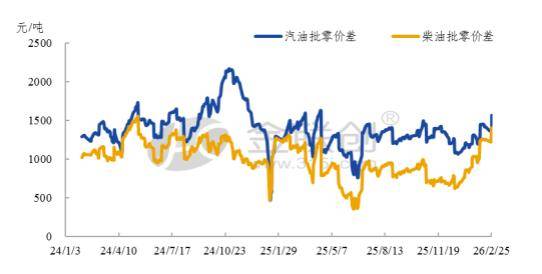
批发行情表现低迷 汽柴批零价差再创新高
Sou Hu Cai Jing· 2026-02-25 09:15
Core Viewpoint - Since 2026, the international oil market has been influenced by three main factors: rising geopolitical risks, tightening supply, and resilient demand growth, leading to an overall upward trend in oil prices with minor corrections [1] Group 1: Oil Price Trends - Brent crude oil has stabilized around $70 per barrel, while WTI has fluctuated near $66 per barrel, with a cumulative increase of nearly 6% during the Spring Festival holiday [1] - Following the price adjustment, domestic refined oil prices saw an increase on the first day after the holiday, but oil prices closed lower for two consecutive days afterward due to insufficient market support [1] Group 2: Price Differentials - The domestic wholesale and retail price differentials have reached new highs, with gasoline price differentials hitting levels not seen since April 2025 and diesel price differentials reaching highs not seen since May 2024 [1] - The recent price adjustments have resulted in a pattern of "three increases and one pause" for refined oil this year, with cumulative increases of 465 yuan/ton for gasoline and 450 yuan/ton for diesel [1] Group 3: Market Dynamics - The market dynamics for gasoline and diesel have shown significant divergence, with gasoline prices experiencing a steady increase while diesel prices have been primarily declining [3] - Gasoline demand has been supported by the Spring Festival holiday, but the ongoing impact of new energy sources continues to suppress gasoline consumption, limiting price increases [3] - Diesel demand has weakened entering the winter season, with traditional low demand periods for outdoor projects and infrastructure, leading to a bearish trend in diesel prices [3] Group 4: Future Outlook - Geopolitical factors are expected to have a more significant impact on oil prices compared to economic and fundamental factors, particularly the outcomes of US-Iran nuclear talks [3] - The likelihood of a new round of price increases remains, with cautious optimism in market sentiment, while gasoline consumption is expected to decline post-holiday, putting downward pressure on gasoline prices [3] - Diesel prices are anticipated to have limited downside potential due to current low price levels and strengthening cost support, with price differentials expected to fluctuate within a narrow range [3]

油价传导分析44:原油成本上涨 但成品油批零、炼油毛利呈现差异化表现
Sou Hu Cai Jing· 2026-02-06 10:18
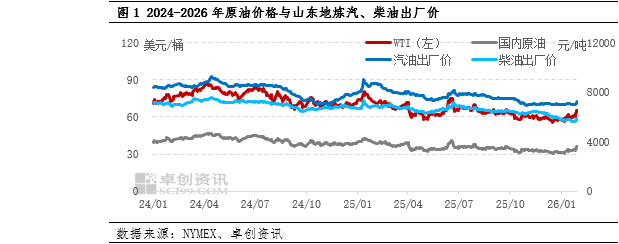
Core Viewpoint - The article discusses the impact of rising crude oil prices on refined oil products, highlighting the differentiated performance of gasoline and diesel margins in January, with expectations for continued divergence in February [1][12]. Group 1: International Oil Price Analysis - In January, the average WTI crude oil price increased by 4.13%, while Brent crude rose by 5.03%, driven by geopolitical tensions and supply disruptions [1]. - The outlook for February suggests a potential decline in crude oil prices, influenced by ongoing geopolitical risks and market sentiment [1][12]. Group 2: Domestic Refined Oil Price Transmission - The fluctuations in crude oil prices directly affect the domestic refining sector, impacting product prices and profit margins [2]. - In January, the gasoline market in Shandong saw a price increase of 290 CNY/ton, while the diesel market experienced a slight increase of 15 CNY/ton, despite overall price declines [4][5]. Group 3: Gasoline and Diesel Margin Analysis - The average gasoline crack spread in Shandong decreased by 16.01% to 716.14 CNY/ton, while the diesel crack spread fell significantly by 61.23% to 275.2 CNY/ton [6][8]. - The theoretical gasoline retail margin decreased by 5.17% to 1833.24 CNY/ton, whereas the diesel retail margin increased by 17.92% to 1655.86 CNY/ton [10][12]. Group 4: Future Outlook - For February, it is anticipated that gasoline margins may improve slightly, while diesel margins are expected to continue their upward trend [12][14]. - The average gasoline price in Shandong is projected to be around 7100 CNY/ton, with a trading range of 7050-7150 CNY/ton, while diesel prices are expected to be around 5650 CNY/ton [12][14].
原油连涨带来支撑 贸易单位柴油库容率低位回升
Jin Rong Jie· 2026-01-19 06:08
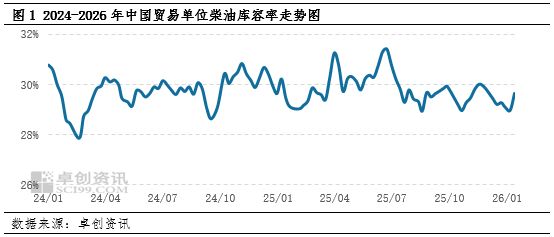
Core Viewpoint - In early January, crude oil prices exhibited a trend of initial decline followed by a rise, reaching a three-month high, which positively influenced market sentiment and increased diesel inventory levels among trade units, although expectations for diesel demand weakened, limiting the overall price increase [3]. Group 1: Crude Oil Price Trends - International crude oil prices initially fell due to geopolitical concerns in South America and the Middle East, but later surged as tensions escalated, leading to a five-day consecutive increase [3]. - The domestic retail price adjustment for refined oil was suspended, transitioning from negative to positive changes in crude oil rates, which boosted market optimism [3]. Group 2: Diesel Inventory and Demand - As of January 15, 2026, diesel inventory levels among domestic trade units reached 29.65% of capacity, an increase of 0.55 percentage points from the previous month and 0.2 percentage points year-on-year [1]. - Despite the increase in inventory levels, diesel demand is expected to weaken as the Spring Festival approaches, leading to cautious operations among trade units [3][7]. Group 3: Price Dynamics - Diesel prices initially declined due to weak demand post-New Year, but the wholesale price pressure remained despite a mid-January rise in crude oil prices [4]. - The average theoretical profit for domestic refined diesel was reported at 1583 CNY/ton, reflecting a 4.28% increase from the previous month, while the profit for main diesel sales rose by 23.93% to 1279 CNY/ton [6]. Group 4: Future Outlook - The geopolitical situation remains uncertain, which may lead to fluctuating crude oil prices, but the fundamental supply-demand dynamics suggest significant upward pressure on prices [7]. - The expectation for a limited increase in domestic refined oil retail prices and a potential decline in diesel prices by approximately 100 CNY/ton in the latter part of January is noted, as demand continues to weaken [7].
预计11月国内汽、柴油炼油利润或环比下跌 批零利润或环比上涨
Xin Hua Cai Jing· 2025-11-06 06:28
Core Viewpoint - The oil market is under pressure with a significant decline in crude oil prices in October, leading to lower retail prices and weak demand for gasoline and diesel, particularly in Shandong province [1][2][4]. Group 1: Oil Price Trends - In October, the average WTI price decreased by 5.45% and Brent by 5.37%, reflecting a downward trend in international oil prices [2]. - The oil market experienced a decline in early October due to oversupply and macroeconomic risks, but prices rebounded later in the month due to geopolitical and macroeconomic factors [2][4]. Group 2: Domestic Market Impact - The retail price of refined oil in Shandong saw two reductions in October, negatively impacting gasoline and diesel prices [4]. - The average gasoline ex-factory price in Shandong fell by 510 CNY/ton (3.94% decrease), while diesel prices dropped by 185 CNY/ton (2.62% decrease) [4]. Group 3: Price Differentials - The average gasoline crack spread in Shandong was 867.91 CNY/ton, down 4.52% month-on-month, while the diesel crack spread increased by 9.39% to 787.87 CNY/ton [4]. - The average theoretical wholesale-retail price differential for gasoline rose by 8.35% to 2051.06 CNY/ton, and for diesel, it increased by 4.12% to 1434.78 CNY/ton [6]. Group 4: Future Outlook - Looking ahead to November, crude oil prices are expected to remain under pressure due to weak demand and increased supply from Saudi Arabia, which may lead to a decline in refined oil prices [7]. - Gasoline demand is anticipated to remain weak without holiday support, while diesel demand may see slight improvement due to construction activities and e-commerce logistics [7].

CGI深度 | “十五五”兼顾绿色转型与经济增长的电价走势分析
中金点睛· 2025-10-30 23:32
Core Viewpoint - The article discusses the challenges and risks associated with electricity pricing in China during the "14th Five-Year Plan" period, emphasizing the need for a balanced approach to ensure both economic growth and green transition while managing the widening gap between wholesale and retail electricity prices [4][10]. Group 1: Electricity Pricing Dynamics - The rapid decline in renewable energy generation costs and increased penetration should ideally lead to lower terminal electricity prices; however, many regions are experiencing rising prices instead, particularly in areas with high market maturity and renewable integration [6][11]. - The widening gap between wholesale and retail prices, referred to as the "scissor difference," poses risks to economic development and long-term green transition, necessitating timely corrections to prevent adverse effects on consumer welfare and industrial competitiveness [26][27]. Group 2: Factors Influencing Price Dynamics - Three main factors contribute to the widening price gap: increased physical system costs due to higher renewable penetration, legacy costs from past contracts related to renewable support mechanisms, and market power exerted by different market participants [6][35]. - China's electricity market faces significant risks of widening price gaps due to inherent limitations in system flexibility, substantial legacy subsidy shortfalls, and an underdeveloped market mechanism that hampers effective price transmission [7][8]. Group 3: Recommendations for Addressing Price Gaps - To mitigate the risks of widening price gaps, a coordinated effort is needed across policy, market, and system levels, including strengthening market regulation, exploring market-based financing combined with fiscal subsidies, and enhancing system flexibility through increased energy storage and market incentives [8][10]. - The article emphasizes the importance of creating a fair and transparent market environment while addressing historical subsidy burdens to alleviate operational pressures on renewable energy enterprises [8][10]. Group 4: Future Electricity Supply Cost Predictions - The article predicts that during the "15th Five-Year Plan" period, China's electricity supply costs may face upward pressure of approximately 5 to 8 cents per kilowatt-hour, higher than during the "14th Five-Year Plan," due to rising system costs and legacy issues [7][56]. - The need for significant investments in grid infrastructure and flexible resources to accommodate the growing share of renewables is highlighted as a critical factor driving future electricity supply costs [56][70].