AI泡沫

Search documents
短暂取代马斯克首富地位,这位科技大佬倚仗的是什么 | 京酿馆
Sou Hu Cai Jing· 2025-09-11 05:06
Core Viewpoint - Oracle's stock price surged over 40% following the announcement of its Q1 earnings, briefly elevating co-founder Larry Ellison to the title of the world's richest person, surpassing Elon Musk, although he ultimately reclaimed the title by the end of the trading day [2][3] Financial Performance - Oracle reported Q1 revenue of $14.93 billion, a 12% year-over-year increase, but below market expectations of $15.03 billion [2] - Cloud revenue grew by 28% to $7.186 billion, accounting for 48% of total revenue, while software revenue declined by 1% to $5.721 billion, making up 38% of total revenue [2] - Hardware revenue increased by 2% to $670 million, and service revenue rose by 7% to $1.349 billion [2] Key Metrics - The standout figure from Oracle's earnings report was the RPO (Remaining Performance Obligations), which reached $455 billion by the end of August, representing a threefold increase compared to the same period last year [3][5] - This significant growth in RPO was attributed to large cloud contracts with AI companies, particularly OpenAI [5] Market Reactions - The dramatic increase in Oracle's stock price, which saw a 35.95% rise, marked the largest single-day gain since 1992 [3] - The surge in stock price was driven by investor excitement over the potential future revenue from cloud contracts, despite concerns about the sustainability of such growth [4][9] Concerns and Challenges - There are doubts regarding the viability of the $300 billion cloud contract with OpenAI, given that OpenAI is currently operating at a loss and is not expected to break even until 2028 [6][8] - The ambitious projections for Oracle's cloud revenue are based on the assumption of continued explosive growth in AI applications, which may not materialize due to competition and market dynamics [8] - The infrastructure required to support the projected growth in cloud services, including significant power supply needs, raises additional concerns about feasibility [9]



跌近15%!寒王遇「茅台魔咒」,这只是开始?
3 6 Ke· 2025-09-05 09:09
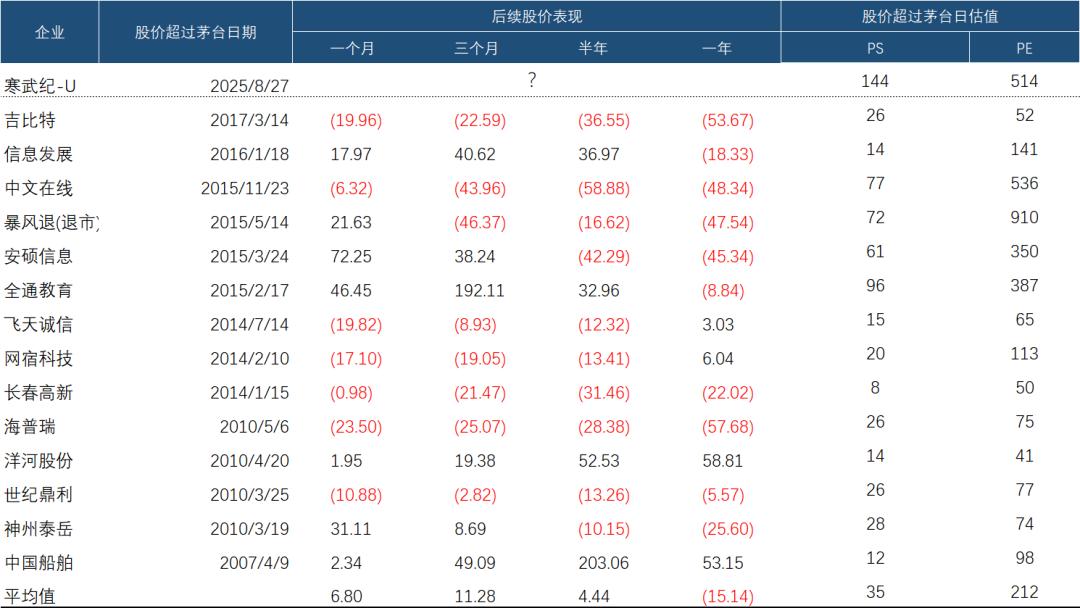
Core Viewpoint - The concept of "Moutai Curse" suggests that any company's stock price exceeding Moutai will subsequently decline, with Cambricon being the latest challenger to this notion after its stock price surged tenfold over the past year, reaching 1465 yuan on August 27, only to drop significantly thereafter [1][2]. Group 1: Historical Context - Over the past eight years, no company has surpassed Moutai's stock price until Cambricon, which briefly held the title of A-share king [1]. - Historically, 14 companies have exceeded Moutai's stock price, primarily around 2015, coinciding with the last major bull market and the impending burst of the mobile internet bubble [1][3]. Group 2: Stock Performance Analysis - Among the 14 companies that surpassed Moutai, half experienced a decline within one month, and five of these were in a downward trend within a year [2][3]. - The average PE ratio of these 14 companies was 232, while Cambricon's PE ratio reached an extreme 514, indicating a significant overvaluation [6][8]. Group 3: Market Sentiment and Risks - The surge in Cambricon's stock price is attributed to the current AI market frenzy, drawing parallels to the mobile internet bubble [7]. - Concerns are rising regarding the sustainability of the AI bubble, with Cambricon's stock price showing a pattern similar to those companies affected by the "Moutai Curse" [8][9]. - As of September 4, Cambricon's stock price fell by 14.45% to 1202 yuan, while Moutai's price remained relatively stable at 1472.7 yuan [9].
跌近15%!寒王遇“茅台魔咒”,这只是开始?
3 6 Ke· 2025-09-05 02:53
Core Viewpoint - The concept of "Moutai Curse" suggests that any company's stock price exceeding Moutai will subsequently decline, with Cambricon being the latest challenger to this phenomenon after its stock price surged tenfold over the past year, reaching 1465 yuan before experiencing a significant drop [1][2]. Group 1: Historical Context - Over the past eight years, no company has surpassed Moutai's stock price until Cambricon, which briefly held the title of A-share king [2]. - Historically, 14 companies have exceeded Moutai's stock price, primarily around 2015, a period marked by a major bull market and the impending burst of the mobile internet bubble [2][4]. Group 2: Performance Analysis - Among the 14 companies that surpassed Moutai, half began to decline within a month, with five of those experiencing a downward trend within a year [4][5]. - Companies like暴风科技 (Storm Technology) and全通教育 (All-in Education) illustrate the volatility, with the former peaking at 327 yuan in 2015 before plummeting due to operational failures and financial issues [5][6]. Group 3: Current Situation of Cambricon - Cambricon's current price-to-earnings (PE) ratio stands at 514, significantly higher than the historical average of 232 for the 14 companies that previously surpassed Moutai [7][9]. - Following its peak, Cambricon's stock price dropped 14.45% to 1202 yuan, indicating a trend similar to those companies that previously faced the "Moutai Curse" [9]. Group 4: Market Conditions - The current market environment for Cambricon is characterized by external risks, including geopolitical tensions and global economic downturns, contrasting with the internal risks faced in 2015 [10].
跌近15%!寒王遇「茅台魔咒」,这只是开始?
36氪· 2025-09-04 13:10
Core Viewpoint - The article discusses the phenomenon known as the "Moutai Curse," which suggests that companies whose stock prices exceed that of Moutai tend to experience a decline thereafter. The latest challenger to this curse is Cambricon, whose stock price surged tenfold over the past year, briefly surpassing Moutai before experiencing a significant drop [4][5]. Group 1: Historical Context - Over the past eight years, no company has surpassed Moutai's stock price until Cambricon. Historically, 14 companies have exceeded Moutai's price, primarily around 2015, a period marked by a bull market and the impending burst of the mobile internet bubble [5][6]. - A review of the stock performance of these 14 companies after surpassing Moutai shows that half of them began to decline within a month, with many experiencing significant drops within a year [9][10]. Group 2: Performance Analysis - Among the 14 companies, only China Shipbuilding and Yanghe Brewery maintained an upward trend for a year after exceeding Moutai's price. The average price-to-earnings (PE) ratio for these companies was 232, while Cambricon's PE ratio reached an extreme 514 [9][13][16]. - The article highlights that the stock price surges of these companies were often driven by speculative bubbles without solid fundamental support, leading to inevitable declines when market enthusiasm waned [15][16]. Group 3: Current Market Conditions - Cambricon's recent stock performance mirrors the patterns observed in previous instances of the "Moutai Curse," with its stock price peaking at 1,465 yuan before dropping significantly. As of September 4, Cambricon's stock closed at 1,202 yuan, reflecting a 14.45% decline [17]. - The current market environment differs from 2015, with risks stemming more from external factors such as geopolitical tensions and global economic downturns, rather than internal leverage issues [17].
万亿AI独角兽+1
Zheng Quan Shi Bao· 2025-09-03 12:29
Core Insights - Anthropic has completed a $13 billion Series F funding round, raising its post-money valuation to $183 billion, nearly tripling from $61.5 billion after its previous funding round in March 2023 [1] - The funding round was led by ICONIQ Capital, Fidelity Investments, and Lightspeed Venture Partners, with participation from notable investors such as Singapore's GIC and Qatar Investment Authority [1] - Since its founding in 2021, Anthropic has raised over $30 billion across nine funding rounds, showcasing a rapid growth trajectory [2] Company Overview - Anthropic was founded by former OpenAI executives, focusing on developing reliable and interpretable AI systems, positioning itself as a strong competitor to OpenAI [2][3] - The company has developed the Claude series of large models, with the latest version, Claude 4.1, surpassing OpenAI's capabilities in certain areas [2] Financial Performance - Anthropic's annualized revenue has exceeded $5 billion, reflecting a fivefold increase from $1 billion at the beginning of the year, making it one of the fastest-growing tech companies [4] - The company's AI programming tool, Claude Code, has generated over $500 million in annualized revenue, with usage increasing tenfold in just three months [4] Business Model - Anthropic's gross margin from direct sales of its AI models and Claude chatbot is approximately 60%, with potential to reach 70% [5] - The company's cloud services, primarily sold through AWS and Google Cloud, are currently operating at a negative gross margin of 30% [5] Market Context - The AI investment landscape is highly competitive, with significant funding flowing into the sector; approximately $40 billion in venture capital was directed towards AI in Q2 2023 [6] - Following the recent funding, the top three AI unicorns are ByteDance ($330 billion), OpenAI ($300 billion), and Anthropic ($183 billion) [6] Industry Challenges - High valuations in the AI sector have sparked discussions about a potential "AI bubble," with critics pointing out that many valuations are based on optimistic future revenue projections [7] - The competitive landscape is intensifying, with major players like Google, Meta, Alibaba, and DeepMind rapidly advancing, which could threaten the current leaders' positions [7]
万亿AI独角兽+1!
证券时报· 2025-09-03 11:49
Core Viewpoint - The article highlights the significant recent funding round for Anthropic, which has positioned it as a leading AI unicorn alongside ByteDance and OpenAI, with a post-money valuation of $183 billion after raising $13 billion in its Series F funding round, marking a nearly threefold increase from its previous valuation of $61.5 billion in March 2023 [1][2]. Funding and Valuation - Anthropic has completed a total of 9 funding rounds since its inception in 2021, raising over $30 billion, with the latest round being the largest single round in recent AI funding history [3][5]. - The company’s valuation has seen exponential growth, from $1.24 million in its Series A round in May 2021 to $183 billion in the latest Series F round [5]. Company Background - Founded in 2021 by former OpenAI executives, Anthropic aims to develop safe and interpretable AI systems, positioning itself as a strong competitor to OpenAI [4]. - The company has quickly developed the Claude series of large models, with the latest version, Claude 4.1, surpassing OpenAI's capabilities in certain areas [4]. Revenue Growth - Anthropic's annualized revenue has exceeded $5 billion, reflecting a fivefold increase from $1 billion at the beginning of the year, making it one of the fastest-growing tech companies [7]. - The Claude Code programming tool, launched in February 2023, has contributed significantly to revenue, achieving over $500 million in annualized revenue and a tenfold increase in usage within three months [7]. Business Model and Profitability - The company has demonstrated a mature business model, achieving a gross margin of approximately 60% from direct sales of its AI models and chatbots, with potential to reach 70% [8]. - However, its cloud services business remains unprofitable, with a gross margin of -30% earlier this year, attributed to revenue sharing with cloud service providers like Amazon and Google [9]. Market Context - The global AI funding landscape is highly competitive, with approximately $40 billion in venture capital flowing into the AI sector in Q2 2023, and foundational model companies raising $5.5 billion [11]. - The article raises questions about the sustainability of high valuations in the AI sector, noting that while revenue growth supports these valuations, actual profitability remains to be validated [12].

美国经济危机四伏:通胀、就业、降息、AI泡沫全亮红灯
Sou Hu Cai Jing· 2025-09-02 01:47
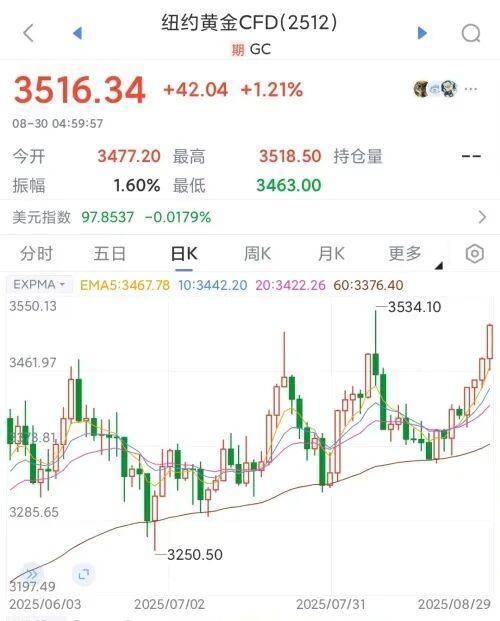
Group 1 - The core inflation indicator, the core PCE price index, rose by 2.9% year-on-year in August, marking a five-month high, indicating that inflation is becoming entrenched in the economy [3] - The Biden administration's tariffs on Chinese goods have not yet fully manifested, suggesting that consumers will soon face a "China-made price surge," potentially leading to a dual inflation scenario [3] - The employment data, previously seen as a shield for the economy, has been called into question after a significant downward revision of June's job additions by 90%, reducing the reported 200,000 new jobs to just 20,000 [4][5] Group 2 - The market is currently focused on the extent of potential interest rate cuts, with a 25 basis point cut in September being almost certain, while some speculate a 50 basis point cut [6] - Gold prices have surged above $3,500 for the first time, reflecting fears of a financial storm, as prominent investors warn of impending market turmoil [6] - The AI sector, which has been a major driver of the stock market, is showing signs of weakness, with a recent MIT study revealing that 95% of companies find AI unhelpful for their business [7][9] Group 3 - The U.S. economy is facing multiple challenges, including tariffs igniting inflation, questionable employment data, erratic interest rate policies, the potential collapse of the AI bubble, and warnings from the gold market, reminiscent of the pre-2008 financial crisis [8]
突然全线暴跌,发生了什么?
Zheng Quan Shi Bao· 2025-09-01 11:50
Group 1 - The semiconductor sector in Japan and South Korea experienced a significant sell-off, with major companies like Advantest and SK Hynix seeing declines of over 9% and 5% respectively, influenced by a sell-off in US tech stocks [1][3] - Concerns about the future performance of AI chip companies arose after underwhelming earnings guidance from US chip giants, leading to fears of slowing growth in the AI chip market [1][3] - Nvidia's reliance on a small number of customers was highlighted, with nearly 40% of its second-quarter revenue for fiscal year 2026 coming from just two clients, raising questions about its dependency on these major customers [1][3][4] Group 2 - The Philadelphia Semiconductor Index dropped over 3%, with notable declines in companies like Marvell Technology and Oracle, further impacting investor sentiment towards AI chip stocks [3] - The overall valuation of the US stock market has reached unprecedented levels, with the S&P 500's price-to-sales ratio hitting 3.23, surpassing the peak during the dot-com bubble [7] - Analysts express skepticism about the sustainability of high valuations for tech giants, suggesting that fundamental performance will ultimately dictate stock prices [8]




突然!全线暴跌,发生了什么?
券商中国· 2025-09-01 11:06
Core Viewpoint - The semiconductor sector in Japan and South Korea has experienced a significant sell-off, primarily influenced by the recent decline in U.S. tech stocks, raising concerns about the future performance of AI chip companies [2][3]. Group 1: Market Reaction - Following the opening of the market, major chip manufacturers in Japan and South Korea saw substantial declines, with Advantest dropping over 9%, Hanmi Semiconductor down over 6%, SK Hynix falling over 5%, and Samsung Electronics decreasing over 3% [2]. - The overall market indices also suffered, with the Nikkei 225 index falling by 1.24% and the KOSPI index declining by 1.35% [3]. Group 2: U.S. Market Influence - The sell-off in Japanese and Korean semiconductor stocks was largely attributed to a more than 3% drop in the Philadelphia Semiconductor Index, with notable declines in companies like Marvell Technology (down over 18%) and Oracle (down 5.9%) [3]. - Concerns were raised regarding the future growth of AI chip companies due to disappointing earnings guidance from some U.S. chip giants [3]. Group 3: Nvidia's Client Dependency - Nvidia's recent disclosures indicated that nearly 40% of its revenue for the second fiscal quarter of 2026 came from just two clients, raising alarms about the company's reliance on a limited customer base [4]. - The two major clients contributed 23% and 16% to Nvidia's total revenue, significantly higher than the previous year's contributions of 14% and 11% [4]. Group 4: Valuation Concerns - Analysts have pointed out that the extreme volatility in U.S. AI chip stocks stems from previously inflated expectations and high valuations, leaving little room for error in earnings reports [5]. - The S&P 500 index's price-to-sales ratio has reached a historic high of 3.23, surpassing levels seen during the dot-com bubble, while the forward P/E ratio stands at 22.5, well above the long-term average of 16.8 since 2000 [6]. Group 5: Market Concentration - The top 10 companies in the S&P 500 now account for 39.5% of the index's total market capitalization, the highest recorded level, primarily driven by tech giants like Nvidia and Microsoft [7]. - Concerns have been raised about the sustainability of these high valuations, with some market participants skeptical about whether fundamentals will support current price levels over time [7]. Group 6: AI Investment Bubble Warnings - Increasing warnings about an "AI investment bubble" have emerged, with industry leaders comparing the current situation to past investment failures, such as SoftBank's investments in WeWork and Zume [8].


不靠中国市场,英伟达也能赚大钱?
3 6 Ke· 2025-08-28 12:11
Core Viewpoint - NVIDIA's Q2 earnings report shows strong revenue growth despite challenges in the Chinese market, highlighting the importance of this market for future growth opportunities [2][4][8]. Group 1: Financial Performance - Total revenue for Q2 reached $46.7 billion, a year-over-year increase of 56% [2]. - Net profit was $26.42 billion, also up 59% year-over-year [2]. - Q3 guidance predicts revenue of $54 billion, excluding sales to Chinese customers for the H20 product [2][4]. Group 2: Market Challenges - NVIDIA did not sell H20 products to Chinese customers this quarter, which has raised concerns among investors [1][3]. - The revenue from the data center segment was $41.1 billion, with a year-over-year growth of 56% but only a 5% increase quarter-over-quarter [5][6]. - The share of revenue from the Chinese market in the data center segment has decreased to single digits [6][8]. Group 3: Future Opportunities - CEO Jensen Huang emphasized the potential $50 billion opportunity in the Chinese market, with expected annual growth of around 50% [3][8]. - NVIDIA's new Blackwell architecture chips are gaining traction, with a 17% quarter-over-quarter revenue increase [8][10]. - The automotive and robotics segment saw revenue of $586 million, a 69% year-over-year increase, driven by autonomous driving solutions [11][13]. Group 4: AI Market Dynamics - Huang predicts a $3 trillion to $4 trillion opportunity in the global AI infrastructure market over the next five years [20][21]. - NVIDIA's role in AI infrastructure is expanding, with significant contributions to AI factory construction costs [23]. - The company is transitioning from solely providing GPUs to becoming a comprehensive AI infrastructure provider [23].