
绿色金融

Search documents
工行贺州分行:强化金融供给 助力地方冲刺“十四五”发展目标
Zhong Guo Jin Rong Xin Xi Wang· 2025-11-19 06:38
Core Viewpoint - China Industrial and Commercial Bank (ICBC) Hezhou Branch is focusing on supporting the real economy, promoting industrial upgrades, developing inclusive finance, and driving green transformation to inject strong momentum into Hezhou's economic development during the critical phase of the "14th Five-Year Plan" [1][2][3] Group 1: Support for Real Economy - ICBC Hezhou Branch prioritizes financial services for the real economy, specifically targeting key industries such as manufacturing, strategic emerging industries, and technological innovation, with a manufacturing loan balance reaching 2.312 billion yuan, an increase of 81.9% year-on-year [1] - The bank has provided 155 million yuan in loans for major infrastructure projects in transportation, energy, and water conservancy, effectively supporting regional economic stability [1] Group 2: Focus on Industrial Upgrades - The bank is enhancing its financial services for local特色优势产业 (characteristic advantageous industries) such as calcium carbonate, gold jewelry, and ecological health, with loans in these sectors exceeding 546 million yuan [2] - The opening of the designated warehouse for the Shanghai Gold Exchange on October 21 has addressed raw material delivery issues for local gold jewelry enterprises, significantly improving capital turnover efficiency [2] Group 3: Commitment to Inclusive Finance - ICBC Hezhou Branch views the development of inclusive finance as a key path to serve the public and promote common prosperity, with inclusive small and micro enterprise loans reaching 1.527 billion yuan and a 24.87% increase in customer numbers since the beginning of the year [2] - The bank is focusing on supporting high-standard farmland construction, specialty planting and breeding, and agricultural product processing, with agricultural loans steadily increasing to 2.05 billion yuan [2] Group 4: Development of Green Finance - The bank is actively developing green finance by optimizing green credit policies and prioritizing support for energy-saving, environmental protection, and ecological governance projects, with a total green loan balance of 2.886 billion yuan by the end of October [3] - ICBC Hezhou Branch is exploring pathways for realizing ecological value to protect local natural resources and convert ecological advantages into developmental benefits [3]

工行北海分行:厚植绿色金融根基 绘就滨海生态画卷
Zhong Guo Jin Rong Xin Xi Wang· 2025-11-19 06:38
Core Viewpoint - The Industrial and Commercial Bank of China (ICBC) Beihai Branch is committed to green development, aligning with national "dual carbon" goals and enhancing ecological civilization through innovative financial support for green transformation [1][2][4] Group 1: Green Financial Development - ICBC Beihai Branch has positioned green finance at the core of its strategy, establishing a dedicated task force to ensure alignment with local development needs and effective implementation of green financial policies [1] - By the end of October 2025, the green loan balance is expected to exceed 2 billion yuan, with a net increase of over 300 million yuan since the beginning of the year, indicating positive progress in green finance practices [1] Group 2: Focused Financial Support - The branch has allocated over 1.5 billion yuan in green project loans, supporting key projects such as a paper industry integrated project and a solar glass production line, thereby facilitating local green infrastructure and low-carbon industrial transformation [2] - As of the end of October, the balance of green working capital loans for large and medium-sized enterprises exceeded 400 million yuan, effectively supporting various green operations [2] Group 3: Inclusive Financial Services - ICBC Beihai Branch extends green financial services to small and micro enterprises, providing credit support of 19.4 million yuan to 10 green small businesses, aiding their environmental upgrades and sustainable development [3] - The branch has implemented a comprehensive risk management system for green finance, focusing on ESG performance and ensuring compliance with environmental regulations [3] Group 4: Future Commitment - ICBC Beihai Branch plans to continue prioritizing ecological and green development, increasing resource investment, and innovating products and services to contribute to a cleaner and greener environment in Beihai [4]
兴业银行昆明分行亮相2025零碳产业生态大会
Xin Hua Wang· 2025-11-19 03:49
Core Viewpoint - The 2025 Zero Carbon Industry Ecological Conference was held in Kunming, focusing on the development paths for zero-carbon industries and the role of financial institutions in supporting this transition [1][2] Group 1: Conference Highlights - The conference gathered participants from government, industry, academia, and research sectors to discuss zero-carbon industry development [1] - A representative from Industrial Bank's Kunming branch shared insights on the bank's innovative solutions for zero-carbon parks, emphasizing a comprehensive service system that includes both financial and non-financial products [1] Group 2: Financial Products and Services - Industrial Bank's Kunming branch has introduced various innovative loan products, including the first "zero-carbon park linked loan" and "biodiversity protection sustainable and green energy generation linked loan" in Yunnan province [2] - The bank has also launched "ESG-linked loans" and "carbon reduction + CCER development + green certificate linked loans," demonstrating its commitment to green finance [2] - The bank has published an "Environmental Information Disclosure Report" for three consecutive years, showcasing its dedication to green finance principles [2] Group 3: Future Plans - Moving forward, Industrial Bank's Kunming branch aims to deepen its engagement in the green finance sector by offering more innovative products and comprehensive services, collaborating with government, enterprises, and society to contribute to Yunnan's zero-carbon development [2]

国泰君安期货商品研究晨报:绿色金融与新能源-20251119
Guo Tai Jun An Qi Huo· 2025-11-19 03:03
2025年11月19日 国泰君安期货商品研究晨报-绿色金融与新能源 | 观点与策略 | | --- | | 镍:镍价破位下行,承压震荡运行 | 2 | | --- | --- | | 不锈钢:弱现实压制钢价,但下方难言广阔 | 2 | | 碳酸锂:短期或有回调 | 4 | | 工业硅:有机硅后续或减产挺价 | 6 | | 多晶硅:弱势震荡格局 | 6 | 国 泰 君 安 期 货 研 究 所 请务必阅读正文之后的免责条款部分 1 期货研究 商 品 研 究 2025 年 11 月 19 日 镍:镍价破位下行,承压震荡运行 不锈钢:弱现实压制钢价,但下方难言广阔 张再宇 投资咨询从业资格号:Z0021479 zhangzaiyu@gtht.com 【基本面跟踪】 镍基本面数据 | | | 指标名称 | T | T-1 | T-5 | T-10 | T-22 | T-66 | | --- | --- | --- | --- | --- | --- | --- | --- | --- | | | | 沪镍主力(收盘价) | 114,840 | -1,910 | -4,540 | -4,860 | -6,320 | -5 ...
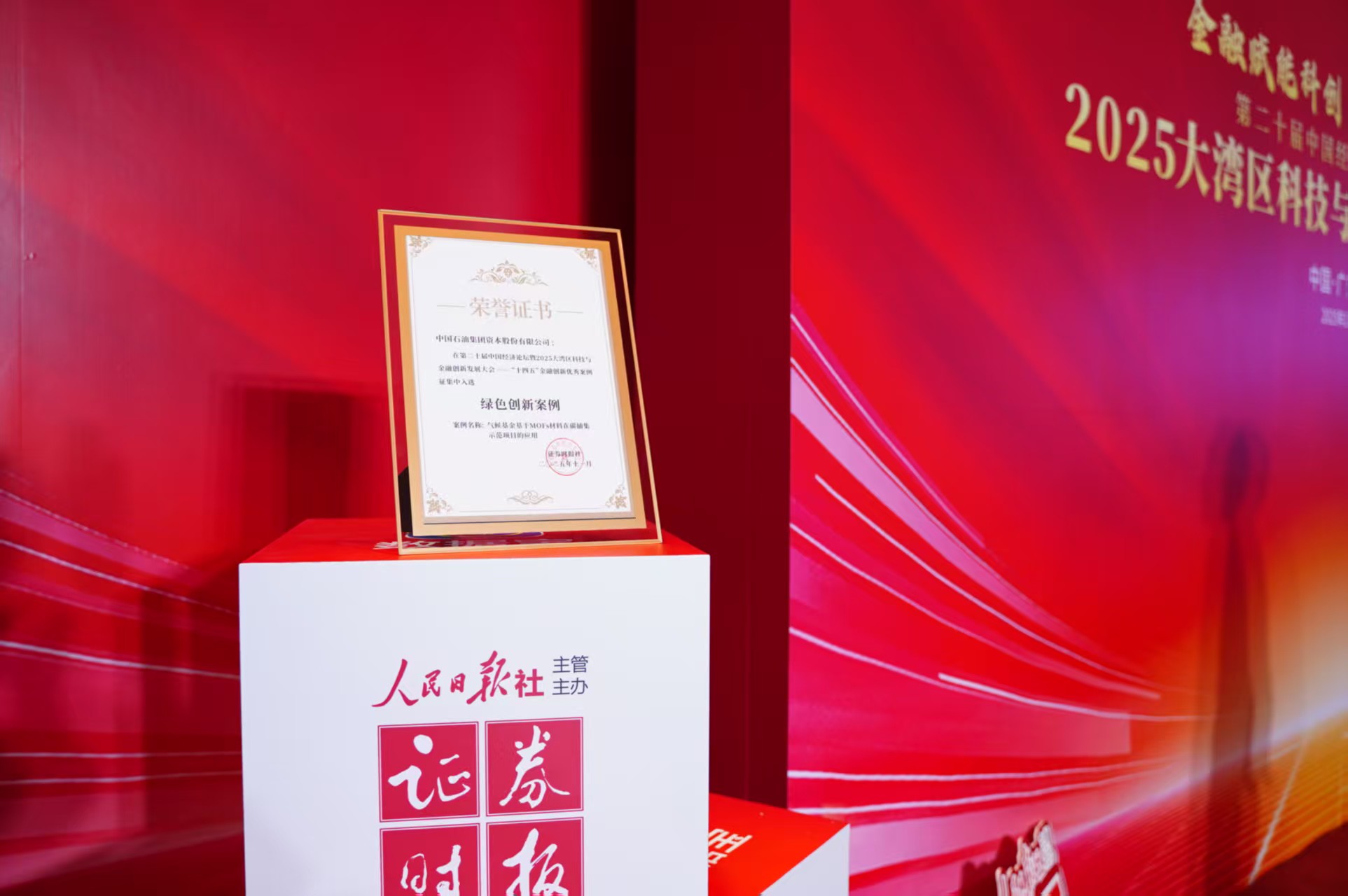
中油资本MOFs碳捕集与CCUS保险实现双重行业突破 绿色金融创新成果入选“十四五”优秀案例
Zheng Quan Shi Bao Wang· 2025-11-19 02:33
Core Viewpoint - The 20th China Economic Forum highlighted two financial innovation cases from China National Petroleum Corporation (CNPC) and Kunlun Insurance Brokerage, showcasing their contributions to green finance and carbon capture technology [1][9]. Group 1: Event Overview - The 20th China Economic Forum was held on November 18 in Nansha, Guangzhou, focusing on "Chinese-style modernization and the economic outlook for the 15th Five-Year Plan" [1]. - The forum attracted over 200 representatives from government, listed companies, financial institutions, and industry experts to discuss topics such as technological innovation policies and financial empowerment for scientific innovation [1]. Group 2: Climate Fund and MOFs Technology - The "Climate Fund based on MOFs materials for gas separation technology" was recognized as a significant case, involving Beijing Blue Shell Clean Energy Technology Co., Ltd., which was invested in by CNPC's OGCI Kunlun Climate Investment Fund in 2023 [2]. - Blue Shell Clean Energy has established the first domestic MOFs carbon capture and utilization facility, achieving a cumulative processing of 32 million cubic meters of associated gas by September 2025 [4]. - The project has successfully captured CO2 with an energy consumption of ≤1.0 GJ per ton, demonstrating effective carbon capture and methane recovery [4]. Group 3: Kunlun Insurance Brokerage's CCUS Insurance - Kunlun Insurance Brokerage introduced a CCUS carbon asset loss insurance to mitigate risks associated with CCUS projects, supporting enterprises in achieving carbon reduction goals [6]. - The first CCUS carbon asset insurance in the oil and petrochemical industry was successfully underwritten for Jilin Oilfield, with an insurance amount of 1.5 million yuan, marking a significant innovation in the sector [8]. - The successful implementation of this insurance product lays a foundation for promoting CCUS insurance products across the oil and petrochemical industry [8]. Group 4: Future Implications - The two recognized green financial innovations will serve as important vehicles for national financial innovation achievements, targeting government departments, regulatory bodies, financial institutions, and mainstream media for dissemination [9].


银企对接 为绿色转型注入新动能
Jin Rong Shi Bao· 2025-11-19 02:03
Core Insights - The financial support for mining enterprises in the Hotan region is significantly increasing, with green mining loans reaching 2.25 billion yuan, a year-on-year growth of 102.64% [1] - The integration of solar energy into mining operations has led to over 80% of production electricity coming from solar sources, reducing costs and aligning with green development goals [2] - The digital transformation of traditional mining operations is being facilitated by financial institutions, with AI technology achieving over 98% sorting accuracy in ore selection [3] - Technological upgrades in mining operations are resulting in a reduction of carbon emissions by approximately 12,000 tons annually, with over 90% removal rate of heavy metal pollutants [4] Financial Support and Green Initiatives - The People's Bank of China in Hotan is actively guiding financial institutions to enhance support for mining enterprises, with green loans making up 12.56% of the total green finance loans in the region [1] - The region's photovoltaic-related loan balance has reached 6.546 billion yuan, reflecting a year-on-year increase of 56.73%, facilitating the widespread application of solar energy in mining [2] Digital Transformation - The implementation of AI and smart control systems in the Huoshao Cloud lead-zinc mine has doubled the average annual lead ingot output per person to 400 tons compared to the industry average [3] - The China Bank in Hotan has invested 420 million yuan in the digital factory construction, with total credit support from local banks reaching approximately 4 billion yuan [3] Environmental Impact and Technological Upgrades - Financial institutions are providing targeted loans of 700 million yuan to support environmental upgrades in mining operations, including waste heat power generation and wastewater treatment [4] - The mining operations have achieved significant improvements in waste, water, and air treatment, surpassing traditional smelting plants in both economic and ecological benefits [4]
老区焕发新生机 金融助力正当时
Jin Rong Shi Bao· 2025-11-19 02:03
Core Viewpoint - The financial sector in Xinyang is actively supporting the revitalization of the revolutionary old area through innovative financial products and services, focusing on agriculture, green finance, technology, and cultural tourism [1][2][3][4][5][6][7] Group 1: Agricultural Support - The Agricultural Bank provided a timely loan of 2 million yuan to a tea farmer, enabling early production of tea, highlighting the importance of financial support for local agriculture [2] - By May 2025, the total balance of inclusive loans in Xinyang reached 69.14 billion yuan, with an increase of 4.34 billion yuan since the beginning of the year [2] Group 2: Green Finance Initiatives - The People's Bank of China Xinyang Branch has issued 6.88 billion yuan in preferential loans to support green projects, leading the province in scale [3] - By March 2025, the balance of green loans in Xinyang reached 32.214 billion yuan, reflecting a year-on-year growth of 21% [3] Group 3: Technological Financial Support - The Xinyang Branch of the People's Bank has implemented a technology finance work plan, focusing on expanding scale and optimizing services, resulting in a technology loan balance exceeding 25 billion yuan by May 2025, with a growth of 10.2% since the beginning of the year [5] - Loans to technology-based SMEs reached 3.86 billion yuan, showing a significant increase of 30.1% [5] Group 4: Cultural and Tourism Development - The Xinyang financial institutions are promoting red tourism and rural study through innovative products like "Red Tourism Loan" and "Red City Study Loan," with a total loan balance for related industries reaching 2.47 billion yuan by June 2025 [6] - The integration of finance, technology, and education at the Dabie Mountain Cadre Academy exemplifies the digital transformation in red education [6] Group 5: Overall Impact - The financial initiatives in Xinyang are transforming the local economy, enhancing agricultural productivity, promoting green projects, supporting technological innovation, and fostering cultural tourism, reflecting the enduring spirit of the anti-Japanese war and the revitalization of the old revolutionary area [7]
提升金融服务“含绿量”
Jin Rong Shi Bao· 2025-11-19 02:03
Core Insights - The People's Bank of China in Shigatse is actively promoting green and low-carbon development, significantly increasing the "green" component of financial services [1][2][3] Group 1: Green Loan Growth - As of September 2025, the balance of green loans in Shigatse reached 8.525 billion yuan, a net increase of 1.4 billion yuan, representing a growth of 20.13%, with green loans accounting for 15.09% of total loans [1] - The city has seen a stable growth in green credit, with energy-related green low-carbon transformation loans amounting to 3.996 billion yuan, a net increase of 284 million yuan [1] Group 2: Policy Tools and Financial Support - The People's Bank of China in Shigatse has implemented precise policy tools to support green credit, including monitoring and on-site guidance, which has led to a stable increase in green credit balance [1] - The bank has successfully utilized carbon reduction support tools, with three projects funded totaling 151 million yuan, focusing on clean energy project development [1] Group 3: Innovation in Green Financial Services - The bank has organized 14 themed financing meetings, providing 59 million yuan in green credit to 16 small and micro enterprises, enhancing financing channels for green businesses [2] - A financing connection was established for key green industry projects, including the Sichuan-Tibet Railway, with a total credit investment of 2.18 billion yuan [2] Group 4: Diversification of Green Financial Tools - The bank is promoting the development of diverse green financial products, implementing a "one place, one product" strategy, and enhancing green service capabilities [3] - As of September, 5,042 personal carbon accounts have been authorized, a 97.49% increase from the beginning of the year, reflecting the growing interest in carbon account mechanisms [3]
五载春秋共奋进,勇立潮头再起航 --青银理财成立五周年
2 1 Shi Ji Jing Ji Bao Dao· 2025-11-19 01:08
Core Viewpoint - Qingyin Wealth Management has successfully navigated its first five years by adhering to the principles of the Asset Management New Regulations, focusing on value creation rather than mere scale expansion, and aligning its strategies with the evolving needs of investors and the broader economy [1][2][9] Group 1: Company Development and Strategy - Qingyin Wealth Management was established as the first city commercial bank wealth management subsidiary in Northern China and the sixth nationwide, responding to market demands and the strategic transformation of its parent company, Qingdao Bank [1] - The company has transitioned from a focus on "scale expansion" to "value creation," emphasizing high-quality development and collaboration with its parent bank to enhance wealth management services [2][9] - Over five years, Qingyin Wealth Management has issued 2,820 products, raising a total of 25,283.59 billion yuan and generating 536.40 billion yuan in returns for clients [3] Group 2: Product Innovation - The product offerings have evolved from "single fixed income" to a diversified portfolio, including cash management, fixed income, "fixed income plus," and equity products, catering to the wealth upgrade needs of residents [4] - The "fixed income plus" products have been a strategic focus, achieving an average annualized return of 3.68% over a specific period, outperforming the market average by 69 basis points [4] - The company has launched the "Tianyuan series" of fixed income products aimed at retirement finance, raising over 6.9 billion yuan, with a focus on high-quality bonds and non-standard assets [4][5] Group 3: Service to the Real Economy - Qingyin Wealth Management positions itself as a strategic partner to the real economy, channeling funds into national strategic areas and supporting green finance initiatives [5][6] - The company has pioneered the issuance of carbon-neutral and ESG-themed products, aligning with national goals for sustainable development [5][6] Group 4: Technological Empowerment - The company has implemented a three-step strategy for digital transformation, focusing on online investment trading, data-driven operations, and intelligent management decision-making [7] - Qingyin Wealth Management has developed a proprietary investment trading platform and a big data management system to enhance investment efficiency and risk control [7][8] - The integration of AI technology into research and decision-making processes is being advanced through the development of an intelligent investment research platform [8] Group 5: Future Outlook - The company aims to transition from being a participant in the financial industry to becoming a key institutional investor, driven by policy support, capital market participation, and product innovation [9] - Qingyin Wealth Management will continue to prioritize high-quality development while maintaining steady growth, focusing on professional capabilities and customer needs [9][10]
五载春秋共奋进,勇立潮头再起航——青银理财成立五周年发展纪实
Zhong Guo Zheng Quan Bao· 2025-11-18 23:54
Core Viewpoint - Qingyin Wealth Management has successfully transformed from a scale-driven model to a value-driven approach, focusing on high-quality development and aligning with the asset management regulations since its establishment five years ago [3][12]. Group 1: Company Development - Qingyin Wealth Management was established in 2020 as the first wealth management subsidiary of a city commercial bank in Northern China, following the implementation of the "Regulations on Wealth Management Subsidiaries of Commercial Banks" [1]. - The company has adhered to its founding principle of "trust and manage wealth for others," responding to market demands and supporting the strategic transformation of its parent company, Qingdao Bank [1][3]. Group 2: Business Model Transformation - The company has shifted its business model from "scale expansion" to "value creation," emphasizing high-quality development and compliance with asset management regulations [3]. - Qingyin Wealth Management has expanded its distribution channels from 3 to 104, improving product structure and increasing the proportion of products with a maturity of one year or more by over 11 percentage points since the beginning of the year [3][4]. Group 3: Product Innovation - The product offerings have evolved from "single fixed income" to "diversified allocation," creating a product matrix that includes cash management, fixed income, "fixed income +," equity, and thematic products [5]. - The "fixed income +" products have been a strategic focus, with a controlled risk exposure and a dynamic management approach to enhance returns while managing risks [5][6]. Group 4: Commitment to Investors - Over five years, Qingyin Wealth Management has issued 2,820 products, raising a total of 25,283.59 billion yuan and generating 536.40 million yuan in returns for clients [4]. - The company has successfully managed low-volatility products, with 291 products maturing at a scale of 462 billion yuan, achieving returns that meet or exceed performance benchmarks [4]. Group 5: Service to the Real Economy - Qingyin Wealth Management has positioned itself as a strategic partner for the real economy, directing funds towards national strategic areas and supporting green finance initiatives [8]. - The company has launched various themed products, including carbon neutrality and ESG, with a total issuance of 144 products and a fundraising scale exceeding 18.3 billion yuan [8]. Group 6: Technological Empowerment - The company has implemented a three-step strategy for digital transformation, focusing on online investment trading, data-driven operations, and intelligent management decision-making [9]. - Qingyin Wealth Management has developed a proprietary investment trading platform and a big data platform to enhance investment management efficiency and risk control [9][10]. Group 7: Future Outlook - The company aims to transition from a "scale-first" approach to a focus on "high-quality development" during the 14th Five-Year Plan period, becoming a key institutional investor in the asset management industry [12][13]. - Qingyin Wealth Management will continue to innovate products and upgrade services while maintaining a balance between quality and steady growth, reinforcing its operational foundation and risk resilience [12][13].