人造太阳

Search documents
高澜股份:参与中科院“人造太阳”EAST项目 提供热管理产品
news flash· 2025-06-03 13:08
Core Viewpoint - The company, GaoLan Co., has been involved in significant nuclear physics projects, including the "artificial sun" EAST project by the Chinese Academy of Sciences, providing thermal management products, although this business segment currently has a minor impact on overall operations [1] Group 1 - GaoLan Co. has participated in the EAST superconducting tokamak experiment and the Chinese Academy of Sciences' spallation neutron source project, supplying thermal management products [1] - The contribution from these projects is relatively small and will not have a major operational impact on the company [1]

【财经早晚报】我国新一代人造太阳再创纪录;国内航线燃油费6月5日起下调;日本医美市场规模超过韩国
Sou Hu Cai Jing· 2025-05-29 10:40
Macro News - The Ministry of Commerce urges the U.S. to completely eliminate unilateral tariffs, emphasizing that trade wars have no winners and protectionism leads to negative outcomes [1] - China's new generation artificial sun, "China Fusion Reactor No. 3," achieves a record of 1 million amperes and 100 million degrees, marking significant progress in fusion experiments [1] Transportation and Travel - The Ministry of Transport predicts that the cross-regional personnel flow during the Dragon Boat Festival will reach 687 million trips, a year-on-year increase of approximately 7.7% [2] - Daily average traffic on national highways is expected to be around 40.7 million vehicles, a 3% increase from the previous year [2] - The expected peak of passenger vehicle flow is on the first day of the holiday, estimated at 38 million vehicles [2] - Daily average traffic of new energy vehicles is projected to be 8.3 million, accounting for about 21% of total daily traffic, significantly up from 14.4% last year [2] Market Movements - The ChiNext Index rose by 1.37%, with over 100 stocks hitting the daily limit up [3][4] - The total trading volume in the Shanghai and Shenzhen markets reached 1.19 trillion, an increase of 175.5 billion from the previous trading day [4] - Key sectors such as unmanned vehicles, digital currency, and innovative pharmaceuticals saw significant gains, while gold stocks experienced declines [4] Company Developments - NVIDIA reported a quarterly revenue of $44.1 billion for Q1 of fiscal year 2026, a 12% increase quarter-on-quarter and a 69% increase year-on-year, but net profit decreased by 15% quarter-on-quarter to $18.8 billion [5][6] - Ideal Auto's Q1 revenue was 25.93 billion yuan, a 1.1% year-on-year increase, with adjusted net profit down 20% to 1.02 billion yuan [6] - Douyin Group established a short drama copyright center to enhance copyright management and improve content quality [6] - JD.com and Xiaohongshu launched the "Red Jing Plan," allowing Xiaohongshu ads to link directly to JD.com shopping pages [7][8] - Apple plans to rename its operating systems to a year-based naming convention, aiming for brand consistency across devices [8]


多国共建“人造太阳”达成重要里程碑
Jie Fang Ri Bao· 2025-05-18 04:12
Core Insights - The ITER project, involving over 30 countries, has completed the construction of the world's largest and strongest pulsed superconducting magnet system, marking a significant milestone towards achieving controllable nuclear fusion energy [1][2] Group 1: Project Overview - ITER is a tokamak device designed to produce large-scale nuclear fusion reactions, simulating the fusion process that powers the sun, with funding from the EU, China, the US, Japan, South Korea, India, and Russia [2] - The fusion process involves combining hydrogen isotopes to form helium, releasing vast amounts of energy, and unlike current nuclear power, fusion does not produce long-lived radioactive waste and uses fuel abundantly found in seawater [2] Group 2: Technical Achievements - The newly completed pulsed magnet system is referred to as the "electromagnetic heart" of the tokamak, essential for magnetic confinement fusion [2] - The central solenoid is a cylindrical magnet measuring 18 meters in height and 4.25 meters in diameter, with a magnetic field strength of 13 teslas, equivalent to 280,000 times the Earth's magnetic field, capable of lifting an aircraft carrier [2] - The total weight of the assembled pulsed magnet system will be close to 3,000 tons, with superconducting magnetic rings produced in collaboration with China [2] Group 3: International Collaboration - ITER is recognized as a model of international cooperation, having maintained its collaborative framework despite geopolitical changes, with thousands of scientists and engineers from multiple countries working together [3] - The project has evolved from its inception in 1985 to the current stage, with significant milestones achieved in construction and installation [3] Group 4: Commercialization Prospects - The fusion energy sector is experiencing a surge in private investment, with a growing number of companies pursuing fusion technology [4] - Predictions for the commercialization of fusion energy vary widely among private enterprises, with timelines ranging from 2028 to 2040 or beyond, reflecting differences in technological approaches and engineering challenges [4]
聚变能源商业化竞速,中国赢面有多大
2 1 Shi Ji Jing Ji Bao Dao· 2025-04-29 13:26
Group 1 - The core viewpoint is that China's "artificial sun" is expected to light its first lamp by 2035, marking a historic turning point in fusion energy development [1][2] - The private company New Hope Group has achieved a significant breakthrough with its "Xuanlong-50U" hydrogen-boron fusion device, realizing a million-ampere discharge for the first time globally [1][2] - The commercialization of controllable nuclear fusion is anticipated to lead to an exponential increase in energy capacity, akin to a leap from the "carriage era" to the "high-speed rail era" [1] Group 2 - China is rapidly advancing from laboratory research to power generation, with a six-step process for the commercialization of controllable nuclear fusion [2] - The China Nuclear Industry Group aims to enter the demonstration phase around 2045, while the China Fusion Engineering Test Reactor (CFETR) is planned to complete its demonstration pile by 2035 [2] - The New Hope Group's hydrogen-boron route is being accelerated using AI algorithms, emphasizing safety, fuel freedom, and a short construction period as its key advantages [2]
在核电工业展感受核电技术新成果:中国核电总规模首次跃居世界第一
Huan Qiu Shi Bao· 2025-04-28 22:30
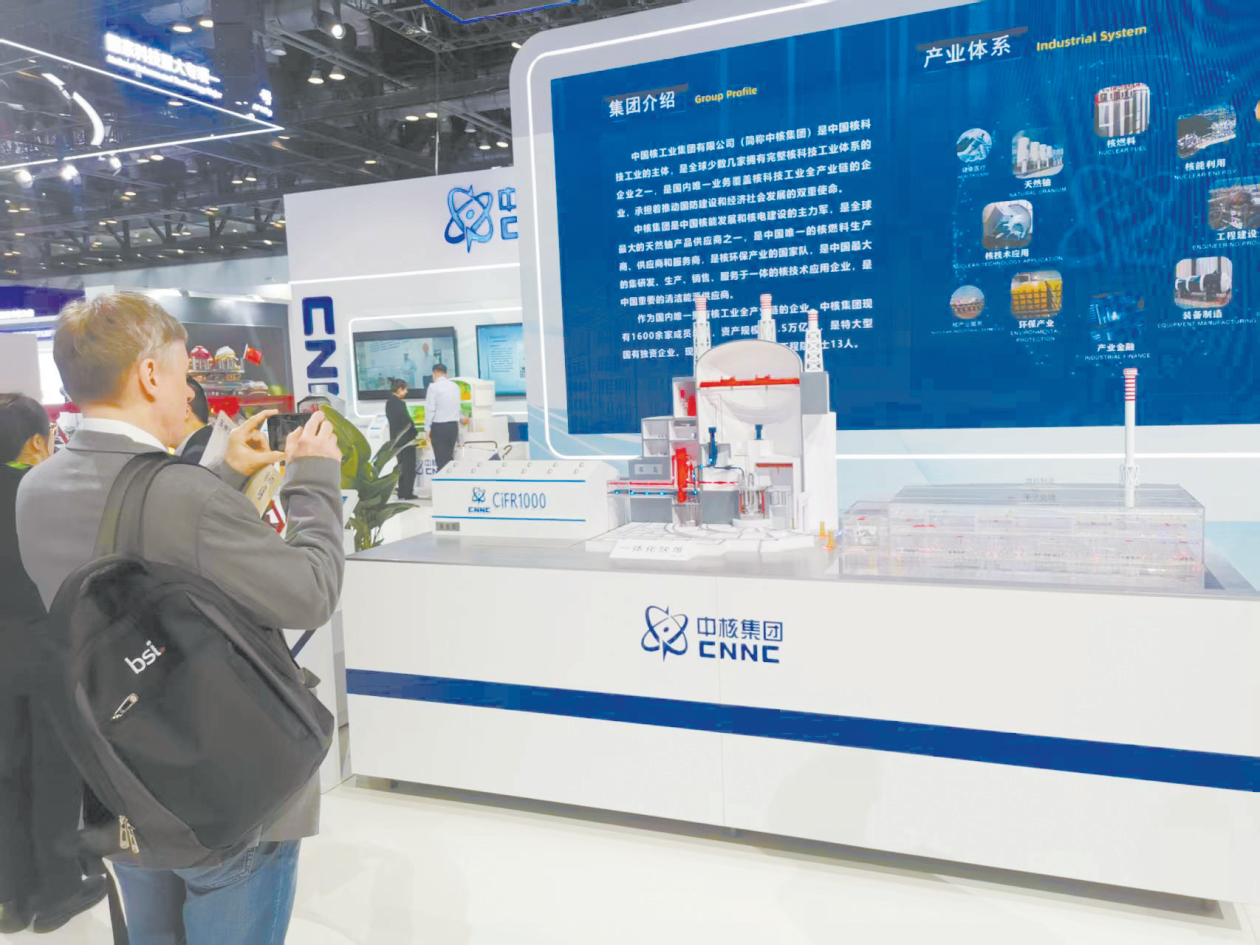
Core Insights - The 2025 Spring International Forum on Sustainable Development of Nuclear Energy and the 16th China International Nuclear Power Industry Exhibition took place in Beijing, gathering representatives from international organizations, governments, research institutions, and the industry to discuss global nuclear energy opportunities and challenges [1] Group 1: China's Nuclear Power Development - As of now, China has 102 nuclear power units in operation, under construction, and approved for construction, with a total installed capacity of 113 million kilowatts, making it the world's largest nuclear power producer [3][4] - The Chinese government has approved five new nuclear projects, totaling ten new units, following a similar approval of five projects and eleven units last year [3] - China has the capability to construct over 40 units simultaneously, with an annual equipment manufacturing capacity exceeding ten sets [3] Group 2: Technological Advancements - China has made significant breakthroughs in various nuclear technology fields, establishing independent brands such as "Hualong One" and "Guohe One" [4] - The "Linglong One" small reactor is expected to be operational by 2026, and the thorium molten salt experimental reactor has achieved full power operation [4] Group 3: Global Nuclear Energy Trends - The global nuclear power landscape is witnessing a resurgence, with 417 operational nuclear units expected by 2024, generating a record 2.8 trillion kilowatt-hours, accounting for 9% of global electricity generation [5] - Major nuclear countries are accelerating their nuclear power projects, with the U.S. planning to commercialize advanced nuclear energy by 2030 and Russia aiming to commission 12 new units by 2035 [5][6] - Emerging countries, including Poland, Turkey, and Saudi Arabia, are also announcing new nuclear construction plans, indicating a broader acceptance of nuclear energy [6] Group 4: Small Modular Reactors and Future Technologies - The development of small modular reactors (SMRs) is being promoted as a solution for countries with limited technical and financial resources to harness nuclear technology [7] - Micro-reactors, typically ranging from 1 to 10 megawatts, are being explored for remote areas and specific applications, such as mining operations and offshore platforms [7][8] - The "artificial sun" concept, focusing on nuclear fusion, is gaining attention, with significant advancements reported in various fusion projects, including ITER [9]


如何开展“人造太阳”聚变研究辐射安全监管?生态环境部回应
Xin Jing Bao· 2025-04-23 06:46
Core Viewpoint - The Chinese government is actively developing a regulatory framework for radiation safety in nuclear fusion research, ensuring the safe advancement of fusion technology while addressing potential radiation risks associated with various fusion devices [1][2]. Group 1: Regulatory Framework - The Ministry of Ecology and Environment has been closely monitoring the developments in fusion research and has initiated forward-looking studies to implement regulations tailored to the specific characteristics of fusion devices [1][2]. - In April 2023, the Ministry issued a notification updating the regulatory requirements for fusion devices, building on a 2016 document that outlined management requirements for small tokamak devices [2]. Group 2: Safety and Risk Management - The current fusion devices are primarily research-focused, with diverse technical routes and working media, leading to varying radiation safety risks [2]. - The Ministry has issued radiation safety licenses to 11 institutions, including the China National Nuclear Corporation and the Hefei Institute of Physical Science, indicating a structured approach to assessing and managing radiation safety risks [2]. Group 3: Future Directions - The Ministry plans to advance the development of a regulatory standard system for fusion, closely track international developments in fusion, and actively participate in the formulation of international standards [2]. - There is an emphasis on building a professional talent pool, particularly by recruiting individuals with expertise in fusion, to establish a consultation database for fusion experts [2].
人类终极能源,又在A股突破
格隆汇APP· 2025-03-27 10:43
Core Viewpoint - Controlled nuclear fusion is regarded as the ultimate energy solution for humanity, with significant advancements in research and engineering feasibility, leading to increased investment and interest in the sector [1][4][10]. Group 1: Industry Developments - Since 2025, organizations like Fusion New Energy and the Chinese Academy of Sciences have initiated approximately 46 procurement projects related to controlled nuclear fusion [1]. - The controlled nuclear fusion sector experienced a surge on March 25, with indices rising over 7%, indicating strong market enthusiasm [1]. - The global fusion energy industry has attracted a total investment of $7.3 billion by 2024, with a notable increase in private fusion companies from 23 in 2021 to nearly 50 by 2025 [10]. Group 2: Technological Advancements - Breakthroughs in superconducting materials and precision engineering have accelerated the research and development of controlled nuclear fusion, making commercial viability more promising [4][9]. - The International Thermonuclear Experimental Reactor (ITER) project, initiated in the 1980s, has faced high costs and delays, but recent advancements in high-temperature superconducting magnets are reshaping the engineering paradigm for tokamak devices [9][10]. - The Chinese Fusion Engineering Test Reactor (CFETR) is a significant project aimed at advancing fusion energy commercialization, with a roadmap outlining key milestones leading to a demonstration power plant by around 2050 [15][16]. Group 3: Investment Landscape - Major investments in fusion energy have been observed, with the U.S. investing over $2.5 billion in 2021 and China maintaining investments around $1 billion in recent years [10]. - Notable figures, such as OpenAI's CEO Sam Altman, have personally invested in fusion startups, highlighting the growing interest from the tech sector [10]. - State-owned enterprises in China, including China Nuclear Power and Zhejiang Energy, have committed significant capital to fusion energy companies, indicating strong governmental support for the industry [11]. Group 4: Market Potential - The global nuclear fusion market is projected to reach $496.55 billion by 2030, with a compound annual growth rate (CAGR) of approximately 7.4% from 2024 to 2030 [21]. - The cost of nuclear fusion experimental reactors is currently high, with estimates reaching hundreds of billions, but advancements in superconducting materials are expected to significantly reduce costs and improve economic viability [23]. - The nuclear fusion supply chain includes upstream raw materials, midstream superconducting magnets, and downstream power plant operations, with a focus on key components like superconducting magnets and vacuum systems [20][21].