房住不炒

Search documents
2026年的房价,已有3大信号!业内人:买卖房子,提前做好准备
Sou Hu Cai Jing· 2025-08-28 01:04
Core Insights - The real estate market is expected to stabilize and differentiate by 2026, moving away from the previous trend of rapid price increases and speculative buying [2][14] Group 1: Policy Signals - The government maintains a strong commitment to the principle that "houses are for living in, not for speculation," indicating a long-term policy direction rather than a temporary slogan [4] - Future policies are likely to be more precise and supportive of genuine homebuyers, while making it increasingly difficult for speculators to profit [5] Group 2: Market Differentiation - The real estate market is experiencing increased differentiation, with a focus on major cities and prime locations becoming crucial for investment decisions [7] - The era of universally rising property prices is over, and buyers must now be more strategic in their choices, as properties in weaker markets may face prolonged adjustments [7] Group 3: Housing Supply Changes - The government is enhancing the housing supply structure, promoting a rental and purchase system that provides more options for first-time buyers and lower-income families [9] - The market is expected to become more rational, with a shift in demand due to the increased availability of various housing types, impacting the resale value of less desirable properties [9] Group 4: Recommendations for Buyers and Sellers - For first-time buyers, it is advisable to remain calm and not expect significant price drops, while being ready to act when a suitable property is found [11] - For those looking to upgrade, it is recommended to replace older, less desirable properties with higher-quality homes that have better long-term value [13] - Investors should reassess their portfolios, considering selling properties that lack location advantages or rental potential, and diversifying investments to mitigate risks [13]


取消限售、发购房补贴……多地出台楼市新政
证券时报· 2025-08-27 13:59
近日,多地发布楼市新政。 8月26日夜间,江苏苏州取消了市区范围内新建商品住房2年限售政策。 同日,安徽淮南出台10条楼市新政,包括发放购房和购买车位(库)补贴、人才购房补贴、团购新房补贴、发购房联动消费券等。 业内人士认为,政策调整体现了各地下半年立足"采取有力措施巩固房地产市场止跌回稳态势"的政策导向,有助于提升房地产市场流动性,增强市场活力。 8月26日夜间,据"苏州住建"公众号消息,苏州取消市区范围内新建商品住房2年限售。 苏州取消限售政策 苏州住建局表示,为进一步满足居民改善性住房需求,即日起,取消苏州市区范围内新建商品住房取得不动产权登记证书满2年方可转让的限制措施(有特殊 限制转让要求的住房除外)。 对此,易居研究院副院长严跃进表示,此次政策调整是苏州市政府根据当前房地产市场形势和居民实际需求作出的重要决策,体现各地下半年立足"采取有力 措施巩固房地产市场止跌回稳态势"的导向。当前改善性住房需求积极释放,原有的转让限制措施在一定程度上制约了居民住房条件的改善。此次取消限售, 将有效降低居民改善住房的交易成本和时间成本,激发市场活力,为房地产市场注入新的动力。 在中指研究院苏州分院高级分析师金珂看 ...

取消限售、发购房补贴……多地出台楼市新政
券商中国· 2025-08-27 13:23
近日,多地发布楼市新政。 8月26日,江苏苏州取消了市区范围内新建商品住房2年限售政策。 同日,安徽淮南出台10条楼市新政,包括发放购房和购买车位(库)补贴、人才购房补贴、团购新房补贴、购房联动消 费券等。 业内人士认为,政策调整体现了各地下半年立足"采取有力措施巩固房地产市场止跌回稳态势"的政策导向,有助于提升 房地产市场流动性,增强市场活力。 苏州取消限售政策 8月26日夜间,据"苏州住建"公众号消息,苏州取消市区范围内新建商品住房2年限售。 苏州住建局表示,为进一步满足居民改善性住房需求,即日起,取消苏州市区范围内新建商品住房取得不动产权登记证 书满2年方可转让的限制措施(有特殊限制转让要求的住房除外)。 对此,易居研究院副院长严跃进表示,此次政策调整是苏州市政府根据当前房地产市场形势和居民实际需求作出的重要 决策,体现各地下半年立足"采取有力措施巩固房地产市场止跌回稳态势"的导向。当前改善性住房需求积极释放,原有 的转让限制措施在一定程度上制约了居民住房条件的改善。此次取消限售,将有效降低居民改善住房的交易成本和时间 成本,激发市场活力,为房地产市场注入新的动力。 在中指研究院苏州分院高级分析师金珂看 ...

取消限售、发购房补贴……多地出台楼市新政
Zheng Quan Shi Bao Wang· 2025-08-27 13:13
Group 1 - The core viewpoint of the article highlights recent policy adjustments in the real estate market across multiple regions, aimed at stabilizing and invigorating the market [2][3][4] Group 2 - On August 26, Suzhou canceled the two-year sales restriction on newly built commercial housing in urban areas to meet residents' demand for improved housing [3] - The policy change in Suzhou is seen as a significant decision by the local government, reflecting the need to enhance market liquidity and stimulate demand for improved housing [3][4] - The cancellation of the sales restriction is expected to lower transaction costs and time for residents seeking to upgrade their housing, thereby injecting new momentum into the real estate market [3][4] Group 3 - In addition to Suzhou, Huainan introduced ten new measures to promote high-quality development in the real estate sector, including various subsidies for home purchases and parking spaces [5][6] - Huainan's measures include a 50% subsidy on the actual deed tax for home purchases, with higher subsidies for specific groups such as military personnel and large families [5][6] - The new policies also support talent acquisition by providing substantial one-time purchase subsidies for qualified new residents buying their first home [6][7] Group 4 - Huainan's new policies encourage group purchases of new homes, offering significant tax rebates for bulk purchases, and promoting further discounts from developers [6][7] - The introduction of consumption vouchers worth 3,000 yuan for homebuyers aims to stimulate related sectors such as home appliances and automobiles [7] - Financial support measures include lowering the minimum down payment and interest rates for personal housing loans, optimizing loan recognition standards, and reducing public housing fund loan rates [7]
未来5年,持有“2套”及以上房产的人会面临2大难题,征兆已显现
Sou Hu Cai Jing· 2025-08-26 20:27
Core Viewpoint - The Chinese real estate market, which has experienced significant price increases since the housing reform in 1998, is now facing challenges due to market saturation and government regulations aimed at curbing speculation and promoting affordable housing options [1][2][4][6] Group 1: Market Dynamics - The rise in real estate prices has led to the emergence of "speculators" and a booming real estate agency industry, with large enterprises and institutions also participating in property accumulation to create a false sense of demand [1] - Government policies are shifting towards a "rent and purchase" model, with an emphasis on affordable housing options like rental and shared ownership, which will limit the potential for significant price increases in the commodity housing market [2][4] Group 2: Challenges for Property Owners - Investors holding multiple properties will face increased difficulty in liquidating their assets due to a saturated market and the competitive nature of government-subsidized housing options [2][6] - The risk of asset depreciation is significant, as the actual purchasing power of money decreases over time, meaning that even if property values remain stable, their real value may diminish [4][6]

楼市迎来新“拐点”,房价或将“超乎想象”,内行人:优先考虑二手房
Sou Hu Cai Jing· 2025-08-26 12:49
Core Insights - The real estate market in China is experiencing a significant shift, with second-hand homes becoming a more attractive option compared to new homes, reflecting changing buyer preferences and market dynamics [1][11]. Market Trends - From January to July 2024, the transaction volume of second-hand homes in 50 major cities increased by 11.2% year-on-year, while new home transactions decreased by 3.7% [1]. - In July 2025, 28 cities saw an increase in new home prices, a decrease of 5 from June, while 33 cities experienced an increase in second-hand home prices, an increase of 2 from June [2]. Buyer Behavior - There is a notable shift in buyer mentality, with more individuals prioritizing practical living conditions such as location, amenities, and schools over mere investment potential [4][11]. - Among young buyers under 30, over 60% are now opting for second-hand homes, up from less than 40% three years ago [8]. Price Dynamics - In first-tier cities, particularly in prime locations, second-hand home prices have shown resilience, with some areas like Haidian District in Beijing seeing a 5% year-on-year increase [4]. - Conversely, many third and fourth-tier cities are facing downward pressure on home prices due to population outflow and insufficient industrial support, with over 100 such cities reporting price declines in the first half of 2025 [5]. Developer Strategies - Developers are adjusting their strategies to compete with the second-hand market, focusing on practicality and cost-effectiveness rather than solely high-end offerings [7]. - The inventory of unsold properties as of June 2025 stood at approximately 630 million square meters, equivalent to nearly two years of sales, indicating significant pressure on developers to lower prices [7]. Investment Considerations - Second-hand homes offer advantages such as price transparency and established neighborhood development, making them a viable option for buyers [10]. - The average appreciation rate for core area second-hand homes in major cities is 22% from 2020 to 2025, compared to 15% for new homes, highlighting the potential for better returns on investment in the second-hand market [10].
未来楼市方向确认!马云再提“新预言”,房产市场将出现两大趋势
Sou Hu Cai Jing· 2025-08-26 02:50
Core Viewpoint - The real estate market is undergoing significant changes, with a shift from investment properties to a focus on residential attributes, leading to a decline in property values and sales [1][3][10]. Group 1: Market Performance - In the first half of 2025, the national sales area of commercial housing decreased by 8.7% year-on-year to 562 million square meters, while sales revenue fell by 12.3% to 5.23 trillion yuan [2]. - Among 70 major cities, 75.7% of new residential prices experienced a month-on-month decline, indicating widespread market challenges [2]. Group 2: Demographic Changes - China's population growth has significantly slowed, with a natural growth rate dropping to -0.15% in 2024 and further to -0.18% in the first half of 2025, marking the first negative growth since the founding of the country [5]. - By 2035, it is projected that around 20% of the population will be aged 65 and above, which will profoundly impact housing demand [5]. Group 3: Changing Demand - A survey in 2025 revealed that only 37% of young adults aged 25-35 prioritize homeownership, down from 53% in 2020, as they increasingly prefer a "light asset" lifestyle [6]. Group 4: Supply Side Adjustments - In the first half of 2025, real estate development investment decreased by 9.3% year-on-year to 4.72 trillion yuan, reflecting the financial pressures faced by real estate companies [9]. - New construction projects have sharply declined, further confirming the market's adjustment [9]. Group 5: Future Market Trends - The rental market is expected to thrive as the investment appeal of real estate diminishes, with rental transaction volumes in major cities increasing by 22% year-on-year in Q2 2025 [12]. - The proportion of second-hand housing transactions is rising, accounting for 43% of total commercial housing transactions in the first half of 2025 [13]. - There is a growing demand for the renovation of aging residential properties, with over 160 million square meters of old communities needing upgrades [13]. - The smart home market reached 547 billion yuan in 2025, growing by 28%, indicating a shift towards healthier living environments [13].

2025年楼市逆转:还在观望的人,已被市场远远甩开
Sou Hu Cai Jing· 2025-08-25 04:09
Core Viewpoint - The Chinese real estate market is experiencing a significant rebound, moving away from a prolonged downturn and entering a phase of steady recovery [1][4]. Market Recovery - In Q2 2025, new residential prices in 70 major cities rose by 3.7% month-on-month, with first-tier cities seeing a 5.2% increase and second-tier cities 4.6% [2]. - The total sales area of commercial housing in the first half of 2025 reached 728 million square meters, a year-on-year increase of 15.6%, while sales revenue hit 7.53 trillion yuan, up 18.2% [4]. Policy Impact - The market turnaround is attributed to a series of effective policy adjustments, including reduced down payment ratios and lower mortgage rates, particularly in first-tier cities where rates have fallen below 4% [5][8]. - The "housing is for living, not for speculation" policy introduced at the end of 2024 marked a significant shift in real estate policy [5]. Supply and Demand Dynamics - The urbanization rate in China reached 67.3% in 2024 and is expected to exceed 68% in 2025, indicating a stable demand for housing as approximately 12 million people migrate to cities annually [8]. - The new housing supply has significantly decreased due to strict regulations over the past three years, with new construction area dropping by 38.6% from its peak in 2021 [8]. Regional Disparities - The recovery is characterized by notable regional differences, with first and second-tier cities like Shenzhen and Shanghai experiencing price increases exceeding 8% year-on-year [9]. - Conversely, third and fourth-tier cities are lagging in recovery, facing inventory pressures due to population outflows [11]. Investor Sentiment - A survey indicated that 43.7% of respondents in Q2 2025 are considering purchasing investment properties, a significant increase of 18.6 percentage points from the previous year [11]. - Funds that previously flowed into stock markets are returning to real estate, reflecting a shift in investor sentiment [11]. Fiscal Health - Land sales revenue in the first half of 2025 reached 2.17 trillion yuan, a year-on-year increase of 23.5%, marking the first significant growth since 2021 [11]. Macroeconomic Context - The real estate sector contributes approximately 25% to GDP and over 15% to employment, underscoring its critical role in stabilizing the economy amid downward pressures [12]. Future Outlook - Experts predict a more rational market moving forward, with housing price growth aligning with income growth, and speculative demand being curtailed [12]. - The forecast for 2025 suggests a potential price increase of 6%, with a more moderate growth rate of around 5% in 2026 [12]. Market Characteristics - The current market is marked by increased regional differentiation, scarcity of quality assets, and a return to the fundamental purpose of housing [14]. - Investors are advised to focus on location, quality, and amenities, as the market matures and the importance of informed decision-making grows [14].
2026年的房价,已有3大信号!业内人:买房或卖房,都要做好准备
Sou Hu Cai Jing· 2025-08-24 09:55
Group 1 - The core viewpoint emphasizes the need for a clear understanding of the real estate market signals, particularly in light of the government's long-term policy of "housing is for living, not for speculation" [1][3] - The first signal indicates that the government's policy direction will continue to suppress speculative investment while protecting genuine housing demand, suggesting that potential homebuyers should act when suitable opportunities arise [1][3] - The second signal highlights the increasing market differentiation, where housing demand is shifting towards core cities and urban areas with strong job opportunities, while weaker markets may face prolonged adjustments [3][5] Group 2 - The third signal points to an optimization in housing supply structure, with a growing variety of housing options such as rental housing and shared ownership, which will cater to the needs of younger individuals and low-income families [5][7] - The adjustment in housing supply is expected to rationalize market heat, indicating that not all properties will be easily sold, particularly those that are of poor quality or in less desirable locations [7] - The outlook for the real estate market by 2026 suggests a more stable and differentiated landscape, moving away from the previous notion that buying property is always profitable, urging a more rational approach to real estate decisions [7]

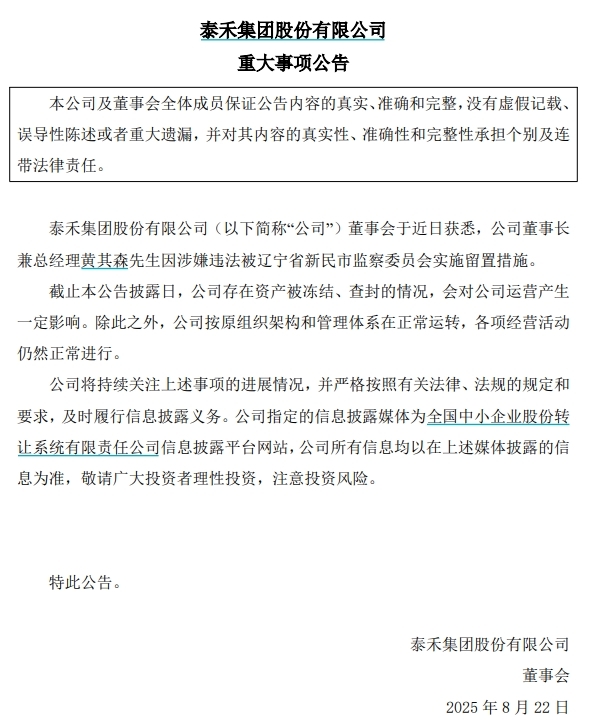
昔日千亿房企巨头暴雷,大佬黄其森被抓!身家一度超过200亿元,无视“房住不炒”的警告,曾疯狂加杠杆
Jin Rong Jie· 2025-08-23 01:04
Core Viewpoint - The former real estate giant, Taihe Group, is facing significant legal and financial troubles, with its chairman Huang Qisong detained for suspected illegal activities, leading to asset freezes and operational impacts [1][5]. Group 1: Legal Issues - Taihe Group has been penalized by the China Securities Regulatory Commission (CSRC) for failing to disclose major lawsuits, resulting in a warning and a fine of 6 million yuan [1][7]. - The company faced 13 lawsuits from July 2020 to May 2021, with a total amount of approximately 967.37 million yuan, representing 48.21% of its audited net assets for 2020 [6]. - From December 2021 to December 2022, Taihe Group encountered 10 additional lawsuits, totaling around 619.06 million yuan, which accounted for 41.84% of its audited net assets for 2021 [6]. Group 2: Financial Condition - As of the end of 2018, Taihe Group had current liabilities of 128.9 billion yuan, a 48% increase year-on-year, while cash on hand was only 14.9 billion yuan [4]. - The company's net debt ratio was 248.31% at the end of 2019, with interest-bearing liabilities recorded at 97 billion yuan [4]. - By April 28, 2023, Taihe Group had outstanding loans of 58.203 billion yuan that were overdue, with guarantees for overdue debts amounting to 5.416 billion yuan [4]. Group 3: Company Background - Huang Qisong, born in 1965, founded Taihe Group in 1996 after leaving the finance sector, quickly establishing it as a leading real estate company in Fujian [3]. - The company expanded its reach beyond Fujian, creating luxury properties like "China Courtyard" in Beijing and becoming a prominent figure in the real estate market [3]. - By 2015, Taihe Group's soaring stock prices made Huang Qisong the richest person in Fujian, with a net worth exceeding 20 billion yuan [3].