
权益投资

Search documents
业绩、股价均创新高,中国人保接下来如何布局|直击业绩会
Guo Ji Jin Rong Bao· 2025-08-28 14:59
Core Insights - China Pacific Insurance (CPIC) reported strong financial results for the first half of 2025, with insurance service revenue reaching 280.25 billion yuan, a year-on-year increase of 7.1% [1] - The company achieved a net profit attributable to shareholders of 26.53 billion yuan, reflecting a 16.9% growth compared to the previous year [1] - Investment assets grew to over 1.7 trillion yuan, marking a 7.2% increase since the beginning of the year [1] Financial Performance - The comprehensive cost ratio for property insurance was 95.3%, the best level for the same period in nearly a decade [3] - New business value in life insurance reached 8.8 billion yuan, setting a historical high for the same period [3] - Total investment income was 41.5 billion yuan, also a record for the same period [3] - The combined net profit for the group was 35.9 billion yuan, achieving a historical peak [3] Stock Performance - CPIC's A-shares reached their highest price in nearly six years, while H-shares hit a record high since their listing 13 years ago [3] - The stock price increase is attributed to several factors, including China's high-quality economic development and improved operating environment [3] Strategic Focus - The company aims to build a world-class insurance financial group, focusing on enhancing protection functions, improving development quality, and deepening six key reforms [3] Regulatory Developments - The non-auto insurance "reporting and operation in one" policy is expected to be implemented in the fourth quarter, which will significantly improve the comprehensive cost ratio [5] - This policy aims to standardize non-auto insurance business and control premium collection risks [5] International Expansion - CPIC is actively pursuing internationalization, with a focus on the overseas market for new energy vehicle insurance [6] - The company has already insured over 1,000 Chinese brand new energy vehicles in Hong Kong, with a current claims ratio of 50% [5] Investment Strategy - Total investment income for the first half of 2025 was 41.478 billion yuan, a 42.7% increase year-on-year, with an annualized total investment return rate of 5.1% [8] - The company plans to enhance its investment strategy by focusing on high-dividend stocks and exploring opportunities for collaboration with invested companies [8][9]

截至6月末信银理财上理财规模突破2.1万亿元 较上年末增长7%
Shang Hai Zheng Quan Bao· 2025-08-28 14:06
Core Viewpoint - CITIC Bank's subsidiary, Xinyin Wealth Management, reported a 7% year-on-year growth in its asset management scale, reaching 2.13 trillion yuan by the end of the reporting period [1] Group 1: Financial Performance - The management scale of Xinyin Wealth Management, including entrusted management, was 2.13 trillion yuan, an increase of 7% compared to the end of the previous year [1] - The number of clients holding wealth management products reached 10.92 million, reflecting a growth of 9.42% from the end of the previous year [1] - The investment income generated for clients amounted to 21.974 billion yuan, representing a year-on-year increase of 20.22% [1] Group 2: Product Structure and Strategy - Xinyin Wealth Management has been enhancing its product structure by focusing on "grasping both ends, promoting the middle, and strengthening equity" [1] - The scale of wealth management products with a duration of one year or more was 729.903 billion yuan, which increased by 64.518 billion yuan, accounting for 34.64% of new products [1] - The scale of equity-linked products reached 207.08 billion yuan, with an increase of 18.579 billion yuan, and the proportion of new products rose from 9.68% at the beginning of the year to 9.83% [1] Group 3: Investment Strategy - Xinyin Wealth Management has strengthened its equity investment capabilities, promoting multi-asset and multi-strategy portfolio investments to reduce correlation and control extreme volatility [1] - The company aims to effectively enhance returns through its diversified investment strategies [1]
中国人保才智伟:对优质标的适时通过举牌、战投等方式加大投资力度
Bei Jing Shang Bao· 2025-08-28 09:02
Core Viewpoint - China Life Insurance is committed to enhancing its equity investment strategies and will focus on high-quality targets that align with national strategies and demonstrate stable long-term performance and growth potential [1] Group 1 - The company plans to continuously enrich its equity investment methods [1] - There will be an increased emphasis on research and preparation for high-quality investment targets [1] - The company intends to invest more aggressively through shareholding and strategic investments in suitable targets [1]
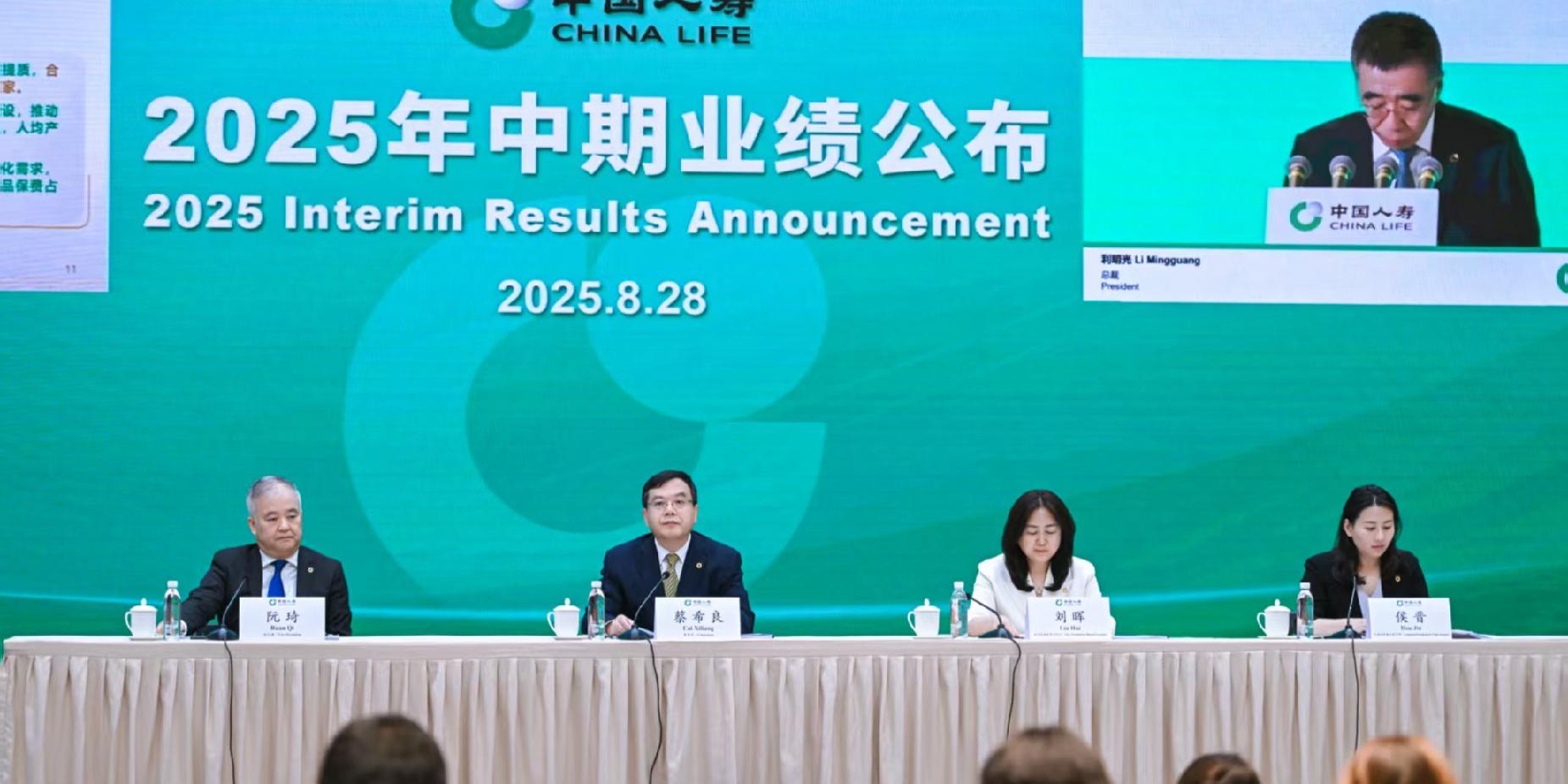
每天净赚2.3亿、新增权益投资超1500亿 中国人寿中报的“含金量”与“新信号”
Jing Ji Guan Cha Wang· 2025-08-28 08:34
Core Viewpoint - China Life Insurance Company reported strong performance in its 2025 interim results, with total assets and investment assets exceeding 7 trillion yuan, net profit of 40.9 billion yuan, and premium income of 525.088 billion yuan, indicating robust growth in a challenging market environment [2][3]. Group 1: Financial Performance - As of June 30, 2025, China Life's total assets and investment assets both surpassed 7 trillion yuan, achieving a net profit of 40.9 billion yuan, equivalent to approximately 2.3 billion yuan per day [2]. - The company collected 525.088 billion yuan in premiums, averaging about 14.38 billion yuan per day, with long-term insurance policies reaching 327 million, meaning one in four individuals holds a policy [2]. - The board proposed a mid-term cash dividend of 2.38 yuan per 10 shares, totaling 6.727 billion yuan in cash dividends [2]. Group 2: Premium Income and Growth Channels - In the first half of 2025, total premiums reached 525.088 billion yuan, marking a historical high for the same period, with a year-on-year growth of 7.3% [3]. - The individual agent channel generated 400.448 billion yuan, while the bank insurance channel achieved 72.444 billion yuan, with the latter growing by 45.7% year-on-year [3][4]. - New single premiums from the individual insurance channel fell by 24.16% to 64.252 billion yuan, while the bank insurance channel saw a significant increase of 111.1% in new single premiums, reaching 35.873 billion yuan [4]. Group 3: Investment Strategy and Market Outlook - China Life's investment assets reached 71.27153 trillion yuan, growing by 7.8% from the end of 2024, with net investment income of 96.067 billion yuan and a net investment yield of 2.78% [6]. - The company added over 150 billion yuan in equity investments in the first half of 2025, reflecting a positive outlook on the equity market [6][7]. - The company maintains a balanced and flexible asset allocation strategy, focusing on opportunities in technology innovation, consumer manufacturing, and new consumption sectors [7][8].


中国人寿上半年权益投资增1500亿,将更关注高股息配置
Di Yi Cai Jing· 2025-08-28 05:16
Core Viewpoint - China Life Insurance is focusing on enhancing the stability and long-term return potential of its equity investments while actively supporting capital market development and shareholder returns [1][3]. Group 1: Investment Performance - As of June 30, 2025, China Life's investment assets reached 71,271.53 billion yuan, a 7.8% increase from the end of 2024 [1]. - The company achieved a net investment income of 960.67 billion yuan, with a net investment yield of 2.78% [1]. - Total investment income was 1,275.06 billion yuan, reflecting a year-on-year growth of 4.2%, with a total investment yield of 3.29% [1]. Group 2: Asset Allocation Strategy - China Life is adjusting its asset allocation strategy across various sectors, maintaining a solid base in fixed income while increasing equity investments by over 150 billion yuan since the beginning of the year [2]. - The company has invested a total of 35 billion yuan in private equity funds and is focusing on high-dividend assets and new productivity sectors [2]. - The overall asset allocation remains stable with high asset quality [2]. Group 3: Shareholder Returns - China Life continues to emphasize quality and efficiency in shareholder returns, maintaining a biannual dividend distribution for two consecutive years [3]. - Since its listing, the company has distributed a total of approximately 2,277 billion yuan in dividends [3].
中国人寿刘晖:权益投资的比例符合公司资产配置中枢,下一步会更加关注高股息股票的配置
Bei Jing Shang Bao· 2025-08-28 04:00
Core Viewpoint - China Life Insurance Company is optimistic about equity investment market opportunities and has increased its investment efforts significantly over the past year, adding over 150 billion yuan in equity asset allocation in the first half of the year [1] Group 1: Investment Strategy - The company has adopted a strategy of steady allocation and optimization of its equity investment structure based on its asset allocation needs [1] - The proportion of equity investments currently aligns with the company's asset allocation center [1] - Future equity allocations will focus more on high-dividend stocks [1]
鹏华丰润LOF: 鹏华丰润债券型证券投资基金(LOF)2025年中期报告
Zheng Quan Zhi Xing· 2025-08-27 13:25
Fund Overview - The fund is named Penghua Fengrun Bond Fund (LOF) and is managed by Penghua Fund Management Co., Ltd. with China Construction Bank as the custodian [3][4] - The fund aims to create higher current returns for its holders while strictly controlling investment risks [3] - The fund's total shares at the end of the reporting period were 186,987,350.59 shares [3] Investment Strategy - The fund employs an active investment strategy to identify various potential value growth opportunities, aiming to achieve returns that exceed benchmarks [3] - Asset allocation strategies involve dynamic adjustments between bonds, stocks, and cash based on macroeconomic analysis and interest rate trends [3] - The fund utilizes various strategies for bond investments, including duration strategy, yield curve strategy, and spread strategy, to enhance total returns while ensuring long-term capital safety [3][4] Financial Performance - The fund's realized income for the reporting period was 3,208,069.78 RMB, with a weighted average net profit margin of 1.04% [6] - The net asset value at the end of the reporting period was 208,830,332.52 RMB, with a net asset value per share of 1.1168 RMB [6][19] - The cumulative net value growth rate since the fund's inception is 97.51% [6] Market Context - The bond market experienced adjustments in the first quarter due to high funding rates and a lack of interest rate cuts, while the second quarter saw a recovery with a more abundant liquidity environment [13] - The fund primarily invested in medium to high-rated credit bonds and engaged in tactical operations with interest rate bonds during the reporting period [13][14] - The macroeconomic outlook suggests a stable economic environment with limited risks of significant downturns, supported by proactive domestic policies [14] Management and Governance - Penghua Fund Management Co., Ltd. has been operational since December 22, 1998, managing a total asset scale of 1,251.3 billion RMB across various funds [8] - The fund management team has extensive experience in investment management and risk control, ensuring compliance with relevant regulations and fund contracts [12]

6家机构、37只个人养老金理财,收益率大多高于同类
2 1 Shi Ji Jing Ji Bao Dao· 2025-08-27 13:00
Core Viewpoint - The personal pension financial products in China have expanded for the ninth time, with a total of 37 products issued by six financial companies, indicating a growing market for personal pension investments [2][3]. Group 1: Market Expansion - As of August 26, 2023, the ninth batch of personal pension financial products was released, with China Postal Savings Bank adding two new products [2]. - A total of 21 commercial banks are now involved in the distribution of these products, reflecting a broader acceptance and integration into the financial system [2]. - The personal pension system was launched in 36 pilot cities in November 2022 and has since expanded nationwide [2]. Group 2: Investment Products and Performance - The personal pension funds can be invested in various financial products, including bank wealth management, savings deposits, commercial pension insurance, and public funds, with a current total of 37 bank wealth management products available [2]. - As of August 27, 2023, the scale of public funds within personal pension products reached 4,117.71 billion yuan, with a significant increase in the number of investors [3]. - The average annualized return for personal pension financial products is over 3.4%, significantly higher than the average return of 2.12% for general wealth management products [6]. Group 3: Investment Strategy and Risk - The long-term nature of personal pension products allows for higher return expectations, as they are designed to be held until retirement, reducing the pressure from short-term market fluctuations [5]. - The asset allocation in personal pension products is more diversified compared to traditional wealth management products, with a higher proportion of equity investments [6][10]. - There is a noted need to increase the equity investment ratio in personal pension products to enhance long-term returns, as current allocations remain conservative compared to international standards [10][11]. Group 4: Comparative Analysis - In comparison to the U.S. personal pension market, where a significant portion is allocated to equity funds, China's pension products show a lower equity allocation, limiting long-term growth potential [11]. - The current trend in the Chinese market reflects a cautious approach to risk, with a focus on stability over higher returns, which may need to evolve as demographic and economic conditions change [11].

6家机构、37只个人养老金理财,收益率大多高于同类
21世纪经济报道· 2025-08-27 11:57
Core Viewpoint - The personal pension financial products in China have expanded for the ninth time, indicating a growing market and increasing participation from various financial institutions [1][2]. Group 1: Market Expansion - As of August 26, 2023, the ninth batch of personal pension financial products has been released, with 37 products issued by 6 financial companies [1]. - Currently, there are 21 commercial banks involved in the distribution of these products, reflecting a broadening of the market [1]. - The personal pension system was launched in November 2022 and has since expanded nationwide, indicating a significant policy shift [1]. Group 2: Investment Performance - The scale of public funds within personal pension products reached 411.77 billion yuan as of August 27, 2023, showing substantial growth [2]. - The average annualized return for personal pension financial products is over 3.4%, significantly higher than the average return of 2.12% for general financial products [5]. - The investment strategy for personal pension products allows for a longer investment horizon, which helps in achieving higher returns compared to traditional short-term products [4][5]. Group 3: Asset Allocation - Personal pension products have a more diversified asset allocation, with approximately 50% in bonds and a higher proportion of equity investments compared to traditional financial products [5][6]. - The investment in equity is still relatively low compared to international standards, indicating room for improvement in the risk-return profile of these products [9]. - The current trend shows a need for a strategic shift towards higher-risk assets to enhance long-term returns, especially in light of increasing life expectancy and inflation [8][9].

个人养老金理财再扩容:6家机构发行37只,收益率大多高于同类
2 1 Shi Ji Jing Ji Bao Dao· 2025-08-27 10:17
Core Insights - The personal pension financial products in China have expanded for the ninth time, with 37 products issued by six financial companies, and 21 commercial banks participating in distribution [1] - The personal pension system was launched in November 2022 and has now expanded nationwide after two years of implementation [1] - As of August 27, 2025, the scale of public funds within personal pension products reached 411.77 billion yuan, with a significant increase in both the number of investors and the total purchase amount [2] Product Performance - Most personal pension financial products have yields higher than their peers, with average annualized returns exceeding 3.4%, compared to 2.12% for general financial products [4] - The investment horizon for personal pension products is longer, allowing for better returns due to reduced short-term market volatility [3][4] - The asset allocation in personal pension products is more diversified, with approximately 50% in bonds and a higher proportion of equity investments compared to traditional financial products [5] Market Trends - There is a growing concern regarding the conservative investment strategies for pension funds, which are heavily weighted towards low-yield assets like government bonds and deposits [6] - The aging population and inflation risks highlight the necessity for higher returns, prompting a shift towards more aggressive investment strategies [7] - Comparatively, China's pension product equity allocation is low compared to developed markets, indicating potential for future growth in returns if equity exposure increases [8]