中美经贸合作

Search documents
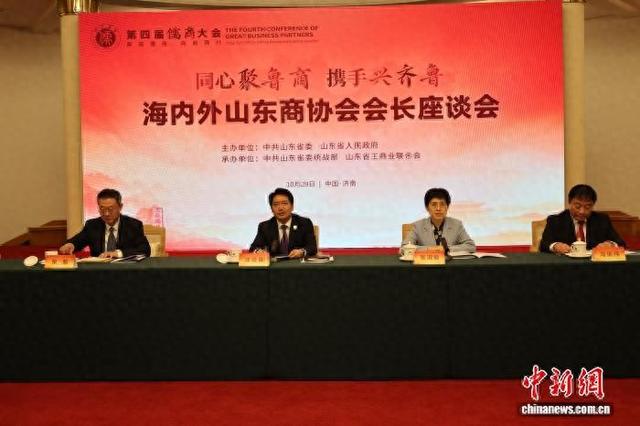
海内外山东商协会会长座谈会召开 共叙乡情友谊共促山东发展
Zhong Guo Xin Wen Wang· 2025-10-29 13:24
Core Insights - The meeting of Shandong business associations from home and abroad was held in Jinan, focusing on cooperation and development opportunities [1][9] Group 1: Government Initiatives - Shandong Provincial Party Committee member and Minister of United Front Work Department, Deng Yunfeng, emphasized the theme "Unite to Promote Shandong Business, Join Hands to Revitalize Qilu" and acknowledged the achievements of business associations [3] - Deng invited associations to guide enterprises in fostering national sentiment and taking on modern responsibilities, while enhancing service capabilities and building a resource-sharing platform for high-quality development [3] Group 2: International Cooperation - The President of the American Chinese Entrepreneurs Association, Shi Qianping, shared the association's achievements since its establishment in 2016, including various forums aimed at promoting Sino-US economic cooperation [6] - The association plans to regularly hold economic forums and themed salons to facilitate exchanges between Chinese entrepreneurs and Shandong [6] - The Macau Shandong Association aims to promote Shandong's economic achievements and investment environment, enhancing cooperation between Macau and Shandong [6] Group 3: Agricultural Export Initiatives - The Macau Shandong Association plans to establish a model for exporting Shandong agricultural products, starting with cherry tomatoes, and will invest in overseas warehouses in Malaysia for direct exports [7] Group 4: Overseas Service Support - The President of the French Shandong Chamber of Commerce, Liu Sheng, highlighted the need for a "service station" to provide comprehensive support for enterprises venturing abroad, and the chamber is working on establishing such a service center in France [9] - The Middle East European China Technology Exchange Association has facilitated numerous overseas technology enterprises entering China and vice versa, promoting local cooperation networks [9][10] Group 5: Technological Collaboration - The association suggested deepening economic and technological cooperation with Central and Eastern European countries, promoting practical collaboration across various fields [10] - A proposal was made to host a "Hungary Shandong Week" to showcase Shandong's achievements in high-end manufacturing, green energy, and cultural tourism, inviting participation from Central and Eastern European enterprises [10]

美调整针对中国航运和造船业的歧视性措施符合中美两国的长远利益
Zheng Quan Shi Bao Wang· 2025-10-29 13:20
此次中美经贸磋商达成的初步共识,对全球航运造船业恢复正常的商业市场秩序具有积极意义,也体现 了中国政府维护全球海事业公平环境和中国航运及造船业利益的坚定立场。中美双方达成初步共识,对 中国航运和造船业的未来是一件好事,对减少全球海事工业发展的不确定性、稳定全球海运供应链以及 重塑对中国造船的信心更具重要意义。 航运与造船业的国际性要求全球公平市场环境和供应链畅通合作,对特定国家搞产业霸凌只会损害全球 产业利益。希望美方立足长远发展和共同利益,与中国相向而行,多合作、不对抗,共同担负起全球发 展的责任。 (作者李彦庆系中国船舶工业行业协会秘书长) 近日,中美两国经贸团队在马来西亚吉隆坡举行中美经贸磋商。我们关注到,此次磋商将美对我造船业 301调查措施纳入议题,并取得了积极进展。中国商务部国际贸易谈判代表兼副部长李成钢在磋商结束 后对媒体表示,中美经贸团队就美对华海事物流和造船业301措施等议题进行了深入、坦诚讨论和交 流,建设性地探讨了一些妥善处理双方关注的方案,形成了初步共识。李成钢在会见媒体记者时表 示:"美方表达立场是强硬的,中方维护利益是坚定的"。这既表达了双方寻求共同利益的艰难,更显示 中国维护自身 ...
一个稳定的中美经贸关系有利于两国,有利于世界
Guo Ji Jin Rong Bao· 2025-10-29 12:20
Core Points - The meeting between Chinese President Xi Jinping and U.S. President Donald Trump is scheduled for October 30 in Busan, South Korea, to discuss U.S.-China relations and mutual concerns [1] - Recent U.S.-China trade negotiations in Kuala Lumpur resulted in a basic consensus on addressing mutual concerns, with both sides agreeing to further detail and domestic approval processes [1] Group 1: Economic Relations - The U.S.-China economic relationship is characterized as mutually beneficial, with trade volume increasing from under $2.5 billion in 1979 to nearly $688.3 billion in 2024 [2] - The stability of U.S.-China economic relations is crucial for global economic stability, as the two countries account for over 40% of the world's economy [2] - The interdependence in manufacturing and consumption between the U.S. and China is significant, with both countries playing vital roles in global supply chains [4] Group 2: Cooperation and Future Outlook - The importance of cooperation and mutual respect is emphasized, with a call for both nations to work towards common prosperity and global benefits [5] - The recent trade negotiations are seen as a step towards achieving substantial progress in U.S.-China economic cooperation, with expectations for the U.S. to reciprocate China's efforts [4] - The Chinese government has reiterated its commitment to high-level openness and cooperation, aiming to create a win-win situation for both countries [5]
中美经贸凌晨达成框架共识!TikTok或迎最终协议,全球股市直线拉升
Sou Hu Cai Jing· 2025-10-28 04:14
Core Insights - The U.S.-China trade negotiations have reached a significant turning point with the announcement of the "Framework Agreement on Economic and Trade Relations in the Digital Age," coinciding with a final operational agreement for TikTok, leading to a surge in global capital markets [3] Group 1: U.S.-China Trade Breakthrough - Tariff Ceasefire Upgrade: The U.S. confirmed the cancellation of 91% of tariffs on Chinese goods set to increase in April 2025, with the remaining 10% frozen until after the 2026 elections. China will lift import restrictions on U.S. soybeans and chips, committing to purchase 3 million tons of U.S. soybeans [3] - TikTok Ultimate Solution: U.S. user data will be stored in Oracle's Texas data center, encrypted, and prohibited from being transmitted to China. ByteDance retains algorithm ownership but will open API access for audits, while a U.S. consortium will hold 80% equity [3] - New Mechanism for Tech Cooperation: Establishment of the "U.S.-China Digital Governance Committee" to review tech export compliance quarterly, with predictions of cross-border e-commerce exceeding $300 billion by 2026 [4] Group 2: Capital Market Reactions - Cross-Border E-commerce Surge: Amazon and Temu announced a reduction in commission rates for Chinese sellers to 5%, with logistics times cut to three days [4] - Semiconductor Industry Restructuring: SMIC received U.S. export licenses for 14nm chips, and Nvidia's H20 chip pre-orders in China surpassed 500,000 units [4] - AI Application Ecosystem Explosion: ByteDance opened TikTok's recommendation algorithm to Microsoft, boosting Bing's search integration by 40%, while major companies announced a 35% reduction in large model training costs [4] Group 3: Implications of the Agreement - Technological Standards Contest: The U.S. acknowledged the validity of Chinese AI algorithm patents and promised equal representation in IEEE standard-setting, while China agreed to adopt the U.S.-led ISO/IEC 42001 AI management certification [5] - Cross-Border Data Flow Testing: A "data sandbox" will be established in Hainan and Texas to test compliance for financial and medical data, exploring a cross-border CBDC settlement mechanism limited to $10 billion initially [5] - New Geoeconomic Balance: The U.S. recognized the contributions of the Belt and Road Initiative in developing countries and committed to not obstruct third-party participation, while China will increase agricultural imports from the U.S. to $50 billion annually [5] Group 4: Outstanding Issues - Risk of Technological Decoupling: The U.S. requires ByteDance to complete the "de-China" transformation of its algorithms by 2027, removing all Chinese training data, while Huawei's 5G equipment remains excluded from U.S. government procurement [5] - Ongoing Regulatory Conflicts: The U.S. SEC mandates Chinese companies to adopt new accounting standards, which differ from domestic standards, and the TikTok content review committee will have a 4:3 member ratio between the U.S. and China, potentially leading to cultural conflicts [5] - Industry Subsidy Disputes: The U.S. Commerce Department identified Chinese renewable energy subsidies as violations of WTO rules, threatening a 301 investigation, while China demands the removal of investment restrictions in the U.S. CHIPS Act [5]

突发特讯!中国商务部通告全球:中美可以找到解决彼此关切的办法
Sou Hu Cai Jing· 2025-10-27 02:12
Core Viewpoint - The article emphasizes the need for rational dialogue in the ongoing U.S.-China economic negotiations, highlighting that both sides can find solutions to their concerns despite existing tensions [1][6]. Group 1: Rationality and Confidence Behind Statements - The statement "we can find a way" reflects China's confidence and rationality rather than weakness, as U.S. farmers and businesses are already feeling the negative impacts of tariffs, leading to significant losses [1][3]. - The U.S. has previously placed over a thousand Chinese companies on a control list, while China has tightened rare earth export controls, indicating a willingness to negotiate rather than resort to threats [3]. Group 2: U.S. Strategy of Pressure and Negotiation - The U.S. has employed a strategy of imposing tariffs and regulations to create tension, followed by high-level negotiations to set conditions, but this approach is losing effectiveness as American businesses oppose these tariffs [4]. - The recent Madrid talks showed that both sides can reach consensus on reducing investment barriers and resolving corporate issues, suggesting a path forward through negotiation [4]. Group 3: Mutual Concerns and Win-Win Solutions - "Resolving mutual concerns" does not imply unilateral concessions but finding a balanced solution acceptable to both parties, as the U.S. relies on China's 80% share of the global rare earth market for its electric vehicle and military industries [5]. - China is open to supplying rare earths but insists that the U.S. should not use these resources as leverage against Chinese companies, while the U.S. must remove tariffs to regain market access for its agricultural products [5]. Group 4: Importance of Rational Signals - The statement from the Ministry of Commerce sets a rational boundary for the ongoing negotiations, indicating that both sides have incurred costs from the trade friction, and the key lies in whether the U.S. can genuinely abandon threats and tariffs [6]. - The historical context of U.S.-China trade, which grew from under $2.5 billion in 1979 to nearly $688.3 billion in 2024, underscores the importance of mutual cooperation over confrontation [6].

环球时报社评:世界期待听到来自中美的更多好消息
Xin Lang Cai Jing· 2025-10-26 22:47
文章指出,有分析注意到,在吉隆坡中美经贸磋商中,美方有这样的表述:"美中经贸关系是全球最具 影响力的双边关系","美方愿同中方通过平等、尊重的方式解决分歧、加强合作,实现共同发展"。这 是在前4次经贸磋商中没有明确出现过的表述,其中"全球最具影响力"与"平等、尊重的方式"也比日内 瓦共识更往前进了一步。如果对比这5轮磋商中美方的表态,人们更能直观感受到,华盛顿的态度在 向"相互尊重、和平共处、合作共赢"原则不断靠拢。这既是中美关系一路走来的深刻经验总结,也是新 时期两国的正确相处之道。我们乐见美方的这一表态,更希望看到华盛顿能进一步将其落实到行动中。 关税战、贸易战不符合任何一方的利益,对于在经贸合作中出现的分歧和摩擦,中美两国也应该在平 等、尊重、互惠的基础上协商解决。希望美方与中方相向而行,共同落实好两国元首历次通话重要共识 和今年以来历次经贸磋商成果,进一步积累互信、管控分歧,拓展互利合作,推动双边经贸关系不断迈 向更高水平。世界期待听到来自中美的更多好消息。 ...
李成钢:中美双方就有关议题形成了初步共识
Sou Hu Cai Jing· 2025-10-26 10:36
中国商务部国际贸易谈判代表兼副部长李成钢26日说,中美经贸团队就双方关注的经贸议题进行了深 入、坦诚的讨论和交流。 双方的讨论包括众多的议题,比如双方各有关注的出口管制议题,对等关税进一步延长暂停期问题,芬 太尼关税和芬太尼禁毒合作问题,进一步扩大贸易问题,美方301船舶收费相关措施问题等等,中美双 方就此进行了建设性的探讨,美方表达立场是强硬的,中方维护利益是坚定的。经过一天多的非常紧张 的讨论,中美双方就上述这些议题建设性地探讨了一些妥善处理双方关注的方案,形成了初步共识。下 一步各自将会履行内部报批程序。 来源:新华社 ...
李成钢:中美就有关议题形成了初步共识
Xin Jing Bao· 2025-10-26 09:43
Core Viewpoint - The Chinese and U.S. trade teams engaged in in-depth and candid discussions on various trade issues, leading to constructive exploration of solutions and preliminary consensus on key topics [1] Group 1: Discussion Topics - The discussions covered multiple issues, including export control topics, extension of the suspension period for reciprocal tariffs, fentanyl tariffs, fentanyl anti-drug cooperation, and U.S. 301 vessel fee measures [1] - Both sides expressed strong positions, with the U.S. maintaining a hardline stance while China remained firm in protecting its interests [1] Group 2: Outcomes and Next Steps - After over a day of intense discussions, both parties explored constructive solutions to address mutual concerns and reached a preliminary consensus [1] - Each side will proceed with internal approval processes to formalize the agreements reached during the discussions [1]
银河期货粕类日报-20251020
Yin He Qi Huo· 2025-10-20 09:59
1. Report Industry Investment Rating No relevant information provided. 2. Core View of the Report - The overall supply pressure in the soybean market remains significant, and the price center of the soybean system is expected to shift downward. The domestic soybean meal and rapeseed meal markets are in a state of relatively loose supply and demand, and the upward space for prices is limited. It is recommended to adopt a wait - and - see strategy for unilateral trading and conduct M11 - 1 positive spreads for arbitrage. For options, sell a wide - straddle structure [3][7][9][10]. 3. Summary by Relevant Catalogs Market Review - The U.S. soybean futures showed an obvious rebound due to macro - level improvement. The domestic soybean meal and rapeseed meal futures also rebounded, with soybean meal being less affected by market information and rapeseed meal showing a phased rebound after a deep decline. The inter - month spreads of soybean meal showed a rebound, while those of rapeseed meal had limited changes. Spot supply was relatively small, and transactions were mainly based on basis [2]. Fundamental Analysis International Market - For U.S. soybeans, the carry - over stock of the old crop increased slightly, and the new crop supply increased slightly. The price decline space is limited, but it may face downward pressure if exports are not boosted. South American old - crop soybeans are in a state of loose supply and demand, and Brazilian farmers' slow selling progress may put pressure on prices. The international soybean meal supply pressure is significant, with an expected increase in soybean crushing volume in major producing areas and only a slight increase in imports in major importing countries [3]. Domestic Market - The domestic soybean meal supply pressure has improved but remains relatively loose. As of October 17, the actual soybean crushing volume was 2.1662 million tons, the开机率 was 59.59%, the soybean inventory was 7.687 million tons (up 0.38% from last week and 27.49% year - on - year), and the soybean meal inventory was 0.9762 million tons (down 9.54% from last week and up 4.16% year - on - year). The rapeseed meal demand has weakened, the开机率 has decreased, and the supply pressure still exists. As of the week of October 17, the rapeseed crushing volume in coastal oil mills was 12,000 tons, the开机率 was 3.2%, the rapeseed inventory was 6,000 tons (down 12,000 tons from last week), and the rapeseed meal inventory was 7,800 tons (down 3,700 tons from last week) [7]. Macro - economic Analysis - Reports indicate that Sino - U.S. communication has reduced concerns about trade conflicts, but the Madrid negotiations did not provide clear information on soybeans. The market is still worried about supply uncertainty, and the upward space for the domestic soybean meal futures is limited as China's long - term demand for U.S. soybeans decreases [8]. Logical Analysis - The market showed a slight rebound with limited changes. New negative factors are scarce after previous negative factors were fully reflected. The overall supply pressure is significant due to the progress of U.S. soybean harvesting and the increase in Brazilian new - crop planting area, so the upward space for the futures is limited. The domestic soybean meal supply and demand are relatively loose, and the inventory is high. The rapeseed meal inventory is low, but demand is average, and prices may face pressure. The inter - month spreads of soybean meal are significantly affected by the macro - economy, while those of rapeseed meal are affected by supply uncertainty and may face downward pressure [9]. Trading Strategies - Unilateral: Wait and see. - Arbitrage: M11 - 1 positive spreads. - Options: Sell a wide - straddle structure [10][11].
如何解读中美第四轮经贸会谈的结果︱重阳问答
重阳投资· 2025-09-26 07:32
Core Viewpoint - The fourth round of China-U.S. economic and trade talks resulted in a constructive dialogue, focusing on resolving the TikTok issue, reducing investment barriers, and promoting economic cooperation [2][3]. Group 1: TikTok Issue - The resolution of the TikTok issue emerged as the core outcome of the recent economic talks, with the U.S. seeking a swift resolution as a key demand, especially with the upcoming midterm elections [3]. - A new agreement was signed by Trump to establish a TikTok U.S. data security company, allowing the U.S. to gain majority ownership at a lower valuation while ensuring transparency in user data and algorithm compliance [3]. - China retains less than 20% ownership and maintains control over core business operations, marking a significant easing of previous U.S. demands for outright sale or ban [3]. Group 2: Leadership Meeting - Both sides reached a consensus on facilitating a meeting between their leaders, with a phone call occurring on September 19, confirming a meeting during the APEC summit in November [4]. - For the U.S., this meeting is crucial to demonstrate cooperation amidst political pressure from the midterm elections, while for China, it serves as an opportunity to showcase strategic stability and advance specific economic topics [4]. - The effectiveness of the negotiation mechanism has improved, with four rounds of talks this year focusing on core issues, reducing the risk of negotiation breakdowns and enhancing efficiency [4]. Group 3: Overall Negotiation Mechanism - The established negotiation mechanism has proven effective, allowing for focused discussions on key issues, which benefits both nations and contributes to global stability [4]. - Despite ongoing strategic competition, this mechanism ensures a balance of localized negotiations without complete breakdowns, aligning with the interests of both countries [4].