买方投顾

Search documents
“818理财节”展现券商财富管理新图景
Zheng Quan Ri Bao· 2025-08-06 16:26
Core Insights - The "818 Wealth Management Festival" serves as a significant indicator of the transformation in the wealth management sector of the securities industry, shifting from high-yield products to comprehensive service capabilities [1] - Regulatory policies, including the new "National Nine Articles," emphasize the importance of serving the real economy and resident wealth management, guiding the strategic direction of securities firms [1] - The upgrade of wealth management services is becoming a core driver of high-quality development in the industry, characterized by professional deepening, intelligent empowerment, and personalized services [1] Group 1: AI and Service Enhancement - The integration of AI and big data is reshaping financial service models, with AI becoming a core engine for transformation in advisory services [2] - Securities firms are leveraging AI to gain insights into customer needs, providing personalized services and enhancing service efficiency while reducing costs [2] - The regulatory environment is encouraging firms to accelerate the development of wealth management services and strengthen their research capabilities [2] Group 2: Ecosystem Development - The shift from selling individual products to creating an ecosystem is essential for meeting the diverse and personalized needs of clients [3] - Securities firms are innovating by combining products, services, and tools to create a comprehensive investment ecosystem [3] - The development of a closed-loop service system integrates internal research resources with external asset management institutions [3] Group 3: Investor Education and Protection - The festival highlights the importance of investor protection, with firms innovating educational systems to promote rational investment concepts [3] - Securities firms are adhering to the "seller's due diligence" obligation, ensuring that product recommendations align with clients' risk tolerance [3] - The implementation of investor education and protection measures enhances overall investor quality and trust in securities firms [3] Group 4: Overall Industry Trends - The "818 Wealth Management Festival" showcases breakthroughs in AI empowerment, service models, and compliance operations, indicating a shift towards a customer-centric, technology-supported, and compliance-focused ecosystem [4] - The industry is expected to see more firms participating with differentiated products and services, providing investors with a wider range of options [4]
基金代销谋变: 淡化“翻倍基” 看重长期回报
Shang Hai Zheng Quan Bao· 2025-08-04 02:09
Core Viewpoint - The transformation of fund distribution institutions towards a client experience-focused "buy-side advisory" model is becoming an inevitable trend in the industry [1][6]. Group 1: Industry Trends - The performance of public funds in China continues to improve, with several funds achieving significant returns, such as the Yongying Medical Innovation Mixed Fund, which has seen a net value increase of 112.7% this year [2][3]. - Fund distribution platforms are increasingly emphasizing long-term profitability over short-term performance, with many platforms showcasing funds that have consistently generated positive returns over five years [4][5]. Group 2: Institutional Changes - Fund distribution institutions are adopting a more restrained marketing approach, focusing on metrics such as investor experience and long-term performance rather than just short-term gains [5][6]. - The regulatory framework is evolving, with the introduction of a classification evaluation mechanism for fund sales institutions, which includes metrics related to investor profitability and holding periods [5].
基金代销谋变:淡化“翻倍基” 看重长期回报
Shang Hai Zheng Quan Bao· 2025-08-03 13:34
Core Viewpoint - The transformation of fund distribution institutions is an inevitable trend, focusing on long-term returns rather than short-term performance [2][8]. Group 1: Industry Trends - Fund distribution platforms are increasingly emphasizing long-term profitability, with many mainstream platforms showcasing funds with consistent positive returns over five years [3][5]. - The rise of "doubling funds" has attracted attention, with some funds, such as the Yongying Medical Innovation Mixed Fund, showing a net value increase of 112.7% this year [4]. Group 2: Changes in Fund Distribution Practices - Fund distribution institutions are adopting a more restrained marketing approach, focusing on long-term performance metrics rather than short-term gains [5][7]. - Platforms like LiCaiTong and Ant Fund are prioritizing funds that have outperformed the market over five years, indicating a shift towards a more sustainable investment strategy [6][7]. Group 3: Regulatory and Market Influences - The "Action Plan for Promoting High-Quality Development of Public Funds" aims to establish a classification evaluation mechanism for fund sales institutions, incorporating various performance metrics [7]. - The dual influence of policy and market dynamics is driving fund distribution institutions to prioritize investor experience and long-term performance over short-term results [8].



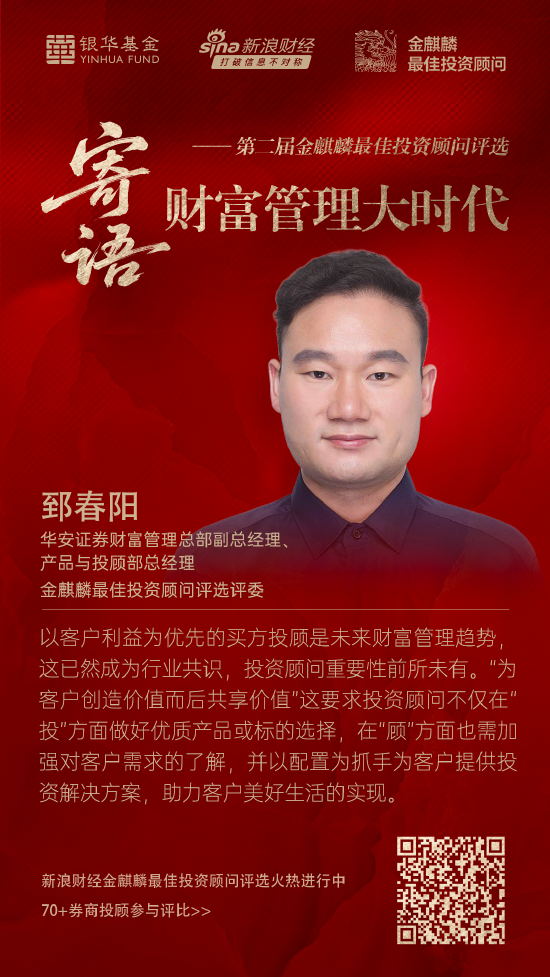
华安证券郅春阳:以客户利益为优先的买方投顾是未来财富管理趋势
Xin Lang Zheng Quan· 2025-07-29 08:36
专题:第二届新浪财经金麒麟最佳投资顾问评选 新浪财经主办、银华基金独家合作的"第二届金麒麟最佳投资顾问评选"活动火热进行中! 我国财富管理行业迈入超级大年,随着居民理财意识逐渐升华,中国财富管理行业已经迎来高增长周 期,投资顾问作为财富管理"最后一公里"的引路人,其触达客户、沟通客户、服务客户的属性直接影响 着全民资产配置的走向。在此背景下,投资顾问面临哪些机遇和挑战?他们该如何"修炼内功"? 基于此,新浪财经与银华基金共同打造"金麒麟最佳投资顾问评选"品牌活动,寻找优秀投资顾问,赋能 投顾IP建设,共建展业平台!金麒麟最佳投资顾问评选活动旨在为投资顾问提供一个展示形象、扩围服 务、提升能力的舞台,为优秀投资顾问与大众投资人搭建沟通对话的桥梁,助推中国财富管理行业健康 发展。 华安证券财富管理总部副总经理、产品与投顾部总经理郅春阳受邀成为本次大赛的评审委员会成员之 一。 郅春阳表示,以客户利益为优先的买方投顾是未来财富管理趋势,这已然成为行业共识,投资顾问重要 性前所未有。 "为客户创造价值而后共享价值"这要求投资顾问不仅在"投"方面做好优质产品或标的选择,在"顾"方面 也需加强对客户需求的了解,并以配置为抓 ...

泛理财管理行业的转型之路:黄燕铭、刘嵚、汪圣明、杨峻共话买方投顾新生态
Morningstar晨星· 2025-07-23 09:59
Core Viewpoint - The wealth management industry is facing challenges such as compressed returns, increased risk volatility, and diversified customer demands, necessitating a transformation towards a "buy-side advisory" model for high-quality development [4][6]. Group 1: Transformation Breakthrough - Asset management institutions are shifting from a product-driven model to a customer-centric value creation approach, emphasizing the importance of aligning asset and liability management in the insurance sector [6][7]. - The banking wealth management sector must transition from external expansion to internal development, moving towards a "fixed income plus" strategy that embraces multi-asset and multi-strategy approaches [7][8]. - Public fund companies need to enhance their research capabilities and innovate products, such as REITs and overseas allocations, to meet the growing wealth management demands of residents [8][9]. Group 2: Ecological Reconstruction - Building a "buy-side advisory" ecosystem requires both institutional transformation and collaboration among industry players, focusing on long-term value creation for clients rather than short-term profits [10][11]. - The core of investor education should be to help clients understand their investment cognitive limitations, thereby transferring trading authority to professional advisors [10][11]. - Key points for constructing a buy-side advisory model include strengthening the buy-side positioning, establishing a customer-centric advisory system, optimizing assessment models, enhancing channel collaboration, and leveraging financial technology [11][12].

首尾规模相差超百倍,券商如何破局养老金融?
Sou Hu Cai Jing· 2025-07-20 12:46
Core Insights - The personal pension fund distribution by securities firms is facing significant challenges, with sales figures remaining low compared to banks, which can offer a wider range of products [1][3][4] - There is a stark disparity in the sales scale among securities firms, with the top firms achieving sales in the millions while others struggle to reach even ten thousand [3][4] - Despite difficulties, some securities firms are leveraging buy-side advisory services to provide tailored pension planning solutions, aiming to overcome business development bottlenecks [5][7][9] Distribution Scale - The sales scale of personal pension products among 18 disclosed securities firms ranges from over 20,000 to more than 2 million, indicating a disparity exceeding 100 times [3] - Only 6 firms have surpassed 10 million in sales, with the highest being CICC at 2,482.76 million [3] - Securities firms' sales account for only 1.5% of the total issuance scale of public pension funds, which stands at 9.143 billion [3] Competitive Landscape - Banks hold a significant advantage over securities firms in terms of customer base, channel functionality, account attributes, and product offerings [3][4] - The complexity of the personal pension account setup, which requires bank cooperation for securities firms, adds to the operational challenges [4][12] - The market is shifting from a focus on account opening to a comprehensive competition in product strength and ecosystem services [14] Service Innovation - Some firms, like CICC and China Galaxy Securities, are enhancing their service offerings by integrating asset allocation concepts and personalized services to improve customer satisfaction [8][9] - CICC employs a dual approach of investment education and advisory services to help clients navigate the pension fund landscape [7] - The introduction of independent third-party evaluation services for pension products is suggested to aid consumers in making informed choices [12][13] Regulatory Environment - The China Securities Association has indicated plans to facilitate more securities firms in obtaining licenses for selling bank wealth management and insurance products, which could enhance their service capabilities [11][13] - New regulations on financial product sales will take effect in February 2026, aiming to standardize the appropriateness of financial product offerings [11]
首尾规模相差超百倍,券商如何破局养老金融?
中国基金报· 2025-07-20 12:32
Core Viewpoint - The personal pension fund distribution by securities firms is facing significant challenges, with sales figures remaining low compared to banks, which offer a wider range of products and services [1][3][4]. Group 1: Current Market Situation - In the first half of this year, personal pension fund sales through securities firms were less than 5000 yuan, a stark contrast to zero sales last year [1]. - The sales scale of personal pension products among 18 securities firms varies dramatically, with a difference of over 100 times between the largest and smallest firms [3]. - Only six securities firms have surpassed 10 million yuan in sales, with the largest being CICC at 24.83 million yuan [3]. Group 2: Challenges Faced - Securities firms are limited in their ability to sell a full range of personal pension products compared to banks, which can offer savings, insurance, and various investment products [1][4]. - The requirement for securities firms to rely on banks for personal pension trading accounts complicates the business process [4]. - The average return of FOF products over two years is only 2.92%, which, combined with declining interest rates on savings and insurance products, has dampened public interest in personal pension products [5]. Group 3: Strategies for Improvement - Some securities firms are adopting a buy-side advisory approach to provide tailored pension planning solutions to clients [6][8]. - CICC and China Galaxy Securities are leveraging their strengths in wealth management and insurance sales to enhance their personal pension services [9][12]. - The introduction of independent third-party evaluation services for personal pension products is suggested to help clients navigate the complex product landscape [11]. Group 4: Future Outlook - The industry is shifting from a focus on account opening to a comprehensive competition in product strength and ecosystem services [12]. - The recent regulatory changes may allow securities firms to sell bank wealth management and insurance products, potentially addressing the current challenges in the personal pension market [11][12]. - The emphasis on transforming complex professional capabilities into simple solutions for clients is seen as crucial for the future of personal pension services [13].


基金降费“接力赛”:超千只产品入“低价”行列
Huan Qiu Wang· 2025-07-10 02:46
Group 1 - The fund industry is experiencing a wave of fee reductions, with over 20 funds announcing lower management and/or custody fees, aimed at reducing investor holding costs [1][2] - The number of "low-fee" fund products with management fees at 0.15% or below has surpassed 1,050 [1] - Major fund companies such as E Fund, Guotai Junan, and others have implemented fee reductions, with some funds lowering management fees significantly, such as a drop from 0.90% to 0.55% [1] Group 2 - The current wave of fee reductions reflects the ongoing deepening of public fund fee reforms, with expectations for a third phase focusing on sales fees to accelerate [2] - The China Securities Regulatory Commission (CSRC) has indicated that further reductions in fund sales fees are expected to save investors approximately 45 billion yuan annually starting in 2025 [2] Group 3 - As the number of low-fee products increases, fund companies are exploring more refined charging models, such as tiered service fees based on holding periods to encourage long-term investment [4] - The continuous fee reductions are pushing the industry towards a more standardized and inclusive direction, while fund companies are encouraged to strengthen their research capabilities to attract and retain investors [4]
盈米基金肖雯: 与客户利益保持一致 帮助客户实现长期回报
Zhong Guo Zheng Quan Bao· 2025-07-06 20:35
Core Viewpoint - Yingmi Fund has won the "Fund Advisory Institution Golden Bull Award" and the "Fund Advisory Excellent Return Golden Bull Award" at the "Third Fund Advisory Golden Bull Award" selection, emphasizing the importance of aligning with client interests and providing long-term support to navigate market cycles [1] Group 1: Investment Advisory Evolution - The buy-side advisory is transitioning from a fund portfolio-following 1.0 model to a client account management 2.0 model, focusing on personalized solutions based on clients' investment goals and risk tolerance [4] - Yingmi Fund's digital service system has significantly improved client investment experiences, with advisory clients showing a much longer average holding period compared to self-directed clients [4] Group 2: Client Education and Behavior Change - The complexity of financial products and market volatility creates a gap in understanding for the general public, which buy-side advisory aims to bridge by providing tailored solutions and enhancing client investment knowledge [2][3] - The goal of client education is to foster healthier investment habits and reduce emotional trading behaviors, ultimately leading to better investment outcomes [2] Group 3: Industry Trends and Future Outlook - The public fund industry is shifting from a focus on scale to prioritizing investor returns, aligning with the core philosophy of fund advisory services [4] - Yingmi Fund reports that over 89% of advisory clients on its platform were profitable as of June 30, 2025, with an average holding period of 690 days, indicating a successful adaptation to long-term investment strategies [4] - The future of fund advisory is expected to see more diverse institutions emerging, exploring various business models and enhancing the advisory ecosystem [5]
盈米基金肖雯:账户管理模式下的投顾服务体系升级
Morningstar晨星· 2025-07-02 09:40
Core Viewpoint - The article emphasizes the importance of goal-based financial planning and asset allocation as a mainstream model in wealth management, highlighting the role of investment advisors in helping clients achieve their financial objectives through structured strategies and dynamic monitoring [1][4][5]. Group 1: Evolution of Investment Advisory - The investment advisory business has evolved over five years from pilot exploration to model upgrading, with significant changes in how financial products are strategized and utilized by various financial institutions [2][3]. - The introduction of regulatory frameworks, such as the draft management regulations for investment advisory services, marks a transition from exploratory practices to standardized operations, defining key characteristics of investment advisory services [3]. Group 2: Goal-Based Financial Planning - The goal-based financial planning model has gained traction in the past two decades, allowing for the breakdown of vague financial aspirations into actionable life goals, which are then matched with appropriate asset allocation strategies [4][5]. - This model has a profound impact on the wealth management industry by shifting the focus from seeking excess returns to helping clients achieve their financial life goals, thus enhancing the value proposition of investment advisory services [5]. Group 3: Local Practices in Financial Planning - Investment advisors are encouraged to help clients prioritize their life goals and create personalized asset allocation plans based on risk tolerance, expected returns, and investment timelines [8]. - A multi-tiered account management system supports the investment advisory service model, allowing for the isolation and dynamic adjustment of funds to meet various client goals [8]. Group 4: Key Insights for Investment Advisory - Four key insights have emerged from the past five years of investment advisory practice: 1. Establishing a systematic understanding of clients and their goals through robust data platforms [9]. 2. Reconstructing business processes and service systems from a buyer's perspective to enhance client service [9]. 3. Promoting agile collaboration among organizational structures, talent, values, and assessment systems to center around client returns [9]. 4. Focusing on the development and upgrade of technological systems to enhance service capabilities through data and AI [9].