基金投顾业务

Search documents
财富管理系列报告(一):证券公司为什么现在要重视基金投顾
CMS· 2026-03-17 03:33
Investment Rating - The report maintains a recommendation for the industry, focusing on the importance of wealth management and fund advisory services [4]. Core Insights - The report emphasizes the need for securities companies to prioritize fund advisory services due to supportive policies, channel transformations, and recovering demand [2]. - It highlights the advantages of securities companies in developing fund advisory services, including customer base, asset allocation capabilities, and adaptable service models [3]. - The investment experience and returns from fund advisory services are expected to improve significantly as the capital market evolves [4]. Summary by Sections 1. Importance of Fund Advisory Services - The regulatory environment is shifting towards regularizing fund advisory services, with pilot programs expected to transition to standard practices [21]. - The potential for expanding the range of investable products, including index funds and ETFs, is anticipated to enhance the business landscape for fund advisory services [22]. 2. Advantages of Securities Companies - Securities companies can leverage their comprehensive financial licenses to acquire customers through multiple low-cost channels [3]. - Their expertise in various asset classes and risk management tools positions them well for customized fund advisory services [3]. - The balanced development of online and offline channels, along with ongoing financial technology advancements, allows for flexible adaptation of different fund advisory models [3]. 3. Investment Recommendations - The report suggests focusing on companies like CICC, CITIC Securities, and Huatai Securities, considering their business synergy, brand influence, and financial technology capabilities [4].
两会|东方财富董事长其实:建议加快推动基金投顾业务试点转常规,提升券业数字化水平
证券时报· 2026-03-11 08:49
Core Viewpoint - The article emphasizes the importance of high-quality development, employment, and agriculture, highlighting the focus on topics related to people's livelihoods during the national congress [1]. Group 1: Fund Advisory Business - The fund advisory business has been included in 60 pilot institutions since its launch in 2019, with overall stable operation, but there is room for optimization in service supply, investment range, and fee models [5][6]. - Recommendations include accelerating the transition of the fund advisory business from pilot to regular status, expanding the investment range to include public REITs and private securities investment funds, and developing a multi-tiered fee structure [6][8]. Group 2: Digitalization in Securities Industry - The securities industry has further optimization opportunities in digitalization, with suggestions to promote online processing of securities business and encourage exploration of intelligent upgrades [7][8]. - It is recommended to improve the application norms for artificial intelligence in the securities field, ensuring compliance and risk management [9]. Group 3: AI in Financial Services - AI is seen as a key driver for high-quality financial development, enhancing service accessibility and risk management capabilities [10][11]. - The application of AI in the financial sector is evolving from basic information processing to autonomous decision-making, which could significantly improve service efficiency [12][13]. Group 4: Future Outlook for Securities Industry - The "14th Five-Year Plan" period is crucial for China's economic transformation and high-quality development, with significant growth in the number of listed companies and total market value [14]. - The securities industry is encouraged to enhance its service capabilities for the real economy, improve wealth management services, and strengthen technological empowerment for high-quality development [15][16].



两会|东方财富董事长其实:建议加快推动基金投顾业务试点转常规,提升券业数字化水平
券商中国· 2026-03-11 03:05
Core Viewpoint - The article emphasizes the need for the enhancement of fund advisory services and the digitalization of the securities industry, highlighting the importance of adapting to the evolving financial landscape and meeting the growing wealth management demands of the public [4][6][12]. Group 1: Fund Advisory Services - The fund advisory business has been piloted since 2019, involving 60 institutions, but there are still areas for optimization in service supply, investment scope, and fee models [4]. - Recommendations include accelerating the transition of fund advisory from pilot to regular status, expanding the range of investable assets, and creating a multi-tiered fee structure to align incentives between advisory firms and investors [5]. - Initial steps could involve including public REITs and private securities investment funds in the advisory scope, with a long-term goal of incorporating bank wealth management products and insurance asset management products [5]. Group 2: Digitalization of the Securities Industry - The article suggests further enhancing the digitalization of the securities industry to align with the goals of building a financial powerhouse [6]. - Recommendations include promoting online processing of securities business, such as margin trading and stock options, to improve service efficiency and investor experience [6]. - Encouragement for the exploration of intelligent upgrades in the securities sector through collaborative efforts and regulatory sandboxes is also highlighted [7]. Group 3: AI in Financial Services - AI is seen as a key driver for enhancing the inclusivity of financial services and improving risk management capabilities within the financial industry [8]. - The application of AI in finance is evolving from cost reduction to becoming a critical engine for high-quality financial development, with potential to transform service delivery from a reactive to a proactive model [9]. - The integration of multi-modal deep reasoning and collective intelligence is expected to create new opportunities in the securities research and investment system [9]. Group 4: Future Outlook - The "14th Five-Year Plan" period is recognized as a pivotal time for China's economic transformation and capital market development, with significant growth in the number of listed companies and total market value [11]. - Looking ahead to the "15th Five-Year Plan," the securities industry is encouraged to focus on enhancing its role in supporting the real economy, improving wealth management services, and embracing technological advancements [12].

2025年基金市场回顾及2026年展望:革故鼎新,质启未来
CMS· 2026-02-25 15:38
Report Summary 1. Investment Rating The document does not mention the investment rating of the industry. 2. Core Views The report reviews the fund market in 2025, including the overall situation of the public - offering fund industry, the development of various sub - categories of public - offering funds, and the situation of private - offering securities investment funds. It also provides a market outlook for 2026 and selects several types of funds for attention. In 2025, the public - offering fund market achieved significant positive returns, and the private - offering securities investment fund market expanded in scale. In 2026, with the resonance of China's and the US policies, the A - share market is expected to shift from liquidity - driven to profit - driven, and attention should be paid to specific investment directions and the rhythm of the fixed - income market [2][9]. 3. Summary by Directory 3.1 Public Fund Overall Overview - **Asset Management Market Overview**: By the end of Q3 2025, the total scale of China's asset management business reached 80.03 trillion yuan. Public - offering funds and private - offering funds drove the growth of the asset management scale, with public - offering funds contributing 3.92 trillion yuan to the scale growth. The public - offering fund market maintained strong vitality, with a total scale of 36.67 trillion yuan and a total share of 31.30 trillion shares by the end of 2025, showing year - on - year growth [16][20]. - **Public Fund New - issuance Market**: In 2025, stock - type and bond - type funds were the main new - issuance products. The new - issuance volume of stock - type funds was large, and the new - issuance scale was comparable to that of bond - type funds, mainly relying on passive products [40]. - **Non - monetary Head Managers of Public Funds**: Since 2021, the top - three managers in terms of non - monetary fund scale have been relatively stable. In 2025, E Fund, China Asset Management, and GF Fund had different product line focuses in terms of stock and incremental scale. Huatai - Peregrine Fund and Invesco Great Wall Fund showed good performance [47][48]. - **Performance of Public Fund Products**: In 2025, the public - offering fund market achieved significant positive returns. Commodity - type funds represented by gold performed excellently, and stock - type funds also received good returns with reduced volatility and drawdown [3][56]. 3.2 Hot Topics in the Fund Industry - **Reform of Public - offering Fund Policies**: In 2025, a series of reform measures were introduced to promote the transformation of the public - offering fund industry from "scale - oriented" to "return - oriented" [59]. - **New - style Floating - rate Funds**: In 2025, new - style floating - rate funds were successively launched, which had important impacts on the public - offering fund market, such as guiding long - term holding and strengthening the binding mechanism between fund companies and investors [67][69]. - **Commercial Real Estate REITs**: In 2025, the pilot of commercial real estate REITs was officially launched, and 12 products had been officially declared by February 13, 2026 [73][75]. - **Development of the Fund Investment Advisory Industry**: Policy support, product expansion, and institutional empowerment promoted the development of the fund investment advisory industry. The investment scope of fund investment advisors was gradually broadened, and leading public - offering funds entered the market [77][79]. 3.3 Overview of Sub - categories of Public Funds - **Active Equity Funds**: In 2025, the scale of active equity funds rebounded, with an average return of 33.29%. Funds focusing on the AI industry chain led the gains [101]. - **Industry Theme Funds**: By the end of 2025, there were 2,009 industry theme funds, with a significant increase in scale. Funds in technology communication, large - scale technology, and large - scale manufacturing sectors led the gains [4][150]. - **Active Fixed - income Funds**: In the low - interest - rate environment and the rising equity market in 2025, the management pressure of pure - bond portfolios increased, while the scale of bond - containing funds increased significantly [170][174]. - **Passive Funds**: By the end of 2025, the total scale of passive funds exceeded 7.5 trillion yuan. ETFs continued to expand, and industry themes and bonds frequently created hot topics [205]. - **FOF Funds**: By the end of 2025, the total scale of FOF funds increased significantly, with performance showing significant differentiation. The new - issuance market recovered [296][309]. - **Quantitative Funds**: The scale of quantitative funds expanded rapidly, with index - enhanced funds dominating the scale. The new - issuance market of A500 and ChiNext/Science and Technology Innovation Board index - enhanced funds was hot, and small - cap products had outstanding returns [334][346]. 3.4 Overall Situation of Private - offering Securities Investment Funds - **Existing Situation**: By the end of December 2025, the existing scale of private - offering securities investment funds reached a record high of 7.08 trillion yuan, a year - on - year increase of 35.82%. The number of funds decreased, and fund managers continued to be cleared out [377]. - **New - issuance Market**: In 2025, the number and scale of newly - registered private - offering securities investment funds both increased. The access for new fund managers remained strict [382]. - **Industry Pattern**: The number of private - offering funds with a scale of over 10 billion yuan increased, while the number of those with a scale of less than 500 million yuan decreased significantly [391]. - **Market Trends**: In 2025, the scale of quantitative private - offering funds expanded again, and 14 new quantitative private - offering funds exceeded 10 billion yuan in scale. The regulatory rules for program trading were implemented [394][399]. - **Market Trends**: The number of insurance - funded private - offering securities investment funds increased to 7, and insurance funds increased their layout in the equity market through private - offering funds [400]. 3.5 Market Outlook in 2026 - **Macroeconomic Outlook**: In 2026, China's fiscal policy aims to balance "stable growth" and "structural transformation." If the fiscal space is fully released, a series of positive macroeconomic changes are expected. The total demand growth rate is expected to return to expansion [402][404]. - **Investment Direction**: In the equity market, attention should be paid to computing power, AI applications, AI power, cutting - edge technologies proposed in the 14th Five - Year Plan, pro - cyclical sectors, and domestic demand expansion and consumption recovery. In the fixed - income market, the interest rate center may rise, and the trading rhythm should be grasped [9]. - **Fund Selection**: The report selects several types of funds, including all - market investment equity funds, equity funds under different investment themes, fixed - income funds, and index - enhanced funds [10][11][12].
《中国基金投顾业务洞察报告(2025)》发布:试点六周年成效显著,超七成客户实现稳健盈利
Morningstar晨星· 2025-12-18 01:05
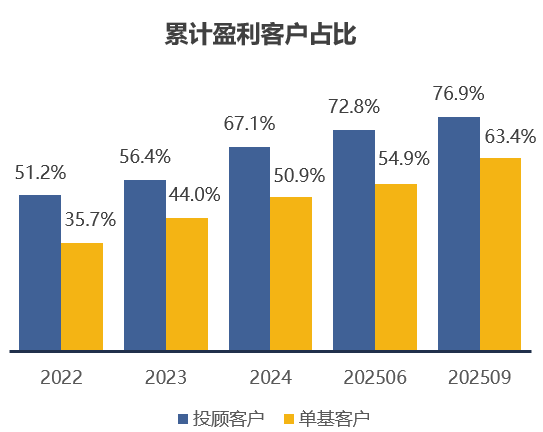
Core Findings - The report highlights eight key findings that demonstrate the critical role of the buy-side advisory model in enhancing investor experience [3] - The advisory service has achieved dual optimization in both experience and behavior for clients [2] Investment Experience - Advisory clients have a significantly better investment experience, with a cumulative profit ratio of 76.9%, compared to 63.4% for self-directed fund investors, representing a 13.5 percentage point increase [4] - In terms of risk management, only 1% of advisory clients experienced losses exceeding 20%, and only 0.2% faced losses over 30%, which is 1/10 and 1/15 of the same metrics for self-directed clients, respectively [4] Asset Allocation - Advisory clients exhibit a scientifically balanced asset allocation, with the proportions of money market, bond, stock, and mixed funds stable between 16% and 26%, avoiding excessive concentration in any single asset [7] - Over 90% of advisory clients have holdings of less than 100,000 yuan, breaking down barriers to professional wealth management services [7] Investment Behavior - Advisory clients are increasingly adopting a rational investment approach, with a reinvestment rate rising to 38.2% by September 2025, up from 12.1% in 2022, indicating a growing trend towards additional investments [10] - The average holding period for clients has extended to nearly two years, effectively mitigating irrational actions triggered by short-term market fluctuations [10] Client Recognition - The recognition of advisory services among clients has significantly improved, with only 8% expressing dissatisfaction [13] - Trust levels are high, with 77.7% of advisory clients willing to continue using the service, and 56.2% willing to recommend it to others, indicating a positive word-of-mouth effect [13][20] Client Demographics - The report reveals a clear profile of advisory clients, showing a dual trend of youth and maturity: 40% of clients are under 35 years old, up from 32.3% in 2022, and 8.3% are aged 18-25, significantly higher than the 4.4% among self-directed clients [24] - The gender ratio is becoming more balanced, with female clients increasing from 44.5% in 2022 to 48% by September 2025 [24] - The proportion of clients with over five years of investment experience has surged from 6.6% in 2022 to 32% in 2025, attracting both new investors and long-term investors [24] Client Needs and Industry Challenges - Clients have clear demands, focusing on three main areas: a pressing need for professional services, with 73.7% seeking one-on-one advisory communication; retirement planning as a primary goal for over 40% of clients; and a strong concern for strategy stability, with 72.8% worried about the risk-return performance of advisory strategies [27][31] - The industry faces two core challenges: nearly 80% of clients prioritize historical performance and investment capability over the completeness of advisory services when selecting firms, and there is a notable gap in the experience of clients who have paused services, with a dissatisfaction rate of 14.2% and a return intention of 44.3% [31] Recommendations for Industry Development - The report proposes six recommendations for high-quality industry development, including enhancing advisory team expertise, focusing on retirement financial scenarios, improving strategy stability and transparency, deepening investor education, optimizing service experience, and strengthening core client retention [34] Industry Progress - The report emphasizes that six years of pilot practice have proven that the fund advisory business effectively improves investor profit experiences and guides rational investment behavior, transitioning the industry from "product sales" to "asset allocation services" [36]

《中国基金投顾业务洞察报告(2025)》发布 试点六周年成效显著 超七成客户实现稳健盈利
Xin Hua Cai Jing· 2025-12-16 06:53
Core Insights - The report highlights the significant transformation of the fund advisory business from "0 to 1" since the pilot program began in 2019, driven by regulatory changes and the growing demand for wealth management among residents [1][37] Group 1: Key Findings - The report identifies eight core findings that demonstrate the critical role of the buy-side advisory model in enhancing investor experience [2] - Advisory clients have a significantly better investment experience, with a cumulative profit ratio of 76.9%, compared to 63.4% for self-directed fund investors, indicating a 13.5 percentage point advantage [3] - In terms of risk management, advisory clients show a much lower percentage of significant losses, with less than 1% experiencing losses over 20% and only 0.2% over 30%, compared to 10% and 15% for self-directed clients, respectively [3] Group 2: Client Behavior and Recognition - Advisory clients exhibit more rational investment behavior, with a reinvestment rate of 38.2% as of September 2025, a significant increase of over 26 percentage points from 12.1% in 2022 [11] - Client satisfaction with advisory services is high, with only 8% expressing dissatisfaction; 77.7% are willing to continue using the service, and 56.2% would recommend it to others [16][22] Group 3: Client Demographics and Needs - The report reveals a dual trend of younger and more experienced clients in the advisory space, with clients under 35 increasing from 32.3% in 2022 to 40% in September 2025, and those with over five years of investment experience rising from 6.6% to 32% [26] - Clients express clear needs, with 73.7% seeking one-on-one professional communication, and over 40% prioritizing retirement planning as their main investment goal [27] Group 4: Industry Challenges and Recommendations - The industry faces challenges, including a lack of comprehensive investment philosophy among clients, with nearly 80% focusing on historical performance rather than service quality [29] - The report provides six recommendations for industry improvement, including enhancing professional capabilities, focusing on retirement financial planning, and improving strategy stability and transparency [36]
国泰海通:基金销售新规引导行业回归本源 继续看好低估的非银板块
Zhi Tong Cai Jing· 2025-12-15 01:28
Core Viewpoint - The report from Guotai Junan indicates a significant increase in market attention towards sectors with stable interest rates, low valuations, and improving fundamentals as the outlook for 2026 approaches, particularly favoring the brokerage and insurance sectors [1] Group 1: Brokerage Sector - The brokerage sector is expected to benefit from valuation and performance improvements driven by investment-side reforms in 2026 [1] - The focus on risk pricing and management is anticipated to favor leading public funds and specialized wealth management institutions [1] Group 2: Insurance Sector - The insurance sector is seen as having investment opportunities due to expected valuation increases stemming from stable interest rate forecasts [1] Group 3: Fund Sales Regulations - Recent regulations on public fund sales aim to standardize various aspects such as promotion, live sales, performance assessment, and ethical conduct, steering fund sales back to a focus on "real long-term investor returns" [1] - The new regulations are expected to help the asset management industry return to the essence of risk pricing and management [1] - The long-term prospects for fund advisory services are viewed as more promising [1]

券商实践“双投顾”模式,是推动赚钱的新题解吗?
Xin Lang Cai Jing· 2025-11-13 15:24
Core Viewpoint - The "dual investment advisory" model is transitioning from an innovative attempt in the industry to a mainstream practice, allowing securities firms and fund companies to collaborate within a compliant framework to enhance investment strategies and services [1][2] Group 1: Dual Investment Advisory Model - The dual investment advisory model involves collaboration between licensed securities firms and fund companies to optimize advisory strategies and improve service processes [1] - This model allows licensed institutions to break through their capability boundaries, achieving resource integration and complementing each other's strengths to expand the market for investment advisory services [2][6] - The model is seen as a shift from "individual institutional efforts" to "ecological collaboration," promoting a more efficient division of labor in the industry [6] Group 2: Product Innovation and Market Response - The "Happiness Small Goal" product exemplifies effective practice of the dual investment advisory model, showing significant growth in scale and efficiency since its launch, with a high proportion of retail clients [3][4] - The product features a diversified investment strategy that includes various asset classes, aiming to disperse risk globally and meet the strong demand for stable returns from clients [4] - In a low-interest-rate environment, traditional "fixed income+" products face challenges, making innovative products like "Happiness Small Goal" more appealing to investors [3] Group 3: Challenges and Considerations - The industry faces three main challenges in deepening collaboration: compliance constraints, power dynamics, and risk-sharing concerns [7] - Compliance pressures are significant, especially for institutions under the same parent company, which complicates cross-institutional cooperation due to strict regulatory requirements [7] - The need for clear delineation of responsibilities and risk-sharing mechanisms is crucial for sustainable collaboration in the dual investment advisory model [9] Group 4: Future Outlook - As the dual investment advisory model matures and industry consensus builds, it is expected to resolve challenges in wealth management, leading to a win-win situation for institutions, investors, and the industry [10]
试点六年 基金投顾供需错配仍存
Bei Jing Shang Bao· 2025-10-29 16:40
Core Insights - The article highlights the significant progress and challenges in the development of the public fund investment advisory business in China over the past six years since its pilot launch [1][2][3] Group 1: Business Development - The pilot program for public fund investment advisory services was officially launched by the China Securities Regulatory Commission (CSRC) on October 25, 2019, with 60 institutions obtaining pilot qualifications [2] - As of October 2025, the asset scale of buyer advisory services has exceeded 120 billion yuan, with some institutions reporting a high profitability ratio among their advisory accounts [2][3] - The overall profitability of advisory accounts has been significantly higher than non-advisory accounts, with reported excess returns of 7.01%, 4.23%, and 1.33% over one, two, and three years respectively [2] Group 2: User Experience and Strategy - Institutions have developed diverse strategies to cater to different investor needs, including liquidity management, conservative investments, and aggressive investments [3] - Feedback from clients indicates a generally positive experience with advisory services, although challenges remain in user awareness and service content alignment with client needs [3][4] Group 3: Fee Structure and Optimization - Suggestions for optimizing the fee structure include diversifying the charging model and linking advisory fees to product performance to align the interests of advisors and investors [4] Group 4: Investment Variety and Regulatory Support - There is a call for a broader range of investment products, including overseas markets and various asset classes, to meet diverse investor demands [5][6] - The CSRC is actively working to transition the advisory business from pilot to regular status, with plans to include more investment options such as Sci-Tech Innovation Board ETFs [6][7]
益民基金《推动公募基金高质量发展行动方案》解读:政策东风至,投顾启新程
Xin Lang Ji Jin· 2025-10-09 02:19
Core Viewpoint - The China Securities Regulatory Commission (CSRC) has officially released the "Action Plan for Promoting the High-Quality Development of Public Funds," which sets a new direction for the public fund industry in China, emphasizing "quality improvement and efficiency enhancement" [2] Group 1: Policy Framework - The Action Plan establishes a clear regulatory framework for fund advisory services, indicating that service standards, entry thresholds, and regulatory requirements will be detailed, leading to standardized management of advisory services [3] - This standardization aims to enhance service professionalism and ensure that investors understand the service content, return logic, and risk boundaries [3] Group 2: Investor-Centric Approach - The Action Plan emphasizes that investor returns should be the primary focus, requiring fund companies to create a performance evaluation system centered on fund investment returns [4] - This shift from a scale-focused approach to one that prioritizes long-term returns will align the compensation of fund managers and advisors with actual fund performance [4] Group 3: Long-Term Investment Focus - The Action Plan mandates that fund companies adopt a long-term investment philosophy, with at least 80% of the evaluation weight on medium to long-term returns over three years [5][6] - This requirement is expected to shift advisory services away from short-term speculation towards long-term asset allocation [5] Group 4: Tailored Wealth Management - The Action Plan encourages fund companies to develop products and services that cater to diverse resident wealth management needs, particularly supporting the creation of index funds and low-volatility products [7] - Advisory services will be able to offer personalized investment plans based on precise demand profiles, ensuring that every investment aligns with individual needs [7] Group 5: Technological Empowerment - The Action Plan signals a push for digital transformation in the industry, including the launch of a direct sales platform for institutional investors, which will enhance service accessibility and reduce costs [8] - The policy also aims to lower fund sales fees, making financial services more affordable for investors [8] Group 6: Risk Management - The Action Plan emphasizes the importance of risk control, requiring that risk management be integrated throughout the advisory service process [9] - This includes preemptive risk diversification, real-time monitoring, and dynamic adjustments based on market changes [9] Group 7: Collaboration with Long-Term Funds - The Action Plan supports the entry of long-term funds into the market, enhancing the service capabilities of fund companies towards various long-term capital sources [10] - The expertise gained in managing long-term funds will benefit personal investors, optimizing retirement planning and improving portfolio resilience [10]