硅光技术

Search documents
要有光!高盛上调“光模块双巨头”中际旭创和新易盛目标价,“暴涨后估值依然合理”
硬AI· 2025-08-27 15:37
Core Viewpoint - Goldman Sachs expresses unprecedented optimism for the leading optical module companies, Zhongji Xuchuang and Xinyi Sheng, despite their recent significant stock price increases [3][4]. Group 1: Valuation and Price Targets - Goldman Sachs has raised the 12-month target prices for Zhongji Xuchuang to RMB 392 and Xinyi Sheng to RMB 398, based on their reasonable valuations despite recent stock price surges [9][24]. - The expected price-to-earnings (P/E) ratios for 2026 are 19x for Xinyi Sheng and 23x for Zhongji Xuchuang, which align closely with their historical averages since 2021 [4][24]. Group 2: Market Drivers - Three main drivers are identified for the upward revision of target prices: ongoing supply tightness, elimination of tariff risks, and a slowdown in the rate of price declines [5][9]. - The industry is facing a tight supply of upstream components, such as 200G EML lasers, which benefits leading companies like Zhongji Xuchuang due to their scale and silicon photonics technology advantages [11]. - The recent U.S. tariff policy has exempted optical modules shipped from Thailand and Malaysia, alleviating concerns about market share loss due to trade tensions [7][14]. Group 3: Price Trends and Earnings Projections - The average selling price (ASP) decline is expected to slow from a previous forecast of 20% to 15% annually from 2025 to 2027, driven by supply constraints and increased demand for higher-end products [8][14]. - Goldman Sachs has raised its earnings per share (EPS) forecasts for Zhongji Xuchuang and Xinyi Sheng by 3% to 38% for the years 2025-2027 [9][16]. Group 4: Long-term Growth Potential - The value of optical modules in AI infrastructure is continuously increasing, with a rising "binding rate" between optical modules and GPUs [17]. - The expected spending on optical modules per dollar of GPU expenditure is projected to increase from $0.07 in the H100 GPU era to $0.12 in the next-generation Rubin Ultra GPU era [18][20]. - This trend, along with product upgrades from 800G to 1.6T and eventually to 3.2T, is expected to provide strong and sustainable revenue growth for Zhongji Xuchuang and Xinyi Sheng, mitigating concerns about cyclical risks in the industry [21]. Group 5: Reasonable Valuation Post-Price Surge - Despite significant stock price increases, Goldman Sachs believes the valuations of both companies still do not fully reflect their growth potential [23][24]. - Long-term profit forecasts suggest that peak net profits for Zhongji Xuchuang and Xinyi Sheng could reach approximately RMB 400 billion and RMB 360 billion, respectively, by 2029 [25].



中际旭创20250827
2025-08-27 15:19
Summary of Conference Call for Zhongji Xuchuang Company Overview - **Company**: Zhongji Xuchuang - **Industry**: Optical Communication and Data Center Infrastructure Key Financial Performance - **Q2 2025 Revenue**: Exceeded 8 billion RMB, a 22% increase from Q1 2025 [2][5] - **Gross Margin**: Reached 41.5%, up nearly 5 percentage points from Q1 2025 [2][5] - **Net Profit**: Approximately 2.6 billion RMB, a 50% increase from Q1 2025 [2][5] - **Net Profit Margin**: Surpassed 30%, reaching 31% for the first time [2][5] - **H1 2025 Revenue**: Totaled 14.8 billion RMB, a year-on-year growth of about 40% [3] - **Operating Cash Flow**: Approximately 3.2 billion RMB for H1 2025 [3] Business Segments and Growth Drivers - **Optical Module Business**: Major contributor to revenue, with a gross margin of about 40% [3][5] - **800G Product Demand**: Rapid growth observed, with a significant increase in silicon photonics technology contributing to margin improvements [2][6] - **1.6T Product Launch**: Expected to scale in Q3 and Q4 2025, further enhancing profitability [2][6] Capacity Expansion and Supply Chain Management - **Production Capacity**: Actively expanding both domestically and internationally, focusing on high-end products like ADOT and 800G [2][7][8] - **Raw Material Supply**: Facing tight supply conditions, particularly for key components; the company is securing inventory and locking in supplier capacity [9][13] - **Dividend Policy**: Plans to gradually increase dividend payouts to return value to shareholders, supported by strong cash flow [10] Research and Development - **R&D Investment**: Higher than industry average to ensure technological leadership and product innovation [4][19] - **New Technologies**: Focus on silicon photonics, optical switching (OCS), and CPU developments, with commercial applications expected to grow [4][19] Market Trends and Future Outlook - **Data Center Interconnect Demand**: Significant growth anticipated in optical and copper interconnects, driven by AI infrastructure needs [20][21] - **ZR Coherent Optical Modules**: Increasing importance in AI data centers, with ongoing development of 400G and 800G ZR modules [23] - **Future Product Development**: Active research on 3.2T pluggable modules, although current demand is primarily for 1.6T and 800G [15][14] Strategic Initiatives - **Focus on Scale-Up Solutions**: R&D efforts aimed at addressing light connection needs in scale-up scenarios, presenting new market opportunities [11][12] - **Market Positioning**: The company is positioning itself to meet the growing demand for high-speed optical modules, particularly in AI and data center applications [21][22] This summary encapsulates the key points from the conference call, highlighting the company's financial performance, growth strategies, market trends, and future outlook in the optical communication industry.
华工科技(000988):光模块增速靓丽,盈利能力或进一步改善
Shanxi Securities· 2025-08-27 06:01
Investment Rating - The report maintains a "Buy-A" rating for the company [1] Core Views - The company has shown impressive growth in its optical module segment, which is expected to further improve profitability [1] - The company achieved a revenue of 76.29 billion yuan in H1 2025, representing a year-on-year increase of 44.66%, with a net profit of 9.11 billion yuan, also up 44.87% year-on-year [4][5] - The company is a leading supplier of optical modules for data center construction in China and a leader in PTC and sensor markets for electric vehicles [8] Financial Performance - In Q2 2025, the company reported a revenue of 42.74 billion yuan, a year-on-year increase of 39.19% and a quarter-on-quarter increase of 27.36% [4] - The company's gross margin and net margin for H1 2025 were 20.24% and 11.88%, respectively, showing a decrease compared to the same period last year [7][8] - The company’s operating expenses have been effectively controlled, with the overall expense ratio decreasing to 9.94% from 13.16% year-on-year [8] Business Segments - The company’s smart manufacturing, connectivity, and sensing businesses achieved revenues of 16.76 billion, 37.44 billion, and 21.54 billion yuan in H1 2025, with year-on-year growth rates of -2.95%, +124%, and +17%, respectively [5] - The connectivity segment has seen significant growth, with the launch of a 3.2T CPO solution and mass production of 800G ZR/ZR+ Pro coherent optical modules [6] - The sensing business has made breakthroughs in pressure sensors, with sales exceeding the total for the previous year, and is focusing on domestic substitution [6] Profit Forecast and Valuation - The company is expected to achieve net profits of 18.7 billion, 24.1 billion, and 29.6 billion yuan for the years 2025 to 2027, with year-on-year growth rates of 52.8%, 29.2%, and 22.8%, respectively [8] - The estimated earnings per share (EPS) for 2025, 2026, and 2027 are projected to be 1.86 yuan, 2.40 yuan, and 2.94 yuan [8]

中际旭创上半年营收同比增长36.9%,净利增长69.4%,拟每10股派发4.0元 | 财报见闻
Hua Er Jie Jian Wen· 2025-08-26 13:53
Core Viewpoint - The demand for high-end optical modules, particularly 800G, has significantly increased due to the AI infrastructure construction boom, benefiting Zhongji Xuchuang, which reported substantial revenue and profit growth in the first half of 2025 [1][2]. Financial Performance - The company achieved an operating revenue of 14.789 billion yuan, a year-on-year increase of 36.95% [1][2]. - The net profit attributable to shareholders reached 3.995 billion yuan, reflecting a year-on-year growth of 69.40% [1][2]. - The net profit after deducting non-recurring gains and losses was 3.975 billion yuan, up 70.40% year-on-year [1][2]. - Operating profit was 4.877 billion yuan, a year-on-year increase of 78.77% [2]. - The gross profit margin improved to 39.96%, up 6.13 percentage points from 33.83% in the same period last year [2][3]. - The net cash flow from operating activities was 3.218 billion yuan, a significant increase of 232.45% year-on-year, indicating improved cash return capabilities [2][6]. Market Dynamics - The investment surge in AI infrastructure has led to an explosive growth in demand for high-end optical modules [3]. - Major cloud service providers, including Microsoft, Amazon, Meta, and Google, increased their capital expenditures by 69% to 87.4 billion USD in Q2 2025 [2]. - Chinese internet giants, including Alibaba, Tencent, and Baidu, saw a 99.38% year-on-year increase in capital expenditures, totaling 55.012 billion yuan in Q1 2025 [2]. Production and Capacity - The optical communication transceiver business generated revenue of 14.432 billion yuan, with a gross profit margin of 39.96% [3]. - The company's production capacity for optical communication transceivers reached 11.61 million units, with a production volume of 9.4 million units and sales of 9.05 million units [5]. Technological Advancements - The optical module industry is undergoing significant technological changes, with rapid developments in silicon photonics, coherent technology, and linear pluggable optical modules [5]. - The market share of silicon photonics technology is expected to rise from 27% in 2023 to 59% by 2030 [5]. - The company holds 385 patents, including 201 invention patents, showcasing its commitment to technological innovation [5]. Competitive Position - Zhongji Xuchuang ranks first among global optical module manufacturers in 2024, with a continuously increasing market share [5]. - The company has established long-term stable partnerships with leading global cloud data center clients and mainstream communication equipment manufacturers, providing a competitive edge in high-end optical modules [5][6]. - The top five customers accounted for 60.14% of the company's revenue, indicating a high but manageable customer concentration risk [6]. Shareholder Returns - The company plans to distribute a cash dividend of 4.00 yuan per 10 shares, totaling 444 million yuan, reflecting a commitment to shareholder returns [6].
新易盛上半年业绩暴增约355% 出口占比超九成
Zheng Quan Shi Bao Wang· 2025-08-25 15:00
Core Insights - The company reported significant growth in its 2025 semi-annual results, driven by the surge in global AI computing demand and accelerated cloud data center construction, with revenue exceeding 10 billion yuan and net profit increasing over 350% [1] Financial Performance - For the first half of 2025, the company achieved operating revenue of 10.437 billion yuan, a year-on-year increase of 282.64% - Net profit attributable to shareholders reached 3.942 billion yuan, a staggering increase of 355.68% - Net profit after deducting non-recurring gains and losses was 3.934 billion yuan, up 354.93%, with core profitability metrics significantly outpacing industry averages [1] Product Performance - The company's core business, optical module products, benefited from the explosion in AI computing demand, with point-to-point optical modules generating revenue of 10.409 billion yuan, a year-on-year growth of 287.44% - Gross margin improved by 4.12 percentage points to 47.48% - The company launched OSFP1.6T and OSFP-XD1.6T optical modules, achieving the highest global energy density of over 500 kWh/㎡, supporting CMIS5.0 protocol, and has been applied in AI cluster projects by leading global internet companies [2] Global Expansion - The company's global layout has shown significant results, with overseas revenue accounting for 94.4%, totaling 9.86 billion yuan, primarily from large cloud service providers and telecom equipment manufacturers in North America, Europe, and Southeast Asia - The overseas production base in Thailand continues to release capacity, while subsidiaries in Singapore and the United States focus on regional market expansion and technical services, forming a "R&D in China, global production, local service" operational system [2] R&D and Innovation - R&D investment reached 3.337 billion yuan, a year-on-year increase of 157.56%, with the number of R&D personnel rising to 7,120, accounting for 40% of total employees - The company applied for 1,211 new patents during the reporting period, with a total of 144 authorized patents, including 59 invention patents in key technology areas such as silicon photonic chip packaging and low-power design [3] Future Strategy - The company will focus on the "AI + Optical Communication" strategy, further expanding 1.6T optical module capacity and accelerating the commercialization of silicon photonic technology - It aims to enhance the global market share of high-speed optical modules to 30% by the end of 2025, supporting the global digital economy and "dual carbon" goals [4]
中际旭创20250824
2025-08-25 09:13
Summary of Zhongji Xuchuang Conference Call Company Overview - Zhongji Xuchuang has rapidly captured market share by deeply binding with major clients such as Google, Amazon, and Meta, establishing a leading position in the optical module industry with significant market share in 40G optical modules [2][3][10] - The company has a strong technological foundation, having launched 40G and 100G optical module products ahead of competitors, and has made breakthroughs in parallel packaging technology and COB (chip on board) processes, effectively reducing packaging costs [2][4][5] Key Industry Insights - The optical module industry is characterized by a stable competitive landscape, with Zhongji Xuchuang holding nearly 40% market share, benefiting from strong downstream demand and slow capacity expansion from upstream chip manufacturers [2][10] - The shift towards silicon photonics technology is crucial for future data center development, as EML (electro-absorption modulated laser) solutions face yield and capacity issues at 1.6T and iteration bottlenecks at 3.2T [6][7] Technological Innovations - Zhongji Xuchuang has maintained its industry-leading position through continuous investment in technology and innovation, being one of the first to mature and promote parallel packaging technology [4][5] - The company has developed its own silicon photonic chips and possesses system design capabilities and high-precision optical coupling technology, maintaining a gross margin above 40% [2][8][9] Market Dynamics - The demand from major internet companies in the U.S. is robust, with annual capital expenditures around $340-350 billion, while upstream suppliers are expanding capacity slowly, allowing Zhongji Xuchuang to better manage material supply [10][11] - Chinese companies have significant advantages in capacity and profit margins compared to U.S. firms, which struggle with delivery and capacity expansion [11] Future Growth Potential - The company is expected to accelerate the delivery of silicon photonic solutions, enhancing gross and net profits, and driving revenue growth [2][8][13] - Current market valuations are considered undervalued, with potential for significant growth as the company adapts to future technological changes [2][20] Strategic Positioning - Zhongji Xuchuang is well-prepared for technological shifts, having anticipated the importance of silicon photonics even when the market was skeptical [14] - The company plans to leverage the upcoming period to generate cash flow for investments in semiconductor transformation and emerging technologies [19] Conclusion - The outlook for Zhongji Xuchuang is optimistic, with expectations of maintaining high market share and improving profitability through strategic technological advancements and market positioning [13][20]
瞄准“后摩尔时代”颠覆性技术路线 上海选出硅光领域“潜力股”
Di Yi Cai Jing· 2025-08-24 09:25
Core Viewpoint - Silicon photonics is recognized as a disruptive technology that combines the characteristics of integrated circuits, such as large scale, high precision, and low manufacturing costs, with the advantages of photonic technology, including ultra-high speed, low power consumption, and high anti-interference capabilities [1][5] Group 1: Competition Overview - The "Zhangjiang Cup Silicon Photonics Innovation and Entrepreneurship Competition" concluded with various roadshow activities focusing on "Optical Interconnect + Optical Computing" and "Optical Sensing + Open" categories [1][3] - A total of 19 innovative silicon photonics projects from enterprises, universities, and research institutes across the country entered the finals [3] Group 2: Award Winners - In the "Optical Interconnect + Optical Computing" category, Shanghai Lankun Microelectronics Technology Co., Ltd. won the first prize for its "Micro-ring Photonic Integrated Interconnect Chip" project [3] - The second prize was awarded to projects from Qiming Photonics (Beijing) Technology Co., Ltd. and Shanghai Jiao Tong University, while the third prize went to Shanghai University of Science and Technology and the Shanghai Institute of Microsystem and Information Technology [3] - In the "Optical Sensing + Open" category, Shanghai Jiao Tong University won the first prize for its "Integrated Optical Coherence Tomography System Based on Silicon Photonic Chips" [3] Group 3: Industry Support and Development - The competition was organized by the Silicon Photonics Innovation Alliance, which includes over 70 leading technology enterprises, key universities, and research institutions [6] - The Shanghai Silicon Photonics Future Industry Cluster was officially launched in June, with eight companies signing agreements to establish operations [5][6] - The Shanghai Future Industry Fund, in collaboration with eight quality market-oriented funds, launched a matrix for the Silicon Photonics Future Industry Fund, emphasizing the importance of project layout, platform construction, and ecosystem development [5][6]
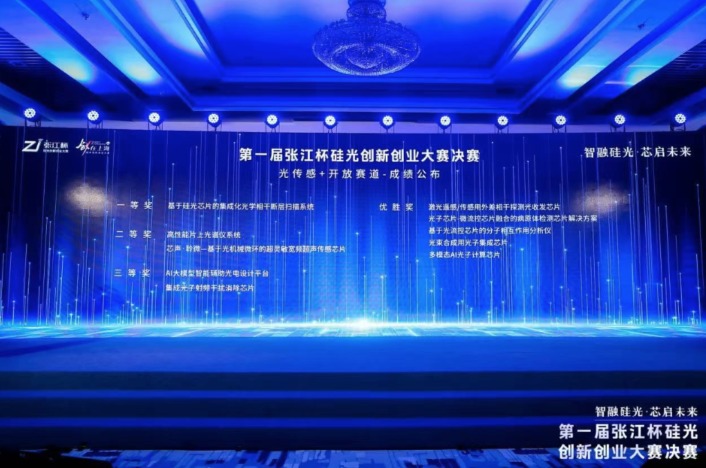
瞄准“后摩尔时代”颠覆性技术路线,上海选出硅光领域“潜力股”
Di Yi Cai Jing Zi Xun· 2025-08-24 09:25
Core Insights - Silicon photonics is recognized as a disruptive technology that combines the characteristics of integrated circuits with the advantages of photonic technology, such as high speed, low power consumption, and strong anti-interference capabilities [1][5] - The "Zhangjiang Cup Silicon Photonics Innovation and Entrepreneurship Competition" concluded with various projects showcasing advancements in silicon photonics [2][3] Group 1: Competition Overview - The competition featured 19 innovative silicon photonics projects from various enterprises, universities, and research institutions across the country [3] - Shanghai Lankun Microelectronics Technology Co., Ltd. won the first prize in the "Optical Interconnect + Optical Computing" track with its "Micro-ring Photonic Integrated Interconnect Chip" project [3] - In the "Optical Sensing + Open" track, Shanghai Jiao Tong University's project on an integrated optical coherence tomography system won the first prize [3] Group 2: Project Highlights - The winning project in the optical interconnect track focuses on utilizing CMOS technology to enhance bandwidth density and efficiency [4] - The project from the Chinese Academy of Sciences aims to address satellite communication needs through silicon photonics technology [5] - The competition highlighted various application directions for silicon photonics technology, indicating its industrialization potential [5] Group 3: Industry Development - Shanghai is actively promoting the development of the silicon photonics industry through project layout, platform construction, and ecosystem building [5] - The Shanghai Silicon Photonics Future Industry Cluster was officially launched in June, with eight companies signing agreements to establish operations [6] - The competition was organized by a silicon photonics innovation alliance, which includes over 70 leading technology enterprises, universities, and research institutions [6]
AI 应用驱动算力需求持续高增长,泉果基金调研华工科技
Xin Lang Cai Jing· 2025-08-21 09:18
Core Viewpoint - The company has shown significant growth in revenue and net profit, driven by innovation and strategic focus on key industries such as new energy vehicles, shipbuilding, and AI [2][3][5]. Financial Performance - For the first half of 2025, the company achieved operating revenue of 76.29 billion, a year-on-year increase of 45%, and a net profit attributable to the parent company of 9.11 billion, also up 45% [2][3]. R&D and Innovation - The company invested 4.61 billion in R&D during the reporting period, marking a 19% increase year-on-year, and launched the "Doctor 500" plan to attract high-level talent for core technology breakthroughs [3][5][6]. Business Segments - **Perception Business**: Generated 21.54 billion in revenue, up 17% year-on-year, with sensor business revenue at 19.42 billion [3]. - **Connectivity Business**: Revenue reached 37.44 billion, a 124% increase, with significant growth in data communication products [4]. - **Laser + Intelligent Manufacturing**: Achieved 16.76 billion in revenue, with notable growth in high-power laser equipment [4]. Market Expansion - The company is enhancing its global operations, with a focus on expanding its international business and establishing overseas production bases [3][4][5]. Future Outlook - The company is optimistic about the demand for domestic data communication optical modules, anticipating a shift from 400G to 800G products and further advancements in silicon photonics technology [7][9]. - The laser intelligent equipment business is expected to benefit from the ongoing transformation in the new energy vehicle and shipbuilding industries, with a focus on automation and smart manufacturing [10]. International Collaboration - The perception business is rapidly expanding in overseas markets, particularly in the high-end automotive sector, with significant orders from international car manufacturers [11][12].
中国产业叙事:新易盛
新财富· 2025-08-20 08:05
Core Viewpoint - The explosive growth in global AI computing power demand has led to a significant performance surge for Xinyi, redefining the growth boundaries of the optical module industry, with Q1 2025 revenue soaring to 4.1 billion yuan, a year-on-year increase of 264%, and net profit reaching 1.6 billion yuan, up 385% year-on-year [1][5][9]. Group 1: Company Overview - Xinyi was founded in Chengdu in 2008, focusing on high-performance optical modules for data centers, telecom networks, security monitoring, and smart grids [5][9]. - The company established a wholly-owned subsidiary in 2011, separating its production and R&D centers to enhance its focus on high-speed optical module technology [6]. - Xinyi went public on the Shenzhen Stock Exchange in 2016, raising 417 million yuan, marking a strategic leap in its development [9]. Group 2: Technological Advancements - Xinyi has achieved breakthroughs in various optical module technologies, including 100G, 400G, and 800G, and plans to start small-scale delivery of 1.6T optical modules in Q2 2025 [6][10]. - The company has successfully captured nearly 30% of the global market share for 800G optical modules, with a significant reduction in power consumption [11][14]. - The acquisition of US-based Alpine has positioned Xinyi to lead in silicon photonics technology, enhancing its competitive edge in the optical module market [14][17]. Group 3: Market Dynamics - The demand for AI computing power is driving the need for higher capacity data centers, with projections indicating that the average capacity of new large-scale data centers will double in the next four years [22][23]. - Major tech companies are significantly increasing their capital expenditures for data centers, with Microsoft and Amazon projected to spend $80 billion and $100 billion, respectively, by 2025 [23]. - The industry is undergoing a transformation driven by AI technology, which is expected to reshape power supply and cooling systems in data centers, marking a shift from quantitative to qualitative changes in the sector [23].