AIGC

Search documents
阿里巴巴美股盘前大涨超9%
21世纪经济报道· 2025-09-24 11:21
Core Insights - Alibaba's recent cloud conference highlighted significant investments in AI and cloud infrastructure, igniting market enthusiasm for the company and its role in the AI industry [1][3] - Cathie Wood's Ark Investment disclosed a $21 million investment in Chinese tech stocks, including $16.13 million in Alibaba, further boosting investor confidence [1] - Following these developments, Alibaba's stock surged over 9% in both Hong Kong and U.S. pre-market trading [1] Investment and Strategic Direction - Alibaba plans to increase its capital expenditure from 380 billion yuan, aiming to enhance its global data center energy capacity by tenfold by 2032 [3] - The introduction of the "Super Artificial Intelligence" (ASI) concept positions Alibaba to create an "Android system for the AI era," emphasizing an open-source approach [3] - The company showcased advanced capabilities in large-scale clusters and high-density AI servers, indicating a substantial increase in computational power [3] Market Reactions and Stock Performance - The stock performance of Alibaba's related companies, such as Hangzhou Steel and China Electric Power, saw significant gains, reflecting the positive market sentiment [4] - Southbound capital has consistently increased its holdings in Alibaba, reaching 2.013 billion shares, marking the 26th consecutive trading day of net buying [4] - Goldman Sachs raised its price target for Alibaba's U.S. stock from $163 to $179 and its Hong Kong stock target from 158 HKD to 174 HKD, maintaining a "buy" rating based on optimistic AI-driven growth expectations [4]


游戏板块午后异动拉升,游戏ETF(159869)现涨近4.5%
Mei Ri Jing Ji Xin Wen· 2025-09-24 09:26
Core Insights - The gaming sector experienced a significant surge, with the gaming ETF (159869) rising nearly 4.5% and attracting a net inflow of 1.036 billion yuan over the past 10 trading days, indicating strong investor interest [1] - Individual stocks such as G-bits rose over 8%, reaching new highs, while other companies like Shenzhou Taiyue, Kaiying Network, and Giant Network also saw gains [1] - According to Guangfa Securities, Tencent's "Delta Action" topped the iOS bestseller list after its new season launch, showcasing the enduring appeal of competitive gaming [1] - Kaiying Network is accelerating its integration of the Legend Box and has signed brand cooperation agreements with leading manufacturers, which is expected to contribute to performance growth in Q3 [1] - Wanlian Securities predicts a recovery in the overall performance of the media sector in H1 2025, with a notable rebound in the gaming sector's performance in Q2 2025, driven by content supply recovery, AI technology integration, policy support, and consumer spending recovery [1] - The gaming sector is catalyzed by multiple factors including AI, content, and commercialization model transformations, with the gaming ETF (159869) tracking the performance of A-share listed companies in the animation and gaming industry, presenting investment opportunities [1]
蔚领时代发布沉浸式XR影视作品《木兰2125》
Huan Qiu Wang· 2025-09-24 09:11
Core Insights - The article discusses the launch of the immersive XR film "Mulan 2125" by Weiling Era, highlighting the transformation of entertainment through XR technology [1][2] - "Mulan 2125" is a 3A-level immersive XR production that will be commercially operated at the Beijing 798 Super Dimension VR Cinema [1] - The film adopts a series format, allowing for richer storytelling compared to traditional XR content, which typically lasts 20-30 minutes [1] Technology and Production - Weiling Era utilizes AI to optimize production processes, significantly reducing the content production cycle and overcoming traditional efficiency bottlenecks [1] - The company has developed its own XR holographic streaming technology to meet the high computational demands of real-time rendering, enabling seamless, high-definition experiences for users [1] - The film features a comprehensive production process with high-level CG capabilities across art, visual effects, sound design, and action design, creating immersive scenes that engage the audience's senses [2] Recognition and Distribution - "Mulan 2125" was selected for the immersive competition section of the 82nd Venice International Film Festival, marking it as the only independently produced entry from mainland China this year [2] - The film is set to be available on major immersive headset platforms, including Meta Quest and Apple Vision Pro [2]
阿里AI“大招连击”,总市值涨出三千亿!
2 1 Shi Ji Jing Ji Bao Dao· 2025-09-24 08:53
Group 1 - Alibaba's cloud conference on September 24 highlighted significant investments in AI and cloud infrastructure, with a focus on the new "ASI" concept and plans for massive computing power investments [1][2] - Cathie Wood's Ark Investment disclosed a $21 million investment in Chinese tech stocks, including $16.13 million in Alibaba, further boosting market sentiment [1] - Following the conference and investment news, Alibaba's stock rose by 9.16% to HKD 174.0, with a market capitalization exceeding HKD 3.3 trillion [1] Group 2 - Alibaba Cloud's strategy in the AI era was outlined, with a goal to increase global data center energy consumption by tenfold by 2032 compared to 2022 [2] - The conference showcased advanced capabilities in large-scale clusters and high-density AI servers, indicating a significant leap in computing power investment [2] - Related stocks in the A-share market saw active performance, with several companies, including Hangzhou Steel and Zhongdian Xilong, hitting their daily price limits [2][3] Group 3 - Southbound capital has consistently increased its holdings in Alibaba, reaching 2.013 billion shares, marking the 26th consecutive trading day of net buying [3] - Goldman Sachs raised its price target for Alibaba's U.S. stock from $163 to $179 and for its Hong Kong stock from HKD 158 to HKD 174, reflecting optimism about Alibaba Cloud's valuation and AI-driven growth [3]
阿里夸克发布全新AI创作平台“造点” 已接入通义万相Wan2.5
Zheng Quan Ri Bao Zhi Sheng· 2025-09-24 06:34
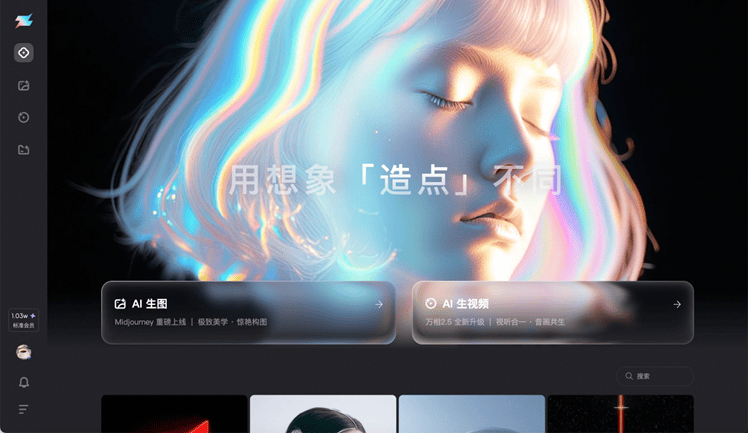
Core Insights - Alibaba's AI flagship application Quark has launched a new AI creation platform called "ZaoDian," integrating AI-generated images and videos, and is the first in China to support synchronized audio-visual video generation with the latest model, Tongyi Wanshang Wan2.5 [1][3] Group 1: Platform Features - "ZaoDian" incorporates advanced capabilities from the Midjourney V7 image generation model, providing a one-stop creative experience for users with both image and video functionalities [1][3] - The platform can generate synchronized voice, sound effects, and background music for videos, supporting a duration of 10 seconds and achieving 1080P HD quality at 24 frames per second, suitable for cinematic scene creation [3] - The model demonstrates strong instruction-following capabilities, allowing for complex continuous changes in video generation, such as camera movements [3] Group 2: Target Audience and Use Cases - "ZaoDian" supports various professional creator needs, including multi-image references, style codes, and detailed parameter control, making it suitable for e-commerce, graphic design, and film/game applications [3] - During the beta testing phase, "ZaoDian" attracted numerous professional AIGC creators, resulting in popular works like "Medieval Oil Painting Chorus" and "Cultural Relics Eating Mooncakes" [3] - The platform offers a lightweight creative experience for general users, allowing for fun features like "one-sentence photo editing" and "AI creative videos," as well as everyday photo editing needs [4]
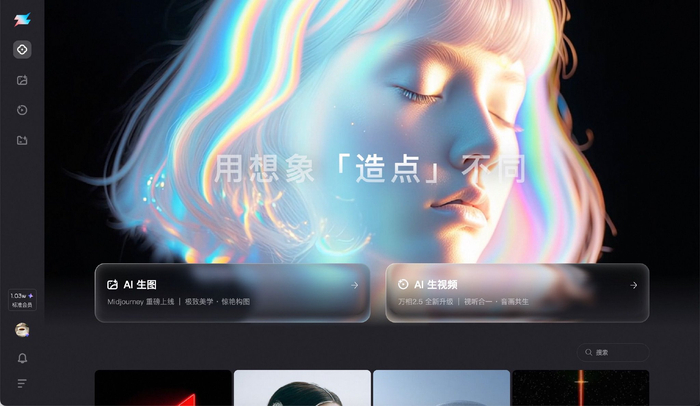
阿里夸克发布全新AI创作平台“造点”,已接入通义万相Wan2.5
Ge Long Hui· 2025-09-24 03:46
Core Insights - Alibaba's AI flagship application Quark has launched a new AI creation platform called "ZaoDian," integrating AI-generated images and videos, and is the first in China to support synchronized audio-visual video generation with the latest model, Tongyi Wanshang Wan2.5 [1][3] Group 1: Platform Features - "ZaoDian" incorporates advanced capabilities from the Midjourney V7 image generation model, providing a comprehensive creative experience for users with both image and video functionalities [1][3] - The platform can generate synchronized human voices, sound effects, and background music for videos up to 10 seconds long, achieving a complete narrative in a single generation [3] - It supports 1080P HD video at 24 frames per second, meeting the quality requirements for cinematic scene creation [3] Group 2: Target Audience and Use Cases - The platform is designed to cater to both professional AIGC creators and casual users, offering features like "one-sentence image editing" and "AI creative videos" for everyday photo editing needs [4] - It is particularly strong in generating Asian portraits, Chinese text, and traditional cultural elements, making it suitable for e-commerce, graphic design, and film/game applications [3][4] Group 3: User Engagement and Feedback - During the beta testing phase, "ZaoDian" attracted numerous professional AIGC creators, resulting in popular works such as "Medieval Oil Painting Chorus" and "Cultural Relics Eating Mooncakes" [3] - Users have reported enhanced creative efficiency due to the upgraded video model, which allows for synchronized audio and video output [3]
秘塔科技推出新版搜索方式Agentic Search;智元机器人GO-1通用具身基座大模型全面开源丨AIGC日报
创业邦· 2025-09-24 00:07
Group 1 - Agentic Search launched by Mita Technology allows users to perform 5-15 tool calls autonomously in one search, with a model parameter scale increased by 10 times compared to the previous version [2] - DingTalk AI Table Assistant officially launched, enabling users to create AI tables and supporting workflows from platforms like Bailian and Coze [2] - Genie Operator-1 (GO-1) by Zhiyuan Robot is now fully open-sourced, marking the first global release of a general-purpose embodied intelligence model using the ViLLA architecture [2] - Alibaba's Qianwen has updated three large models, including the open-source multimodal model Qwen3-Omni, which shows significant advantages in audio tasks compared to similar models [2]
21专访丨从产品出口到AI生态,万兴科技全球化破局
2 1 Shi Ji Jing Ji Bao Dao· 2025-09-23 23:41
Core Viewpoint - The article highlights the global expansion strategy of Wankang Technology, a Chinese AIGC software company, emphasizing its evolution from product export to localized operations and AI-driven innovation in the global market [1][2]. Group 1: Company Strategy - Wankang Technology was established in 2003 with a focus on overseas markets, leveraging the advantages of mature intellectual property protection and online payment infrastructure in foreign markets [2][3]. - The company has undergone three strategic phases: product export (2003-2010), localization (2011-2018), and AI innovation (2019-present), achieving significant revenue growth from millions to over a billion [3][4]. - The company prioritizes business replicability when considering market opportunities, focusing on IT and digital creative sectors due to their low marginal costs [3][4]. Group 2: Globalization and Market Penetration - Wankang Technology employs a diversified and localized marketing strategy, utilizing search engine optimization, influencer marketing, and social media to enhance brand recognition across over 200 countries [4][6]. - The company addresses cultural differences by building local teams and ensuring compliance, while also driving product innovation through technology [4][5]. - The company aims to capitalize on the global creator economy, projected to reach $2.71 trillion by 2037, by empowering creative individuals [5][6]. Group 3: Product Development and Innovation - The company focuses on self-research and development, covering the entire software development cycle from market analysis to dynamic optimization [4][6]. - Wankang Technology is advancing its AIGC digital creative software products, with plans to launch the 2.0 version of its multimedia model "Wankang Tianmu" in the first half of 2025 [4][6]. - The company is expanding its product line through a "platform + entrepreneur" model, enhancing its creative software matrix and lowering barriers for creators [6].

与华语电影新生代同行
Ren Min Ri Bao Hai Wai Ban· 2025-09-23 22:50
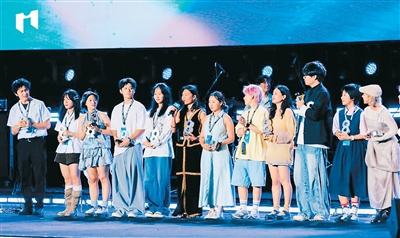
IM是"In Moments"的简称,意为"从这一刻起"。平潭IM两岸青年影展(以下称"平潭IM")是以扶持全 球高校青年影视创作力量为目标的专业影像节展,集短片评比、论坛、展映等于一体。 本届影展由竞赛、培育、展映、论坛、活动五大板块组成,其间还举办了创作训练营、提案大会、青年 之夜等配套活动,为两岸青年电影人提供展示才华、实现梦想的平台。 新生代创作者彰显开阔视野 作为影展"重头戏",本届平潭IM的短片主竞赛单元共征集剧情短片2059部、非剧情短片519部。"Z世 代"创作力量集中爆发成为本届影展的显著亮点,主竞赛单元参赛者平均年龄仅24岁,00后创作者占比 超过55%。 经过评选,50部短片佳作入围线下展映环节。入围短片题材丰富多元,涵盖社会关怀、个人成长、文化 传承等多个维度。改编自真实经历的《独唱团》,从儿童的视角探讨了集体与个体的边界;《无用路》 以闽南海岛为舞台,用黑色幽默解构两个少年的成长经历;AI题材《柯得的幻想》引发观众关于人与 科技的深层思考……这些作品表达了青年创作者对生活的观察,彰显了新生代华语电影人开阔的创作视 野。 平潭IM两岸青年影展颁奖典礼。 主办方供图 9月7日晚,福建平潭 ...
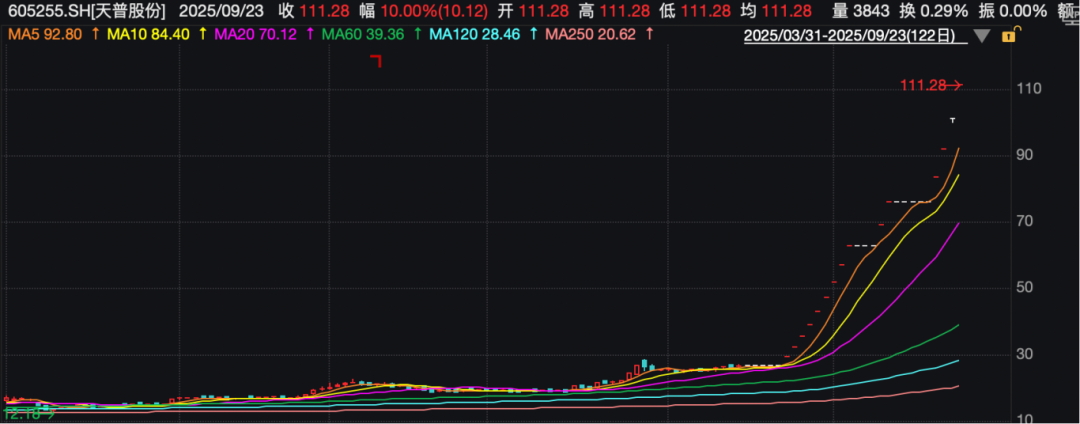
15连板!605255,停牌核查!
Zheng Quan Shi Bao· 2025-09-23 19:12
Core Viewpoint - Tianpu Co., Ltd. (605255) has experienced a significant stock price surge, with a 317.72% increase over 15 consecutive trading days, leading to a suspension for investigation due to a disconnection from the company's fundamentals [1][2][4] Group 1: Stock Performance and Market Reaction - Tianpu's stock price reached 111.28 CNY per share, with a total market capitalization of 14.9 billion CNY [2] - The stock has been suspended for investigation for the third time due to abnormal trading activities [1][6] - The Shanghai Stock Exchange has issued warnings regarding the stock's volatility and has taken regulatory measures against certain investors for disruptive trading behavior [7] Group 2: Acquisition and Control Changes - The recent surge in Tianpu's stock price is attributed to a takeover bid by Zhonghao Xinying (Hangzhou) Technology Co., Ltd., which aims to gain control through various means, including equity transfer and capital increase [4] - The total investment for the acquisition exceeds 2.1 billion CNY, with Zhonghao Xinying contributing approximately 965 million CNY [4] - After the completion of the transaction, Zhonghao Xinying and its partners will hold a combined 50.01% stake in Tianpu, while the original controlling shareholder's stake will decrease to 25% [4] Group 3: Company Background and Future Prospects - Zhonghao Xinying focuses on high-performance AI chips and computing clusters for the AIGC era, having completed nine rounds of financing with a valuation of 4.412 billion CNY [5] - Despite the acquisition, there are no immediate plans for asset injection or significant changes to Tianpu's main business within the next 12 months [6] - The company has cautioned investors about potential risks associated with the stock's volatility and the uncertainty surrounding the control change [6]