人工智能(AI)

Search documents
全球首批人形机器人店员深圳上岗!机器人ETF(159770)昨日成交额2.28亿元,规模冲百亿!机构:人形机器人产业化进程加速
2 1 Shi Ji Jing Ji Bao Dao· 2025-11-14 01:32
Market Performance - The market experienced a significant rally on November 13, with major indices closing higher; the Shanghai Composite Index reached a ten-year high, while the ChiNext Index rose over 2% [1] - By the end of the trading day, the Shanghai Composite Index increased by 0.73%, the Shenzhen Component Index rose by 1.78%, and the ChiNext Index gained 2.55% [1] ETF Highlights - The Robot ETF (159770) tracking the CSI Robot Index closed up by 0.74% with a trading volume of 228 million yuan on November 13 [1] - The Robot ETF (159770) saw a net subscription of 18 million units on November 12, bringing its total scale to 9.797 billion yuan [1] - The Robot ETF has experienced continuous net inflows for 20 consecutive trading days, accumulating over 1.68 billion yuan [1] Chip Sector Insights - The Chip ETF Tianhong (159310) tracking the chip industry index rebounded with a nearly 2% increase [2] - The Chip ETF has seen significant capital inflow, with net inflows for four consecutive trading days, totaling over 10 million yuan [2] - The chip industry is expected to see a 37.62% year-on-year growth in net profit attributable to shareholders in the first half of 2025, driven by policy support and surging demand [2] Robotics Industry Developments - The global first batch of cyber store clerks began operations in Shenzhen on November 11, indicating advancements in AI and robotics [3] - Michael Spence, a Nobel laureate, noted that the AI development gap between China and the U.S. is narrowing, with both countries accelerating their advancements [3] - The humanoid robot industry is progressing rapidly, with companies like Tesla, Xiaopeng, and Leju Intelligent releasing new humanoid robots [4] - The humanoid robot supply chain is categorized into three main segments: "brain—body—whole machine integration," with the core value concentrated in the midstream components [3]



沙特交易所CEO穆罕默德·艾·鲁迈赫接受证券时报记者专访时表示: 中国在AI等领域吸引了全球资本 中沙资本市场的合作进展令人鼓舞
Zheng Quan Shi Bao Wang· 2025-11-14 01:07
Core Viewpoint - The CEO of the Saudi Exchange, Mohammed Al Rumaih, emphasizes the potential for deepening cooperation between China and Saudi Arabia in capital markets, particularly in high-tech sectors like AI, and invites Chinese investment institutions to participate in the Saudi capital market [1][2]. Group 1: Progress in Cross-Listing - The Saudi Exchange has made significant progress in cross-listing initiatives, with the introduction of regulations for Saudi Depositary Receipts (SDRs) approved by regulators, facilitating Chinese companies' cross-listing in Saudi Arabia [3]. - The Saudi Exchange has launched four ETFs in China, with two listed on the Hong Kong Stock Exchange and one each on the Shanghai and Shenzhen exchanges, while also welcoming two China-themed ETFs in the Saudi market [2][3]. Group 2: Market Growth and Internationalization - The Saudi Exchange is one of the fastest-growing capital markets globally, completing over 40 IPOs annually, with a market capitalization of $2.6 trillion, including over $100 billion from international investors [4]. - The presence of Chinese financial institutions in Saudi Arabia has increased, with the first Chinese brokerage firm achieving significant success, attracting more Chinese companies to the Saudi capital market [4][5]. Group 3: Future Cooperation and Opportunities - The Saudi Exchange aims to expand cooperation by launching more ETF products and enhancing investment channels between the two countries, with a focus on mutual investment growth [6]. - There is a strong interest in AI and complementary industries, with both countries looking to explore collaborative opportunities in these sectors, leveraging China's leadership in AI and Saudi Arabia's focus on developing this field [6].
12月降息未定!美联储戴利强调“数据依赖”立场
Xin Hua Cai Jing· 2025-11-14 00:55
Group 1 - The Federal Reserve's balance sheet has faced criticism, necessitating clear and transparent communication regarding changes in bond holdings and policy intentions [1] - The balance sheet serves multiple functions, including regulating bank reserves and supporting monetary policy implementation, and should be adjusted dynamically based on financial system needs [1] - The Fed is nearing the end of a three-year balance sheet reduction plan and is discussing the potential need to restart bond purchases to ensure alignment between bank reserves and system demand [1] Group 2 - There is cautious optimism regarding the U.S. economic outlook, with a significant reduction in uncertainty, although concerns about a slowdown in the labor market are increasing [2] - Inflation is decreasing but remains persistent, particularly in the services sector, and the Fed aims to reduce inflation to 2% while maintaining the credibility of this target [2] - The impact of artificial intelligence (AI) on employment is not yet clear, with no significant reports of job losses attributed to AI, and it is believed that AI investments will not create a bubble similar to the tulip mania [2] - The balance of policy risks is expected to be heavily tilted towards inflation until mid-2025, after which it may begin to shift towards a more balanced state [2]
中国在AI等领域吸引了全球资本 中沙资本市场的合作进展令人鼓舞
Sou Hu Cai Jing· 2025-11-13 21:43
Core Viewpoint - The Saudi Stock Exchange (Tadawul) is actively seeking collaboration with Chinese investment institutions, particularly in high-tech sectors and through the development of exchange-traded funds (ETFs) and cross-listing of companies [1][2]. Group 1: Cooperation Developments - The CEO of Tadawul, Mohammed Al Rumaih, highlighted the increasing frequency of interactions between the Chinese and Saudi capital markets, with recent memorandums of understanding signed with both the Shanghai and Shenzhen stock exchanges, as well as the Hong Kong Stock Exchange [2]. - Currently, four ETFs from Saudi Arabia are listed in China, with two on the Hong Kong Stock Exchange and one each on the Shanghai and Shenzhen exchanges. Additionally, two China-themed ETFs have been introduced in the Saudi market, with one becoming the largest ETF in Saudi Arabia [2][4]. - Progress has been made in exploring dual listing mechanisms, with discussions held with several Chinese companies considering cross-listing in Saudi Arabia [4][5]. Group 2: Market Growth and Opportunities - The Saudi Stock Exchange is one of the fastest-growing capital markets globally, completing over 40 IPOs annually and reaching a market capitalization of $2.6 trillion, with over $100 billion in investments from international investors [5]. - The presence of a Chinese brokerage firm in Saudi Arabia has attracted more Chinese companies to the Saudi capital market, and numerous fintech companies are also exploring opportunities in the region [5][6]. - There is a growing interest from top Chinese asset management companies seeking to understand the Saudi capital market and investment details [6]. Group 3: Future Collaboration Prospects - Mohammed Al Rumaih expressed confidence in the future of cooperation between the two countries, emphasizing the potential for expanding the range of ETF products and enhancing investment channels between the two capital markets [7]. - The focus on artificial intelligence (AI) as a key area for development in both countries presents additional opportunities for collaboration, with discussions ongoing about facilitating bilateral investments in this sector [7].

沙特交易所CEO穆罕默德·艾·鲁迈赫:中国在AI等领域吸引了全球资本中沙资本市场的合作进展令人鼓舞
Zheng Quan Shi Bao· 2025-11-13 18:06
Core Insights - Saudi Arabia is keen to deepen cooperation with China in capital markets, particularly in high-tech sectors and artificial intelligence [1][3][8] - Significant progress has been made in cross-listing mechanisms and the introduction of exchange-traded funds (ETFs) between the two countries [2][4][5] Group 1: Capital Market Cooperation - The CEO of the Saudi Exchange, Mohammed Al Rumaih, expressed enthusiasm for inviting Chinese investment institutions to participate in the Saudi capital market [1][3] - In 2023, the Saudi Exchange signed memorandums of understanding with both the Shanghai and Shenzhen stock exchanges, as well as the Hong Kong Stock Exchange, to explore joint listings and fintech collaborations [3][5] - Currently, four Saudi ETFs are listed in China, with two on the Hong Kong Stock Exchange and one each on the Shanghai and Shenzhen exchanges, while two China-themed ETFs have also been introduced in Saudi Arabia [3][4] Group 2: Cross-Listing Developments - The Saudi Exchange has introduced regulations for Saudi Depositary Receipts (SDRs), which have received regulatory approval, facilitating Chinese companies' cross-listing in Saudi Arabia [4] - Discussions have been held with multiple Chinese companies considering cross-listing, with the condition that their development strategies align with Saudi Arabia's Vision 2030 [4][5] Group 3: Investment Opportunities - The Saudi capital market is one of the fastest-growing globally, completing over 40 IPOs annually, with a market capitalization of $2.6 trillion, attracting significant international investment [5][6] - There has been an increase in interest from Chinese asset management companies seeking to understand the Saudi capital market better [7] - The Saudi Exchange is simplifying regulations to facilitate foreign investment, which has garnered positive responses from international investors, particularly from China [6][8] Group 4: Future Collaboration - There is optimism about expanding cooperation between the two countries' capital markets, with plans to launch more ETFs and enhance investment channels [8] - The focus on complementary industries, particularly in AI, is seen as a significant opportunity for collaboration, with both countries aiming to leverage their strengths [1][8]
本轮AI投资热“浇不灭”!蔡昉、王一鸣、孙学工最新发声
券商中国· 2025-11-13 14:40
Core Viewpoint - The current AI investment boom is seen as both a revolutionary opportunity and a potential bubble, but it is unlikely to diminish due to its critical role in addressing major challenges like climate change and aging populations, as well as its importance in national competitiveness [2]. Group 1: AI Investment Insights - The AI investment wave is characterized by a strong expectation for future productivity, leading companies to avoid the risk of falling behind [2]. - AI is described as "creative destruction," necessitating a balance between its creative and destructive aspects through institutional frameworks [2]. - There is a call for the establishment of an inclusive social security system powered by AI to create new jobs and improve employment quality, thereby reducing income inequality [2]. Group 2: Financial Support for Innovation - The current financial support system for technology innovation should transition from debt-based to equity-based, enhancing the role of capital markets in supporting innovation [3][4]. - There is a need to expand financial services for high-tech enterprises and specialized small and medium-sized enterprises, optimizing the linkage between loans and equity investments [3]. - Encouragement of venture capital development and maintaining a stable environment for IPOs and refinancing are essential for fostering innovation [4][5]. Group 3: Macroeconomic Trends and Policy Recommendations - China's GDP growth for the first three quarters of the year was 5.2%, with expectations for a slight decrease in the fourth quarter due to high base effects, but an overall target of around 5% growth for the year remains achievable [6][7]. - Recommendations include increasing the budget deficit rate to 4.5% and enhancing government spending to support economic stability and growth [7]. - A call for more proactive fiscal and monetary policies to ensure a supportive macroeconomic environment as the country enters the new five-year plan period [7].

认定AI泡沫 “大空头”伯里果断清算Scion基金
智通财经网· 2025-11-13 14:14
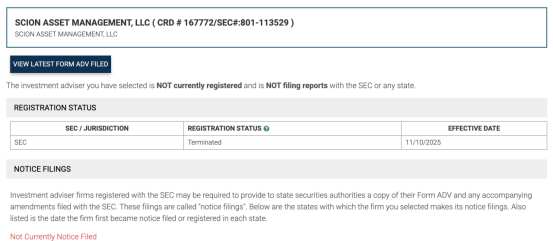
Core Insights - Michael Burry, known for predicting the 2008 financial crisis, is exiting asset management, with his firm Scion Asset Management LLC officially terminating its registration as of November 10, 2025 [1][5] - Burry plans to liquidate his funds and return capital to investors by the end of the year, citing a significant divergence between market valuations and his assessments [1][5] - His recent actions and statements indicate a belief that the market is overvalued and lacks rationality, particularly regarding large tech companies and AI valuations [5][6] Company Actions - Scion Asset Management managed $155 million in assets as of March and has been viewed as a barometer for detecting bubble risks [5] - Burry has established short positions against AI-related stocks like Nvidia and Palantir, reflecting his cautious stance on the AI-driven market rally [5][6] - The firm’s termination and Burry's decision to return capital signal a retreat from what he perceives as a fundamentally manipulated market [5][8] Market Context - Burry's exit highlights the challenges faced by short-sellers in a market characterized by optimism towards the tech sector and retail investor enthusiasm [7] - The recent performance of AI-related stocks has significantly contributed to the S&P 500's gains, with reports indicating that these stocks accounted for 75% of the index's increase since November 2022 [8] - Burry's actions may symbolize a protest against speculative trends in the market, as he adheres to a value-driven investment philosophy [8][9] Future Outlook - It remains uncertain where Burry will direct his investments post-liquidation, with speculation suggesting a shift towards family office or private investment strategies [8] - Burry's upcoming announcement on November 25 may provide insights into his future investment direction [6][8]
Bitfarms .(BITF) - 2025 Q3 - Earnings Call Transcript
2025-11-13 14:02
Financial Data and Key Metrics Changes - In Q3 2025, Bitfarms achieved total revenue of $84 million, with $69 million from continuing operations, representing a year-over-year increase of 156% in revenue [40][41] - Gross mining profit was $21 million, with a gross mining margin of 35% and an average direct cost of $48,200 per Bitcoin mined [41] - Adjusted EBITDA from continuing operations was $20 million, or 28% of revenue, up from $2 million, or 8% of revenue year-over-year in Q3 2024 [42] Business Line Data and Key Metrics Changes - The company introduced a new program for digital asset management, Bitcoin 2.1, aimed at offsetting Bitcoin production costs and achieving higher value per Bitcoin sold [41] - The all-in cost per Bitcoin from continuing operations was $82,400, which, after accounting for net gains from derivatives, effectively reduced to $55,200 [42] Market Data and Key Metrics Changes - The demand for data center infrastructure is accelerating, with lease rates growing at an average rate of 12% since 2022, compared to 3% over the previous 20 years [8][10] - Analysts predict a massive shortfall of nearly 45 GW of power for data centers by 2030, confirming the increasing demand for HPC and AI infrastructure [10] Company Strategy and Development Direction - Bitfarms is transitioning to become a leading North American HPC and AI infrastructure company, focusing on optimizing lease rates and margins [5][12] - The company plans to prioritize infrastructure development, take advantage of the supply-demand gap, and develop infrastructure for NVIDIA's next-generation Vera Rubin GPUs [12][13] - The strategic focus includes converting existing Bitcoin mining sites to HPC and AI workloads, with significant developments planned in Washington and Pennsylvania [20][25][30] Management's Comments on Operating Environment and Future Outlook - Management expressed high conviction in the value of their energy portfolio and the demand for power, emphasizing the strategic location of their megawatts [16][19] - The company is well-capitalized with over $1 billion available for funding development projects, indicating strong financial health and a clear vision for future growth [44][45] Other Important Information - The company has secured 170 MW of operating power in Quebec, with plans to convert Bitcoin mining infrastructure to HPC and AI, representing a unique opportunity to increase data center capacity [19][29] - A successful convertible note offering raised $588 million, enhancing financial flexibility and supporting ongoing development initiatives [38][39] Q&A Session Summary Question: Can you share more on how you guys are thinking about economics for Vera Rubin GPU infrastructure? - Management highlighted that the increasing shortage of infrastructure will drive economics, with higher energy density requirements for next-generation GPUs leading to greater economic incentives for deployment [47][49] Question: What is the expected timeline for expanding power capacity at Panther Creek and Scrubgrass? - Management indicated that positive indications for power capacity expansion have been received, with potential quick conversions subject to regulatory approval [59][60] Question: Can you clarify the counterparty to the $128 million critical IT supply agreement for Washington? - The agreement is with a large publicly traded American national company that supplies data center equipment and services, enhancing the facility's attractiveness for both colocation and cloud services [72] Question: What are the biggest challenges to meeting timelines for Washington, Sharon, and Panther Creek? - Management noted that construction bottlenecks are hard to forecast, but having strong partners and project management teams in place mitigates risks [78] Question: What is the expected CapEx for 2026? - Management stated that CapEx figures for 2026 are still being finalized, with more clarity expected in Q1 as NVIDIA completes reference designs for the Vera Rubin infrastructure [79][80]

这些指标不仅事关美国消费者,更关系美国假日经济是否放缓
第一财经· 2025-11-13 13:34
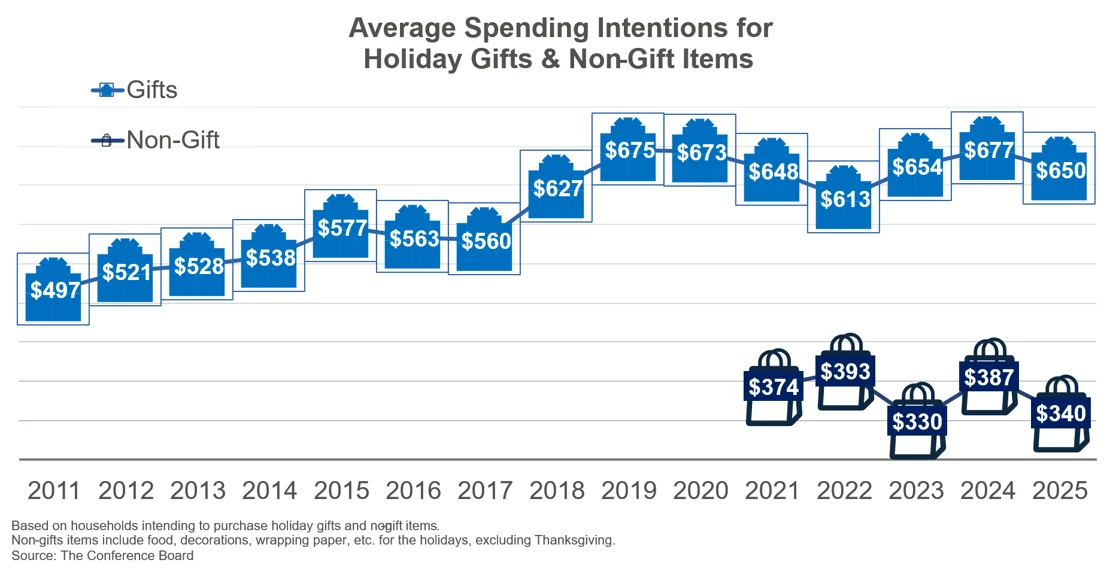
Core Insights - The upcoming holiday consumer outlook in the U.S. is negatively impacted by inflation, labor market slowdown, and tariff factors, with only consumers aged 65 and above planning to increase spending compared to last year [2][3]. Consumer Spending Trends - Consumers aged 35 and below are primarily responsible for the decline in gift spending, while those aged 35-45 and 55-64 are tightening their budgets in non-gift areas [3]. - The average holiday-related spending per consumer is projected to be $990 in 2025, a 6.9% decrease from $1,063 in 2024, and close to the 2023 estimate of $985, but lower than the 2022 ($1,006) and 2021 ($1,022) levels [7]. - Planned spending on gifts is expected to drop to $650, down 3.9% from last year's $677, marking the lowest level since 2022 [7]. - Non-gift spending, including food and decorations, is anticipated to decrease by 12% to $340 [7]. Employment and Retail Dynamics - Retailers and hotel groups are hiring the fewest seasonal employees in over a decade, with a reported 8.4% decrease in holiday job postings and a 12% drop in temporary hotel staff recruitment [3][12]. - The cautious hiring reflects a pessimistic outlook for the holiday shopping season, with consumer confidence at its lowest since June 2022 [14]. - Major retailers like Target and Amazon are planning to hire fewer seasonal workers compared to previous years, indicating a trend of reduced labor demand in the retail sector [15]. Consumer Behavior Changes - Consumers are becoming more pragmatic, favoring essential items over luxury gifts, with only about 5% citing AI and social media recommendations as key factors in their purchasing decisions [7]. - There is an increased interest in purchasing toys, games, and gift cards in 2025, with toys and games expected to become the top category for purchases [7]. - The proportion of consumers planning to buy gifts online remains steady at 43%, with higher income consumers showing a greater inclination towards online shopping [9]. Economic Outlook - Experts indicate that U.S. domestic demand is declining due to inflation and tariff impacts, with a notable shift towards a "K-shaped" economic recovery [11]. - Predictions suggest that holiday sales will grow by only 3.7% to 4.2% this year, lower than the previous year's growth rate of 4.3% [14].
这些指标不仅事关美国消费者,更关系美国假日经济是否放缓
Di Yi Cai Jing· 2025-11-13 12:59
Group 1: Holiday Spending Outlook - The upcoming holiday spending outlook in the U.S. is impacted by inflation, labor market slowdown, and tariff factors, with only consumers aged 65 and above planning to increase spending on gifts and non-gifts compared to last year [1] - The Conference Board survey indicates that younger consumers (under 35) are the primary reason for the decline in gift spending, while consumers aged 35-45 and 55-64 are tightening their budgets in non-gift areas [2][5] - The survey predicts that the average holiday-related spending per consumer in the U.S. will be $990 in 2025, a 6.9% decrease from $1,063 in 2024, and lower than 2022 and 2021 levels [6] Group 2: Consumer Behavior Changes - Consumers are becoming more pragmatic, favoring essential gifts over desired items, with gift spending expected to drop to $650 this year, the lowest since 2022 [6] - The budget for non-gift items, including food and decorations, is expected to decrease by 12% to $340 [6] - There is a notable increase in the intention to purchase toys and games, vacation and travel products, and gift cards in 2025, with toys and games rising to the top of the list [7] Group 3: Employment and Retail Dynamics - Retailers are hiring fewer seasonal employees, with predictions of less than 500,000 temporary hires in the last quarter of 2025, the lowest since 2009 [12] - Major retailers like Walmart and Target are cautious about hiring, reflecting a cautious outlook for the holiday shopping season due to ongoing inflation and economic uncertainty [13] - The Michigan Consumer Sentiment Index has dropped to its lowest level since June 2022, indicating declining consumer confidence [13] Group 4: Economic and Trade Factors - The logistics and trade sectors report that tariffs and inflation are contributing to a decline in domestic demand, with a noted decrease in consumer spending capacity [10] - The retail sector is maintaining low inventory levels due to economic uncertainties and tariff situations, with a "K" shaped recovery trend becoming more apparent [11] - The Oxford Economics survey indicates a one-third probability of the U.S. entering a recession in the next 12 months, with trade policy being a major concern for businesses [15]