
Fiscal Policy

Search documents
Fed Chair Powell Says Effects of Tariffs Take Time to See
Bloomberg Television· 2025-06-24 18:28
You look back and you're teaching a history class. What what would you blame that increase in prices on back in that time period. So I'll start with the fact that it was extremely global.So we saw that there were literally was a point at which not a single country in the world had inflation 2% or below. So it was everywhere. So you have to look to common factors.And I would say that the pandemic and the closing of the global economy and then the reopening of it in all cases with some support, that's that's ...


Fed Chair Powell: We're not at neutral level because forecasters expect inflation increase
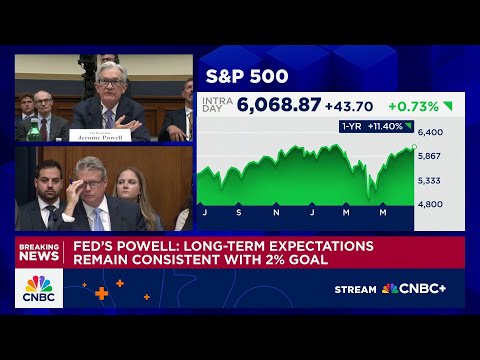
CNBC Television· 2025-06-24 15:09
yield back. >> The gentleman's time has expired. The vice chairman of the full committee, Mr.. Huizenga of Michigan, is recognized for five minutes. >> Thank you, chair Hill and Chair Powell. Good to see you again.I got a lot to cover, so we're going to try and keep this concise. But following up a bit on what Chair Hill had been talking about, you know, you had said in January 29th, 2025, quote, we don't know what will happen with tariffs, with immigration, with fiscal policy and with regulatory policy. I ...
瑞银:6 月美联储FOMC_美联储的新展望
瑞银· 2025-06-23 02:09
Investment Rating - The report does not explicitly provide an investment rating for the industry or specific companies within it Core Insights - The FOMC left rates unchanged but revised projections for GDP growth and inflation, indicating a more comfortable stance on inflation than previously anticipated [2][3] - The median projected GDP growth was marked down for 2025 and 2026, with a return to trend growth expected in 2027 [3] - Unemployment rates are projected to remain at 4.5% for 2025 and 2026, dipping slightly to 4.4% in 2027 [2][8] - Core PCE inflation is expected to decrease from 3.1% in 2025 to 2.1% in 2027, but neither headline nor core inflation is projected to return to target levels [2][8] Summary by Sections Economic Projections - Change in real GDP is projected at 1.4% for 2025, 1.6% for 2026, and 1.8% for 2027, with long-run growth also at 1.8% [8] - Unemployment rate projections are 4.5% for 2025 and 2026, and 4.4% for 2027, with a long-run projection of 4.2% [8] - PCE inflation is projected at 3.0% for 2025, 2.4% for 2026, and 2.1% for 2027, with a long-run projection of 2.0% [8] - Core PCE inflation is projected at 3.1% for 2025, 2.4% for 2026, and 2.1% for 2027 [8] - Federal funds rate projections are 3.9% for 2025, 3.6% for 2026, and 3.4% for 2027, with a long-run projection of 3.0% [8]
高盛:全球利率-通胀带来缓解,油价带来风险
Goldman Sachs· 2025-06-15 16:03
13 June 2025 | 7:27PM BST Global Rates Trader Inflation Offers Relief, Oil Offers Risks Inflation relief for global bond markets was short-lived as geopolitical tensions saw oil prices move sharply higher into the weekend. Even with some improvement in the underlying growth versus inflation trade-off and signs of duration risk appetite finding better footing, the macro impediments to a sharp move lower in US yields remain largely in place. Heading into the June FOMC decision, we continue to think any sustai ...

The End of the Long Bond Era
Bloomberg Originals· 2025-06-13 08:00
Bond Market Dynamics - The bond market is experiencing uncertainty due to government borrowing, trade wars, and tax cuts [2] - Long bonds, particularly those maturing in 30 years or more, are at the center of concerns [4] - Volatility in the bond market has increased, with yields on long bonds spiking above 5%, nearing the highest since 2007 [6] - Investor demand for long bonds has disappeared, resembling the volatility of meme stocks or crypto [13] Fiscal Policy and Debt - The US is projected to incur another $22 trillion deficit over the next 10 years [3] - Concerns about fiscal spending are driving long-term interest rates up, requiring higher yields to compensate for risk [14] - Government fiscal deficit problems are a ticking time bomb, leading to higher, longer-term yields [22][23] Global Implications - A global movement of rates higher has been observed [18] - Volatility in long-term bonds poses a problem for governments, as investors demand higher yields [20] - Higher yields will affect housing affordability, auto loans, student loans, and credit card rates [21] - The selloff in longer term bonds shows investors that major governments have a huge fiscal deficit problem [22] Long Bond Specifics - Long bonds were popular when investors sought decent yields due to near-zero or negative interest rates in Europe and Japan [8] - Austria Century Bonds, maturing in 2120, have seen their price fall about 75% from their peak in 2021 [12] - Rising long-end yields have increased by some 50 basis points, signaling potential financial stress [7]

股市北上,商品南下,到底谁错了?
雪球· 2025-06-09 07:36
Core Viewpoint - The article discusses the divergence between the stock market and the commodity market in China, highlighting a structural bull market in stocks driven by "loose fiscal policy" while commodities face a prolonged bear market due to overcapacity and economic downturns [3][21]. Group 1: Market Performance - The stock market has shown resilience, remaining around 3300 points for nine months, while the commodity market has been dominated by bearish trends, with 39 out of 67 commodity futures contracts declining since the beginning of the year [3][4]. - Key industrial commodities such as coking coal, glass, and methanol have seen significant price drops, with coking coal down 34% in the first half of the year and 80% from its peak in 2021 [4][10]. Group 2: Fiscal Policy Impact - The "loose fiscal policy" since September 2024 is focused on targeted investments in infrastructure, technology, and consumer sectors rather than broad stimulus measures, which has led to a structural bull market in certain sectors of the stock market [6][8]. - The fiscal policy aims to support long-term projects rather than immediate economic stimulation, resulting in a continued deflationary environment with CPI and PPI remaining in negative territory [7][8]. Group 3: Sector Analysis - The sectors benefiting from the fiscal policy include TMT (Technology, Media, and Telecommunications) and certain consumer goods, which are characterized by innovation and high value [8][22]. - Conversely, traditional sectors such as real estate, coal, and paper have struggled due to overcapacity and the ongoing real estate downturn, reflecting a disconnect between stock market performance and commodity prices [9][22]. Group 4: Commodity Market Dynamics - The decline in industrial commodities is attributed to three main factors: the impact of the real estate downturn on black metals, overcapacity in the chemical sector, and excessive investment in new energy leading to supply gluts [10][11]. - The article notes that the only commodities performing well are copper, aluminum, and tin, which are linked to fiscal policy directions and emerging industries [11][12]. Group 5: Market Behavior and Futures - The structure of market participants, primarily producers and traders, influences the commodity market dynamics, where producers engage in hedging to mitigate losses during downturns, leading to prolonged price declines [15][19]. - The article emphasizes that while individual companies may find it rational to hedge and maintain production, this collective behavior can lead to a market-wide inability to stabilize prices, resulting in a continued downward trend [19][20]. Group 6: Conclusion - The article concludes that the stock market reflects expectations while the commodity market is more indicative of current realities, particularly regarding overcapacity issues [21][23]. - The financial market's role in absorbing losses from the real economy is highlighted, suggesting that the current commodity price declines are a result of financial participants sharing the burden of deflation [23][24].

摩根士丹利:美丽大法案-前期集中赤字,但财政刺激有限
摩根· 2025-06-09 05:41
Investment Rating - The report does not explicitly provide an investment rating for the industry Core Insights - The "One Big Beautiful Bill" is projected to add $2.84 trillion in deficits through 2034, with two-thirds of this total ($1.89 trillion) occurring by 2029. Tax cuts are front-loaded and expire in 2028, while spending cuts, primarily affecting Medicaid, do not begin until 2027. The fiscal impulse is modest, estimated at about 0.2 percentage points in 2026, and is expected to become a drag thereafter [5][19][24]. Summary by Sections Legislative Overview - The House approved the reconciliation legislation for the Fiscal Year 2025 Concurrent Budget Resolution, known as the "One Big Beautiful Bill Act" (OBBA), with a narrow margin of 215-214 [6]. Fiscal Impact - The bill is expected to result in a modest fiscal impulse of approximately 0.2 percentage points in 2026, with a significant drag on growth anticipated thereafter. The overall fiscal stance is viewed as regressive, with tax cuts benefiting upper-income households while spending cuts impact low-income households [5][8][48]. Major Provisions - The legislation includes provisions that extend and expand the Tax Cuts and Jobs Act (TCJA), maintain current individual income tax rates, and restore bonus depreciation deductions for qualified investments. New tax cuts include no taxes on tips and overtime, and an enhanced state and local tax deduction (SALT) cap increased to $40,000 [10][11][12][13]. Spending Cuts - Major spending reductions proposed include cuts to Medicaid, which will impose work requirements and reduce federal assistance. The bill also reduces spending on the Supplemental Nutrition Assistance Program (SNAP) and modifies student loan provisions, leading to an estimated $250-$300 billion reduction in SNAP outlays and $350 billion in student loan savings over ten years [17][18][19]. Deficit Projections - The report estimates that the OBBA could lead to a total deficit increase of approximately $2.84 trillion over ten years, with significant deficit reduction measures included. However, the net increase in the deficit could approach $4 trillion if tax cuts are extended beyond their planned expiration [18][19][27]. Tariff Revenues - The report notes that tariff revenues are not included in the scoring of the bill, but estimates suggest that they could be substantial, potentially offsetting a significant portion of the deficit increase. The effective tariff rate is projected to rise, contributing to revenue generation [33][35][40]. Economic Growth Implications - The initial fiscal impulse from the bill is expected to boost GDP in 2026, but this will likely be offset by later fiscal contractions, resulting in an average drag on real GDP of about -0.4% over ten years [64][65]. The report emphasizes that the fiscal multipliers associated with the bill's provisions are generally unfavorable, particularly for expansionary measures [62][64].
The Trump And Elon Feud | ITK With Cathie Wood
ARK Invest· 2025-06-07 00:41
[Music] Greetings everyone. It is uh in the know day as well employment Friday uh and uh we have a lot to discuss as usual we'll we'll go through fiscal policy monetary policy economic indicators market indicators and uh we'll talk a little bit about uh some real breakthroughs in terms of uh the market recognizing how much innovation is taking place. Um so uh starting w with fiscal policy and I'll I'll go through and and just uh make a few observations before we flip to charts.So um on fiscal policy, well t ...


摩根士丹利:2025 年美国消费者手册-当下需知要点
摩根· 2025-06-04 01:50
Investment Rating - The report does not explicitly provide an investment rating for the industry Core Insights - The report highlights the potential impacts of the recent tax bill on various consumer cohorts, indicating a relatively neutral effect on aggregate consumer income and spending, with low-income consumers likely facing negative impacts due to cuts in transfer payments, while high-income consumers may benefit from tax cuts [3][13][15] Key Consumer Forecasts - Real consumption growth is projected to slow from 3.1% in 2024 to 0.9% in 2025 and further to 0.7% in 2026 [7][8] - Nominal personal consumption expenditures are expected to decrease from 5.7% in 2024 to 3.9% in 2025 and 2.9% in 2026 [8] Fiscal Factors Affecting Consumers - The tax bill is expected to have a neutral impact on consumer income and spending at the aggregate level, with tax cuts offset by spending cuts to programs like SNAP and Medicaid [11][13] - The estimated cost of tax policy changes is projected to be $282 billion over one year and $2,047 billion over ten years [12] Labor Market & Income - Payroll growth is expected to average 98,000 in 2025, down from 168,000 in 2024, with the unemployment rate projected to rise slightly to 4.3% [41][41] - Real disposable personal income growth is expected to slow to 1.3% in 2025 and 1.5% in 2026 [64] Consumption & Sentiment - Consumer sentiment has deteriorated, with spending intentions turning negative across most categories, particularly in discretionary spending [72][75] - Inflation remains a top concern for consumers, with a net 17% expecting the economy to worsen over the next six months [75] Credit & Balance Sheet - The report indicates a decline in credit card loan growth from 7.5% in 2024 to 4.8% in 2025, with net charge-off rates expected to rise [8]
高盛:中国的三件事
中国饭店协会酒店&蓝豆云· 2025-07-01 00:40
Investment Rating - The report does not explicitly provide an investment rating for the industry Core Insights - Manufacturing PMI in China softened from 50.3 in November to 50.1 in December, while non-manufacturing PMI increased significantly from 50.0 to 52.2, indicating a positive trend in the services and construction sectors [1][2] - Property sales in top-tier cities have shown notable increases, with new home sales up nearly 40% year-over-year and existing home sales rising more than 50% year-over-year, suggesting a stabilization in the property market led by these cities [3][7] - The report highlights a significant inventory overhang in lower-tier cities, indicating that national property prices may have further room to decline, and homebuilding activity is expected to remain depressed for an extended period [3] Summary by Sections Manufacturing Sector - The official NBS manufacturing PMI decreased slightly, indicating a softening in manufacturing activity, while the non-manufacturing PMI showed improvement, particularly in construction and services [1][2] Property Market - High-frequency tracking indicates that property sales in major cities are significantly higher than the previous year, with a 40% increase in new home sales and over 50% in existing home sales [3][7] - The report suggests that the recovery in the property market is primarily driven by top-tier cities, while lower-tier cities continue to face challenges due to excess inventory [3] Policy Developments - Recent policy announcements indicate a commitment to accelerate credit extension and potential cuts to the reserve requirement ratio (RRR) and policy rates in early 2025, reflecting a proactive approach to economic management [8]