
数字化转型

Search documents
打造3个万亿级集群 AI核心产业规模超4400亿元
Zheng Quan Shi Bao· 2025-11-21 00:44
证券时报记者 吴少龙 11月20日,广东省政府正式印发《广东省国家数字经济创新发展试验区建设方案(2025—2027 年)》,明确提出到2027年,将广东打造为国际一流数字经济发展高地,将粤港澳大湾区建设为全球数 字化水平最高的湾区。 锚定这一目标,《方案》提出了一系列具体指标:到2027年,数字经济发展水平稳居全国首位,数 字经济核心产业增加值占GDP比重超过16%,打造3个具有国际竞争力的万亿级数字产业集群,培育若 干高价值数字产业新赛道,数据产业规模年均复合增长率超15%,人工智能核心产业规模超过4400亿 元,规模以上工业企业数字化转型突破6万家,算力规模超过60EFLOPS(每秒浮点运算次数)。 《方案》以数据要素市场化配置改革为主线,提出六大主要任务。一是推进数据要素市场化配置改 革,强化核心要素供给。围绕构建数据基础制度新范式等三方面提出工作任务,着重推动数据要素供得 出、流得动、用得好,强化数字经济核心要素供给。 三是加快关键核心技术突破,打造国际一流数字产业集群。围绕"引领数字技术新突破"等六方面提 出工作任务,强调以数字技术突破带动数字产业"数据—算力—算法—终端"全链条创新发展,培育具有 ...
发挥险资长期稳健优势!股权投资仍有巨大潜力|聚焦2025深圳国际金融大会
Zheng Quan Shi Bao· 2025-11-21 00:09
Group 1: Financial Innovation and Development - The 2025 Shenzhen International Financial Conference focused on "Global Financial Markets and Policy Innovation," gathering industry leaders to discuss new paths for financial development [1] - The conference highlighted the importance of technology in reshaping the financial industry, with increasing investments in technology sectors and a shift in financial institutions' focus from traditional networks to technological capabilities [1][2] - The Greater Bay Area has implemented over 30 financial innovation measures during the 14th Five-Year Plan, establishing a policy matrix to support high-quality regional financial development [2][3] Group 2: Insurance Sector Transformation - The insurance industry is urged to transition towards comprehensive risk management, focusing on four key areas: supporting the real economy, enhancing social security, maintaining financial safety, and establishing a disaster insurance system [3][4] - Insurance funds are seen as crucial for supporting national strategies and the real economy, with a shift from limited to precise regulation in investment practices [3][4] Group 3: Talent Development and Market Structure - There is a steady increase in the number and proportion of technology talents in China's financial institutions, but a gap remains compared to international financial centers [2] - Experts suggest enhancing the capital market ecosystem by improving inclusivity and adaptability, and restructuring the capital market to better support innovation and economic growth [10][11] Group 4: Long-term Capital and Financial Stability - The need to strengthen long-term capital sources, such as social security funds and insurance capital, is emphasized to provide stable funding for infrastructure and technology projects [6][8] - The conference underscored the role of financial systems in supporting high-quality economic development and the importance of open financial markets for fostering innovation [9][10]
发挥险资长期稳健优势!股权投资仍有巨大潜力|聚焦2025深圳国际金融大会
证券时报· 2025-11-21 00:00
Group 1: Core Perspectives - The 2025 Shenzhen International Financial Conference focused on "Global Financial Markets and Policy Innovation," gathering industry leaders to discuss new paths for financial development [1] - Technology innovation is emphasized as a national strategy and a core engine for reshaping the financial industry, with increasing investment in technology sectors driving financial market functions [1][2] - The insurance industry is urged to transition towards comprehensive risk management, focusing on supporting the real economy and enhancing public safety through innovative insurance products [3][4] Group 2: Talent and Human Resources - The total number and proportion of technology talents in China's financial institutions are steadily increasing, but there remains a gap compared to international financial centers like New York [2] - Future talent development should focus on cultivating interdisciplinary and composite financial talents through collaboration between universities and the market [2] Group 3: Insurance Sector Developments - The insurance industry is encouraged to develop innovative products that cater to the "new three types" and green industries, establishing a comprehensive risk protection system [3] - The "14th Five-Year" period saw significant financial innovation achievements in the Greater Bay Area, with over 30 financial institutional innovation measures implemented [2] Group 4: Investment Strategies - Insurance capital's equity investment aims to ensure capital safety while serving national strategies and the real economy, with a diversified investment landscape evolving from "limited opening" to "precise regulation" [4] - Recommendations for optimizing the policy environment for insurance capital include enhancing capital constraint mechanisms and clarifying investment decision rules [4] Group 5: Financial System and Market Structure - A strong financial system is essential for a high-quality real economy, requiring robust legal currency and budgetary constraints to effectively hedge risks [6] - The integration of technology and finance is seen as crucial for supporting enterprise innovation and economic growth, with a call for a balanced approach to venture capital and angel investment [7][8] Group 6: Future Outlook and Recommendations - The "15th Five-Year" plan suggests enhancing the inclusiveness and adaptability of capital market systems to better coordinate investment and financing functions [12] - The Greater Bay Area is positioned as a core practice area for the "light asset, heavy capital" transformation, promoting collaborative innovation and financial strength [13]


中信建投万字报告!展望2026年经济、债市、全产业链投资策略
Sou Hu Cai Jing· 2025-11-20 23:47
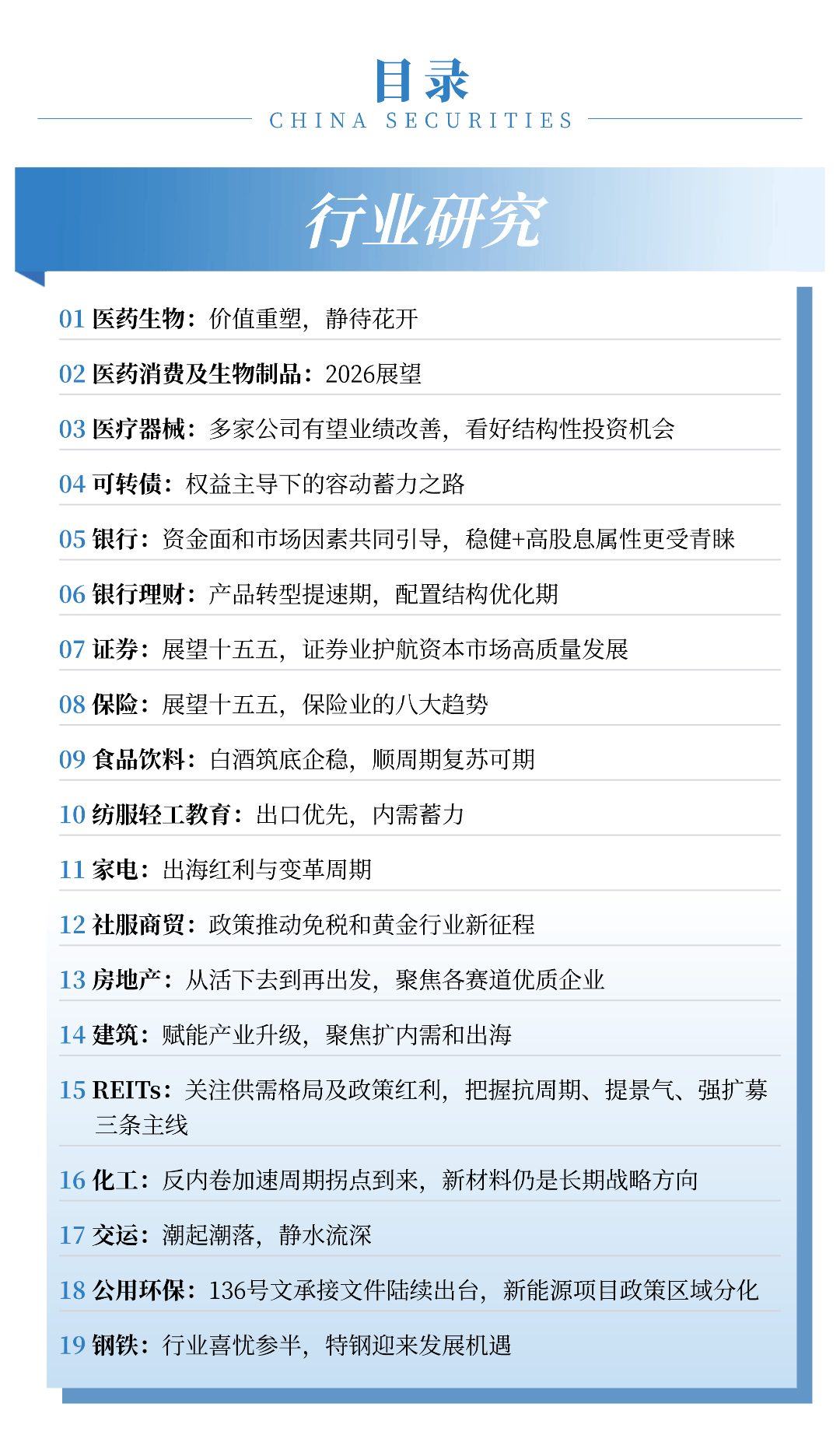
Group 1: Investment Strategies Overview - CITIC Securities released a comprehensive report on investment strategies for 2026, covering global capital markets, macroeconomic policies, A-shares, overseas markets, bond markets, asset allocation, and industry investment strategies [1] - The report includes insights from 19 research teams and spans approximately 30,000 words [1] Group 2: Pharmaceutical and Biotech Investment Strategies - The Chinese pharmaceutical industry is entering a critical phase characterized by "innovation realization + global layout," supported by population and domestic demand, as well as manufacturing capabilities [3][4] - The industry needs to focus on internal supply chain security and compliance while exploring diversified international expansion [3] - Key investment opportunities for 2026 include innovation commercialization, global breakthroughs, policy optimization, and industry mergers and acquisitions [3][5][6] Group 3: Medical Device Investment Strategies - The medical device sector is expected to see performance improvements in 2026 due to policy easing, new product launches, and international expansion [14] - The long-term investment opportunities in this sector stem from innovation, internationalization, and mergers and acquisitions [14] - The industry is witnessing a shift towards high-value consumables and innovative technologies such as brain-computer interfaces and AI in healthcare [14][15] Group 4: Consumer Healthcare and Bioproducts - The traditional Chinese medicine sector is expected to recover from short-term pressures, with improved demand anticipated by year-end [9] - The blood products industry is focusing on supply growth and consolidation, with significant demand for immunoglobulin and factor products [10] - The vaccine sector is under pressure but is expected to improve with new product sales and international expansion [10] Group 5: Banking Sector Investment Strategies - The banking sector is expected to continue its weak recovery in 2025, with a focus on high dividend strategies [25][26] - The sector's fundamentals are stabilizing, with credit growth projected at 7%-8% and non-interest income expected to improve [26] - High dividend yield strategies are favored, particularly for state-owned banks and those with solid fundamentals [27] Group 6: Wealth Management and Financial Products - The wealth management sector is entering a phase of product transformation and structural optimization, with an expected growth rate of 10% in 2026 [28][33] - The focus is on multi-asset and multi-strategy products, with a significant increase in mixed product offerings anticipated [29][30] - The integration of AI and digital technologies is expected to enhance risk management and operational efficiency in wealth management [30] Group 7: Non-Banking Financial Institutions - The securities industry is poised for a new growth cycle, driven by policies that enhance capital market inclusivity and adaptability [35][36] - The industry is experiencing a shift from self-operated models to collaborative, light-asset business strategies [36][37] - The internationalization of Chinese securities firms is gaining momentum, providing new opportunities for growth [38][39] Group 8: Insurance Sector Trends - The insurance industry is expected to undergo significant changes during the "14th Five-Year Plan" period, focusing on balancing interests among insurers, channels, and customers [43][44] - Key trends include the transformation of savings products, innovation in health insurance, and the development of new distribution channels [43][44] - The sector is anticipated to benefit from improved performance and valuation recovery, presenting investment opportunities [43][44] Group 9: Food and Beverage Sector - The food and beverage sector is recovering from a prolonged downturn, with a focus on premium products like liquor and health-oriented snacks [48][49] - The liquor industry is expected to stabilize as consumer confidence improves, with a focus on high-quality brands [49][50] - The snack and beverage segments are seeing growth driven by health trends and innovative product offerings [52][53]

深圳国际金融大会聚焦全球金融创新,业内人士认为—— 发挥险资长期稳健优势 股权投资仍有巨大潜力
Zheng Quan Shi Bao Wang· 2025-11-20 23:21
Core Insights - The Shenzhen International Financial Conference emphasizes the importance of financial innovation and the role of insurance capital in equity investment for economic development [1][2][3] Group 1: Financial Innovation and Technology - Technology innovation is highlighted as a national strategy and a core engine for reshaping the financial industry [1] - The share of venture capital investment in the technology sector, loans to high-tech enterprises, and the market capitalization of the A-share technology sector are all on the rise, indicating technology's critical role in driving the financial market [1] - Financial institutions are increasing their investments in fintech, shifting the industry's core competitiveness from traditional network expansion to technological advancement [1] Group 2: Talent Development - The total number and proportion of technology talents in China's financial institutions are steadily increasing, but there remains a gap compared to international financial centers like New York [2] - There is a need for collaboration between universities and the market to cultivate interdisciplinary and composite financial talents to support international competitiveness [2] Group 3: Insurance Sector Development - The insurance industry is urged to transition towards comprehensive risk management, focusing on four key areas: serving the real economy, enhancing social security, maintaining financial safety, and establishing a disaster insurance system [3] - The Greater Bay Area has implemented over 30 financial innovation measures during the 14th Five-Year Plan, creating a policy matrix to support high-quality regional financial development [2][3] Group 4: Equity Investment Potential - The core goal of insurance capital equity investment is to ensure capital safety while serving national strategies and the real economy [3] - Insurance capital investment has evolved from "limited opening" to "precise regulation," leading to a diversified investment landscape that extends from traditional infrastructure to new productive forces [3][4] - Recommendations for optimizing the policy environment for insurance capital include enhancing capital constraint mechanisms, clarifying rules, enriching asset management product systems, and opening innovative investment tools [4]
擦亮中小企业专精特新金字招牌
Jing Ji Ri Bao· 2025-11-20 22:14
Group 1 - As of now, China has cultivated over 140,000 specialized and innovative small and medium-sized enterprises (SMEs), with more than 17,600 national-level "little giant" enterprises contributing 9.6% of revenue and 13.7% of profits among large-scale industrial SMEs [1] - The Ministry of Industry and Information Technology (MIIT) has strengthened institutional arrangements to support the growth of specialized and innovative SMEs, including a development evaluation mechanism and financial support for over 4,200 "little giant" enterprises [1] - The integration of large, medium, and small enterprises is crucial for enhancing the resilience of industrial and supply chains, with over 500 technology innovation demands published by large enterprises and participation from more than 1,500 SMEs in the past two years [1] Group 2 - Digital transformation is essential for SMEs to develop in a specialized and innovative direction, with central financial support for over 45,000 SMEs and the establishment of over 3,500 digital transformation service providers [2] - The automotive industry, which has high demands for digital transformation, is seeing companies like Wuxi Huaguang Automotive Parts Group implement digital solutions to enhance production efficiency and traceability [2] - The MIIT has introduced a management approach for creating national public service demonstration platforms for SMEs, focusing on providing comprehensive services including digital transformation and innovation support [3] Group 3 - The MIIT aims to build a high-quality, efficient service system for SMEs, leveraging various innovation and entrepreneurship platforms to support the growth of SMEs [3] - The creation of public service platforms and bases is a key strategy to meet the diverse service needs of SMEs at different growth stages, with a focus on online services and local support [3] - Future efforts will include enhancing financial support mechanisms and leveraging fiscal funds to strengthen the precision of financial assistance for SMEs [3]
“数智”转型强引擎 科技赋能开新局
Xin Hua Ri Bao· 2025-11-20 21:18
Core Insights - The core viewpoint of the articles emphasizes the commitment of Taixing Rural Commercial Bank to technological innovation as a key driver for high-quality development, focusing on efficiency, risk control, and service optimization. Group 1: Digital Transformation Initiatives - The bank has implemented a digital application system covering front, middle, and back offices through a combination of independent research and external absorption, addressing operational pain points and enhancing performance evaluation and risk management systems [1]. - A new mechanism for data sharing and business collaboration has been established, allowing real-time access to critical information such as loan dynamics and account changes, thus breaking down traditional information barriers [1]. Group 2: Automation and Efficiency - The bank has developed 48 RPA application scenarios, improving business processing efficiency by over 30%, thereby freeing up human resources and reducing operational risks [2]. - Data is treated as a core production factor, with mechanisms in place for data collection, analysis, and application, enabling precise customer targeting and risk management through data-driven strategies [2]. Group 3: Talent Development - The bank places significant emphasis on building a skilled workforce for digital transformation, providing tailored training for key positions, which has resulted in over 200 personnel trained in data analysis and application [3]. - The training combines online theoretical learning with offline practical exercises, enhancing the ability of staff to analyze and solve problems using data tools [3]. Group 4: Future Directions - The bank plans to continue its focus on the integration of technology and business, exploring new applications of artificial intelligence and big data to enhance financial services and improve customer experiences [3].
深圳国际金融大会聚焦全球金融创新 业内人士认为——发挥险资长期稳健优势 股权投资仍有巨大潜力
Zheng Quan Shi Bao· 2025-11-20 19:16
Core Insights - The 2025 Shenzhen International Financial Conference focuses on "Global Financial Markets and Policy Innovation," gathering industry leaders to discuss new paths for financial development [1] - Keynote speeches emphasize the role of technology in reshaping the financial industry and the importance of insurance in supporting high-quality economic development during the 14th and 15th Five-Year Plans [1][2] Group 1: Technology in Finance - Technology innovation is highlighted as a national strategy and a core engine for transforming the financial industry [1] - Investment in technology by financial institutions is increasing, shifting the competitive landscape from traditional network expansion to technological advancement [1] - The share of venture capital investment in technology, loans to high-tech enterprises, and the market capitalization of the A-share technology sector are all on the rise, indicating technology's critical role in serving the real economy [1] Group 2: Talent Development - The total number and proportion of technology talents in China's financial institutions are steadily increasing, but there remains a gap compared to international financial centers like New York [2] - Future talent development should focus on cultivating interdisciplinary and composite financial talents through collaboration between universities and the market [2] Group 3: Insurance Sector Innovations - The insurance sector is urged to transition towards comprehensive risk management, focusing on four key areas: supporting the real economy, enhancing social security, maintaining financial safety, and establishing a disaster insurance system [3] - The Greater Bay Area has implemented over 30 financial innovation measures during the 14th Five-Year Plan, creating a policy matrix to support high-quality regional financial development [2] Group 4: Investment Strategies - Insurance fund equity investment is seen as crucial for building a strong financial nation, with a focus on ensuring fund safety while serving national strategies and the real economy [3] - The investment landscape for insurance funds has evolved from "limited opening" to "precise regulation," with a diversified investment approach extending into new productive industries [3][4] - Recommendations for optimizing the policy environment for insurance fund investments include enhancing capital constraints, clarifying rules, enriching asset management product systems, and opening innovative investment tools [4]
株洲千金药业股份有限公司关于2025年第三季度业绩说明会召开情况的公告
Shang Hai Zheng Quan Bao· 2025-11-20 19:14
Group 1 - The company held a Q3 2025 performance briefing on November 20, 2025, to discuss operational results and financial status with investors [1] - The meeting featured participation from the chairman, independent director, board secretary, and financial officer, who addressed investor inquiries [1] Group 2 - The company is expanding its production capacity through new workshops and upgrading existing production lines to meet the demand for new products [2] - The company reported a 32% year-on-year revenue growth in its sanitary products business for Q3 2025, while also focusing on digital transformation and new retail strategies [2] - The company maintains a leading position in the gynecological traditional Chinese medicine market, with a market share of 25.8% for its main product in 2024 [2] Group 3 - The company’s investment in Hunan Newhe Biopharmaceutical Co., Ltd. aims to enhance resource integration and strategic layout within the pharmaceutical industry [4] - The company is currently in the process of integrating three pharmaceutical companies to improve overall synergy [4] - The company’s cash management yields approximately 2% annually [8] Group 4 - The company plans to maintain stable dividends, having consistently provided a high proportion of cash dividends since its listing [6] - The company’s acquisition of Qianjin Xiangjiang and Qianjin Xieli is expected to enhance its performance, with consolidation of financial results starting in October and November 2025 [5] Group 5 - The company is undergoing a digital transformation in its pharmacy operations, shifting from a product-centric to a customer-centric model [9] - The collaboration with Alibaba focuses on building a C-end operation platform and a smart women's health platform [10]

广东明确3年内数字经济创新发展试验区建设目标 打造3个万亿级集群 AI核心产业规模超4400亿元
Zheng Quan Shi Bao· 2025-11-20 18:31
Core Viewpoint - The Guangdong Provincial Government has officially issued the "Guangdong Province National Digital Economy Innovation Development Pilot Zone Construction Plan (2025-2027)", aiming to establish Guangdong as a leading global digital economy hub by 2027 and to make the Guangdong-Hong Kong-Macao Greater Bay Area the highest digitalized bay area in the world [1][2] Summary by Sections Development Goals - By 2027, Guangdong aims to maintain the top position in digital economy development in China, with the core industries of the digital economy accounting for over 16% of GDP, the creation of three internationally competitive trillion-level digital industry clusters, and a data industry scale with an annual compound growth rate exceeding 15% [1] - The core industry scale of artificial intelligence is expected to exceed 440 billion, with over 60,000 large-scale industrial enterprises undergoing digital transformation and computing power exceeding 60 EFLOPS [1] Key Tasks - **Data Element Marketization Reform**: Focus on market-oriented allocation of data elements, enhancing the supply of core elements, and ensuring effective data flow and utilization [1] - **Infrastructure Optimization**: Strengthen the foundational infrastructure for digital economy development through the establishment of reliable data circulation networks and green collaborative computing networks [1][2] - **Core Technology Breakthroughs**: Accelerate breakthroughs in key technologies to foster international-level digital industry clusters, promoting innovation across the entire digital technology chain [2] - **Digital Transformation Promotion**: Advance the digital transformation of enterprises and industries, emphasizing the role of artificial intelligence in enhancing various sectors [2] - **Digital Economy Vitalization**: Support the establishment of digital finance investment funds and encourage state-owned enterprises to engage in digital economy investments [2] - **Collaborative Development**: Enhance cooperation within the Guangdong-Hong Kong-Macao Greater Bay Area and promote high-level open cooperation to elevate the province's digital economy collaboration and openness [2]