
代币化

Search documents
【招银研究|资本市场专题】认识代币货基,链上财富管理新版图——财富视角看稳定币系列之一
招商银行研究· 2025-08-01 08:47
Core Viewpoint - Tokenized money market funds (TMFs) represent a digital form of traditional money market funds, leveraging blockchain technology for enhanced traceability, transparency, and potential efficiency improvements. The market for TMFs in Hong Kong is expected to accelerate with the anticipated opening of secondary market trading [3][5][26]. Group 1: Understanding Tokenized Money Market Funds - TMFs are digital representations of traditional money market funds, where each token represents a share in the fund, maintaining similar underlying assets such as bonds and short-term deposits [7][8]. - The current TMFs in Hong Kong are primarily non-listed and only allow subscription and redemption in the primary market, with secondary market trading expected to be permitted within the year [8][10]. - The issuance of TMFs provides a dual distribution model, allowing participation through traditional brokers and digital asset platforms [7][8]. Group 2: Mechanism and Market Landscape - The operational mechanism of TMFs involves key participants such as tokenization service providers, custodians, and qualified distributors, ensuring compliance and security in managing tokenized assets [11][12]. - The TMF market in Hong Kong is rapidly developing, with various funds launched, including those by Bosera and Huaxia, covering multiple currencies [17][18][19]. Group 3: Comparison with Traditional Money Market Funds - The primary differences between TMFs and traditional money market funds include ownership recording methods, transparency levels, management fees, and transaction efficiency [20][21]. - TMFs utilize decentralized record-keeping via blockchain, enhancing transparency and reducing fraud risks compared to centralized systems of traditional funds [22]. - While TMFs currently have similar initial investment thresholds as traditional funds, future secondary market trading may lower these barriers [24][25]. Group 4: Future Prospects and Market Potential - The future of TMFs appears promising, driven by market demand, technological innovation, and regulatory clarity, with significant growth potential anticipated [26][27]. - The successful issuance of TMFs is expected to facilitate the connection between crypto assets and traditional financial assets, serving as a foundation for further tokenization in asset management [26][27]. - The market for TMFs is projected to grow significantly, with estimates suggesting that tokenized products could reach $400 billion by 2030, with TMFs being a key driver [28][32].


美国SEC推出“加密项目” 推动金融市场走向链上
Hua Er Jie Jian Wen· 2025-07-31 21:08
Group 1 - The SEC has launched a "crypto project" aimed at modernizing securities regulations to adapt to cryptocurrency-based trading models [1] - SEC Chairman Paul Atkins emphasized the need to evaluate the potential benefits and drawbacks of transitioning from off-chain to on-chain environments [1] - The concept of "tokenization" is gaining interest, which involves issuing digital certificates on blockchain networks that represent publicly traded securities or real assets [1] Group 2 - Crypto trading platforms like Robinhood, Gemini, and Kraken have opened tokenized stock services to non-U.S. users, while Coinbase is seeking SEC approval to offer similar services in the U.S. [2] - Atkins highlighted the importance of "super apps," which integrate multiple services into one mobile application, and called for efficient licensing structures to avoid overlapping regulations [3] - The U.S. government’s digital asset market working group released a report proposing frameworks to enhance the U.S.'s dominance in the digital asset market, which Atkins has directed the SEC's crypto task force to implement [3]

年内涨超160%!这只美股成散户最爱,原因是......
Jin Rong Jie· 2025-07-31 14:27
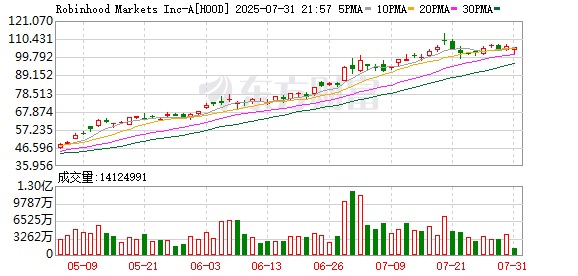
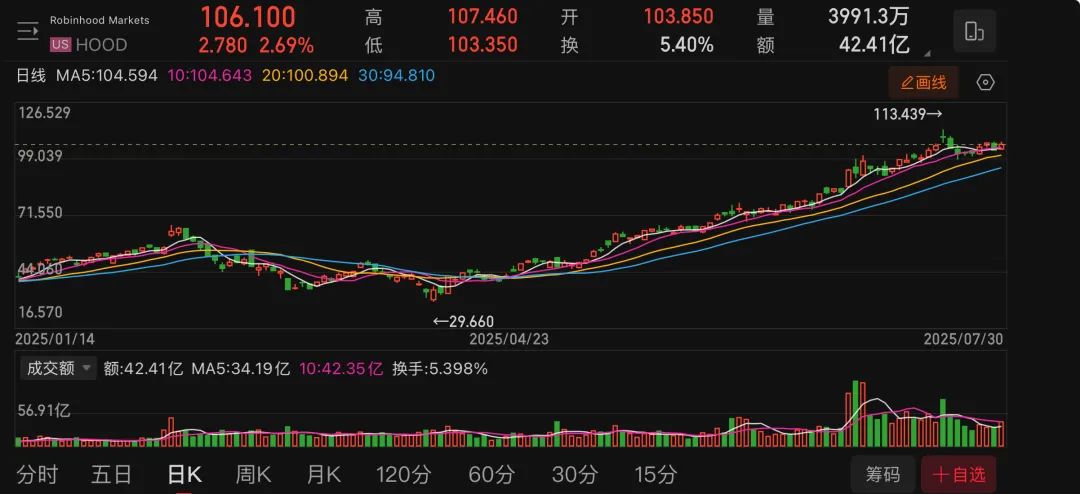
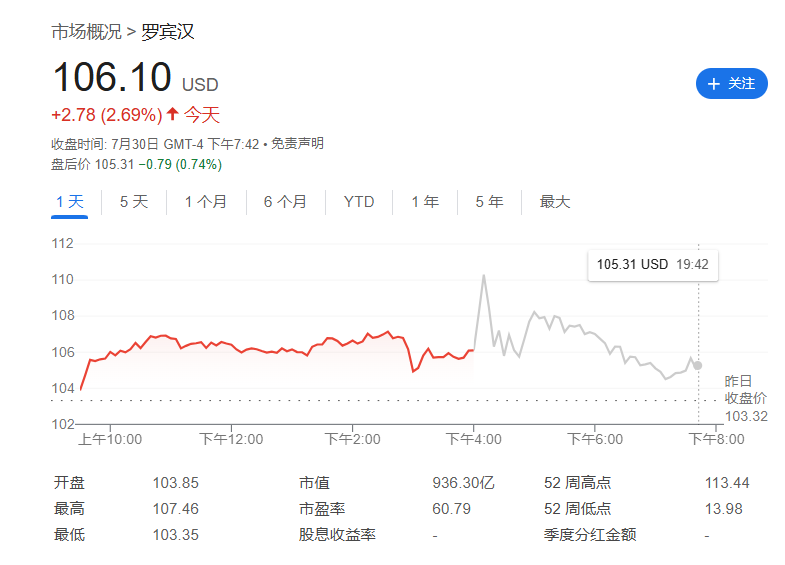
Core Insights - Robinhood reported a strong quarterly performance driven by the cryptocurrency trading boom, exceeding market expectations with total revenue of $989 million, a 45% year-over-year increase, and a net profit of $386 million, a 105% increase [1][2] - The company's cryptocurrency trading revenue was a standout, growing 98% year-over-year to $160 million, marking the fifth consecutive quarter of triple-digit growth [1][2] Revenue Growth - The impressive performance was attributed to significant increases in trading volumes across stocks, options, and cryptocurrencies [2] - Trading revenue, interest income, and other income are the main revenue sources, with cryptocurrency trading becoming a key growth driver [2][3] - Options trading revenue rose 46% to $265 million, while stock trading revenue increased 65% to $66 million [3] User Growth and Engagement - Robinhood saw a substantial increase in user engagement, with 2.3 million new funded accounts in Q2 2025, bringing the total to 26.5 million [3] - The average revenue per user increased by 34% year-over-year to $151, indicating enhanced user value [3] Long-term Financial Management - The platform's retirement account assets surpassed $20 billion, with 1.5 million clients holding retirement accounts, showcasing progress in long-term investment strategies [4] - Total assets on the platform surged 99% year-over-year to $279 billion, driven by strong net deposits and asset acquisitions [4] Market Position and Future Outlook - Despite its rapid growth, Robinhood has not been included in the S&P 500 index, raising concerns about its long-term financial stability and reliance on volatile trading revenues [5] - The company is expanding into tokenized financial products, which has sparked regulatory scrutiny and concerns about compliance and investor protection [6] - CEO Vlad Tenev expressed a preference for partnerships over obtaining a banking license, indicating a strategic approach to entering banking-related services [6]
年内涨超160%!这只美股成散户最爱 原因是......
Guo Ji Jin Rong Bao· 2025-07-31 13:57
Core Insights - Robinhood reported strong quarterly results driven by a surge in cryptocurrency trading, with total revenue increasing by 45% year-over-year to $989 million, surpassing market expectations of $908 million [2] - The company's net profit soared by 105% to $386 million, and diluted earnings per share (EPS) grew by 100% to $0.42 [2] - Cryptocurrency trading revenue was a standout, growing by 98% to $160 million, marking the fifth consecutive quarter of triple-digit growth [2][4] Revenue Growth - Robinhood's impressive performance is attributed to significant increases in trading volumes across stocks, options, and cryptocurrencies [4] - Trading revenue, interest income, and other income are the primary revenue sources, with trading revenue being the core component [4] - Options trading revenue rose by 46% to $265 million, while stock trading revenue increased by 65% to $66 million [5] - Net interest income grew by 25% to $357 million, driven by an expansion in interest-earning assets and active securities lending [5] User Growth and Engagement - The platform saw a substantial increase in user engagement, with 2.3 million new funded accounts in Q2 2025, bringing the total to 26.5 million, exceeding expectations [5] - The average revenue per user increased by 34% year-over-year to $151, indicating enhanced user value [5] Long-term Financial Management - Robinhood has made significant strides in long-term investment management, with retirement account assets surpassing $20 billion and 1.5 million customers holding retirement accounts [6] - The total asset scale of the platform surged by 99% year-over-year to $279 billion, supported by strong net deposits and rising valuations in stocks and cryptocurrencies [6] Future Outlook - Management expressed optimism for the future, noting strong performance in July with record trading volumes for stocks and options [7] - The company is exploring partnerships rather than pursuing a banking license, collaborating with Coastal Community Bank to launch bank-like products [9]
年内涨超160%!这只美股成散户最爱,原因是
Guo Ji Jin Rong Bao· 2025-07-31 13:45
Core Insights - Robinhood reported a strong quarterly performance driven by the cryptocurrency trading boom, exceeding market expectations with total revenue of $989 million, a 45% year-over-year increase, and a net profit of $386 million, a 105% increase [1][3] - The company's cryptocurrency trading revenue was a standout, growing 98% year-over-year to $160 million, marking the fifth consecutive quarter of triple-digit growth [1][3] Revenue Growth - The robust performance was attributed to significant increases in trading volumes across stocks, options, and cryptocurrencies, with trading revenue being the core component [3] - Cryptocurrency trading revenue has been a key driver of overall revenue growth, with a notable 700% increase in Q4 2024, reaching $358 million, and a 98% increase in Q2 2025 [3][4] User Growth and Engagement - Robinhood saw a substantial increase in user engagement, with 2.3 million new funded accounts in Q2 2025, bringing the total to 26.5 million, surpassing expectations [4] - The average revenue per user increased by 34% year-over-year to $151, indicating enhanced user value [4] Long-term Financial Management - The platform's retirement account assets surpassed $20 billion, with 1.5 million customers holding retirement accounts, showcasing progress in long-term investment strategies [5] - Total assets on the platform surged 99% year-over-year to $279 billion, driven by strong net deposits and asset acquisitions [5] Regulatory and Competitive Landscape - Despite its rapid growth, Robinhood has not been included in the S&P 500 index, raising concerns about its long-term financial stability and reliance on volatile trading revenues [6] - The introduction of synthetic stock tokens for companies like OpenAI and SpaceX has sparked regulatory scrutiny, with potential compliance issues and investor protection concerns [6][7] Strategic Partnerships - The CEO expressed a preference for partnerships over obtaining a banking license, indicating a collaboration with Coastal Community Bank to launch bank-like products [7]
中信建投应瑛:香港稳定币开闸,数字人民币 、RWA 如何破局
Sou Hu Cai Jing· 2025-07-31 04:36
Core Viewpoint - The implementation of the Stablecoin Regulation in Hong Kong marks a significant shift in the international payment landscape, aiming to enhance the global status of Hong Kong as a virtual asset hub and facilitate the internationalization of the Renminbi while promoting a "de-dollarization" strategy [1] Group 1: Stablecoin and Digital Currency - Hong Kong's stablecoin and digital Renminbi are complementary rather than competitive, working together to create a "de-dollarized" payment network through "currency bridges" and on-chain payments [2] - The stablecoin is positioned as a fiat currency on-chain, while Real World Asset (RWA) tokenization focuses on asset financing and trading [3] Group 2: Regulatory and Market Dynamics - The high entry barrier for stablecoin licenses in Hong Kong (HKD 25 million capital and 100% high liquidity asset reserve) may guide the market towards licensed brokers and banks, but technology giants can also play a significant role due to their extensive application scenarios [5][7] - The stablecoin market is expected to see increased competition in the distribution and application phases, providing brokers with new revenue opportunities in virtual asset trading services [7] Group 3: Technological and Operational Challenges - The main technical challenge lies in accurately reflecting the value of on-chain assets [4] - The successful implementation of a "H-share model 2.0" requires addressing foreign exchange controls, financial compliance, and anti-money laundering reviews [5] Group 4: Market Trends and Projections - The trading volume of stablecoins is projected to exceed that of Visa and Mastercard by 2024, with a 53% increase in active wallets in Hong Kong [8][10] - The application of stablecoins in cross-border payments is driven by regulatory improvements, technological advancements, and growing market demand, positioning it as a core application scenario [8] Group 5: Competitive Landscape - The emergence of stablecoins may impact the financing space for emerging markets, particularly as U.S. stablecoins anchor to low-risk assets like U.S. Treasury bonds [9] - Tokenization of high-yield Hong Kong stocks could attract international capital with a higher risk appetite [9]

2025年香港资产管理和私募股权展望报告
Sou Hu Cai Jing· 2025-07-31 01:45
Group 1: Industry Overview - The Hong Kong asset management and private equity industry is demonstrating resilience amidst global geopolitical uncertainties and uneven economic recovery, solidifying its position as a financial hub in the Asia-Pacific region [1][13][18] - By the end of 2024, the total assets under management in Hong Kong's asset and wealth management industry are expected to grow by 13% year-on-year, reaching HKD 35.1 trillion, with net inflows surging by 81% [1][18][21] Group 2: IPO Market Performance - In the first half of 2025, Hong Kong raised HKD 107.1 billion through IPOs, marking the highest level since 2021, driven by "A+H" listings contributing 72% of the total financing [1][21][22] - The strong performance of the IPO market is supported by a robust pipeline of companies in technology, healthcare, and consumer sectors, with a record 26 A-share companies seeking dual listings in Hong Kong [1][21] Group 3: Industry Consolidation and Trends - Global asset management is experiencing significant consolidation, with firms seeking to expand scale and product offerings through mergers and acquisitions, a trend also evident in Hong Kong [2][27][28] - The rise of a "multi-strategy supermarket" model is emerging, where firms offer a wide range of investment solutions to meet the diverse needs of Asia's growing middle class [2][27] Group 4: Regulatory Developments - The Hong Kong Securities and Futures Commission (SFC) is enhancing scrutiny of asset management firms, focusing on potential risks in private fund management and aiming to improve compliance standards [2][34][37] - Key regulatory priorities include investor protection, cybersecurity, and the implementation of robust internal controls to mitigate risks in the digital age [2][34][39] Group 5: Tax Policy Optimization - Hong Kong is reforming its Unified Fund Exemption (UFE) system to include more investment categories and simplify approval processes, enhancing tax certainty for fund managers [3][43][44] - The proposed reforms aim to attract international fund managers by providing clearer guidelines and expanding the scope of tax exemptions [3][43][45] Group 6: Private Equity and Alternative Investments - Despite geopolitical tensions, the Chinese mainland market remains vibrant, with active RMB funding providing exit opportunities for foreign investors [3][48] - The emergence of structured liquidity solutions is accelerating the development of the secondary private equity market, catering to the growing demand for liquidity and exit strategies [3][48] Group 7: Cross-Border Cooperation and Technological Innovation - Hong Kong is enhancing cross-border investment facilitation, with initiatives like "Cross-Border Wealth Management Connect 2.0" expanding participation and product offerings [4][13] - Technological innovations, particularly in artificial intelligence and virtual assets, are reshaping the industry landscape, improving operational efficiency and attracting retail investors [4][5][13] Group 8: Family Offices and Wealth Management - The number of family offices in Hong Kong is projected to grow by 43% by 2025, driven by government initiatives to attract ultra-high-net-worth individuals [5][13] - Local asset management firms are expanding services to include wealth management and tax consulting, enhancing Hong Kong's appeal to global family offices [5][13]
数字币交易接近翻倍,“美国网红券商”Robinhood业绩超预期
Hua Er Jie Jian Wen· 2025-07-31 00:37
Group 1 - Robinhood reported a strong quarterly performance with total net revenue increasing by 45% year-over-year to $989 million, surpassing analyst expectations of $921.5 million [1] - Cryptocurrency trading revenue was a significant highlight, soaring by 98% to $160 million, just below the analyst forecast of $162.1 million, ending a streak of five consecutive quarters of triple-digit growth [1] - The company's net profit doubled to $386 million, equating to earnings of $0.42 per share, exceeding market expectations [1] Group 2 - CFO Jason Warnick expressed optimism about the company's future, noting a strong start to the third quarter with net customer deposits accelerating to approximately $6 billion and robust trading activity [3] - Robinhood has accelerated its innovation in the cryptocurrency space, launching "tokenized" stocks in 30 European countries, which has drawn regulatory scrutiny [3] - The tokenized stock trading allows retail investors in Europe to purchase tokens linked to shares of private companies like OpenAI and SpaceX, but has faced opposition from OpenAI and investigation from European regulators [3] Group 3 - Robinhood is opting for a partnership model with banks rather than applying for a banking license, as CEO Vlad Tenev believes the drawbacks of obtaining a banking license outweigh the benefits [4] - The company is collaborating with Coastal Community Bank to launch bank-like products, reflecting a strategy to balance rapid expansion with compliance risks [4]
Virtu Financial(VIRT) - 2025 Q2 - Earnings Call Transcript
2025-07-30 13:00
Financial Data and Key Metrics Changes - The company recorded $568 million in adjusted net trading income, which translates to $9.2 million per day, marking a 50% increase from $6.1 million per day in Q2 2024 [23][24] - Adjusted EPS for Q2 2025 was $1.53, an 83% increase compared to Q2 2024 [24] - The adjusted EBITDA margin reached 65%, the highest since 2022, reflecting disciplined expense management [21][24] Business Line Data and Key Metrics Changes - Market Making contributed $451 million to adjusted net trading income, while Execution Services contributed $116 million, both reflecting strong performance against market opportunities [10] - Growth initiatives reached an all-time high of $1.3 million per day, accounting for 15% of total adjusted net trading income [10] - The institutional business, Virtu Execution Services (VES), recorded $116 million in adjusted net trading income, indicating strong growth potential [13] Market Data and Key Metrics Changes - Mean realized volatility was 30, with the VIX averaging 24, indicating a favorable trading environment [12] - Equity TCV was up 17% quarter-over-quarter, while notional U.S. equity volumes increased by 9% [12] Company Strategy and Development Direction - The company is focused on expanding its ETF block offering in Europe and enhancing its digital asset capabilities, which are expected to drive future growth [11][16] - The management sees broader crypto adoption as a significant driver of future volume and activity, positioning the company as a key partner in the evolving ecosystem [17] - The transition in leadership to Aaron Simons is expected to bring continuity in core values while introducing a fresh perspective on growth opportunities [20] Management's Comments on Operating Environment and Future Outlook - Management expressed optimism about sustained retail engagement post-pandemic and highlighted structural trends that should compound growth in the coming quarters [15] - The regulatory landscape is viewed positively, with upcoming legislation expected to create new products that require liquidity, aligning with the company's strengths [17] - The company anticipates that the overnight trading market will continue to grow, driven primarily by retail engagement, with potential for institutional participation in the future [94] Other Important Information - The company repurchased $66 million worth of shares in the quarter, totaling $135 million year-to-date, and has repurchased $1.4 billion since the inception of its share repurchase program [21][25] - The leadership transition is seen as a strategic move to ensure the company's continued success and growth [20] Q&A Session Summary Question: Introduction to Aaron Simons and transition details - Management provided background on Aaron Simons, highlighting his long tenure and contributions to the company, and discussed the planned transition process [27][30] Question: Impact of potential repeal of the order protection rule - Management indicated that the repeal could be neutral to slightly positive for the company, potentially reducing overhead costs associated with connecting to various venues [39][43] Question: Strategic merits of operating a hedge fund alongside market making - Management acknowledged the consideration of launching a hedge fund but emphasized the cultural shift it would entail and the current focus on market making [44][48] Question: M&A opportunities and priorities - Management stated that while they continuously evaluate M&A opportunities, the current focus has been on share repurchases, which have proven to be highly accretive [55][58] Question: Opportunities from stablecoin adoption - Management expressed excitement about the potential for stablecoin adoption to drive digital asset transactions and the company's readiness to facilitate these conversions [62][66] Question: Tokenization of equities and market implications - Management discussed the potential for tokenized equities to create new market opportunities, particularly for overseas clients, while emphasizing the need for regulatory clarity [72][74]

万众瞩目!白宫即将发布特朗普时代首份加密货币政策定调报告
智通财经网· 2025-07-30 12:19
Core Viewpoint - The cryptocurrency working group established by President Trump is set to release a policy report that will clarify the government's stance on critical issues affecting the digital asset industry, including tokenization and cryptocurrency legislation [1] Group 1: Regulatory Framework - The report is expected to outline the regulatory framework necessary for the development of cryptocurrency, fulfilling Trump's campaign promise for comprehensive reform in U.S. cryptocurrency policy [1] - It will detail the need for the SEC to establish a framework that allows companies to issue blockchain-based stocks and bonds [1] - The report will also express the government's expectations regarding ongoing legislative discussions in Congress aimed at creating broad regulatory guidelines for cryptocurrencies [1][2] Group 2: Tokenization and Market Structure - Industry participants are particularly interested in the report's content on tokenization, which refers to converting financial assets like bank deposits, stocks, and bonds into crypto assets [3] - The report is anticipated to recognize the necessity for the SEC to develop a framework for tokenization, although specific wording details remain unclear [3] - The White House's expectations for Congress regarding cryptocurrency market structure legislation will also be clarified in the report, following the House's passage of the "Clarity Act" to establish a regulatory framework for cryptocurrencies [3] Group 3: Stablecoins - Recently, Trump signed a bill to establish federal rules for stablecoins, which are cryptocurrencies pegged to the U.S. dollar, marking a significant victory for the digital asset industry [3] - The White House hopes that Congress will subsequently pass market structure legislation that will have a broader impact on the industry [3] Group 4: Conflicts of Interest - Concerns regarding conflicts of interest have arisen due to Trump's support for the cryptocurrency industry, particularly as his family has launched a cryptocurrency and he holds shares in a crypto platform [4]