
国产化替代

Search documents
研判2026!中国高压大电流连接器接触件行业进入壁垒、市场政策汇总、产业链图谱、市场规模、竞争格局及发展趋势分析:国产化替代进程加速[图]
Chan Ye Xin Xi Wang· 2026-01-20 01:18
Core Insights - The rapid growth of China's new energy vehicle market is driving the demand for high-performance high-current connectors, with the market expected to reach 12.68 billion yuan by 2025, a year-on-year increase of 14.0% [1][7]. Overview - High-voltage high-current connection systems are essential components for power transmission in various applications, including new energy vehicles, energy storage, and industrial equipment [2][3]. Market Demand - The demand for high-current connectors is primarily driven by the new energy vehicle sector, which is projected to account for over 60% of the market by 2025 [6][7]. - The expansion of the energy storage industry and the upgrade of industrial automation equipment are also contributing to the growing demand for high-performance connectors [1][5]. Industry Barriers - The high-voltage high-current connector industry has significant technical barriers, requiring substantial investment in research and development across multiple disciplines [5][6]. - Leading companies have established proprietary designs and advanced simulation modeling techniques, creating a challenging environment for new entrants [5][6]. Market Policies - The Chinese government has implemented various policies to support the development of the electronic components industry, including high-voltage high-current connectors, creating a favorable environment for growth [6][7]. Competitive Landscape - The market is characterized by a mix of international giants and rapidly growing domestic companies, with international firms like TE, Amphenol, and Molex dominating the high-end market [8][9]. - Domestic companies such as AVIC Optoelectronics and Lixun Precision are leveraging local market opportunities and technological advancements to enhance their competitiveness [8][9]. Development Trends - The industry is expected to see continuous upgrades in technology and performance, adapting to higher voltage platforms and improving key performance metrics [13][14]. - The demand for high-current connectors will be driven by multiple sectors, including new energy vehicles, energy storage, and industrial automation [14][15]. - Domestic companies are accelerating the pace of technological breakthroughs and market penetration, aiming to reduce reliance on international brands [15][16]. - The focus on green and intelligent transformation will shape the industry's future, with an emphasis on sustainable materials and smart manufacturing technologies [16].




深挖合作潜力,抢抓“中国红利”,中韩开启新一轮自贸协定谈判
Huan Qiu Shi Bao· 2026-01-19 22:59
Group 1 - The second phase of the Korea-China Free Trade Agreement (FTA) negotiations has commenced in Beijing, with both countries aiming to achieve substantial progress by the end of the year [1][2] - The FTA, effective since December 20, 2015, has significantly contributed to South Korea's economy, generating hundreds of billions of dollars in trade surplus with China annually, but South Korea is now facing a trade deficit for the first time since diplomatic relations began in 1992 [1][2] - The current negotiations focus on market access in the service, investment, and financial sectors, which are seen as crucial for South Korea to capitalize on the "second round of the China dividend" [2][4] Group 2 - The trade dynamics between South Korea and China have shifted, with South Korea's exports to China declining by an average of 0.3% annually, while imports from China have increased by 5% annually, leading to a trade deficit starting in 2023 [3] - The South Korean government is optimistic about leveraging its strengths in finance, law, and culture to regain market share in China, aiming to offset the merchandise trade deficit with service trade surpluses [4][6] - The geopolitical context, including pressure from the U.S. on South Korean semiconductor manufacturers, is influencing South Korea's urgency to strengthen economic ties with China [5][6]
澄天伟业(300689) - 2026年1月19日投资者关系活动记录表
2026-01-19 16:00
Group 1: Liquid Cooling Business - The company has developed a series of liquid cooling products, including stainless steel corrugated pipes and related components, and is assisting Taiwanese clients with liquid cooling plate components and process validation [1] - A total investment of CNY 362 million is planned for the industrialization of liquid cooling systems, with CNY 114 million allocated for the liquid cooling R&D center and group information technology projects [1] - The liquid cooling business is in an active market expansion phase, with current revenue scale being small but ongoing sample testing and mass production with major clients [1] Group 2: Semiconductor Packaging Materials - The semiconductor packaging materials business is involved in supplying materials for MOSFET, IGBT, and SiC power modules, with projected revenue from this segment accounting for nearly 10% of total revenue in 2024 [4] - The business is expected to maintain strong growth in 2025, with major clients including well-known domestic power semiconductor packaging companies [4] - The company aims to enhance its production capacity for lead frames and high thermal conductivity copper heat dissipation bases to capitalize on the domestic market's demand and the trend of localization [4] Group 3: Smart Card Business - The smart card business is stable, with a significant portion of revenue coming from international markets, driven by the demand for identity authentication and financial security [5] - The company is focusing on upgrading this business towards service-oriented models to improve profit margins, while maintaining its current scale [5] - Future investments will be more concentrated on semiconductor packaging materials and liquid cooling businesses, reflecting a strategic shift [5] Group 4: Risks and Compliance - The company acknowledges potential technical, market, and application validation risks associated with new business and product development [6] - It emphasizes adherence to legal and regulatory requirements for information disclosure, urging investors to make rational investment decisions and be aware of risks [6]
调研速递|天禄科技接待申银万国等5家机构 TAC膜国产化进程引关注
Xin Lang Zheng Quan· 2026-01-19 10:32
Group 1 - The core viewpoint of the article highlights the progress and feasibility of domestic production of TAC film in China, driven by the acceleration of the localization of the polarizer segment [2][6] - The transfer path of the liquid crystal display industry chain is outlined as "USA-Japan-Korea-Taiwan-China," with Japan still dominating core component technology [2] - The domestic production of LCD panels has reached approximately 70% of global capacity since BOE established its first production line in 2005 [2] Group 2 - The collaboration between BOE and Tianlu Technology for the TAC film project began in 2020, driven by the trend of polarizer localization [3] - The construction of the factory for the TAC film project is progressing steadily, with the main equipment expected to be installed and tested in the first half of 2026 [4] - The company holds a 56.4603% stake in Anhui Jiguang after the recent financing round, ensuring it will continue to consolidate the financial results of the subsidiary [5]
国产EDA厂商再获加注,上海国资拟斥资6.92亿元入股概伦电子
Guan Cha Zhe Wang· 2026-01-19 09:02
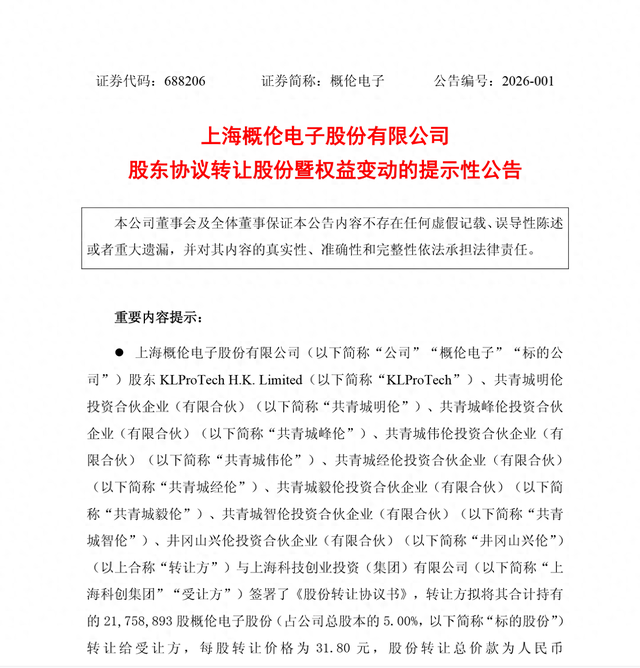
Group 1 - Shanghai Gaialen Electronics Co., Ltd. announced the introduction of a strategic investor, Shanghai Science and Technology Venture Investment (Group) Co., Ltd., which will acquire 5.00% of its shares [1] - The share transfer agreement involves the transfer of approximately 21.7589 million unrestricted circulating shares at a price of 31.80 yuan per share, totaling approximately 692 million yuan [1] - Following the transaction, Shanghai Science and Technology Venture Investment will become a significant shareholder and has committed not to reduce its holdings for 18 months [1] Group 2 - The investment is part of a strategic cooperation agreement aimed at enhancing business collaboration and building an industrial investment ecosystem [2] - Shanghai Science and Technology Venture Investment, established in 2014 with a registered capital of 5.5 billion yuan, is a wholly-owned subsidiary of Shanghai State-owned Capital Investment Co., Ltd., managing assets worth 88.6 billion yuan [2][3] - Gaialen Electronics is the first listed EDA company in China, providing comprehensive EDA solutions and is currently undergoing a major asset restructuring worth 2.174 billion yuan [4] Group 3 - The company aims to transition from an "EDA tool provider" to a one-stop chip design solution platform, potentially becoming the first listed company in China to achieve deep collaboration between EDA and semiconductor IP [4] - In the first three quarters of 2025, Gaialen Electronics reported revenue of 315 million yuan, a year-on-year increase of 12.71%, and a net profit of 41.99 million yuan, a significant year-on-year increase of 173.46% [4]

国产化替代背后,“制造能力不差,缺的是品牌和销售途径”
Guan Cha Zhe Wang· 2026-01-19 03:27
Core Insights - JD's mission is to be a technology and service provider based on supply chains, focusing on supply chain services across various industries [1] - The current issue in China's supply chain is not a lack of products but an oversupply, with excessive information technology implementation that often does not add value [1] - The Taipu brand by JD Industrial addresses pain points in manufacturing by providing solutions that enhance procurement efficiency, reducing procurement time from months to hours [1] Group 1 - JD Industrial has over 50 million SKUs supporting the industrial procurement system, enabling rapid sourcing and standardization of materials [1] - The manufacturing sector in China has been rapidly evolving, but many companies have not effectively integrated their supply chain systems [1] - The emergence of "domestic substitution" as a response to geopolitical challenges has created new opportunities for Chinese manufacturing [2] Group 2 - JD serves as a platform to help Chinese manufacturers enhance their brand, sales channels, and customer reach, addressing gaps in the market [2] - The company leverages its supply chain capabilities to assist both domestic and international businesses in overcoming challenges [2]

港股速报 | 调整来袭 港股低开 航空股逆势走高
Sou Hu Cai Jing· 2026-01-19 03:17
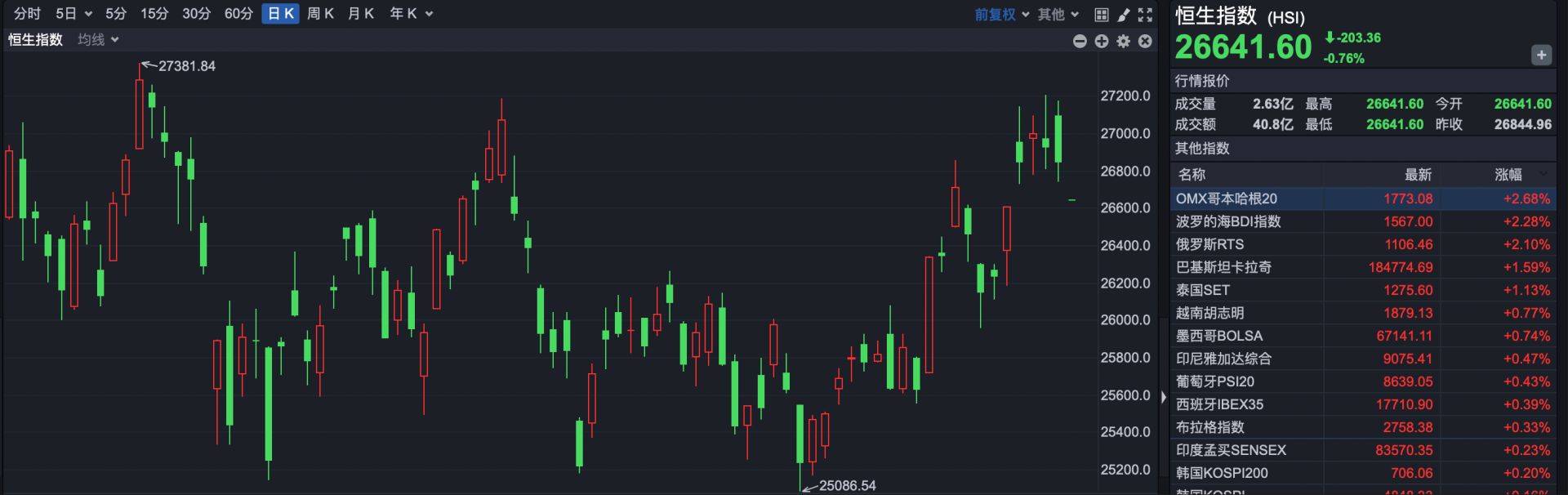
Market Overview - The Hong Kong stock market opened lower on January 19, with the Hang Seng Index at 26,641.60 points, down 203.36 points, a decline of 0.76% [1] - The Hang Seng Tech Index opened at 5,777.07 points, down 45.11 points, a decrease of 0.77% [4] Airline Sector Performance - Airline stocks showed resilience, with China Eastern Airlines (HK00670) rising over 6%, and both China Southern Airlines (HK01055) and Air China (HK00753) increasing by more than 2% [3] - China Eastern Airlines reported a 4.93% year-on-year increase in passenger capacity for December 2025, with passenger turnover up 7.61% and a seat load factor of 85.65%, up 2.14 percentage points [6] - China Southern Airlines announced an 11.89% year-on-year increase in passenger capacity for December 2025, with passenger turnover up 11.20% and a seat load factor of 84.05%, down 0.53 percentage points [7] - Air China reported a 4.0% year-on-year increase in passenger capacity for December 2025, with passenger turnover up 10.0% and a seat load factor of 82.2%, up 4.5 percentage points [7] Other Sector Movements - The technology sector saw widespread declines, with Bilibili dropping over 4%, Alibaba and Kuaishou down over 2%, and Xiaomi and Meituan down over 1% [7] - The metals sector was active, with Zijin Mining opening over 1% higher [7] - The lithium battery sector experienced mostly gains, with BYD rising over 1% [7] - The domestic real estate sector faced declines, with Country Garden falling over 10% [7] - The biopharmaceutical sector opened lower, with Tigermed down over 2% [7] Economic Outlook - According to Galaxy Securities, the U.S. CPI for December 2025 rose 2.7% year-on-year, with core CPI up 2.6%, both in line with previous values [8] - The U.S. PPI for November increased by 3%, exceeding the forecast of 2.7% [8] - Initial jobless claims in the U.S. decreased by 9,000 to 198,000, significantly below the market expectation of 215,000, marking the lowest level since November of the previous year [8] - China's foreign trade in 2025 reached 45.47 trillion yuan, a year-on-year growth of 3.8%, marking nine consecutive years of growth [8] - The M2-M1 spread at the end of December 2025 was 4.7 percentage points, widening from the previous month's 3.1 percentage points [8] Investment Recommendations - The technology sector remains a long-term investment focus, benefiting from price increases in the supply chain, domestic substitution, and accelerated AI applications [8] - The consumer sector is expected to continue benefiting from policy support, with attention needed on policy implementation and improvements in consumption data [8] - Given the escalating geopolitical tensions, precious metals and other safe-haven assets are likely to benefit [8]
A股三大指数集体低开,创业板指跌0.6%
Feng Huang Wang Cai Jing· 2026-01-19 01:36
Group 1 - A-shares opened lower with all three major indices declining: Shanghai Composite Index down 0.27%, Shenzhen Component Index down 0.41%, and ChiNext Index down 0.6% [1] - The commercial aerospace and AI application sectors experienced significant declines, indicating a potential overheating in these areas [1] Group 2 - CITIC Securities suggests that the recent active cooling of the market may lead to adjustments in previously hot sectors, but the overall cross-year market trend remains intact [2] - The firm highlights sectors such as AI computing power, non-ferrous metals, innovative pharmaceuticals, and automotive as having clear growth catalysts, while previously hot sectors like commercial aerospace and AI applications may undergo temporary adjustments [2] Group 3 - Guosheng Securities indicates that the recent market downturn may have reached its short-term limit, with the Shanghai Composite Index down 0.45% for the week [3] - The firm notes that 23 sectors are currently experiencing daily-level increases, suggesting a healthy market environment with potential for continued upward movement [3] Group 4 - Galaxy Securities anticipates narrow fluctuations in the Hong Kong stock market due to reduced expectations for short-term interest rate cuts by the Federal Reserve and increased geopolitical uncertainties [4] - The firm recommends focusing on the technology sector as a long-term investment theme, driven by multiple positive factors including price increases in the supply chain and accelerated AI applications [4] - The consumer sector is expected to benefit from policy support, with current valuations at relatively low levels, indicating significant long-term upside potential [4]

银河证券:港股或窄幅震荡
Sou Hu Cai Jing· 2026-01-19 00:32
Group 1 - The core viewpoint indicates that the Federal Reserve's expectation for interest rate cuts in the short term has decreased, leading to increased geopolitical uncertainty which will affect investor risk appetite, resulting in a forecast of narrow fluctuations in the Hong Kong stock market [1] Group 2 - The technology sector is expected to remain a long-term investment focus, benefiting from multiple positive factors such as price increases in the supply chain, domestic substitution, and accelerated AI application [1] - The consumer sector is likely to continue benefiting from policy support, with current valuations at relatively low levels, indicating significant medium to long-term upside potential; future attention should be paid to the implementation of policies and improvements in consumer data [1] - Due to escalating geopolitical tensions, safe-haven assets like precious metals are expected to benefit [1]
银河证券:全球地缘政治不确定性加剧 预计港股窄幅震荡
智通财经网· 2026-01-19 00:24
Group 1 - The report from Galaxy Securities indicates that the expectation for a short-term interest rate cut by the Federal Reserve has decreased, and global geopolitical uncertainties are increasing, leading to a forecast of narrow fluctuations in the Hong Kong stock market [1] - The technology sector is highlighted as a long-term investment focus, benefiting from multiple positive factors such as price increases in the supply chain, domestic substitution, and accelerated AI applications [1] - The consumer sector is expected to continue benefiting from policy support, with future attention needed on the implementation of policies and improvements in consumer data [1] Group 2 - In the past week, the Hong Kong stock market showed strong performance, with the Hang Seng Index rising by 2.34%, the Hang Seng Tech Index by 2.37%, and the Hang Seng China Enterprises Index by 1.90% [2] - Among the primary industries, nine sectors increased while two decreased, with materials, consumer staples, and information technology leading the gains at 4.31%, 3.91%, and 3.60% respectively [2] - The average daily trading volume on the Hong Kong Stock Exchange was HKD 301.69 billion, an increase of HKD 28.58 billion from the previous week [2] Group 3 - As of January 16, 2026, the PE and PB ratios of the Hang Seng Index were 12.20 times and 1.24 times, respectively, reflecting increases of 0.44% and 0.52% from the previous week [3] - The risk premium for the Hang Seng Index is at 3.95%, which is significantly below the three-year rolling average, indicating a low-risk appetite among investors [3] - The premium index for the Hong Kong-Shanghai Stock Connect has decreased to 120.43, placing it at the 17th percentile level since 2014 [3]