房住不炒

Search documents
房产持有成本全面调整,三大政策影响上亿房主
Sou Hu Cai Jing· 2025-07-14 00:32
Core Viewpoint - A significant transformation in China's real estate policy has begun, marked by a series of heavy-weight regulations aimed at property ownership, rental, and loans, reflecting a shift towards a healthier and more stable real estate market [1][9]. Policy Adjustments - The Ministry of Housing and Urban-Rural Development and the Ministry of Finance released the "Guiding Opinions on Adjusting Urban Housing Holding Costs," introducing a differentiated housing holding cost adjustment mechanism, where costs increase with the number of properties owned [1][2]. - The new holding costs are categorized into basic service fees, property management fees, and a newly introduced urban housing resource occupation fee, which will be charged progressively based on property valuation [2][3]. Taxation Changes - The "Management Measures for Individual Rental Income Tax" will enforce stricter tax collection on individuals with multiple rental properties, transitioning from a flat-rate to a 20% tax on actual rental income, with a higher rate of 25% for those owning five or more properties [3][5]. - The expected increase in tax revenue from these measures is projected to exceed 800 billion yuan, highlighting the potential for improved tax collection efficiency [5]. Loan Management - The "Notice on Strengthening Personal Housing Loan Management" sets stricter conditions for loans on multiple properties, with a minimum down payment of 50% for the second home and 70% for the third and subsequent homes [4][7]. - Loan interest rates will also increase with the number of properties owned, with the rate for a third home reaching 4.95%, significantly higher than the first home [7]. Market Reactions - Following the announcement of these policies, there was a 12.7% increase in the number of second-hand homes listed in major cities, while prices saw a slight decline of 1.3% [8]. - Many banks reported a more than 60% increase in early repayment applications, primarily from owners of multiple properties [8]. Long-term Implications - The policies are expected to suppress speculative buying and promote a healthier rental market, aligning with international practices in real estate regulation [8][9]. - The overall aim is to shift the focus of the real estate market back to residential needs rather than speculative investment, ultimately fostering a more sustainable development model [9].


7月开始,是“尽快买房”还是“再等一等”?马云王石不谋而合
Sou Hu Cai Jing· 2025-07-13 23:41
Core Viewpoint - The real estate market in 2025 is experiencing uncertainty, with key figures like Jack Ma and Wang Shi providing insights that suggest a potential turning point in July, indicating a cautious optimism for market recovery [1][3][6] Group 1: Market Adjustment and Recovery - Both Ma and Wang agree that the market has undergone a significant adjustment period, with Ma stating that the adjustment is nearing its end and Wang noting that the market is in a phase of adjustment [3][5] - They emphasize that the potential for further significant declines in the market is limited, with a focus on stability being the prevailing theme [3][5] Group 2: Policy Impact - Both figures express optimism regarding the future effects of policy changes, with Ma predicting a more relaxed policy environment in the second half of the year and Wang highlighting the importance of policy effects becoming evident after July [5][6] - Recent government measures aimed at ensuring housing delivery, optimizing purchase restrictions, and lowering down payments and interest rates are seen as critical support for their market outlook [5] Group 3: Housing as a Necessity - Ma stresses the need for real estate to return to its fundamental role as housing, while Wang warns that any market recovery should not revert to previous high-growth patterns, aligning with the national stance of "housing is for living, not for speculation" [5][6] - This shift indicates that the previous investment-driven logic based on soaring property prices is no longer viable, with future market dynamics expected to be driven by residential demand [5][6] Group 4: Buyer Guidance - For potential homebuyers, those with genuine housing needs and financial capability may find it a suitable time to enter the market, while investors should remain cautious and avoid unrealistic expectations of price surges [5][6]

投资吗?倾家荡产的那种……
Sou Hu Cai Jing· 2025-07-13 10:23
Group 1 - The real estate market experienced unexpected growth in 2020, particularly in Shenyang, where new projects were quickly sold out despite initial expectations of a downturn [1][3] - By 2023, the housing market showed signs of decline, with new homes struggling to sell and an increase in second-hand listings, indicating a potential downward trend in prices [3][5] - The perception of real estate as an investment was challenged, highlighting that properties are primarily consumer goods that may not yield profits, especially as market conditions change [5] Group 2 - Transitioning to the stock market in 2023, the company faced challenges as retail investors were left vulnerable to market fluctuations and the influence of institutional investors [6][8] - The stock market was characterized as a zero-sum game, where information asymmetry and capital advantages played significant roles, making it difficult for average investors to succeed [6][8] - The understanding of stock trading as a speculative activity rather than genuine investment was emphasized, with the potential for significant losses if not approached with caution [8][10] Group 3 - In 2025, the company shifted focus to gold as a perceived safe-haven asset, but historical trends indicated that gold could also be subject to volatility and speculative behavior [10] - The narrative of gold as a stable investment was questioned, revealing that it could behave similarly to other assets in terms of price fluctuations [10] - The overall investment journey illustrated the importance of recognizing personal limitations and the risks of following market trends without a solid understanding [11]
鹤岗房价低,为何没人买?
Sou Hu Cai Jing· 2025-07-09 23:07
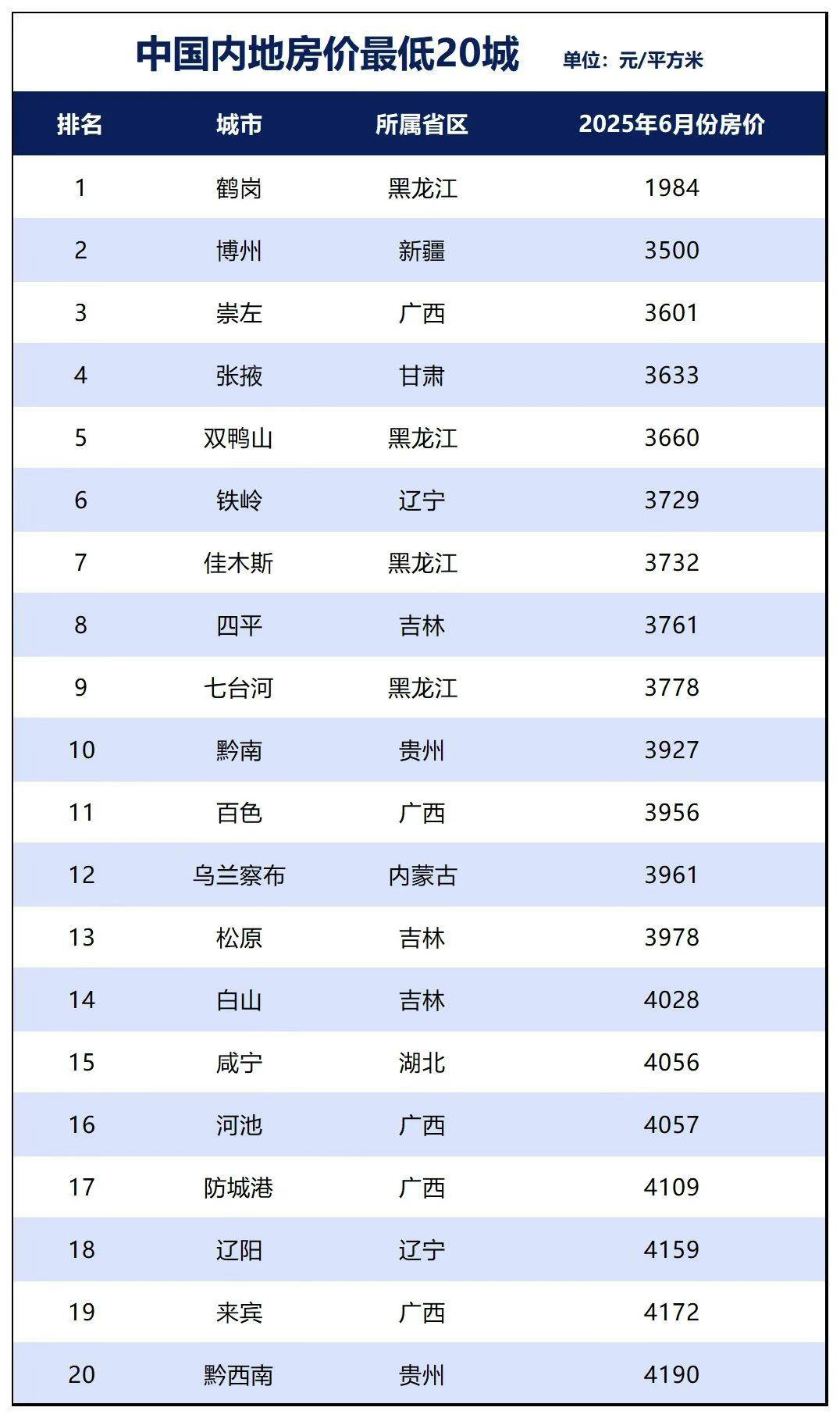
Core Insights - The article highlights the lowest housing prices in 20 cities in mainland China, with the cheapest being in Hegang, Heilongjiang at 1984 yuan per square meter [1][2] - The prevailing sentiment in the real estate market is shifting towards self-occupation rather than investment, as the "housing is for living, not for speculation" ideology takes hold [2][4] - The lack of industrial development and growth opportunities in cities like Hegang leads to low demand for housing, despite its affordability [2][4] Summary by Categories Housing Prices - Hegang, Heilongjiang has the lowest housing price at 1984 yuan per square meter, followed by cities like Bole, Xinjiang at 3500 yuan and Chongzuo, Guangxi at 3601 yuan [1] - The list includes various cities with prices ranging from 1984 yuan to 4190 yuan per square meter, indicating a significant disparity in housing costs across regions [1][2] Market Sentiment - The current market trend reflects a focus on self-occupation rather than investment, with potential buyers prioritizing personal needs over speculative purchases [2][4] - The article suggests that even in affordable markets like Hegang, the lack of demand persists due to the absence of industrial growth and job opportunities [2][4] Economic Factors - The article emphasizes that housing prices are indicative of a city's overall economic health, with higher prices in cities like Shanghai reflecting better economic conditions and opportunities [4] - The comparison between Hegang and major cities illustrates that low prices alone do not attract population influx, as individuals seek places with better consumption opportunities and income potential [4]
未来3年,楼市或将面临“新变局”?2种趋势下,房产走势逐渐明朗
Sou Hu Cai Jing· 2025-07-05 04:06
Core Viewpoint - Since the initiation of the housing market reform in 1998, significant improvements have been observed in the living conditions of Chinese residents, with per capita living space increasing from 6-7 square meters to 39 square meters, marking a direct and notable achievement of the reform [1] Group 1: Economic Impact of Real Estate - The booming real estate market has become a powerful engine for China's economic growth, driving the prosperity of numerous related industries such as steel, cement, furniture, decoration, and home appliances, while also absorbing a large workforce [1] - The rapid increase in housing prices is a direct negative consequence of the market reform, with average prices soaring from 2000 yuan per square meter at the beginning of the reform to a peak of 11,000 yuan per square meter last year, particularly in first-tier cities where prices surged from 3000 yuan to 65,000 yuan per square meter [3] Group 2: Housing Affordability Issues - Despite the overall growth in living conditions, the housing price surge has not benefited all demographics, particularly middle and low-income groups and migrant workers, leading to a persistent housing demand that remains unmet [3] - Even after a decline in the real estate market in the latter half of last year, high housing prices continue to exceed the purchasing power of most residents, with homes in first-tier cities costing 6-7 million yuan and even in third and fourth-tier cities requiring over 100,000 yuan [3] Group 3: Government Initiatives - The government is increasing investment in affordable housing, planning to invest approximately 3 trillion yuan to construct 8.7 million units of affordable rental housing over the next five years, which will effectively divert demand from the commodity housing market [4] - The future real estate market is expected to evolve into a tripartite structure consisting of the commodity housing market, rental housing market, and shared ownership housing market, leading to a gradual exit of speculative investment demand [4] Group 4: Future Market Trends - Over the next three years, significant changes are anticipated in the Chinese real estate market, with a clear trend towards reducing reliance on the real estate sector for economic growth, as emphasized by the Minister of Housing and Urban-Rural Development [5] - The ongoing "housing is for living, not for speculation" policy and increased government efforts in affordable housing construction are expected to effectively limit the potential for significant price increases in the housing market, opening the door for long-term adjustments [6]
江海保利大都汇:蝉联2025年上半年江海住宅网签套数榜首
Nan Fang Du Shi Bao· 2025-07-04 07:14
Group 1 - The core viewpoint is that the Poly Dushi project has achieved significant sales success, ranking first in residential sales in the Jianghai District for the first half of 2025, following its previous title as the sales champion in 2023-2024, indicating strong market recognition for its product quality [1][4] - Poly Dushi is positioned as a comprehensive urban living complex, featuring a prime location with access to major roads, scenic rivers, and multiple parks, along with essential amenities such as a commercial street and quality educational institutions nearby, enhancing the living experience for residents [2][4] - The project is recognized as Jiangmen's first 4.0 residential development, offering innovative design features such as high ceilings and private gardens, with a high utilization rate of space, which has attracted significant attention from homebuyers and set a new standard for living quality in Jianghai [3][4] Group 2 - Poly, as a central enterprise, has been deeply involved in Jiangmen for 13 years, focusing on understanding and developing the local market, which has led to a successful strategy of combining quality products, services, and brand reputation [4] - The continuous sales success of Poly Dushi reflects the effectiveness of Poly's strategy to prioritize customer satisfaction and quality living, contributing to the high-quality development of the industry [4] - In the context of the "housing for living, not speculation" policy, Poly aims to create enduring quality living spaces that contribute to the modernization of Jiangmen as a coastal city [4]

高盛:受人口萎缩与房价走低影响,未来国内住宅需求将持续走低
Sou Hu Cai Jing· 2025-06-26 13:32
Core Viewpoint - The report by Goldman Sachs indicates a significant decline in housing demand in China due to population decrease and urbanization slowdown, predicting a shift towards a "housing for living, not for speculation" model in the real estate market [1][4]. Demand and Supply Dynamics - The annual demand for urban housing in China is expected to drop from an average of 9.4 million units in the 2010s to 4.1 million units between 2025 and 2030, significantly lower than the peak demand of 20 million units in 2017 [1][4]. - The housing unit-to-household ratio has reached 1.16, exceeding the international warning line of 1.1, with a vacancy rate of 12.1%, indicating a severe supply-demand imbalance [5][6]. - The total inventory of commercial housing amounts to 93 trillion yuan, which is 70% of GDP, with a de-stocking cycle exceeding 30 months, suggesting that the demand side is nearing saturation [5][6]. Market Sentiment and Future Outlook - The ongoing decline in housing prices is expected to deter investment interest, with predictions that housing prices may drop by 20%-25% by 2025, further exacerbating market hesitance [9]. - The real estate sector, which contributes approximately 25% to GDP, is likely to face negative effects on investment and consumption due to shrinking demand [9]. - The report suggests that the real estate market will enter an "L-shaped" adjustment period over the next decade, characterized by structural differentiation and a policy-driven weak recovery rather than a complete downturn [12]. Demographic Trends - The population of individuals born in the 1990s is 40 million less than that of the 1980s, and the number of newborns has plummeted by 40% compared to eight years ago, leading to a shrinking pool of first-time homebuyers [5][12]. - The marriage registration numbers have declined for nine consecutive years, contributing to a decrease in "marriage housing" demand and reinforcing the trend towards rental housing [13]. Policy Implications - The report highlights the need for policy adjustments, such as promoting affordable housing and urban renewal, to address the challenges faced by the real estate sector [9][12]. - The shift from a focus on quantity to quality in housing demand is anticipated as urbanization approaches its limits, with a growing preference for smaller and more suitable housing options [12][13].

X @Yuyue
Yuyue· 2025-06-26 09:32
Market Analysis & Investment Strategy - The analysis suggests that domestic Chinese real estate may not be the optimal asset for decentralized individuals in the crypto space due to lower rental yields compared to potential returns from crypto assets [1] - The report highlights a global arbitrage opportunity, referencing the "渡边太太" concept where low-interest Japanese Yen is used to invest in higher-yield foreign assets, a strategy similar to some crypto investors [1] - The document points out that a 4% annual yield is easily achievable in the crypto space, while traditional RMB cash assets offer lower bank interest rates of less than 15% [1] Real Estate Market Dynamics - The analysis indicates that the Chinese real estate market is entering a phase of "housing is for living, not for speculation," while other global markets like Dubai are experiencing rapid growth [1] - The report mentions the ease for crypto investors to purchase properties in countries like Dubai using USDT, contrasting with the challenges faced by wealthy Chinese individuals [1]
“催买房”无效后,国家将动真格?明年开始房地产将呈现3大变化
Sou Hu Cai Jing· 2025-06-16 10:06
近年来,房地产市场一直受到"催买房"政策的刺激,但效果逐渐减弱。眼下,国家终于决定采取更加"实在"的措施来应对这一困境。 从明年开始,房地产市场将迎来前所未有的三大变化,这些变化可能会让很多人措手不及。无论是购房者还是房地产行业的从业者,都可能因此受到不同程 度的影响。此次变化不再是单纯的政策补救,而是真正意义上的行业变革。那么,究竟是什么原因促使国家下定决心采取这一系列措施呢? 曾经的房市火爆 2008年至2019年,房地产市场一度火爆,提到买房,每个人都充满期待。价格像火箭一样蹭蹭上涨,投资者们比谁都更积极抢购,似乎只要买房就能稳赚不 赔。房产投资回报率高,一套房子转手就能赚几十万,远远超过了大多数人的收入。 装修行业也迎来了黄金时期,瓷砖、地板、家具厂商忙得不可开交。甚至连小区门口的早餐摊也生意兴隆,因为工地上的工人们每天都能买几百份早餐。而 中介公司更是如雨后春笋般开遍了大街小巷,房源一挂牌就会迎来大量询问,哪怕房东开价高,也没人怕。 全国各地工地如火如荼,吊塔林立,大卡车排着队进城。那个时代,拥有几套房的人走在街头仿佛都带着光环,房地产商的身影几乎占据了富豪榜的一半, 资产动辄上千亿。 银行也对房地 ...

2025深蓝智库 | 购房者心中的好房子:有阳台比大客厅更重要,无障碍与智能化遭遇二选一
Bei Jing Shang Bao· 2025-06-09 04:10
Core Insights - The demand for balconies has surpassed that for large living rooms among homebuyers, indicating a shift in residential needs from spatial dimensions to functional versatility [3][4] - There is a significant generational divide in preferences, with older generations prioritizing accessibility features while younger buyers focus on smart home technology [6][12] Group 1: Balcony Preferences - 66% of respondents consider balconies a key purchasing criterion, exceeding the 54% who prioritize large living rooms, reflecting a deeper change in living requirements [3] - The preference for balconies is particularly strong among the "75" generation, with 84.62% valuing them for their practical use in daily life [3][4] - The "00" generation shows a lower demand for balconies at 60%, focusing instead on maintenance costs and usage frequency [4][6] Group 2: Smart Home and Accessibility Features - Only 42% of respondents view smart home systems as a core consideration, while 37% prioritize accessibility features, highlighting a stark generational contrast [6] - The "00" generation shows a 100% preference for smart home technology, while 87.5% of those aged 52 and above prioritize accessibility features [6][8] - This divergence illustrates the differing living challenges faced by various age groups, with younger buyers seeking digital integration and older buyers focusing on safety and convenience [6][8] Group 3: Housing Size and Configuration - The most popular housing size is 120-150 square meters, chosen by 51% of buyers, as it meets the needs of families while allowing for effective space planning [11] - Among the "00" generation, 60% prefer units smaller than 120 square meters for economic reasons, while 62.5% of those aged 52 and above prefer the same size for ease of maintenance [11][12] - The three-bedroom configuration is favored by 65% of buyers, particularly among the "90" and "85" generations, who see it as essential for current and future family needs [12][11] Group 4: Community and Green Space - The "90" generation places a high value on community green spaces, with 90% considering it a core factor in their purchasing decision [7] - There is a notable consensus between the "00" and 52+ age groups regarding the low priority given to children's play areas and community greenery, reflecting changing family structures and lifestyle choices [6][7] - The need for age-friendly facilities is becoming increasingly important as the population ages, with a focus on integrating modern technology into traditional safety features [8][9]