
数字技术

Search documents
顺差超4千亿!世界越来越喜欢“中国大脑”?
Da Zhong Ri Bao· 2025-12-12 08:09
Core Viewpoint - China's commercial aerospace sector is expanding its international cooperation, exporting knowledge-intensive services, as evidenced by the successful launch of the Kuaizhou-1A rocket carrying nine satellites for international clients [1][3]. Group 1: Service Trade Overview - In the first ten months of the year, China's service trade exports reached 2.909 trillion yuan, a growth of 14.3%, with knowledge-intensive service exports at 1.468 trillion yuan, increasing by 9.5% [3][4]. - Knowledge-intensive services are characterized by high technology content, significant human capital investment, and strong knowledge attributes, including telecommunications, financial services, and research services [6]. Group 2: Cultural and Technological Exports - Chinese cultural products, such as the video game "Black Myth: Wukong" and animated films like "Ne Zha," have gained international acclaim, showcasing China's cultural influence [8]. - The 2025 China International Service Trade Fair attracted participation from 85 countries, highlighting China's growing role in global service trade [9]. Group 3: Growth in Knowledge-Intensive Services - From 2021 to 2024, China's knowledge-intensive service trade increased from 2.3259 trillion yuan to 2.8965 trillion yuan, with a trade surplus rising from 198.9 billion yuan to 418.1 billion yuan [10]. - Companies like Inspur and Shandong Digital Human Technology are successfully exporting advanced technology solutions to various countries, demonstrating the global reach of Chinese innovation [12]. Group 4: Policy Support and Strategic Initiatives - Local and national initiatives are being implemented to enhance the international competitiveness of service exports, including financial support and streamlined processes for service trade [14]. - The Chinese government aims to promote the export of knowledge-based services, recognizing their strategic importance in the global market [14]. Group 5: Economic Impact and Future Outlook - China's service trade surplus has surpassed 400 billion yuan, reflecting a significant opportunity for domestic companies in the global market [15]. - The contribution of service trade to GDP is notably higher than that of goods trade, emphasizing the importance of developing service-oriented industries for economic growth [18].


刘世锦:加强金融强国建设,用现代化金融体系为制造强国、消费强国提供服务
Xin Lang Cai Jing· 2025-12-12 05:51
Core Insights - The conference emphasized the importance of identifying, cultivating, and leveraging growth advantages in the context of profound changes in economic conditions [1][3] Group 1: Growth Advantages - The first advantage discussed is the "catch-up potential," which remains stable from both demand and technology perspectives, requiring a humble and willing attitude to learn for significant growth at lower costs and shorter timeframes [1][3] - The second advantage is the "new technological revolution," where China has a relatively small gap in digital and green technologies, allowing it to either catch up or lead in certain fields [1][3] - The third advantage is the "super-large market economy," which encompasses all categories of industries classified by the United Nations, providing a larger innovation network and more sources of innovation [1][3] Group 2: National Strengths - Based on these three advantages, the next step is to promote the construction of three national strengths: manufacturing, consumption, and financial power [2][4] - The emphasis is on building a modern financial system to support the manufacturing and consumption power of the country [2][4]
邹蕴涵:康养产业扩容提质正当时
Jing Ji Ri Bao· 2025-12-12 00:17
Group 1 - The core viewpoint of the article emphasizes the robust growth and sustainable development of the health and wellness industry in China, driven by demand upgrades and technological innovations, leading to a virtuous cycle between consumption and industry [1][2] - The health and wellness market in China is projected to reach nearly 15 trillion yuan by 2030, focusing on health maintenance, rehabilitation, and wellness, becoming a new growth point for consumption [1] - The rapid growth of health and wellness consumption is closely linked to demographic changes, particularly the aging population, which has led to increased health awareness and diversified consumer demands [1][2] Group 2 - The elderly population has become a significant consumer group in the health and wellness industry, characterized by a shift from survival-based consumption to quality-focused consumption [2] - Technological advancements, particularly in digital technology and artificial intelligence, are enhancing service quality and efficiency in the health and wellness sector, enabling better data management and personalized care plans [3] - The "health and wellness +" model is emerging, integrating various industries such as culture, tourism, and finance, which is driving the development of diverse consumer categories and creating a synergistic effect [3] Group 3 - The coverage of health and wellness services is expanding from major cities to smaller cities and rural areas, resulting in a more diverse and accessible supply system [4] - The article suggests that systematic policies should be implemented to enhance the quality and capacity of health and wellness consumption, addressing challenges such as supply homogenization and talent shortages [4] - Encouraging the convergence of quality resources into the health and wellness industry is essential for stimulating demand and releasing the vitality of industry development [4]
中国数字技术助力沙特智慧城市建设
Ren Min Ri Bao· 2025-12-11 22:11
Core Insights - The Jeddah Comprehensive Development Project, a key initiative under Saudi Arabia's Vision 2030, is being constructed by Chinese companies, showcasing the significant role of digital technology in infrastructure projects [1][2]. Group 1: Digital Technology in Construction - The project utilizes full-process digital simulation to optimize design and enhance construction efficiency, with a total area of 5.7 million square meters and a coastline of 9.5 kilometers [2]. - Building Information Modeling (BIM) is employed to create a 1:1 model, allowing for early detection of engineering conflicts and reducing rework, thus providing support for site development and planning simulations [2][3]. - A case study highlighted the use of 3D animation to validate the feasibility of critical installations, which significantly improved installation efficiency and safety [3]. Group 2: Augmented Reality and Smart Systems - Augmented reality devices are integrated into the project, enabling precise location and rapid fault detection of infrastructure elements, with a positioning accuracy of ±5 millimeters [4]. - The project has developed a smart irrigation and fertilization system to address local climatic challenges, achieving a seedling survival rate of 95% and doubling cultivation efficiency [6]. Group 3: Future Prospects and Collaboration - The project aims to integrate big data and artificial intelligence for dynamic management of the smart city platform, enhancing urban management capabilities [5]. - The successful application of Chinese solutions in this project is expected to be replicated in other Saudi cities, fostering innovation and collaboration between China and Saudi Arabia [5][7].
安徽东生智能制造有限公司成立 注册资本500万人民币
Sou Hu Cai Jing· 2025-12-11 00:48
Group 1 - A new company, Anhui Dongsheng Intelligent Manufacturing Co., Ltd., has been established with a registered capital of 5 million RMB [1] - The legal representative of the company is Wang Dongwu [1] - The company's business scope includes manufacturing electronic vacuum devices, electronic components, intelligent drones, and various intelligent equipment [1] Group 2 - The company is involved in software development, including artificial intelligence applications and digital cultural creative software [1] - It offers a wide range of technology services, including technical consulting, technology transfer, and information technology consulting [1] - The company also focuses on blockchain technology-related software and services, as well as cloud computing equipment sales [1]
中国—东盟博览会马来西亚专题展在吉隆坡圆满落幕
Ren Min Ri Bao· 2025-12-10 20:48
本报南宁12月10日电(记者庞革平)记者从中国—东盟博览会秘书处获悉,近日,为期3天的中国—东盟 博览会走进东盟(马来西亚)专题展(简称马来西亚展)在吉隆坡会展中心圆满闭幕。 马来西亚通讯部副部长张念群表示,此次展会为马来西亚企业对接中国优质产品与技术提供了高效平 台,尤其是人工智能等高新技术领域的展示,与马来西亚的发展需求高度契合。 据悉,东博会自2004年创办以来,已成为中国与东盟国家间最具影响力的经贸合作平台之一。20余年的 深耕,东博会已形成主展和非会期多个专业展相辅相成,同时每年在多个东盟国家举办境外展,并 以"一云一厅两中心"为骨干,打造永不落幕的展会新格局。 本次马来西亚展精准对标中国—东盟自贸区3.0版新增的九大领域,展品涵盖人工智能、智能硬件、数 字技术、绿色建材及特色农业等方面。来自中国广西、湖南、广东及香港等地的近20家优质企业,集中 展示了包括AI眼镜、智能空气架子鼓、新型环保材料、特色食品及非遗工艺品在内的一系列创新产品 与服务。展会现场气氛热烈,采购商询盘洽谈踊跃,多项合作意向快速达成,为两国产业链深度融合注 入新动力。 ...
普惠支付 从乡村到跨境
Bei Jing Shang Bao· 2025-12-10 12:00
Core Viewpoint - Tencent's Vice President Lin Haifeng emphasizes the importance of inclusive payment services that cater to diverse groups, including rural residents, the elderly, and foreigners, aiming for universal accessibility in payment solutions [1][3]. Group 1: Development of Inclusive Payment - Inclusive payment is a crucial part of inclusive finance, providing affordable and convenient payment services to all social strata, particularly focusing on small businesses, the elderly, and farmers [3]. - The People's Bank of China reports that over 95% of individuals have bank accounts, with a mobile payment penetration rate of 86%, the highest globally [3]. - In rural areas, mobile payment transactions reached 33.93 billion, a year-on-year increase of 33.03%, with transaction amounts growing by 8.98% to 11.944 trillion yuan [4]. Group 2: Enhancements for Foreigners - The People's Bank of China has implemented measures to improve payment convenience for foreigners, including establishing service demonstration zones at airports and enhancing POS systems in key commercial areas [4]. - By mid-2025, active mobile payment users among incoming foreigners are expected to exceed 10 million, with transaction numbers and amounts increasing by 162% and 149% year-on-year, respectively [4]. Group 3: Digital Currency and Technological Integration - The digital yuan pilot program has expanded to 26 regions, with cumulative transaction amounts reaching 9.4 trillion yuan and processing 2.56 billion transactions, marking a 37.9% increase in transaction volume year-on-year [5]. - Digital technology is reshaping the cost structure and service boundaries of inclusive payments, with AI and blockchain enhancing transaction security and efficiency [8]. Group 4: Challenges in Inclusive Payment - Rural areas still face weak payment infrastructure, with significant issues such as limited bank branches and cash withdrawal difficulties [6]. - The payment industry suffers from a lack of interoperability, with multiple standards and networks leading to inefficiencies and resource wastage [7]. - The competitive landscape is characterized by high homogeneity and short-term survival pressures, which hinder innovation and long-term growth [7]. Group 5: Future Directions - Future efforts should focus on optimizing service networks in remote areas, enhancing accessibility for special groups, and ensuring a balanced approach between innovation, security, and inclusivity [9]. - Regulatory bodies need to improve rules for fair competition, while payment institutions should prioritize service to the real economy, fostering a healthy payment ecosystem [9].

“数字丝路”赋能文化出海,中国数字文化扬帆全球新蓝海
Guo Ji Jin Rong Bao· 2025-12-10 09:29
Core Insights - The seminar "Building the Digital Silk Road" focused on the challenges and opportunities for Chinese digital cultural products in global markets, emphasizing the shift from simple content export to deeper integration and interaction [1][3] Group 1: Digital Cultural Products - The rise of "digital new three samples" (short videos, online literature, and games) has fostered a thriving cultural ecosystem, with platform technology reshaping cultural connections along the Silk Road [1] - Chinese digital content is transitioning from a "one-way output" model to a "two-way interaction" model, positioning itself as a significant leader in the global market [1][2] Group 2: Global Acceptance and Integration - More Chinese digital lifestyles are being accepted overseas, with innovations like mobile payment and mini-programs enhancing cross-cultural connections [2] - The evolution of cultural export has progressed through four stages, culminating in a phase of deep integration where aesthetic and lifestyle elements are shared globally [3] Group 3: Role of Youth and Technology - Global youth are becoming key definers and promoters of cross-cultural exchanges, actively participating in content creation rather than being passive consumers [3] - Digital technologies, such as Tencent's mixed model, are lowering creative barriers, enabling international students to produce culturally blended 3D works [3] Group 4: Future of Cultural Export - The process of cultural export differs significantly from previous corporate expansions, with a proactive response to global curiosity about Chinese culture [4] - The future of cultural export relies on emotional resonance with young audiences, leveraging platform power, technological advancements, and global co-creation models to facilitate cross-border cultural exchange [4]
清华美学敦煌艺术成果展在联合国总部举行
人民网-国际频道 原创稿· 2025-12-10 06:20
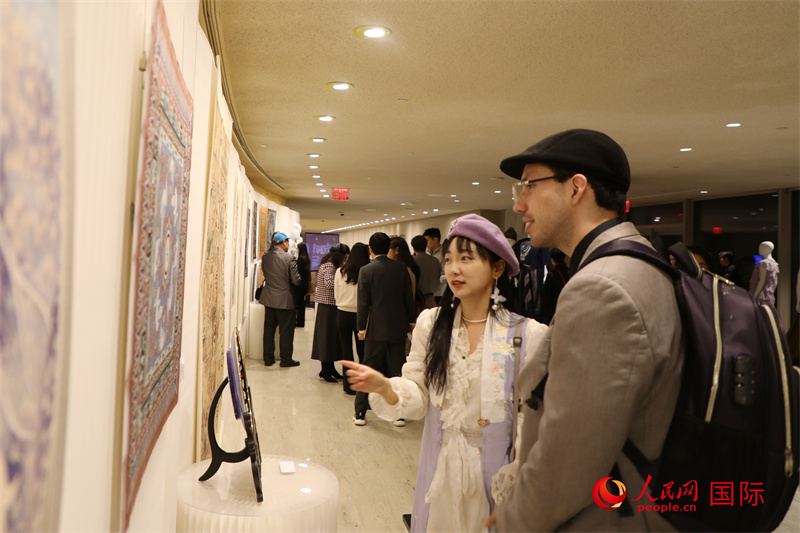
人民网联合国12月9日电 (记者李志伟)当地时间12月8日晚,"敦耀光华:清华大学美术学院敦煌艺术研究 及设计成果展"在纽约联合国总部举行开幕仪式。中美各界、联合国职员、各国嘉宾200多人参加了活动。 当地时间12月8日晚,"敦耀光华:清华大学美术学院敦煌艺术研究及设计成果展"在纽约联合国总部举行开幕仪 式。图为观众正在观看展览。人民网记者 李志伟摄 本次展览由清华大学美术学院、联合国中国书会和北美清华校友会联合会共同主办。继2024年10月在法国巴 黎中国文化中心举办之后,本次活动是"敦耀光华展"国际巡展的第二站。 开幕式上,中国驻纽约总领馆教育处余有根参赞在致辞中表示,敦煌的艺术价值已超越其历史背景。此次展 览为世界提供一个绝佳的契机,去接触人类最重要、最璀璨的艺术文化瑰宝之一。 清华大学美术学院副院长王小茉在致辞中说,本次展览系统呈现了学院在敦煌研究方面的教学与科研成果, 特别是在新时代背景下围绕人工智能、数字技术、虚拟时尚等前沿领域的探索。以此为契机,进一步提升学院的 国际影响力。 北美清华校友会联合会会长任钢在致辞中表示,北美清华校友长期致力于搭建文化交流桥梁,将清华精神带 入国际社会,推动文化、教 ...
视频 丨 趣链科技董事长 李伟
Zhong Guo Jing Ying Bao· 2025-12-10 05:03
趣链科技董事长 李伟:在数字技术、数字基建方面,我们已经处于国际水平。其中最重要的优势是数 据要素,没有数据其他都是空谈。全世界范围内,中国的数据基础是最好的。 0:00 ...