深度学习

Search documents
创业黑马:子公司黑马天启联合厦门算能推出了政企服务一体机
Zheng Quan Ri Bao Wang· 2025-08-29 11:45
Core Viewpoint - The company is launching an integrated government-enterprise service machine in January 2024 to address issues faced by governments and SMEs in project application processes, utilizing advanced technologies to enhance efficiency and transparency [1] Group 1: Product Development - The integrated service machine is a collaboration between the company's subsidiary, Heima Tianqi, and Xiamen Suan Neng, aimed at solving project application challenges for governments and SMEs [1] - The machine leverages enterprise and intellectual property big data, natural language processing, and deep learning technologies, combined with a policy large model, to quickly access policy information and accurately match projects [1] Group 2: Benefits and Impact - The service machine is designed to reduce application costs for enterprises and improve the success rate of applications, thereby enhancing the execution efficiency and transparency of government policies [1] - It aims to foster a win-win cooperation between government and enterprises [1] Group 3: Technical Specifications - The integrated service machine is built on the SG series intelligent computing servers from Suan Neng, achieving an integrated design of hardware and software to meet diverse customer needs [1] Group 4: Future Strategy - The company will determine its next development strategy based on market demand and industry trends [1]

英伟达自动驾驶算法工程师面试
自动驾驶之心· 2025-08-28 23:32
Core Insights - The article discusses the competitive landscape of the autonomous driving industry, highlighting the detailed job roles and recruitment processes at companies like NV [3][4][5][6][11][12][14]. Recruitment Process - NV has a highly structured recruitment process with multiple interview rounds, including technical assessments and coding challenges [3][4][5][6][11][12]. - Candidates are evaluated on their project experiences, particularly in areas like Model Predictive Control (MPC) and Simultaneous Localization and Mapping (SLAM) [5][8][11][12]. Technical Skills - The interviews focus on advanced technical skills, including knowledge of optimization algorithms, dynamic programming, and deep learning applications in autonomous driving [5][8][11][12]. - Coding challenges often involve data structures and algorithms, such as merging linked lists and dynamic programming problems related to grid navigation [6][8][11][12]. Industry Trends - There is a noticeable trend towards standardization in the autonomous driving technology stack, with a shift from numerous specialized roles to more unified models [22][25]. - The article emphasizes the importance of community and collaboration among professionals in the autonomous driving sector to navigate the evolving landscape [22][25]. Community and Networking - The establishment of a community platform for professionals in autonomous driving is highlighted, aiming to facilitate knowledge sharing and job opportunities [19][22][25]. - The community includes members from various companies and research institutions, fostering collaboration and support for job seekers [19][22][25].


科学界论文高引第一人易主,Hinton、何恺明进总榜前五!
机器人圈· 2025-08-27 09:41
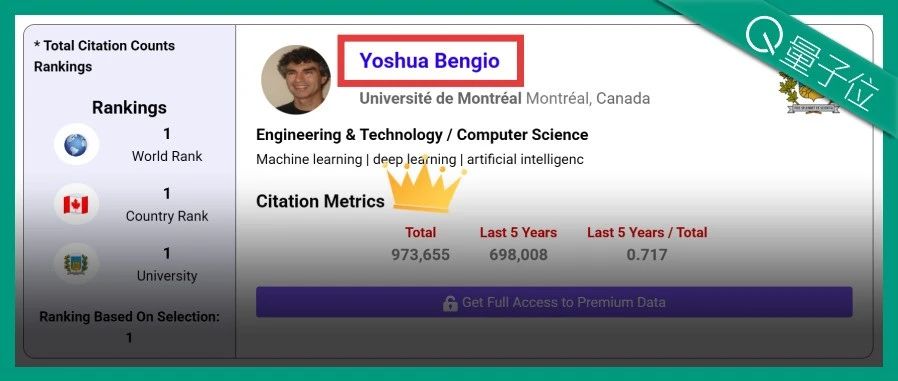
Core Insights - Yoshua Bengio has become the most cited scientist in history with a total citation count of 973,655 and 698,008 citations in the last five years [1] - The ranking is based on total citation counts and recent citation indices from AD Scientific Index, which evaluates scientists across various disciplines [1] - Bengio's work on Generative Adversarial Networks (GANs) has surpassed 100,000 citations, indicating significant impact in the AI field [1] Group 1 - The second-ranked scientist is Geoffrey Hinton, with over 950,000 total citations and more than 570,000 citations in the last five years [3] - Hinton's collaboration on the AlexNet paper has received over 180,000 citations, marking a pivotal moment in deep learning for computer vision [3] - The third and fourth positions in the citation rankings are held by researchers in the medical field, highlighting the interdisciplinary nature of high-impact research [6] Group 2 - Kaiming He ranks fifth, with his paper on Deep Residual Learning for Image Recognition cited over 290,000 times, establishing a foundation for modern deep learning [6] - The paper by He is recognized as the most cited paper of the 21st century according to Nature, emphasizing its lasting influence [9] - Ilya Sutskever, another prominent figure in AI, ranks seventh with over 670,000 total citations, showcasing the strong presence of AI researchers in citation rankings [10]
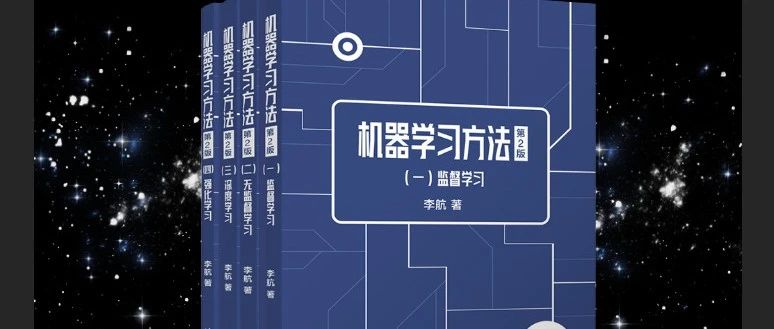
打磨7年,李航新书《机器学习方法(第2版)》发布,有了强化学习,赠书20本
机器之心· 2025-08-27 03:18
Core Viewpoint - The article discusses the release of the second edition of "Machine Learning Methods" by Li Hang, which expands on traditional machine learning to include deep learning and reinforcement learning, addressing the growing interest in these areas within the AI community [4][5][22]. Summary by Sections Overview of the Book - The new edition of "Machine Learning Methods" includes significant updates and additions, particularly in reinforcement learning, which has been gaining attention in AI applications [4][5]. - The book is structured into four main parts: supervised learning, unsupervised learning, deep learning, and reinforcement learning, providing a comprehensive framework for readers [5][22]. Supervised Learning - The first part covers key supervised learning methods such as linear regression, perceptron, support vector machines, maximum entropy models, logistic regression, boosting methods, hidden Markov models, and conditional random fields [7]. Unsupervised Learning - The second part focuses on unsupervised learning techniques, including clustering, singular value decomposition, principal component analysis, Markov chain Monte Carlo methods, EM algorithm, latent semantic analysis, and latent Dirichlet allocation [8]. Deep Learning - The third part introduces major deep learning methods, such as feedforward neural networks, convolutional neural networks, recurrent neural networks, Transformers, diffusion models, and generative adversarial networks [9]. Reinforcement Learning - The fourth part details reinforcement learning methods, including Markov decision processes, multi-armed bandit problems, proximal policy optimization, and deep Q networks [10]. - The book aims to provide a systematic introduction to reinforcement learning, which has been less covered in previous textbooks [4][10]. Learning Approach - Each chapter presents one or two machine learning methods, explaining models, strategies, and algorithms in a clear manner, supported by mathematical derivations to enhance understanding [12][19]. - The book is designed for university students and professionals, assuming a background in calculus, linear algebra, probability statistics, and computer science [22]. Author Background - Li Hang, the author, is a recognized expert in the field, with a background in natural language processing, information retrieval, machine learning, and data mining [24].
陶朗食品双AI解决方案国内首秀,水果分选进入双AI时刻
Zhong Guo Shi Pin Wang· 2025-08-26 06:48
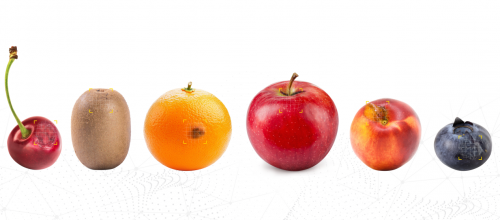
Core Viewpoint - The company TOLAN Food is showcasing its dual AI optical sorting platforms, Spectrim and InVision², equipped with the LUCAi™ artificial intelligence engine, at the 2025 China International Fruit Expo and Asia International Fruit and Vegetable Exhibition, marking the first simultaneous exhibition of these technologies in China, aimed at driving innovation in the fruit sorting industry [1][2]. Group 1: Technology and Innovation - TOLAN has been a leader in the sorting field for over 50 years and has focused on AI and food sorting technology since 2010, developing the LUCAi™ AI engine that utilizes deep learning to accurately identify various fruit defects [2][3]. - The dual AI optical sorting platforms leverage continuously iterated algorithms of the LUCAi™ engine to enhance the sorting process, overcoming challenges in identifying complex fruit defects that traditional machine learning struggles with [2][3]. - The LUCAi™ engine can process up to 40,000 images per second, significantly improving defect recognition capabilities compared to traditional sorting systems, thus providing precise quality metrics for fruits from harvest to market [3]. Group 2: Market Strategy and Localization - TOLAN is committed to deepening its localization strategy in the Chinese market, having established regional headquarters, manufacturing bases, supply chain centers, and technical testing centers since entering China in 2010 [5]. - The company’s AI sorting systems can utilize localized data to upgrade algorithms and effectively identify regional fruit defects, ensuring quality that meets local demands [5]. - As the largest producer and consumer of fruits globally, China represents a strategic market for TOLAN, which aims to leverage its dual AI solutions to help clients capture high-value markets and promote the standardization of AI sorting in the Chinese fruit industry [5].
让东北老铁人人都能当周杰伦
虎嗅APP· 2025-08-25 13:34
Core Viewpoint - The article discusses the evolution and potential of AI in the music industry, highlighting the journey of a company focused on AI music generation and the belief in democratizing music creation for everyone [6][10]. Group 1: Historical Context of AI in Music - The first electronic speech synthesizer, Voder, was built in 1938, marking the initial connection between AI and audio [7]. - In 1957, the first computer-generated music piece, "Illiac Suite," was created, but progress in AI music was slow for decades [7]. - The introduction of Google's Magenta project in 2016 showcased the capabilities of AI in music generation, leading to significant advancements in the field [8]. Group 2: Personal Journey and Company Development - The CEO of the company, who has a background in AI algorithms, experienced a pivotal moment in 2016 when he successfully separated vocals from accompaniment using deep learning techniques [8][9]. - The company was founded in 2021, aiming to create a platform where everyone can compose music, similar to how short videos democratized content creation [10][11]. - The CEO believes that music creation can also achieve equality, allowing diverse voices and stories to be expressed through music [10][11]. Group 3: Technological Innovations and Challenges - The emergence of large models based on the Transformer architecture in 2021 led to significant advancements in AI music generation, culminating in the launch of a product referred to as the "ChatGPT of music" [9][10]. - The company is focused on rapid product iterations, aiming to enhance user engagement and creativity through innovative features [39][48]. - The challenge lies in stimulating user creativity and finding effective ways to shorten the music creation process [45][46]. Group 4: Business Model and Market Positioning - The company plans to offer a freemium model, allowing users to create a limited number of songs for free, with monetization options based on song popularity [52][53]. - A significant effort has been made to build a comprehensive music data labeling database, which serves as a competitive advantage in the AI music space [54]. - The company aims to differentiate itself from competitors by focusing on user-generated content and providing a platform for music creation that emphasizes user ownership of their work [55][61].

超97万:Yoshua Bengio成历史被引用最高学者,何恺明进总榜前五
机器之心· 2025-08-25 06:08
Core Insights - The article highlights the prominence of AI as the hottest research direction globally, with Yoshua Bengio being the most cited scientist ever, accumulating a total citation count of 973,655 and 698,008 citations in the last five years [1][3]. Group 1: Citation Rankings - The AD Scientific Index ranks 2,626,749 scientists from 221 countries and 24,576 institutions based on total citation counts and recent citation indices [3]. - Yoshua Bengio's work on Generative Adversarial Networks (GANs) has surpassed 100,000 citations, outpacing his co-authored paper "Deep Learning," which also exceeds 100,000 citations [3][4]. - Geoffrey Hinton, a pioneer in AI, ranks second with over 950,000 total citations and more than 570,000 citations in the last five years [4][5]. Group 2: Notable Papers and Their Impact - The paper "AlexNet," co-authored by Hinton, Krizhevsky, and Sutskever, has received over 180,000 citations, marking a significant breakthrough in deep learning for computer vision [5][6]. - Kaiming He’s paper "Deep Residual Learning for Image Recognition" has over 290,000 citations, establishing ResNet as a foundational model in modern deep learning [10][11]. - The article notes that ResNet is recognized as the most cited paper of the 21st century, with citation counts ranging from 103,756 to 254,074 across various databases [11]. Group 3: Broader Implications - The high citation counts of these influential papers indicate their lasting impact on the academic community and their role in shaping future research directions in AI and related fields [17].

科学界论文高引第一人易主!AI站上历史巅峰
量子位· 2025-08-25 05:54
Core Viewpoint - Yoshua Bengio is recognized as the most cited living scientist across all disciplines, not just in computer science, highlighting his significant impact on deep learning and artificial intelligence [4][19]. Group 1: Background and Contributions - Yoshua Bengio, born in 1964 in Paris, is a prominent figure in deep learning, having co-founded the field alongside Geoffrey Hinton and Yann LeCun [8][11]. - His early academic journey included a PhD under Hinton at McGill University, where he shifted focus from classical statistical models to neural networks [10][12]. - Bengio's major contributions include the development of probabilistic modeling, high-dimensional word embeddings, attention mechanisms, and generative adversarial networks (GANs) [13][16]. Group 2: Key Publications - Bengio's influential papers include "A Neural Probabilistic Language Model" (2000), which addressed the "curse of dimensionality" in language modeling, laying the groundwork for modern language models [14]. - The paper "Generative Adversarial Nets" (2014), co-authored with Ian Goodfellow, is his most cited work, with over 100,904 citations [17]. - The 2015 paper "Deep Learning," co-authored with Hinton and LeCun, is considered a foundational text in the field, summarizing deep learning's evolution and theoretical underpinnings [16][17]. Group 3: Recent Developments - In June 2023, Bengio announced the establishment of a non-profit organization, LawZero, aimed at developing the next generation of AI systems, with an initial funding of $30 million [19][20]. - LawZero focuses on understanding the learning world rather than action-oriented AI, aiming to provide verifiable answers to enhance scientific discovery and address AI risks [20]. Group 4: Citation Rankings - Bengio currently leads in citation counts among living scientists, with his closest competitor being Geoffrey Hinton, who has nearly 940,000 citations [21]. - The AD Scientific Index ranks researchers based on various metrics, including total citations, reflecting the prominence of AI and medical research in current academic discourse [23][26].
地平线HSD量产在即:国内最像特斯拉FSD的辅助驾驶系统,定义行业新高度
IPO早知道· 2025-08-25 03:39
Core Viewpoint - Horizon has launched its most significant upgrade of the high-performance urban auxiliary driving product HSD, which is recognized as the "most Tesla-like FSD system" in China, enhancing safety, efficiency, and comfort in driving [3][5]. Group 1: Product Development and Features - HSD is built on the Journey 6P platform, achieving ultra-low latency from "photon input to trajectory output" and introducing reinforcement learning for maximizing model potential [8]. - The product covers various driving scenarios, including urban areas, highways, rural roads, and parking lots, and can handle complex driving tasks without relying on memory mapping [3][5]. - Horizon has established cooperation intentions with nearly 10 global automotive brands, with the first mass production set to be launched on Chery's Exeed Star Era E05 [3][5]. Group 2: Market Trends and Growth - The high-level auxiliary driving technology is transitioning from validation to large-scale adoption, with 902,200 new cars equipped with urban NOA delivered in China in the first five months of the year, marking a 152.5% year-on-year increase [5]. - Horizon has achieved over 8 million sets of front-mounted mass production shipments and over 200 mass-produced vehicle models as of the end of Q1 this year [16]. Group 3: Strategic Vision and Competitive Edge - The founder and CEO of Horizon emphasizes the importance of continuous technological iteration and the launch of high-performance products to maintain market leadership [16]. - Horizon's strategy of "soft and hard integration" has allowed it to achieve over 1000 times improvement in computing performance over the past decade, supporting the mass production of over 10 computing solutions [19][21]. - The company aims to become a leading player in the high-level auxiliary driving market, leveraging its unique position as a "full-stack soft and hard technology enterprise" with extensive practical experience [23].

三个月、零基础手搓一块TPU,能推理能训练,还是开源的
机器之心· 2025-08-24 04:02
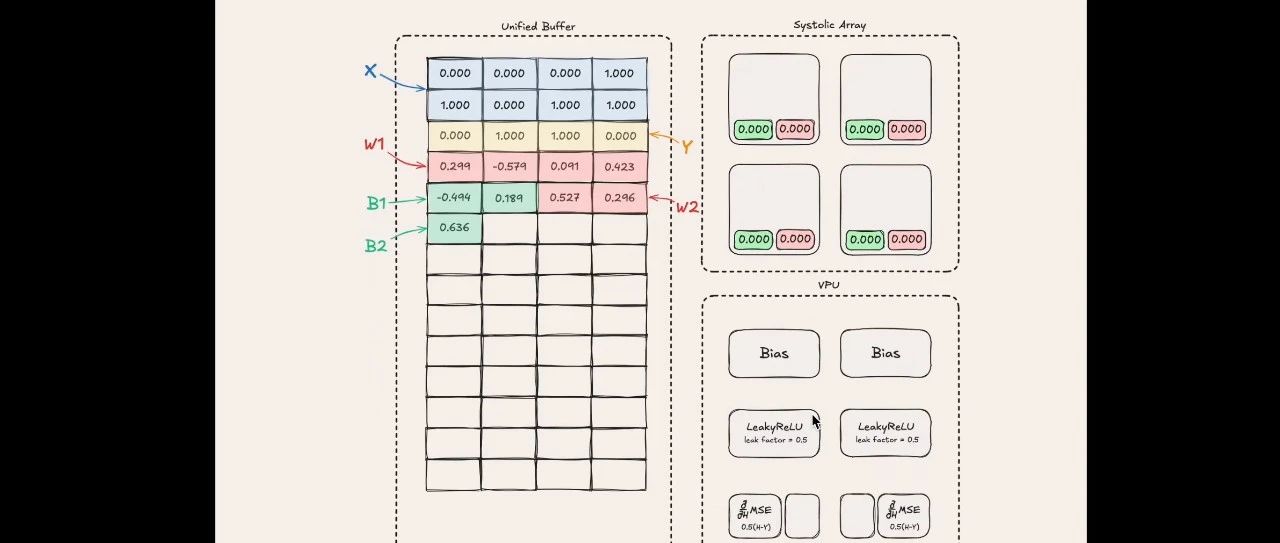
Core Viewpoint - The recent advancements in large model technology have renewed interest in AI-specific chips, particularly Google's TPU, which has evolved significantly since its deployment in 2015, now reaching its 7th generation [1][9]. Group 1: TPU Overview - TPU is a specialized chip designed by Google to enhance the speed of machine learning model inference and training, focusing on executing mathematical operations efficiently [9]. - The architecture of TPU allows it to perform matrix multiplication efficiently, which constitutes a significant portion of computations in deep learning models [14][31]. Group 2: TinyTPU Project - The TinyTPU project was initiated by engineers from Western University in Canada to create an open-source ML inference and training chip, motivated by the lack of a complete open-source codebase for such accelerators [5][7]. - The project emphasizes a hands-on approach to learning hardware design and deep learning principles, avoiding reliance on AI tools for coding [6]. Group 3: Hardware Design Insights - The project team established a design philosophy of exploring unconventional ideas before consulting external resources, leading to the re-invention of many key mechanisms used in TPU [6]. - The hardware design process involves understanding clock cycles, using Verilog for hardware description, and implementing a systolic array architecture for efficient matrix multiplication [10][12][26]. Group 4: Training and Inference Mechanisms - The TinyTPU architecture allows for continuous inference by utilizing a double buffering mechanism, which enables the loading of new weights while processing current computations [61][64]. - The training process leverages the same architecture as inference, with additional modules for gradient calculation and weight updates, allowing for efficient training of neural networks [71][118]. Group 5: Control and Instruction Set - The control unit of TinyTPU employs a custom instruction set architecture (ISA) to manage control signals and data flow, enhancing the efficiency of operations [68][117]. - The ISA has evolved to include 94 bits, ensuring that all necessary control flags and data fields are accounted for without compromising performance [117].