
马太效应

Search documents
42家上市券商“半年考”:自营业务扮靓业绩,谁是掉队者?
Jing Ji Guan Cha Wang· 2025-09-06 04:02
Core Insights - The performance of listed securities firms in the first half of 2025 showed significant growth, with total operating income reaching 251.87 billion yuan, a year-on-year increase of 11.37%, and net profit reaching 104.02 billion yuan, a year-on-year increase of 65.09% [2][3] Group 1: Performance Overview - The top ten listed securities firms achieved substantial revenue growth, with the leading firm, CITIC Securities, reporting an operating income of 33.04 billion yuan, up 20.44% year-on-year, and a net profit of 13.72 billion yuan, up 29.80% [3][4] - Guotai Junan Securities, after a merger, reported a net profit of 15.74 billion yuan, surpassing CITIC Securities by 2.02 billion yuan, although its operating income was 23.87 billion yuan, trailing CITIC by 9.17 billion yuan [3][4] - Among the 42 listed securities firms, 22 reported net profit growth exceeding 50%, while a few firms like Zheshang Securities and Xibu Securities experienced declines in operating income [2][3][5] Group 2: Revenue Breakdown - Brokerage fee income for the 42 listed firms reached 63.45 billion yuan, a year-on-year increase of 43.98%, while self-operated business income surged to 118.27 billion yuan, up 54.87% [8][10] - Major firms like CITIC Securities and Guotai Junan Securities saw self-operated income growth exceeding 60%, with CITIC's self-operated income reaching 19.34 billion yuan, up 62.17% [11][10] Group 3: Market Dynamics - The top ten firms accounted for 68% of total operating income, indicating a strengthening "Matthew Effect" where larger firms continue to dominate the market [14] - The investment banking sector showed signs of recovery, with the top five firms generating 7.45 billion yuan in net income from investment banking, representing 47.96% of the total for all listed firms [14][15] Group 4: Challenges and Opportunities - Some smaller firms faced challenges, with 14 firms reporting declines in investment banking income, attributed to regulatory impacts and market conditions [15][16] - Regulatory changes are encouraging industry consolidation, which may enhance competitiveness and resource allocation within the sector [16]



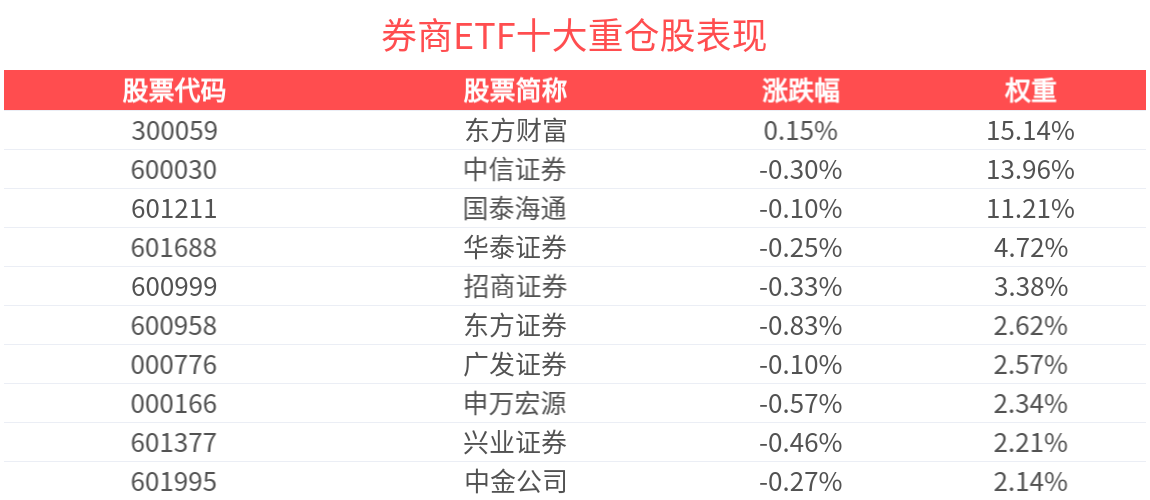
头部券商"马太效应“明显,客户资产规模显著增加,“旗手”券商ETF(512000)交投活跃,成交额超7亿!
Sou Hu Cai Jing· 2025-09-05 05:59
Core Viewpoint - The brokerage sector is experiencing significant growth in revenue and trading activity, driven by increased market engagement and a favorable environment for wealth management services [3]. Group 1: Market Performance - As of September 5, 2025, the CSI All Share Securities Company Index (399975) decreased by 0.30%, with mixed performance among constituent stocks [1]. - Notable gainers included Nanjing Securities (601990) up by 2.26% and Jinlong Co., Ltd. (000712) up by 0.98%, while Guosheng Financial Holdings (002670) led the declines [1]. Group 2: ETF Activity - The brokerage ETF (512000) saw a turnover of 2.59% and a transaction volume of 798 million yuan, with an average daily transaction of 1.861 billion yuan over the past week, ranking it among the top two comparable funds [2]. - The ETF's scale increased by 1.185 billion yuan over the past two weeks, marking a significant growth and placing it third among comparable funds [2]. - The ETF's latest share count reached 51.776 billion, a one-year high, making it the leading fund in its category [2]. Group 3: Brokerage Revenue Growth - In the first half of 2025, 42 A-share listed brokerages reported a total brokerage income of 74.545 billion yuan, reflecting a substantial year-on-year increase of 50.69% [3]. - All brokerages achieved positive growth in this segment compared to the same period last year, indicating strong performance in wealth management [3]. - Key trends in the brokerage wealth management business include an intensifying "Matthew Effect," a primary focus on traditional trading services, increased market attractiveness, and a deepening transformation towards buyer advisory services [3]. Group 4: Profit Forecast - According to analysis from Founder Securities, the brokerage sector is expected to maintain high year-on-year profit growth in the third quarter, with a projected net profit increase of 38% for 2025 [3]. - The return on equity (ROE) is anticipated to rebound to 8.0% [3].
上市券商上半年经纪收入增长超50%,行业“马太效应”凸显;国盛金控:总经理陆箴侃因工作调整辞职 | 券商基金早参
Mei Ri Jing Ji Xin Wen· 2025-09-05 02:05
Group 1: Brokerage Firms - The brokerage firms in A-share market reported a significant increase in brokerage income, totaling 74.545 billion yuan, a year-on-year growth of 50.69% [1] - The top brokerage firms leading in income include CITIC Securities with 7.992 billion yuan, followed by Guotai Junan and Huatai Securities with 6.866 billion yuan and 5.094 billion yuan respectively [1] - The top nine brokerage firms accounted for 58.31% of the total brokerage income, highlighting the "Matthew Effect" in the industry [1] Group 2: Guosheng Financial Holdings - Guosheng Financial Holdings announced the resignation of General Manager Lu Zhenkan, who will continue to serve as a director and committee member [2] - The company will be renamed Guosheng Securities, with Zhao Jingliang, the former deputy general manager of Caida Securities, appointed as the new president [2] - This management change reflects a strategic adjustment focusing on specialized business development, which may bring new growth momentum to the company [2] Group 3: Public REITs Market - The public REITs market has shown signs of recovery, with the CSI REITs Total Return Index rising by 0.42% [3] - Recent trends indicate that if investor risk appetite decreases, it could support further recovery in the REITs market, particularly in stable sectors like warehousing and highways [3] - The recovery of the REITs market enhances its attractiveness as an alternative investment, aiding in asset diversification for investors [3] Group 4: Equity Fund Issuance - The issuance of equity funds has rebounded, with 26 new funds established in just four days, totaling 17.587 billion yuan [4] - The total issuance scale for equity funds in September has reached 22.6 billion yuan, indicating a positive market sentiment [4] - This influx of capital is expected to benefit brokerage and asset management sectors, potentially boosting their revenue [4]





上市券商上半年经纪收入增长超50% 行业“马太效应”凸显
Shang Hai Zheng Quan Bao· 2025-09-04 19:12
Core Viewpoint - The brokerage wealth management business of securities firms has shown a positive development trend due to a significant rebound in market trading activity, with a notable year-on-year increase in revenue for the first half of 2025 [1] Group 1: Brokerage Business Performance - In the first half of 2025, 42 A-share listed securities firms achieved a total brokerage revenue of 74.545 billion yuan, representing a substantial year-on-year growth of 50.69% [1] - All 42 securities firms reported positive growth in brokerage revenue compared to the same period last year, with 13 firms experiencing growth rates exceeding 50% and 40 firms exceeding 30% [2] - The top nine brokerage firms accounted for 58.31% of the total brokerage revenue, with CITIC Securities leading at 7.992 billion yuan [2] Group 2: Revenue Structure and Growth Drivers - The core revenue source for brokerage business remains the agency trading of securities, contributing approximately 85% to the total brokerage revenue, with a year-on-year growth rate of 62.24% [2] - The revenue from the sale of financial products reached 5.567 billion yuan, marking a year-on-year increase of 32.05% [2] Group 3: Client Growth and Market Trends - The number of wealth management clients and high-net-worth clients has significantly increased, with a 45.53% and 23.99% year-on-year growth respectively reported by招商证券 [4] - The transition to buy-side advisory has gained consensus in the industry, with substantial progress made in fund advisory business scale, such as a 48.5% increase in fund advisory scale reported by山西证券 [4] Group 4: Future Outlook - The brokerage industry is expected to continue benefiting from increasing transaction volumes and margin financing, contributing to growth in wealth management and capital intermediary businesses [5] - Net income performance is anticipated to outperform net interest income, likely remaining a core driver of industry performance growth [6]
28家公募基金公司2025年上半年业绩曝光:易方达净利18.77亿元领跑,3家中小型公司亏损超千万元
Mei Ri Jing Ji Xin Wen· 2025-09-04 14:37
Core Viewpoint - The performance of public fund companies in the first half of 2025 shows a significant disparity between leading firms and smaller firms, with top companies achieving substantial profits while many smaller firms face losses [1][6][7] Revenue Summary - A total of 28 public fund companies have reported their operating income, with 8 companies exceeding 1 billion yuan in revenue during the first half of 2025 [1][2] - The top three companies by revenue are E Fund, Huaxia Fund, and GF Fund, with revenues of 58.96 billion yuan, 42.58 billion yuan, and 38.98 billion yuan respectively [2] - 22 companies reported revenues over 100 million yuan, and 11 companies saw revenue growth exceeding 10% year-on-year [2][3] - Notably, Su Xin Fund reported a staggering revenue increase of 4079.97%, although its total revenue was only 2.33 million yuan [2][5] Profitability Summary - Among the public fund companies, 11 reported net profits exceeding 1 billion yuan, with E Fund, GF Fund, and Huaxia Fund leading with net profits of 18.77 billion yuan, 11.8 billion yuan, and 11.23 billion yuan respectively [4] - Several smaller firms, including Jiangxin Fund, Zheshang Fund, and Huaxi Fund, reported losses exceeding 10 million yuan [4] - The net profit growth was particularly strong for Zhongyou Chuangye Fund, which saw a 106.3% increase, while Yungin Fund and Caitong Fund also reported significant growth [5] Industry Dynamics - The gap between leading public fund companies and smaller firms is widening, with larger firms benefiting from comprehensive product lines and robust research capabilities [6][7] - Smaller firms often struggle due to a lack of shareholder resources and brand influence, leading to a reliance on a narrow range of products [6][7] - The industry is at a critical stage of quality improvement, with leading firms continuing to excel while smaller firms must find niche markets and develop unique products to survive [7]
公募赚钱能力大比拼:谁是2025上半年“赚钱王”?
Hua Xia Shi Bao· 2025-09-04 14:12
Core Viewpoint - The public fund industry in China is experiencing a significant "Matthew Effect," where leading companies dominate revenue and profit, while many smaller firms struggle to remain profitable [2][3]. Group 1: Revenue and Profit Performance - The total revenue of the public fund industry shows a stark disparity, with top companies like E Fund and Huaxia Fund leading significantly [3][4]. - E Fund ranks first with a total revenue of 649.43 billion yuan, followed closely by Huaxia Fund at 622.63 billion yuan, and GF Fund at 403.55 billion yuan [4]. - In terms of net profit, Huaxia Fund stands out with 462.99 billion yuan, making it the "profit king" for the first half of 2025, while E Fund follows with 290.04 billion yuan [3][4]. Group 2: Income Sources - Stock and bond price differences remain the primary sources of income for public funds [6]. - In stock price income, Huaxia Fund leads with 26.616 billion yuan, followed by Southern Fund at 8.78 billion yuan and E Fund at 8.116 billion yuan [7]. - Bond price income is topped by Bosera Fund with 10.36 billion yuan, followed closely by GF Fund at 10.289 billion yuan and E Fund at 9.932 billion yuan [7]. Group 3: Performance of Smaller Firms - A total of 13 smaller public fund companies reported negative net profits, including companies like Quan Guo Fund and Zhong Hai Fund, with losses ranging from 9.13 billion yuan to 0.125 billion yuan [10][11]. - Some smaller firms, such as Ruiyuan Fund and Zhonggeng Fund, despite lower total revenues, have shown stable net profit performance [12].

券商上半年成绩单揭晓:10家营收突破百亿元,中信证券稳居投行“一哥”
Hua Xia Shi Bao· 2025-09-04 09:02
Group 1 - The core viewpoint of the articles highlights the overall growth of the securities industry in the first half of 2025, despite market adjustments, with significant revenue increases for leading firms [1][2][3] - Ten leading securities firms reported revenues exceeding 10 billion yuan, with CITIC Securities leading at 33.04 billion yuan, followed by Guotai Junan at 23.87 billion yuan, which saw a substantial increase in net profit [2][3] - The investment banking sector is identified as a key driver of revenue growth, with major firms like CITIC Securities and CICC showing significant year-on-year increases in investment banking income [1][4][5] Group 2 - The "Matthew Effect" in the investment banking sector is becoming more pronounced, with leading firms capturing more quality project resources, while many small and medium-sized firms are experiencing declines in investment banking revenue [6][7] - In the first half of 2025, over 40 out of 50 securities firms reported revenue growth, with notable increases in net profit for several smaller firms, indicating a diverse performance landscape [2][3] - The competitive landscape is shifting, with larger firms dominating the market and smaller firms facing challenges in project acquisition and profitability, leading to a potential increase in industry concentration [6][7]
券商上半年成绩单揭晓:10家营收突破百亿元,投行业务呈现“马太效应”
Hua Xia Shi Bao· 2025-09-04 04:44
Core Insights - The overall performance of the securities industry showed growth in the first half of 2025 despite market adjustments, with ten leading brokerages reporting revenues exceeding 10 billion yuan [2][3] - CITIC Securities led the industry with a revenue of 33.039 billion yuan, while Guotai Junan, after its merger, reported 23.872 billion yuan, surpassing CITIC in net profit [2][5] - The investment banking sector emerged as a key driver for revenue growth, with major firms like CITIC Securities and CICC experiencing significant year-on-year increases in investment banking income [2][7] Revenue Performance - In the first half of 2025, CITIC Securities reported a revenue of 33.039 billion yuan, a year-on-year increase of 20.44%, and a net profit of 13.719 billion yuan, up 29.80% [5][6] - Guotai Junan's revenue reached 23.872 billion yuan, marking a substantial growth of 77.71%, with net profit soaring by 213.74% to 15.737 billion yuan [5][6] - Other notable firms included Huatai Securities and GF Securities, with revenues of 16.219 billion yuan and 15.398 billion yuan, reflecting growth rates of 31.01% and 34.38% respectively [5][6] Investment Banking Sector - Investment banking is identified as a core pillar for securities firms, significantly impacting overall revenue and profit levels [7][9] - CITIC Securities achieved 2.054 billion yuan in investment banking income, a 19.16% increase year-on-year, leading the market with a 19.19% share in underwriting projects [9][10] - Other leading firms such as Guotai Junan and CICC reported investment banking revenues of 1.455 billion yuan and 1.445 billion yuan, with growth rates of 20.22% and 149.70% respectively [9][10] Market Dynamics - The "Matthew Effect" in the investment banking sector is becoming more pronounced, with leading brokerages capturing premium project resources while smaller firms struggle [10][11] - Many smaller brokerages reported declines in investment banking income, with some earning less than 100 million yuan in the first half of 2025 [10][11] - Regulatory changes and increased scrutiny have led to a concentration of project resources among larger firms, further widening the gap between large and small brokerages [10][11]

73家人身险公司上半年合计实现净利润1858亿
Zheng Quan Ri Bao· 2025-09-04 00:14
Core Insights - The life insurance industry in China has shown a significant recovery in net profits for the first half of the year, driven by business structure optimization, cost reduction measures, and improved investment returns [1][3]. Group 1: Profitability Overview - As of September 3, 73 life insurance companies reported a total net profit of 185.8 billion yuan, representing a year-on-year increase of approximately 25% [2][6]. - Out of these, 52 companies were profitable, collectively earning 190.08 billion yuan, while 21 companies reported losses totaling 4.27 billion yuan [2][3]. - Major profitable companies included Ping An Life, China Life, and China Pacific Life, each exceeding 10 billion yuan in net profit, with Ping An Life leading at 50.6 billion yuan [2][4]. Group 2: Losses and Challenges - The company with the highest loss was Hengqin Life, with a loss of 839 million yuan, followed by Bank of China Samsung Life and Aixin Life with losses of 543 million yuan and 384 million yuan, respectively [3][4]. - The competitive landscape is increasingly challenging for smaller insurance companies, which struggle against larger firms in terms of brand, capital, distribution channels, and talent [5][6]. Group 3: Strategic Adjustments - Companies are adjusting product pricing and business structures, including lowering product preset interest rates and promoting the transformation of dividend-type products, which has effectively reduced rigid liability costs [3][4]. - New business value has improved due to proactive optimization of business structures and cost reduction initiatives, with first-year premium income from regular premium products increasing by 25.5% year-on-year [4][5]. Group 4: Market Trends and Future Outlook - The "Matthew Effect" is evident, with the top seven life insurance companies accounting for over 80% of the industry's total net profit [5][6]. - Analysts expect continued improvement in the insurance industry's liability side, with a recovery in asset performance anticipated as macroeconomic conditions improve [6].



73家人身险公司上半年合计实现净利润1858亿元
Zheng Quan Ri Bao· 2025-09-03 16:46
Core Viewpoint - The life insurance industry in China has shown a significant recovery in net profits for the first half of the year, driven by business structure optimization, cost reduction measures, and improved investment returns [1][3]. Group 1: Profitability Overview - As of September 3, 73 life insurance companies reported a total net profit of 185.8 billion yuan, representing a year-on-year increase of approximately 25% [2][6]. - Among these, 52 companies were profitable, collectively earning 190.08 billion yuan, while 21 companies reported losses totaling 4.27 billion yuan [2][3]. - Leading companies in profitability included Ping An Life, China Life, and China Pacific Life, each exceeding 10 billion yuan in net profit, with Ping An Life leading at 50.6 billion yuan [2][4]. Group 2: Losses and Challenges - The company with the highest loss was Hengqin Life, with a loss of 839 million yuan, followed by Bank of China Samsung Life and Aixin Life with losses of 543 million yuan and 384 million yuan, respectively [3][5]. - The competitive landscape is increasingly challenging for smaller insurance companies, which struggle with brand recognition, funding, and talent compared to larger firms [5][6]. Group 3: Business Strategy and Market Trends - Companies are adjusting product pricing and business structures, focusing on reducing high-cost single premium products and promoting regular premium products, which saw a 25.5% increase in first-year regular premium scale [4][5]. - The overall market is expected to improve, with new single premium growth and a recovery in investment returns anticipated due to favorable macroeconomic conditions [6].