
指数化投资

Search documents
沪深ETF规模逾5.7万亿元 注册新规落地激发市场新活力
Zhong Guo Zheng Quan Bao· 2025-11-24 20:13
Core Insights - The ETF market in Shanghai and Shenzhen has shown steady growth, with the total scale exceeding 57,000 billion yuan as of the end of October [1][2] - Recent regulatory changes by the China Securities Regulatory Commission (CSRC) are expected to enhance the ETF registration and listing process, potentially attracting more long-term capital into the market [1][3] Group 1: Market Overview - As of the end of October, there are 772 ETFs in the Shanghai market with a total market value of 40,847.47 billion yuan, reflecting a growth of 2.11% compared to the previous period [1] - The Shenzhen market has 559 ETFs with a total market value of 16,246.33 billion yuan, contributing to a combined ETF total of 57,093.80 billion yuan across both markets [1] Group 2: Brokerages and Trading Activity - The top 30 institutions by ETF trading volume in October include major brokerages like CITIC Securities and Huatai Securities, as well as smaller firms, indicating a stable market structure [2] - The ETF holdings among the top 30 institutions also reflect a mix of comprehensive large brokerages and specialized mid-sized firms, suggesting a trend towards differentiated operations in the ETF business [2] Group 3: Regulatory Changes - The CSRC has optimized the ETF registration and listing process by removing the requirement for a no-objection letter from the stock exchange, which is expected to reduce the administrative burden on industry participants [3] - Fund managers can now directly apply for registration for ETFs tracking mature indices, streamlining the process and enhancing market efficiency [3] - The regulatory changes aim to encourage innovation and differentiation in ETF products, addressing the issue of homogeneity in product offerings [3]
公募基金发行量终结三连降 创近三年新高|财富周历 动态前瞻
Sou Hu Cai Jing· 2025-11-24 00:12
A-shares - Nobikang Artificial Intelligence Technology (Chengdu) Co., Ltd. has submitted its third listing application to the Hong Kong Stock Exchange, with CICC as the sole sponsor [2] - As of November 17, over 10,000 new private equity securities investment funds have been registered this year, with stock strategies being the dominant force in the issuance market [2][3] - In November, 509 overseas institutions conducted research on 109 listed companies, with a focus on the electronics and machinery equipment sectors [2] Financial Products - As of November 20, 19 insurance companies have issued capital replenishment bonds or perpetual bonds this year, totaling over 70 billion yuan, with nearly 70% being perpetual bonds [4] - The latest LPR remains unchanged at 3.0% for 1-year and 3.5% for 5-year terms, maintaining stability for six consecutive months [4] - The Shanghai and Shenzhen Stock Exchanges have released new guidelines to promote high-quality development of index investment [4] Fund Market - As of November 17, a total of 1,378 public funds have been issued this year, surpassing last year's total of 1,143, marking the highest issuance in three years [5] - The average subscription period for new funds has decreased from 22.63 days last year to 16.31 days this year, indicating increased market activity [5] Economic Indicators - In October, China's retail sales grew by 2.8%, with significant increases in the sales of upgraded consumer goods such as gold and jewelry, which rose by 37.6% [6][7] - From January to October, the national general public budget revenue reached 18.65 trillion yuan, a year-on-year increase of 0.8%, while expenditure was 22.58 trillion yuan, up 2% [8]


监管部门赋能ETF高质量发展 指数化投资生态持续优化
Shang Hai Zheng Quan Bao· 2025-11-21 18:43
Core Viewpoint - The development of high-quality ETFs in China is being actively promoted through regulatory optimizations and standardizations, which aim to enhance the investment ecosystem and address issues of product homogeneity and low recognition [1][2]. Group 1: Regulatory Optimizations - The China Securities Regulatory Commission (CSRC) has streamlined the ETF registration and listing process by removing the requirement for a no-objection letter from the stock exchange, allowing fund managers to apply directly for registration [2]. - The total scale of ETFs has surpassed 5.6 trillion yuan, and the recent reforms are expected to further invigorate the market [2]. - A rapid registration mechanism for stock ETFs has been established, aiming to complete registration within five working days from acceptance [2]. Group 2: Market Dynamics - In 2023, a record 328 new ETFs were established, with a total issuance scale of 253.33 billion yuan, marking the highest annual figures to date [4]. - The competitive landscape is intensifying, with multiple fund managers often launching similar innovative products simultaneously, leading to challenges in operational capacity [4][5]. - The head effect in ETFs indicates that larger funds attract more liquidity, while smaller funds may struggle to gain traction, as seen with the 32 existing 中证A500 ETFs, some of which have scales below 100 million yuan [4]. Group 3: Product Naming and Differentiation - The Shanghai and Shenzhen Stock Exchanges have revised their fund business guidelines to standardize ETF naming conventions, requiring names to include core investment elements and fund manager abbreviations [6][7]. - This change aims to improve product recognition and assist investors in making informed decisions, addressing the issue of similar product names in the market [6][7]. - Fund managers are encouraged to adopt differentiated strategies rather than following trends, to avoid issues related to oversaturation and underperformance in fundraising [5][7].
大“揭秘”!这家ETF提供商全球排名为何持续提升
Sou Hu Cai Jing· 2025-11-21 02:49
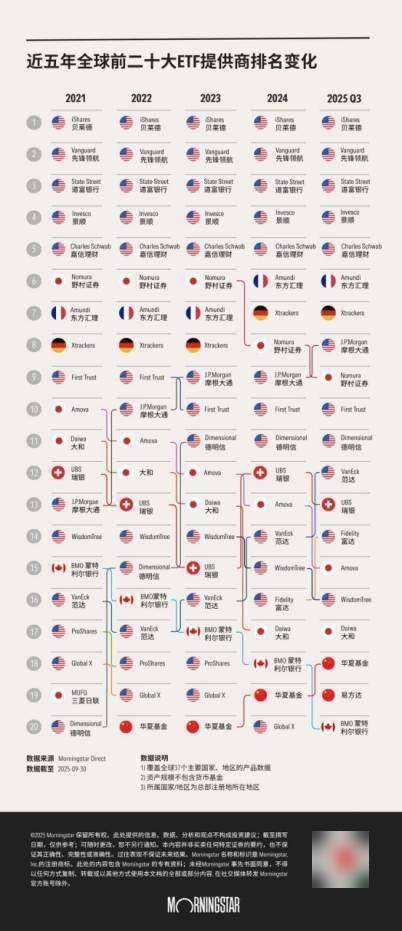
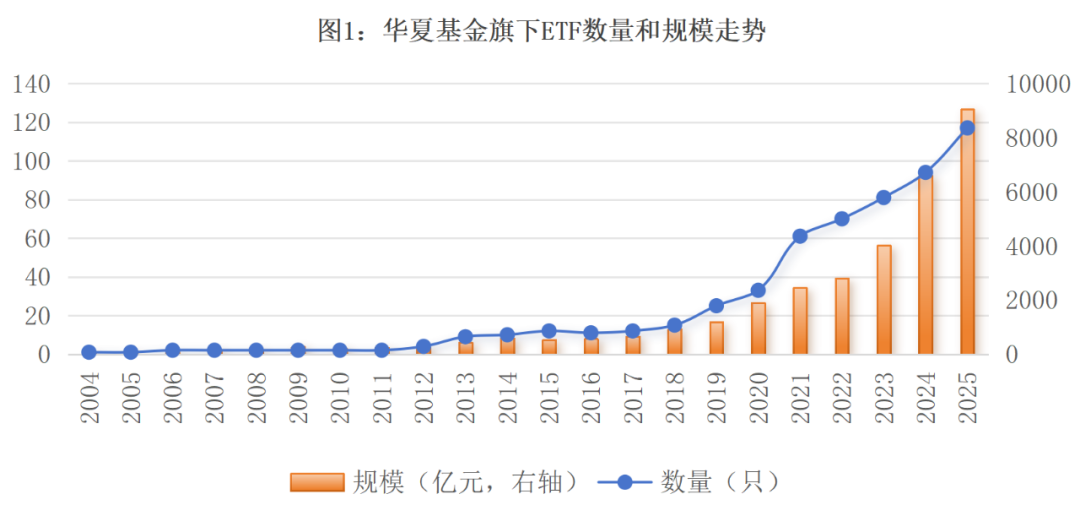
Core Insights - The recent ranking of the top 20 global ETF providers by Morningstar for Q3 2025 shows two Chinese public fund companies making the list, with China Asset Management's significant rise in position being noteworthy [1] - China has surpassed Japan to become the largest ETF market in Asia, with a total ETF scale of approximately 5.5 trillion yuan, solidifying its leading position in the Asia-Pacific region [1] Group 1: Company Performance - China Asset Management's ETF management scale reached 126.8 billion USD, moving up from 19th to 18th place in the global rankings, marking its continuous ascent since entering the top 20 in 2022 [1] - The company has maintained its position as the largest player in the domestic ETF market for over 20 years, having launched the first domestic ETF in 2004 [5][9] - As of November 19, 2025, China Asset Management's equity index scale reached 904.7 billion yuan, leading the industry [5] Group 2: Product Offering - The company offers a comprehensive range of 116 ETF products, covering core broad-based indices, thematic sectors, commodities, and both domestic and international markets [6][14] - The product matrix includes various asset types, allowing for flexible combinations to meet diverse investor needs, thus establishing a robust investment ecosystem [12][14] Group 3: Market Trends - Bloomberg's industry research team predicts that China will become a key growth engine for the Asian ETF market over the next decade, with assets expected to reach 8 trillion USD by 2035 [2] - The strong policy support for the ETF market and the increasing adoption rate among retail investors are expected to drive significant capital inflows and attract more foreign institutional participation [2] Group 4: Strategic Approach - China Asset Management employs a "Lego-style" approach to asset allocation, creating a detailed asset category structure to meet diverse investment needs [12] - The company emphasizes a dual empowerment model of "active equity + passive ETF," allowing it to redefine the value of ETFs beyond mere index replication [10][11]
大“揭秘”!这家ETF巨头全球排名,持续上升!
Zhong Guo Ji Jin Bao· 2025-11-21 02:24
Core Insights - The article highlights the rise of Chinese public fund companies in the global ETF market, with China becoming a significant player in the industry [1][3][10] - Specifically, Huaxia Fund has improved its ranking among global ETF providers, reaching 18th place with an ETF management scale of $126.8 billion as of Q3 2025, marking a continuous upward trend since 2022 [1][3][10] - The growth of the Chinese ETF market is underscored by its total scale of approximately 5.5 trillion yuan, surpassing Japan and establishing China as the largest ETF market in Asia [1][2] Industry Growth Potential - Bloomberg's ETF team predicts that China will be a key growth engine for the Asian ETF market over the next decade, with assets expected to reach $8 trillion by 2035, surpassing current European levels [2] - The strong policy support for ETFs and the increasing adoption rate among retail investors are expected to drive significant capital inflows and attract more foreign institutional participation [2] Huaxia Fund's Competitive Advantages - Huaxia Fund has established a comprehensive ecosystem characterized by "scale foundation + research empowerment + product ecology + long-termism," which has contributed to its sustained ranking improvements [3][10] - The fund has the largest equity index scale in the industry, amounting to 904.7 billion yuan as of November 19, 2025, and has been recognized as the "Passive Investment Golden Bull Fund Company" for eight consecutive years [4][5] - Huaxia Fund offers the most diverse range of ETF products, with 116 ETFs covering various categories, including core broad-based, thematic, commodity, and cross-border markets [4][12] Innovative Investment Strategies - Huaxia Fund employs a dual empowerment strategy of "active equity + passive ETF," redefining the value of ETFs beyond mere index replication [9][10] - The fund's proactive approach in index selection and compilation allows it to align closely with industry trends, ensuring timely and relevant product offerings [9][10] - The "Lego-style" asset allocation strategy enables Huaxia Fund to meet diverse investor needs, creating a robust investment ecosystem that spans all asset classes and scenarios [10][12]
大“揭秘”!这家ETF巨头全球排名,持续上升!
中国基金报· 2025-11-21 02:16
Core Insights - The article highlights the rise of China in the global ETF market, with two Chinese public fund companies making it to the top 20 ETF providers globally, particularly noting the significant progress of Huaxia Fund [1][6] - Huaxia Fund's ETF management scale reached $126.8 billion as of Q3 2025, moving up from 19th to 18th place in the global rankings, showcasing its growth trajectory since entering the top 20 in 2022 [1][6] - The Chinese ETF market has surpassed Japan, becoming the largest in Asia, with a total scale of approximately 5.5 trillion yuan, which strengthens China's leading position in the Asia-Pacific region [1][6] Group 1: Huaxia Fund's Growth - Huaxia Fund has maintained its position as the largest in the domestic ETF market for over 20 years, starting with the launch of the first domestic ETF in 2004 [6][11] - The fund's success is attributed to its comprehensive product ecosystem, which includes 116 ETF products covering a wide range of asset classes and investment strategies [8][18] - As of June 2025, Huaxia Fund had the highest number of clients in the industry, with 3.74 million accounts [9] Group 2: Market Dynamics - The global ETF market is characterized by a "Matthew Effect," where the top three firms (BlackRock, Vanguard, State Street) control 61% of the market share, highlighting the competitive landscape [6] - The report from Bloomberg predicts that China will be a significant growth engine for the Asian ETF market over the next decade, with assets expected to reach $8 trillion by 2035 [2] - The strong policy support and increasing adoption rates among retail investors in China are expected to drive substantial capital inflows and attract more foreign institutional participation [2] Group 3: Innovative Strategies - Huaxia Fund employs a dual empowerment strategy of "active equity + passive ETF," redefining the value of ETFs beyond mere index replication [12][13] - The fund's proactive approach in index selection and product development allows it to stay ahead of market trends, launching innovative products in emerging sectors like AI and 5G [13][14] - The "Lego-style" asset allocation strategy aims to create a comprehensive ecosystem that meets diverse investor needs, enhancing its competitive edge in the market [15][18]
又要见证历史!超5万亿市场传来大消息!存量ETF名称迎来统一规范
Zhong Guo Ji Jin Bao· 2025-11-20 10:51
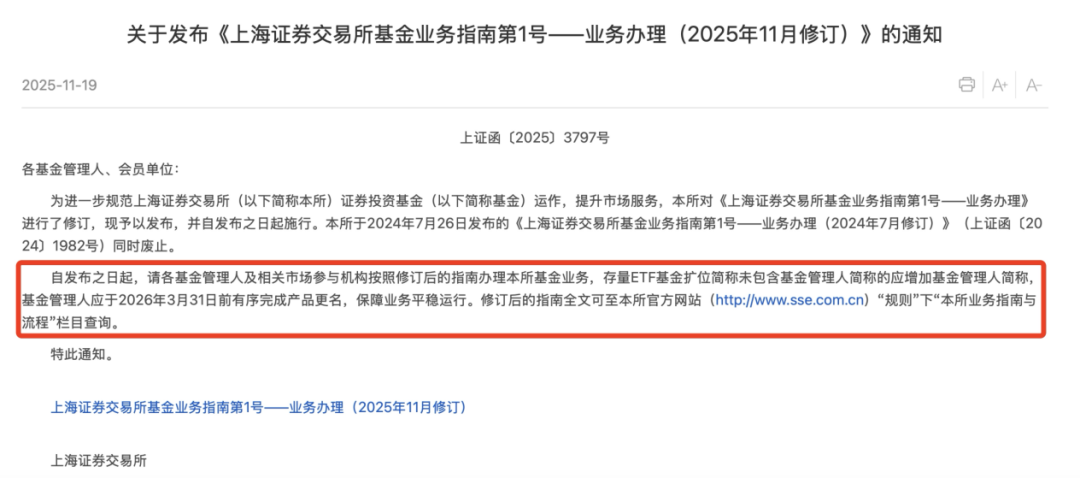
Core Viewpoint - The recent regulatory changes by the Shanghai and Shenzhen Stock Exchanges aim to standardize the naming conventions for existing ETF funds, enhancing product recognition and investor experience in a rapidly growing market [2][3][9]. Group 1: Regulatory Changes - The Shanghai and Shenzhen Stock Exchanges have issued revised guidelines for ETF fund naming, requiring existing ETFs to include the fund manager's abbreviation in their names by March 31, 2026 [2][7]. - The new naming structure for ETFs will follow the format of "core investment element + ETF" and for enhanced ETFs, "core investment element + enhanced + ETF" [6][9]. Group 2: Market Impact - The standardization of ETF names is expected to improve product differentiation and recognition, addressing the issue of name homogeneity that investors face [3][9]. - Several fund companies, including E Fund, Huatai-PB, and GF Fund, have already begun renaming their ETFs to align with the new guidelines, which is anticipated to enhance investor decision-making efficiency [2][10][12]. Group 3: Industry Consensus - There is a consensus within the fund industry that improving ETF name recognition is crucial due to the increasing number of products and intensified competition [9][12]. - The inclusion of fund manager names in ETF titles is likely to benefit well-known brands, potentially disadvantaging smaller firms in a competitive market [12][13].
又要见证历史!超5万亿市场,传来大消息!
中国基金报· 2025-11-20 10:40
Core Viewpoint - The recent regulatory changes by the Shanghai and Shenzhen Stock Exchanges aim to standardize the naming conventions for existing ETFs, enhancing product recognition and investor experience in a rapidly growing market valued at 5.7 trillion yuan [2][5]. Group 1: Regulatory Changes - The Shanghai Stock Exchange has issued revised guidelines for fund operations, mandating that existing ETF names follow a specific structure that includes the core investment elements and the fund manager's abbreviation [3][7]. - The deadline for fund managers to complete the renaming of their products is set for March 31, 2026, ensuring a smooth transition [3][7]. Group 2: Market Impact - The standardization of ETF names is expected to improve product differentiation, helping investors to quickly and accurately identify product features, thereby enhancing investment decision-making efficiency [3][14]. - Several fund companies, including E Fund, GF Fund, and Harvest Fund, have already begun renaming their ETFs to align with the new guidelines, indicating a trend towards clearer and more recognizable product names [12][13][14]. Group 3: Industry Consensus - There is a growing consensus within the fund industry that improving ETF name recognition is essential due to the increasing number of similar products, which has led to a homogenization challenge for investors [11]. - The introduction of standardized naming conventions is seen as a significant step towards strengthening the index investment ecosystem in China, which has recently surpassed the 5 trillion yuan mark in ETF market size [14].

政策护航、行情助燃,年内ETF发行创历史新高
Guo Ji Jin Rong Bao· 2025-11-20 10:12
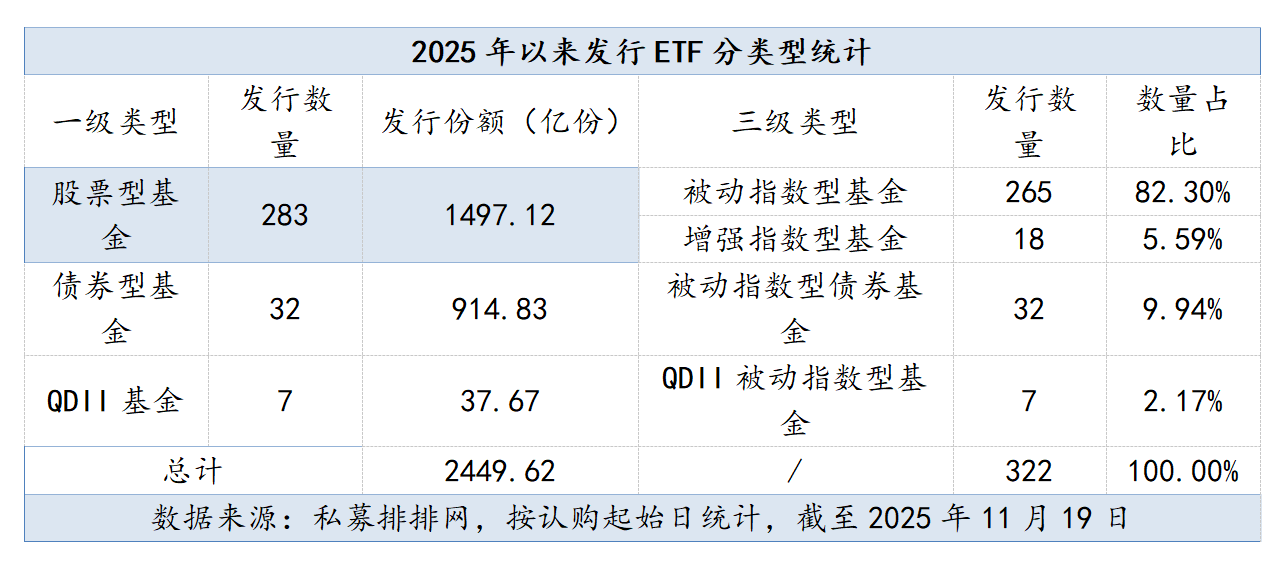
Core Insights - The ETF market has experienced explosive growth in 2023, with a total of 322 ETFs issued, amounting to 2449.62 billion shares as of November 19, significantly surpassing last year's figures [1][2][3] ETF Issuance Statistics - A total of 322 ETFs were issued in 2023, with 283 being stock-type ETFs, accounting for 87.89% of the total issuance [2][3] - The total issuance of stock-type ETFs reached 1497.12 billion shares, representing 61.12% of the overall issuance [2][3] - Bond-type ETFs accounted for 32 issuances, with a total of 914.83 billion shares, making up 37.35% of the total [2][3] - QDII funds, although limited to 7 issuances, showed high market acceptance with a total issuance of 37.67 billion shares, reflecting strong demand for overseas investment tools [3] Market Drivers - Multiple factors have contributed to the rapid growth of the ETF market, including supportive regulatory measures and a favorable market environment [4] - The A-share market's upward trend has positively influenced ETF net values, particularly in active sectors like technology, enhancing investor willingness to enter the market [4] - The inherent advantages of ETFs, such as low fees and risk diversification, along with an expanding product line, have attracted a diverse range of investors [4] - Long-term capital is increasingly allocating a larger proportion to ETFs for stable asset allocation, while individual investors are gradually increasing their ETF holdings due to heightened risk awareness [4]
证监会优化ETF注册流程,取消交易所无异议函环节
Sou Hu Cai Jing· 2025-11-20 08:05
Core Viewpoint - The China Securities Regulatory Commission (CSRC) has announced the optimization of the ETF registration and listing review process, which is expected to deepen the reform of the public fund industry and further enhance market vitality [1][2]. Group 1: Regulatory Changes - The new regulations eliminate the requirement for a no-objection letter from the stock exchange during the ETF registration process, allowing fund managers to apply directly to the CSRC for registration of ETFs tracking mature indices [1]. - After registration, fund managers can apply for issuance and listing based on relevant stock exchange rules, while the stock exchanges will initiate a product development evaluation mechanism for innovative, complex, or new index products [1]. Group 2: Market Development - The CSRC supports market-oriented development of ETF products but advises fund managers to carefully assess market conditions and investor demand to avoid excessive applications and potential issues with fundraising and operational stability [2]. - The domestic ETF market has seen rapid growth, with the number and volume of newly issued ETFs in 2023 significantly surpassing the total for the previous year, indicating that ETFs have become an important source of incremental capital in the equity market [2].