跨境电商

Search documents
跨境电商下半场 钱往哪去?
2 1 Shi Ji Jing Ji Bao Dao· 2026-01-28 23:07
Core Insights - The cross-border e-commerce industry demonstrates unexpected resilience amid a complex global economic landscape, with China's cross-border e-commerce imports and exports projected to reach 27.5 trillion yuan by 2025, a 69.7% increase from 2020 [1] - Companies are shifting their focus from purchasing and operational costs to brand building, indicating a change in decision-making logic within the industry [3] - The need for financial services that understand the future-oriented needs of cross-border e-commerce businesses is becoming increasingly critical, as traditional financial institutions often rely on past data [6] Funding Trends - There is a noticeable shift in where companies are directing their funds, moving from inventory purchases to investments in brand development [3] - Companies are transitioning from a "drop shipping" model to establishing overseas warehouses, which shortens product launch times and enhances consumer experience [4] - The establishment of overseas warehouses complicates the funding structure, requiring companies to manage funds across different currencies and regulatory environments [5] Technology Investment - Companies are increasingly investing in data tools and AI applications to enhance decision-making accuracy in uncertain markets [5] - AI is being utilized to predict growth patterns and funding gaps, allowing for dynamic adjustments in financing to support stable growth [7] - The integration of AI into financial services aims to create a comprehensive service system that addresses the evolving needs of cross-border e-commerce businesses [8] Systemic Challenges - The fragmentation of financial services poses a challenge for companies that require a more systematic approach to funding [7] - There is a growing recognition that funding is not a standalone issue but part of a broader system that includes business objectives and long-term returns [7] - The industry is transitioning from "wild growth" to "refined cultivation," with a focus on certainty becoming more valuable than capital itself in a rapidly changing environment [8]


超级头部商家如何在TikTok Shop再向前一步?
Sou Hu Cai Jing· 2026-01-28 18:51
Core Insights - The cross-border e-commerce sector is entering a phase of "high-intensity competition," with compliance and operational costs rising, making the traditional low-price and volume-driven growth model increasingly ineffective [2] - The U.S. market remains a critical battleground for cross-border brands, evolving into a test for brand pricing systems and global capabilities [2] - TikTok Shop has launched the "TOP Plan," committing significant resources to support top-tier brands and platforms, indicating a shift towards long-term support for growth [2][8] Market Dynamics - The U.S. market is not only about scale but also about establishing a brand's pricing and global capabilities [2] - Brands are reassessing their strategies to maintain business stability while seeking new growth opportunities [2] TikTok Shop Initiatives - TikTok Shop's "TOP Plan" aims to provide comprehensive support for high-quality merchants, enhancing long-term growth certainty through various dimensions such as product, content, marketing, and service [2][8] - The plan includes significant financial incentives, such as $500 and $1,000 subsidies for high-potential products and marketing activities [9][10] Brand Strategies - Brands like Dreame and TYMO BEAUTY are leveraging content to translate product features into relatable consumer experiences, enhancing brand trust and recognition [3][4] - The combination of content marketing, real-life demonstrations, and influencer collaborations is proving effective in driving consumer engagement and sales [4][5] Content and Marketing Approaches - Successful brands are focusing on creating relatable content that resonates with consumers, using real-life scenarios to demonstrate product effectiveness [3][4] - TikTok Shop encourages brands to treat content creation as a long-term strategy, emphasizing the importance of consistent engagement and collaboration with influencers [7][9] Operational Support - The "TOP Plan" also addresses logistical and governance support, ensuring that brands can maintain a stable and predictable customer experience, which is crucial for long-term growth [9][10] - New merchants entering the U.S. market can benefit from reduced platform fees and access to promotional resources, facilitating their growth trajectory [10][27]

宝安首创沉浸式跨境嘉年华,打造场景化出海新范本
Sou Hu Cai Jing· 2026-01-28 17:43
Group 1 - The first "Baopin Outbound" cross-border e-commerce carnival and Bay Area Outdoor Technology International Life Festival will be held on January 30-31, 2026, focusing on the theme "Outdoor Hot Products, One-Stop Chain Global" [1] - The event aims to create an efficient platform for Bay Area outdoor technology companies to expand internationally, utilizing a new model of "real scene experience + industry docking" [1][3] - The carnival will feature a 15,000 square meter open OAO rooftop experience space, showcasing six global themed areas, including North American luxury camping and Southeast Asia's "Baon Intelligent Manufacturing" [5] Group 2 - The event is supported by multiple departments, including the Shenzhen Municipal Bureau of Commerce and the Bao'an District United Front Work Department, leveraging Bao'an's strong industrial base and cross-border logistics advantages [3] - Nearly 100 quality enterprises from the Bay Area will participate, displaying new products and technologies in fields such as sports equipment, smart cycling, outdoor technology, and robotics [7][8] - The event will also gather over 20 global mainstream and emerging e-commerce platforms, providing a comprehensive service network that includes logistics, payment, and marketing [10]

跨境电商下半场,钱往哪去?
2 1 Shi Ji Jing Ji Bao Dao· 2026-01-28 10:10
Group 1 - The cross-border e-commerce industry shows unexpected resilience amid complex global economic conditions, with China's cross-border e-commerce imports and exports projected to reach 2.75 trillion yuan by 2025, a 69.7% increase from 2020 [1] - Cross-border financial service provider Fengbo International has issued loans exceeding $7 billion as of January 2026, with nearly $4 billion facilitated in 2025 alone, doubling the amount from the previous year [1] - Companies are shifting their focus from merely purchasing goods to investing in brand building, reflecting a change in decision-making logic as they adapt to rising platform traffic costs and increased competition [2][3] Group 2 - Businesses are moving from a "drop shipping" model to establishing overseas warehouses, which shortens product launch times and enhances consumer experience and repurchase rates [3] - The funding structure is becoming more complex as companies need to manage diverse currencies and regulatory environments when operating overseas, requiring more flexible financial services [3][6] - There is a growing investment in technology, particularly in data tools and AI applications, as companies seek to enhance decision-making accuracy in uncertain markets [3][4] Group 3 - Traditional financial institutions often rely on past financial data, which creates a mismatch with the needs of cross-border e-commerce businesses that require forward-looking financial support [6][7] - Fengbo International utilizes AI models to predict future business models and funding needs, providing tailored financial services to high-growth companies [6] - The fragmentation of financial services poses a challenge for businesses, which view funding as part of a broader system that must align with business objectives and long-term returns [7][8] Group 4 - The cross-border e-commerce industry is transitioning from "wild growth" to "refined cultivation," with certainty becoming more valuable than capital in a rapidly changing environment [8]
从“卖货”到“品牌扎根”:行业大咖深圳共议出海新周期
Sou Hu Cai Jing· 2026-01-28 09:06
Core Insights - The global e-commerce retail sales are expected to exceed $6 trillion by 2025, indicating a significant paradigm shift in China's cross-border e-commerce sector, moving from a growth model reliant on supply chain and traffic advantages to a focus on sustainable, scalable growth [2] - The first "FundPark Day" summit in Shenzhen gathered over 500 brand sellers, platform representatives, and service providers to explore sustainable growth strategies in cross-border e-commerce, marking a transition from "wild growth" to "systematic cultivation" [2] Industry Consensus - There is a fundamental shift from "goods going abroad" to "brands going abroad" and even "talent and models going abroad," as highlighted by Liu Run, founder of Runmi Consulting. He emphasized the need for companies to understand target market consumers and build brand value centered on "trust" [4] - Successful examples include Haier's voltage-adaptive refrigerators for Kenya and Transsion's localized mobile phones for Africa, showcasing the importance of solving local problems with Chinese advantages [4] - The need for a systematic collaboration of "brand, traffic, platform, and capital" is essential for sustainable growth, as noted by industry KOLs and successful entrepreneurs [5] Paradigm Innovation - The concept of "Growth as a Service" was introduced by FundPark International, marking a shift from being a service provider of operational funding to a multi-dimensional "smart growth partner" that integrates funding, data insights, and ecosystem connections [6][7] - This strategy includes three core engines: AI-driven dynamic financing services, predictive insights for optimization, and a community platform for interaction, aimed at helping businesses make better decisions and achieve sustained growth [7] Deep Dive: AI and Ecosystem Solutions - FundPark International's AI risk control model integrates multi-modal data to create precise business profiles, enabling "data-based credit" without fixed asset collateral, thus addressing financing challenges for SMEs [8] - The application of AI allows for proactive support in business growth, as demonstrated by a case where AI predicted funding gaps and adjusted financing strategies accordingly, enhancing decision-making and avoiding over-expansion risks [8] Future Outlook for 2026 - Key trends for cross-border enterprises by 2026 include compliance, AI integration, and brand development, with compliance being deemed a lifeline [9] - Challenges such as product homogenization, price competition, and evolving consumer expectations necessitate a systematic response from businesses [9] - Opportunities lie in leveraging AI to enhance operational efficiency, explore emerging markets, and deepen brand value, with a focus on either building brand barriers in niche categories or seizing trend opportunities [9] - As of September 2025, FundPark International has secured over $750 million in institutional funding, serving over 33,000 merchants and facilitating loans exceeding $7 billion, indicating market validation of its model [9]

中国年引爆东南亚消费潮!TikTok Shop东南亚跨境电商「春节不打烊」多重激励赋能跨境商家
Yang Zi Wan Bao Wang· 2026-01-28 08:05
Core Viewpoint - As the Chinese New Year approaches, Southeast Asia is experiencing a consumption boom, presenting a critical revenue opportunity for cross-border merchants. TikTok Shop has launched a "Spring Festival Never Stops" incentive program to help merchants prepare in advance and capitalize on this peak season [2] Group 1 - The "Spring Festival Never Stops" initiative encourages merchants to stock up on products and gather marketing materials to ensure continuous operations during the holiday period [2] - Concerns among merchants include delayed customer service responses and reduced shipping efficiency, which could lead to missed opportunities during the Southeast Asian peak season [2] - TikTok Shop is providing guidance on trending keywords such as "New Year Decorations," "Cleaning Supplies," and "Eid Clothing" to assist merchants in identifying hot products and preparing for the upcoming sales events [2]

促消费、稳外贸、扩开放,“十五五”开局之年这样干
Sou Hu Cai Jing· 2026-01-28 07:15
Group 1: Core Economic Strategies - The "15th Five-Year Plan" emphasizes boosting consumption, expanding autonomous openness, and promoting innovative trade development [1] - The Central Economic Work Conference highlights the importance of domestic demand and building a strong domestic market while maintaining openness for multi-field cooperation [1] Group 2: Service Consumption Growth - A focus on new service consumption models with fast growth and strong driving effects is outlined, along with the need to improve supportive policies and eliminate unreasonable restrictions [2] - Events like "Service Consumption Season" and "Chinese Cuisine Fair" are planned to guide localities in creating distinctive service consumption brands in sports, performing arts, tourism, and winter sports [2] Group 3: Consumer Market Development - The lower-tier markets, represented by third and fourth-tier cities and counties, account for 70% of the population and 60% of total retail sales of consumer goods, making them key areas for consumption growth [6] - Strategies will include enhancing circulation facilities, optimizing market environments, and enriching consumption scenarios to activate this potential "blue ocean" [6] Group 4: Trade Promotion Initiatives - Important trade fairs like the Canton Fair will be organized to attract more overseas buyers, with increased support for enterprises participating in overseas exhibitions [9] - The government aims to optimize public services and promote healthy development of new foreign trade models such as cross-border e-commerce [9] Group 5: Import and Export Strategies - Efforts will be made to expand the influence of the "Export China" brand through various matching activities and targeted procurement [11] - Utilizing trade promotion platforms like the China International Import Expo will enhance the convenience of import trade and optimize the structure of imported goods [13] Group 6: Service Trade Development - The development of service trade will follow a "one industry, one policy" approach, with policies aimed at accelerating the export of productive services and enhancing international service capabilities [15] - Emphasis will be placed on leveraging innovations in artificial intelligence, digital economy, and biomedicine to expand emerging service exports [15] Group 7: Autonomous Opening Up - Gradual expansion of autonomous opening in sectors like value-added telecommunications and biotechnology is planned, along with the implementation of zero-tariff measures for all tax items with African countries [19] - The operational policies for the Hainan Free Trade Port will be actively promoted to ensure effectiveness [19] Group 8: Global Supply Chain Cooperation - The strategy includes promoting reasonable and orderly cross-border layout of industrial and supply chains, enhancing cooperation in green development, digital economy, and new energy sectors [21] - The establishment of a comprehensive overseas service system and the promotion of a collaborative service ecosystem for international market expansion are also key objectives [21]

中国企业出海的三种制胜路径
Di Yi Cai Jing· 2026-01-28 02:25
Core Insights - China's GDP reached 140,187.9 billion yuan in the previous year, marking a 5.0% year-on-year growth at constant prices, with overseas contributions from Chinese enterprises accounting for approximately 10% to 15% of GDP [1] - The trend of Chinese companies going global is becoming a necessity, with a shift from merely exporting goods to providing services [3][15] - The CES event showcased a significant presence of Chinese brands, with TCL and Hisense leading in various product categories, indicating a shift in the global consumer electronics landscape [2][8] Industry Trends - The CES attracted over 4,000 companies and 140,000 attendees, highlighting the importance of networking and collaboration among Chinese enterprises [3] - Chinese brands are increasingly dominating the CES, with TCL and Hisense occupying key exhibition spaces, showcasing a range of products from AI robots to home appliances [3][8] - The AI sector is witnessing rapid advancements, with Chinese companies leading in robotics and AI applications, as evidenced by the positive reception of their products at CES [4][5] Market Dynamics - Shenzhen's startups are focusing on understanding Western consumer needs and leveraging local hardware advantages to penetrate overseas markets [7] - The food industry is adopting a different approach, with established products being introduced directly to the U.S. market, emphasizing local production to meet regulatory standards [12] - The overall participation of Chinese companies at CES reflects a strategic long-term investment in global branding and market presence [14] Future Directions - There is a growing emphasis on service capabilities alongside product exports, with companies like Xcotton providing cross-border e-commerce insurance services [15] - The U.S. manufacturing revival presents significant opportunities for Chinese enterprises, with many already establishing local operations to enhance competitiveness [13][15] - The disparity in innovation mechanisms between the U.S. and China highlights the need for improved support for scientific research and commercialization in China [16]


未知机构:金达威调研要点多特倍斯26年加大投入看好代工厂VB改善趋势2026012-20260128
未知机构· 2026-01-28 01:55
Key Points Summary Company and Industry Involved - The report focuses on the company "金达威" (Jindawi) and its operations in the dietary supplement industry, particularly in the production of coenzyme Q10 and contract manufacturing for brands like 多特倍斯 (Duotebei) and others [1][2]. Core Insights and Arguments 1. **Coenzyme Q10 Pricing**: The current price of coenzyme Q10 is considered reasonable, with a decrease noted in December followed by a recovery in January and February due to strong demand. The expectation for 2026 is an increase in volume but a decrease in price, with a target gross margin of 45%-50% [1][1]. 2. **Contract Manufacturing (VB)**: - Anticipated acceleration in revenue from the VB segment, which currently only produces tablets and hard capsules, with soft capsule production expected to start in April [1][1]. - The VB manufacturing process and delivery timelines have been clarified, indicating self-sustaining capabilities that allow participation in large project tenders. Orders have been received from clients like Duotebei, Walmart, and iHerb, although the current volume is small [1][1]. 3. **Brand Strategy**: - Duotebei in the U.S. aims for modest growth, influenced by consumer trends. In China, the focus for 2025 will be on return on investment, with significant investments planned for 2026 to enhance brand penetration and volume, while relaxing profit expectations [1][1]. 4. **Cross-Border Product Management**: The company is leveraging its advantages in cross-border product management, particularly through platforms like Douyin [2][1]. 5. **Investment in U.S. Contract Manufacturing**: Increased investment in U.S. contract manufacturing is highlighted, showcasing a strong competitive edge across the entire supply chain, despite lower margins downstream [2][1]. Other Important but Potentially Overlooked Content 1. **Change in Fund Utilization**: - Plans to establish a smart factory focusing on proprietary health products, potentially utilizing the existing brand "金乐心" (Jinlexin), targeting affordable products in lower-tier cities, specifically in coenzyme Q10 and PQQ [3][1]. - A new project focusing on algae oil, particularly EPA, aimed at vascular health, is also mentioned [3][1]. 2. **Market Dynamics**: The report notes that Douyin's special governance on cross-border VDS is expected to improve competitive dynamics in 2026, alongside increased domestic investments by Duotebei [3][1]. 3. **Empowerment through Smart Factory**: The smart factory in Inner Mongolia is positioned to empower the consumer end, focusing on lower-tier markets [3][1].

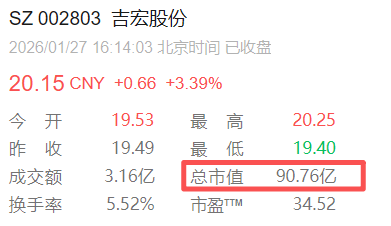
市值突破90亿元!上市大卖一年纯赚3个亿
Sou Hu Cai Jing· 2026-01-27 13:54
Core Viewpoint - Xiamen Jihong Technology Co., Ltd. (referred to as "Jihong Co.") has demonstrated resilience and achieved counter-cyclical growth, as evidenced by its impressive performance forecast for 2025, amidst a sluggish global economic recovery and increasing industry competition [1][2]. Financial Performance - Jihong Co. anticipates a net profit attributable to shareholders of nearly 300 million yuan for 2025, exceeding market expectations [3]. - The company's stock price reacted positively, with a 1.59% increase in A-shares and a peak of 4% in Hong Kong shares, leading to a market capitalization surpassing 9 billion yuan [3]. - The expected net profit for 2025 is projected to be between 273 million and 291 million yuan, representing a year-on-year growth of 50% to 60% [5]. - The net profit after deducting non-recurring gains is forecasted to be between 240 million and 258 million yuan, with a growth rate of 49.98% to 61.35% [5]. Business Model and Strategy - Jihong Co. has successfully transitioned to a dual-driven model, combining cross-border social e-commerce and traditional packaging services [10][11]. - The company has established a strong presence in the cross-border e-commerce sector, ranking second among B2C export e-commerce companies in China with a market share of 1.3% as of 2022 [11]. - The packaging business, as a traditional core, has shown a stable cash flow, contributing 2.099 billion yuan in revenue, with a gross profit margin recovery to 21.5% [13]. Growth Drivers - The growth in 2025 is attributed to the robust recovery of the packaging business and the rapid expansion of cross-border social e-commerce [11]. - Jihong Co. has adopted an "AI-driven cross-border e-commerce business + own brand development + packaging business overseas" long-term strategy, successfully launching several brands [15]. - The company has achieved significant growth in the Southeast Asian market, with a gross merchandise volume (GMV) exceeding 3.8 billion yuan in 2025, marking a 46% year-on-year increase [17]. Future Outlook - The cross-border e-commerce business is expected to continue its strong growth, leveraging early advantages in the Southeast Asian market and comprehensive AI capabilities [20]. - The packaging business is evolving towards smart solutions, creating new profit opportunities [20]. - Jihong Co. faces challenges such as fluctuations in the global trade environment and intense competition in overseas e-commerce, which will test its adaptability [20].