通用人工智能

Search documents
A股千亿级大并购;壁仞科技香港IPO拟发行逾2.47亿股……盘前重要消息一览
Zheng Quan Shi Bao· 2025-12-22 00:15
Group 1 - China Shenhua (601088) announced plans to acquire related assets held by the State Energy Group and its wholly-owned subsidiary, Western Energy, for a transaction price of 133.598 billion yuan [3] - MiniMax, a general artificial intelligence technology company, has passed the hearing at the Hong Kong Stock Exchange. The company, founded in early 2022, focuses on developing general AI technology that integrates text, audio, and visual modalities [3] - Beijing Zhiyu Huazhang Technology Co., Ltd. updated its post-hearing information set, indicating that the company's IPO at the Hong Kong Stock Exchange has officially passed the hearing [3] - Moore Threads held the first "MUSA Developer Conference" (MDC2025) in Beijing, where the founder and CEO introduced the company's core achievement over five years of research: the new generation of fully functional GPU architecture "Huagang" [3] - Vision Technology (301213) announced plans to acquire no less than 60% of Liaojing Electronics' equity, leading to a suspension of its stock [3] - *ST Dongyi (002713) announced that the Beijing First Intermediate People's Court approved the company's restructuring plan, entering the execution phase of the restructuring plan [3] Group 2 - Shengfeng Cement (000672) announced that its wholly-owned subsidiary's IPO application for Yuexin Semiconductor was accepted by the Shenzhen Stock Exchange on December 19, with the company indirectly holding approximately 1.4957% of the equity before the public offering [4] - *ST Mingjia (300506) announced that the capital reserve fund transfer to increase share capital has been completed, totaling 730 million shares, increasing the total share capital to 1.426 billion shares, with stock resuming trading [4] - Biran Technology announced plans to issue 247,692,800 H-shares for its listing in Hong Kong, with a pricing range between 17 to 19.6 HKD per share, and H-shares are expected to start trading on January 2 next year [4]


12月22日你需要知道的隔夜全球要闻
Sou Hu Cai Jing· 2025-12-21 23:30
Market Performance - The three major U.S. stock indices closed higher, with the Dow Jones up 0.38%, the S&P 500 rising 0.88%, and the Nasdaq Composite increasing by 1.31% [1] - Chip stocks saw significant gains, with Nvidia rising nearly 4%, Broadcom up 3%, Intel increasing by 1.4%, and Micron Technology surging nearly 7% [1] - The Nasdaq Golden Dragon China Index rose by 0.86%, with Alibaba up 1.68% and Pinduoduo increasing by 3.5% [1] Federal Reserve Insights - Federal Reserve official Harker expressed concerns about persistent inflation and indicated a preference to keep interest rates stable until spring [2] - The CME "FedWatch" tool shows a 79% probability that the Federal Reserve will maintain interest rates unchanged in January 2024 [2] Oil and Energy Sector - The U.S. is reportedly set to seize a third Venezuelan oil tanker, as the Trump administration intensifies its oil blockade against the Maduro regime, which may risk halting Venezuelan oil production [3] IPO Developments - AI company MiniMax has passed the Hong Kong Stock Exchange hearing [4] - Wall Street technology firm Wallen Technology plans to issue over 247 million shares in its Hong Kong IPO, with a maximum pricing of 19.6 HKD, expected to start trading on January 2, 2024 [4] Geopolitical Developments - Israeli officials plan to inform Trump about potential new strikes against Iran, with Prime Minister Netanyahu expected to meet Trump later this month [5] - Ukrainian President Zelensky mentioned a U.S. proposal for a tripartite meeting involving Ukraine and Russia, although Russian officials stated that such talks are not on the agenda [7] Technology Sector - Nvidia has been approved to acquire a stake in Intel, aiming to reshape the global chip industry landscape [8] - Following a power outage that caused disruptions, Waymo has suspended its robotaxi service in San Francisco, while Tesla CEO Musk stated that Tesla's related services were unaffected [9] Commodity Prices - WTI and Brent crude oil opened higher by 0.6% on Monday [10] - Spot gold surpassed $4,350 per ounce, increasing by 0.42%, while spot silver reached a historic high, breaking $67 per ounce with a daily increase of 2.38% [11]


壁仞科技拟全球发售2.48亿股 引入启明创投、南方基金等基石投资者
Zhi Tong Cai Jing· 2025-12-21 23:23
Core Viewpoint - The company, Wallen Technology (06082), is set to launch an IPO from December 22 to December 29, 2025, aiming to issue 248 million H-shares, with a price range of HKD 17.00 to HKD 19.60 per share, and plans to start trading on January 2, 2026 [1]. Group 1: Company Overview - Wallen Technology develops General-Purpose Graphics Processing Unit (GPGPU) chips and intelligent computing solutions based on GPGPU technology, providing essential computing power for artificial intelligence (AI) [1]. - The company's solutions integrate self-developed GPGPU-based hardware and proprietary BIRENSUPA software platform, supporting AI model training and inference across a wide range of applications from cloud to edge [1]. - Wallen Technology's GPGPU-based solutions demonstrate strong performance and efficiency in pre-training, post-training, and inference of large language models (LLMs), giving the company a competitive edge in the domestic market [1]. Group 2: Market Demand and Financials - The rapid development of AI, particularly LLMs and generative AI, has led to an increasing demand for computing solutions among enterprises to meet their surging needs for computing power and AI applications [2]. - The company has developed a specialized technology product, an intelligent computing solution consisting of a hardware system based on its GPGPU architecture and the BIRENSUPA computing software platform, which can be delivered in large-scale intelligent computing clusters [2]. - In 2023, the company's intelligent computing solutions began generating revenue, with 14 and 12 clients contributing RMB 336.8 million and RMB 58.9 million in revenue for the fiscal years ending December 31, 2024, and June 30, 2025, respectively [2]. Group 3: IPO and Use of Proceeds - Assuming an offering price of HKD 18.30 per share and no exercise of the over-allotment option, the net proceeds from the global offering are estimated to be approximately HKD 4.3506 billion [2]. - Approximately 85% of the proceeds will be allocated for future research and development of the company's intelligent computing solutions, 5% for commercialization, and 10% for working capital and general corporate purposes [2]. Group 4: Cornerstone Investors - The company has entered into cornerstone investment agreements, with cornerstone investors agreeing to subscribe for shares amounting to USD 372.5 million under certain conditions [3]. - Notable cornerstone investors include 3W Fund Management Limited, Qiming Venture Partners, and various insurance and investment firms [3].
壁仞科技(06082)拟全球发售2.48亿股 引入启明创投、南方基金等基石投资者
智通财经网· 2025-12-21 23:19
Core Viewpoint - The company, Birun Technology, is set to launch an IPO from December 22 to December 29, 2025, aiming to issue 248 million H-shares, with a price range of HKD 17.00 to HKD 19.60 per share, and is expected to start trading on January 2, 2026 [1] Group 1: Company Overview - Birun Technology develops General-Purpose Graphics Processing Unit (GPGPU) chips and intelligent computing solutions based on GPGPU, providing essential computing power for artificial intelligence (AI) [1] - The company's solutions integrate self-developed GPGPU-based hardware and proprietary BIRENSUPA software platform, supporting AI model training and inference across a wide range of applications from cloud to edge [1] - The technology has a strong performance in pre-training, post-training, and inference of large language models (LLMs), creating a significant competitive advantage in the domestic market [1] Group 2: Market Demand and Financials - The demand for computing solutions is increasing rapidly due to the growth of AI, particularly LLMs and generative AI, prompting the company to develop specialized technology products [2] - The intelligent computing solutions began generating revenue in 2023, with 14 and 12 clients contributing RMB 336.8 million and RMB 58.9 million in revenue for the fiscal years ending December 31, 2024, and June 30, 2025, respectively [2] - Assuming an offering price of HKD 18.30 per share, the net proceeds from the global offering are estimated to be approximately HKD 4.3506 billion, with 85% allocated for R&D of intelligent computing solutions [2] Group 3: Strategic Partnerships - The company has entered into cornerstone investment agreements, with cornerstone investors agreeing to subscribe for shares amounting to USD 372.5 million under certain conditions [3] - Notable cornerstone investors include 3W Fund Management Limited, Qiming Venture Partners, and various insurance and asset management firms [3]
南财早新闻|广湛高铁今日正式通车;首块L3级自动驾驶牌照诞生
2 1 Shi Ji Jing Ji Bao Dao· 2025-12-21 23:15
Industry Updates - The Guangzhan High-Speed Railway officially opened on December 22, connecting multiple cities including Guangzhou and Zhanjiang, with travel time from Guangzhou Baiyun Station to Zhanjiang North Station taking as little as 1 hour and 32 minutes [1] - The "Sanya-Prague" flight route was launched on December 21, marking the first operational seventh freedom route of Hainan Free Trade Port [2] - China National Offshore Oil Corporation announced that the Bohai Oilfield, the largest offshore oil field in China, is expected to produce over 40 million tons of oil equivalent by 2025, setting a historical record [2] - The domestic first L3-level autonomous driving dedicated license plate was issued in Chongqing, indicating that China is the second country after Germany to officially allow L3 autonomous driving vehicles [2] - The total cargo transported by national railways from January to November reached 3.727 billion tons, a year-on-year increase of 2.7%, highlighting the logistics advantages of China's railways [3] Investment News - The A-share market is maintaining a high-level fluctuation, with the Shanghai Composite Index turning positive last week, while the Shenzhen Component Index and ChiNext Index experienced adjustments. Analysts suggest that the market is entering a critical window for year-end positioning, with structural opportunities expected to align with policy guidance and industry prosperity [4] - The CSI A500 ETF has seen significant inflows, surpassing the CSI 300, with net inflows exceeding 46 billion yuan, and the total scale of the CSI A500 ETF exceeding 240 billion yuan [4] - The public fund issuance market has shifted focus from bond funds to equity funds, with 1,468 new funds established this year, marking the highest number in nearly four years [4] - As of December 18, over 454 listed companies have received institutional research in December, with electronics, machinery, and biomedicine being the top three sectors of interest [4] Company Developments - Samsung launched the industry's first 2nm process smartphone application processor, Exynos 2600, which boasts a performance increase of up to 39% and is expected to be used in certain versions of the Galaxy S26 series [6] - McDonald's opened its first store in Qinghai Province, achieving full coverage in all provincial-level administrative regions in China, with plans to exceed 7,500 restaurants by November 2025 [6] - MiniMax, an AI company, published its post-hearing information package for its IPO, reporting over 212 million individual users across more than 200 countries and regions, along with 130,000 enterprise clients in over 100 countries [6] - On December 21, Sungrow delivered 576MW of energy storage inverters to the Khavda energy base in India, which will become the largest energy storage station in India and one of the largest single energy storage stations globally [7]
壁仞科技(06082) - 全球发售
2025-12-21 22:15
上海壁仞科技股份有限公司 Shanghai Biren Technology Co., Ltd. (於中華人民共和國註冊成立的股份有限公司) 股份代號:6082 全球發售 聯席保薦人、保薦人兼整體協調人、聯席全球協調人、聯席賬簿管理人及聯席牽頭經辦人 整體協調人、聯席全球協調人、聯席賬簿管理人及聯席牽頭經辦人 聯席全球協調人、聯席賬簿管理人及聯席牽頭經辦人 聯席賬簿管理人及聯席牽頭經辦人 重要提示 重要提示: 閣下如對本招股章程的任何內容有任何疑問,應徵詢獨立專業意見。 Shanghai Biren Technology Co., Ltd. 上海壁仞科技股份有限公司 (於中華人民共和國註冊成立的股份有限公司) 全球發售 國際發售股份數目 : 235,308,000股H股(可予重新分配及視 乎發售量調整權及超額配股權行使與 否而定) 聯席保薦人、保薦人兼整體協調人、聯席全球協調人、 聯席賬簿管理人及聯席牽頭經辦人 整體協調人、聯席全球協調人、聯席賬簿管理人及聯席牽頭經辦人 聯席全球協調人、聯席賬簿管理人及聯席牽頭經辦人 聯席賬簿管理人及聯席牽頭經辦人 香港交易及結算所有限公司、香港聯合交易所有限公司及香港中央結 ...
美联储鹰派发声:近期降息?没必要;泽连斯基:乌美新一轮磋商取得建设性进展;破250亿元!我国动画电影票房创纪录;中国机器人夺冠!丨每经早参
Mei Ri Jing Ji Xin Wen· 2025-12-21 21:53
Group 1 - The proportion of existing home sales in China has surpassed 35%, indicating a shift away from the "blind box" approach to home buying. This year, the existing home sales area is expected to account for approximately 30.84% of total sales, with a rise to 35.4% in the first nine months [5] - The Ministry of Housing and Urban-Rural Development has proposed six key tasks to promote high-quality development in the real estate sector, including the establishment of a housing guarantee waiting list system and the advancement of existing home sales [5] Group 2 - MiniMax, a general artificial intelligence company, has passed its hearing with the Hong Kong Stock Exchange, showcasing its significant user base of over 212 million individuals across more than 200 countries and regions, along with 130,000 enterprise clients in over 100 countries [12] - Shangneng Electric has successfully delivered 576MW of energy storage converters to India's largest energy storage station, which will have a total capacity of 1126MW/3530 MWh, marking it as one of the largest single energy storage stations globally [13][14] Group 3 - Samsung has officially launched the world's first 2nm mobile chip, the Exynos 2600, which is currently in mass production, indicating a significant technological breakthrough in the semiconductor industry [18]


通用人工智能公司MiniMax通过港交所聆讯
Zheng Quan Shi Bao Wang· 2025-12-21 14:59
人民财讯12月21日电,通用人工智能(AGI)公司MiniMax(稀宇科技)12月21日首次刊发其聆讯后资料集 (PHIP)版本的招股书资料,有望刷新记录,成为从成立到IPO历时最短的AI公司。 ...
AI进化速递 | OpenAI CEO奥尔特曼:未来告别屏幕和键盘
Di Yi Cai Jing· 2025-12-21 12:59
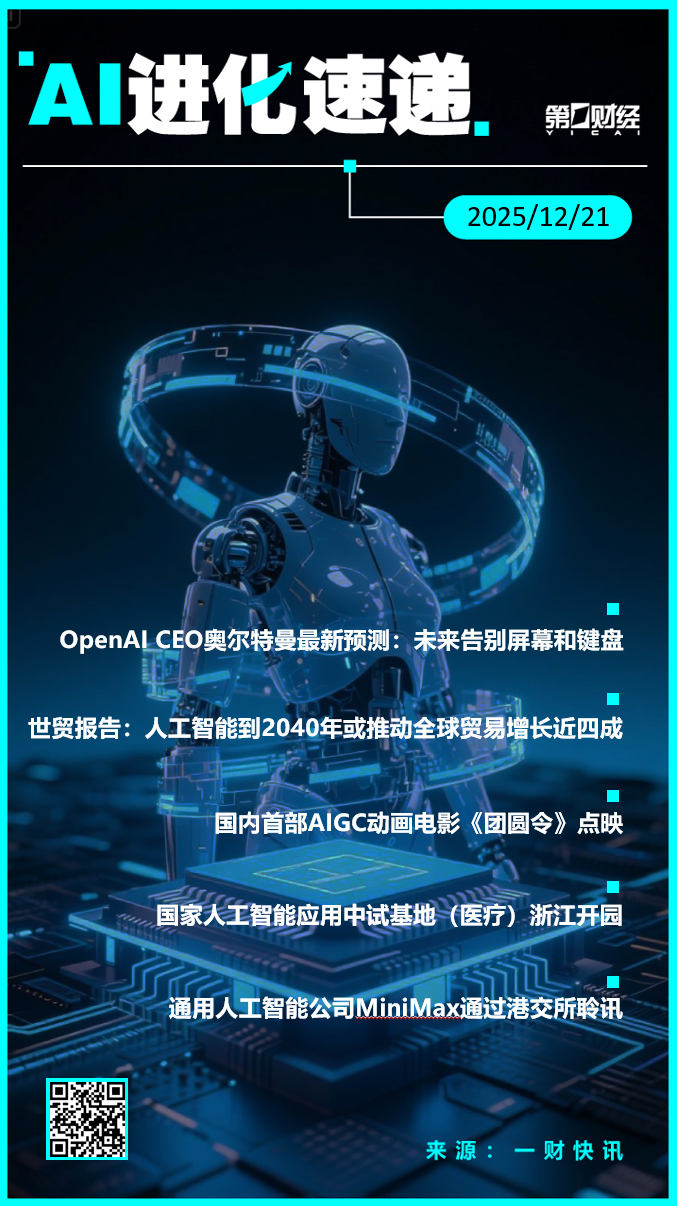
①OpenAI CEO奥尔特曼最新预测:未来告别屏幕和键盘,OpenAI上市会很晚; 奥尔特曼预测:未来告别屏幕和键盘,OpenAI上市会很晚。 ②世贸报告:人工智能到2040年或推动全球贸易增长近四成; ③国内首部AIGC动画电影《团圆令》点映; ⑤通用人工智能公司MiniMax通过港交所聆讯。 国家人工智能应用中试基地(医疗) 浙江开园 通用人工智能公司MiniMax通过港交所聆讯 来 源 : 一 财 快 讯 ④国家人工智能应用中试基地(医疗)浙江开园; ...
MiniMax通过港交所聆讯
财联社· 2025-12-21 12:24
Group 1 - MiniMax, a general artificial intelligence technology company, has passed the Hong Kong Stock Exchange hearing [1] - Founded in December 2021, MiniMax is a Chinese startup focused on developing multi-modal general AI technology, including text, speech, and visual integration [1] - The company has launched the ABAB series of large models and applications such as Glow and Hailuo AI [1]