AR/VR

Search documents
泉果基金调研韦尔股份
Xin Lang Cai Jing· 2025-05-06 07:13
Core Viewpoint - The company has shown significant growth in revenue and profit due to the recovery of the global semiconductor industry and increased demand in high-end smartphone and automotive markets [1][2] Group 1: Financial Performance - In 2024, the company's main business revenue reached 25.67 billion yuan, a 22.43% increase from 2023 [1] - The net profit attributable to the parent company for 2024 was 3.32 billion yuan, a staggering 498.11% increase year-on-year [1] - In Q1 2025, the company achieved a revenue of 6.47 billion yuan, a 14.68% increase compared to the same period last year [1] Group 2: Business Segments - Semiconductor design business generated 21.64 billion yuan in revenue, accounting for 84.30% of total revenue, with a 20.62% increase year-on-year [1] - The image sensor solutions segment achieved 19.19 billion yuan in revenue, representing 74.76% of main business revenue, with a 23.52% increase from the previous year [1] - The automotive simulation IC sales increased by 37.03% year-on-year, contributing to the growth of the simulation solutions business [1] Group 3: R&D and Product Development - The company invested 3.245 billion yuan in R&D for semiconductor design, which is 15.00% of the sales revenue for that segment, marking a 10.89% increase from the previous year [1] - The company is focusing on product upgrades and new product development to enhance competitiveness [1] - The newly launched OV50X sensor, designed for flagship smartphones, is set to enter mass production in Q3 2025 [2] Group 4: Market Trends and Future Outlook - The demand for automotive CIS products is increasing due to the penetration of advanced driving assistance systems in mid-range vehicles [1] - The company anticipates rapid growth in the AR/VR market, with significant investments from global tech giants [2] - The overall gross margin improved to 31.03% in Q1 2025, indicating potential for further enhancement through product and supply chain optimization [2]

探索基于云的半导体生命周期管理的强大功能
西门子· 2025-05-06 06:00
Investment Rating - The report does not explicitly state an investment rating for the semiconductor industry Core Insights - The semiconductor industry is one of the most innovative sectors, essential for new technologies like 5G, AI, and AR/VR [3] - There is a growing demand for greater computing power in smaller spaces, indicating a continuing trend in the industry [3] - The COVID-19 pandemic highlighted vulnerabilities in the global supply chain, particularly during the chip shortage [3] - Over 60% of companies utilize more than six systems to manage their data, leading to inefficiencies and compatibility issues [3] Summary by Sections Current State of the Semiconductor Industry - The semiconductor industry is critical for numerous consumer products and is facing increasing demands for compact and powerful computing solutions [3] - The pandemic has exposed weaknesses in supply chains and raised security concerns due to the inability to prove data traceability [3] Need for Digital Solutions - Companies must adopt digital solutions to enhance control and visibility across processes and systems, ensuring end-to-end digitalization throughout the product lifecycle [4] - Product Lifecycle Management (PLM) systems offer a comprehensive solution for data management across all processes, improving design and production while addressing product complexity [4] - PLM systems facilitate collaboration among stakeholders, enhance quality, provide complete traceability to protect intellectual property, and accelerate product acceptance and time-to-market [4]
龙迅股份(688486):25Q1营收同比微增,关注产能供应改善进度
CMS· 2025-04-30 02:15
Investment Rating - The investment rating for the company is "Accumulate" [3] Core Views - The company reported a slight year-on-year revenue increase of 4.5% in Q1 2025, with revenue of 109 million yuan, but faced a quarter-on-quarter decline of 17.7% due to supply constraints [6] - The company is focusing on improving its supply chain capabilities and has plans to establish a dual-cycle supply system to enhance stability and cost efficiency [6] - Key areas for future research and development include automotive electronics, micro-displays, AR/VR, and high-performance computing (HPC) [6] - The company expects revenue growth to reach 693 million yuan in 2025, with a net profit of 199 million yuan, corresponding to a PE ratio of 49.3 [6] Financial Data and Valuation - Total revenue is projected to grow from 323 million yuan in 2023 to 1.31 billion yuan in 2027, with a compound annual growth rate (CAGR) of 34% to 31% [2][12] - Operating profit is expected to increase from 103 million yuan in 2023 to 391 million yuan in 2027, with a CAGR of 48% to 33% [2][12] - The company's net profit attributable to shareholders is forecasted to rise from 103 million yuan in 2023 to 372 million yuan in 2027, with a CAGR of 48% to 32% [2][12] - The company maintains a healthy balance sheet with a debt ratio of 9.0% and a return on equity (ROE) of 10.2% [3][12] Stock Performance - The company's stock has shown strong performance, with a 1-month absolute return of 31%, a 6-month return of 173%, and a 12-month return of 114% [5]

创新研发成势 上市公司显硬核担当
Shang Hai Zheng Quan Bao· 2025-04-29 20:02
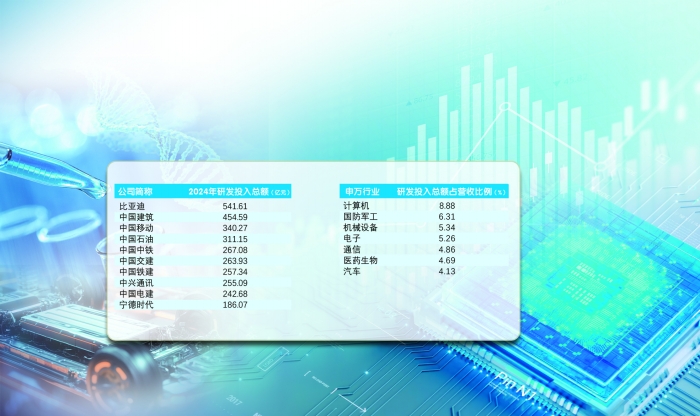
Group 1: R&D Investment Overview - As of April 29, 2024, 5,304 A-share companies disclosed their annual reports, with total R&D expenditure exceeding 1.67 trillion yuan [2] - The computer, defense, machinery, and electronics industries have R&D expenditure accounting for over 5% of their revenue [2] - 42 companies reported R&D spending over 5 billion yuan, while 23 companies exceeded 10 billion yuan; 125 companies had R&D expenditure over 30% of their revenue [2] Group 2: Leading Companies in R&D Investment - BYD's R&D investment reached approximately 54.2 billion yuan in 2024, a 36% increase year-on-year, with cumulative R&D spending exceeding 180 billion yuan [3] - CATL's R&D investment hit a record high of 18.6 billion yuan in 2024, with total R&D spending over 70 billion yuan in the past decade [4] - Major state-owned enterprises like China State Construction and China Mobile reported R&D investments between 20 billion to 45 billion yuan in 2024 [4] Group 3: Emerging Industries and Innovations - New industries are driving innovation, with significant R&D investments in AI and robotics; for instance, Star Ring Technology's R&D expenditure was 70.65% of its revenue in 2024, up from 49.88% [5] - Geke Micro's R&D investment was 9.52 billion yuan, accounting for 14.91% of its revenue, focusing on smart wearable technology [5] - Midea Group has consistently invested over 10 billion yuan annually in R&D, particularly in industrial automation technologies [6] Group 4: R&D as a Growth Driver - High R&D expenditure relative to revenue indicates a strong focus on innovation; for example, Geling Deep Vision's R&D spending was 1.89 billion yuan in 2024, representing 161.18% of its revenue [7] - Heng Rui Pharmaceutical's R&D investment reached 8.228 billion yuan in 2024, with a revenue ratio of 29.40%, contributing to record performance [7] - Seres achieved significant growth with a 70.53 billion yuan R&D investment in 2024, reflecting a 58.9% increase year-on-year [8]




水晶光电(002273):业绩稳步向好,持续加大研发投入
GOLDEN SUN SECURITIES· 2025-04-25 02:49
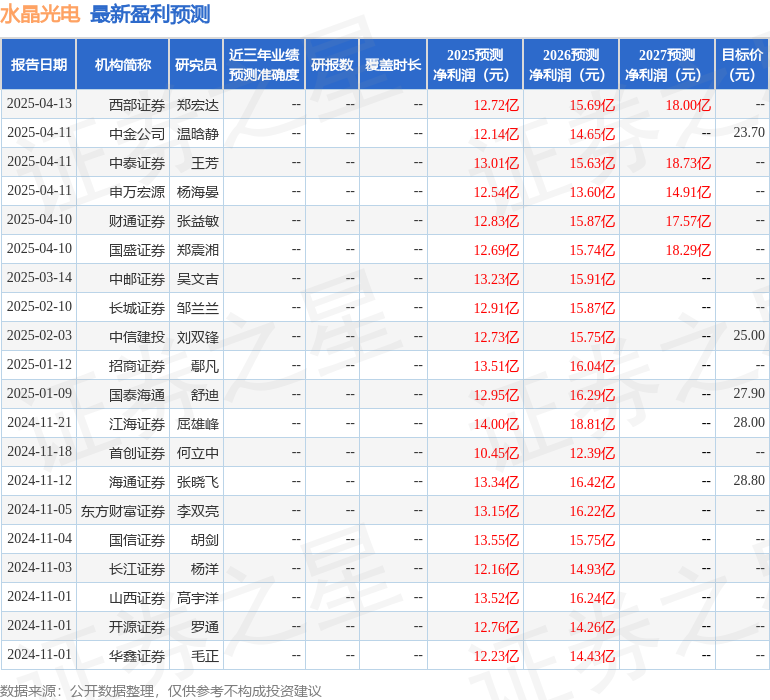
Investment Rating - The report maintains a "Buy" rating for the company [6] Core Views - The company has shown steady improvement in performance, with a significant increase in profitability and a strong focus on R&D investment [1][4] - The company is deeply engaged in three main sectors: consumer electronics, automotive optics, and AR/VR, enhancing customer loyalty and supply chain position [1][2][3] Financial Performance - In Q1 2025, the company achieved revenue of 1.482 billion yuan, a year-on-year increase of 10.20%, and a net profit of 221 million yuan, up 23.67% year-on-year [1] - The gross margin for Q1 2025 was 27.95%, an increase of 3.95 percentage points year-on-year, while the net margin was 15.11%, up 1.3 percentage points year-on-year [1] - The company expects revenues of 7.593 billion yuan in 2025, with a year-on-year growth of 20.9%, and net profit of 1.269 billion yuan, a growth of 23.3% [5] R&D and Innovation - The company is committed to R&D transformation, with total R&D investment reaching 1.165 billion yuan from 2022 to 2024 [4] - In Q1 2025, R&D expenses amounted to 96 million yuan, reflecting a year-on-year increase [4] Market Position and Strategy - In the consumer electronics sector, the company is expanding its market share through innovative optical components and applications [2] - In automotive electronics, the company is leading in AR-HUD technology and has been recognized as a global quality supplier by Jaguar Land Rover [3] - The company is also focusing on AR/VR solutions, collaborating with leading firms to address production challenges and enhance its product offerings [3]

韦尔股份:汽车CIS增长强劲,AR/VR应用多场景拓展-20250417
China Post Securities· 2025-04-17 07:55
Investment Rating - The report maintains a "Buy" rating for the company [1] Core Insights - The company reported a revenue of 25.731 billion yuan in 2024, representing a year-on-year increase of 22.41%, and a net profit attributable to shareholders of 3.323 billion yuan, up 498.11% year-on-year [4][10] - The semiconductor design business is entering a high-growth cycle, driven by AI and the acceleration of automotive intelligence, leading to significant revenue growth [5] - The company has optimized its product structure and supply chain, resulting in improved gross margins and net profits [5] Company Overview - Latest closing price: 124.22 yuan - Total shares: 1.217 billion; Total market capitalization: 151.2 billion yuan - 52-week high/low: 157.98/82.70 yuan - Debt-to-asset ratio: 37.9%; Price-to-earnings ratio: 44.84 [3] Financial Performance - In 2024, the company's main business revenue was 25.670 billion yuan, with semiconductor design and sales contributing 21.640 billion yuan and 3.939 billion yuan, respectively [5] - The image sensor solutions business generated 19.190 billion yuan, showing a year-on-year increase of 23.52% [6] - The automotive market's contribution to revenue was significant, with a 30% increase in revenue from automotive applications [6] Future Projections - The company is expected to achieve revenues of 30.7 billion yuan, 35.9 billion yuan, and 41.8 billion yuan in 2025, 2026, and 2027, respectively, with net profits projected at 4.4 billion yuan, 5.7 billion yuan, and 7.2 billion yuan [10][12] - The current stock price corresponds to a price-to-earnings ratio of 34, 27, and 21 for the years 2025 to 2027 [10]
财信证券:首次覆盖水晶光电给予增持评级
Zheng Quan Zhi Xing· 2025-04-15 04:25
Core Viewpoint - Water Crystal Optoelectronics (002273) has achieved record-high performance in its 2024 annual report, with significant growth across all business segments, leading to an initial "Buy" rating from Caixin Securities [1] Financial Performance - In 2024, the company reported revenue of 6.278 billion yuan, a year-on-year increase of 23.67% - The net profit attributable to shareholders reached 1.030 billion yuan, up 71.57% year-on-year - The net profit after deducting non-recurring gains and losses was 955 million yuan, reflecting an 82.84% increase year-on-year - The gross margin was 31.09%, an increase of 3.28 percentage points year-on-year, while the net margin was 16.63%, up 4.47 percentage points year-on-year [1] Business Segment Performance - Optical Components: Revenue of 2.884 billion yuan, a 17.92% increase, accounting for 45.94% of total revenue, with a gross margin of 36.31% [3] - Thin Film Optical Panels: Revenue of 2.472 billion yuan, a 33.69% increase, making up 39.38% of total revenue, with a gross margin of 26.65% [3] - Reflective Materials: Revenue of 394 million yuan, a 37.17% increase, contributing 6.27% to total revenue, with a gross margin of 30.87% [3] - Automotive Electronics (AR+): Revenue of 300 million yuan, a 3.04% increase, representing 4.78% of total revenue, with a gross margin of 13.53% [3] - Semiconductor Optics: Revenue of 129 million yuan, a 19.50% increase, accounting for 2.06% of total revenue, with a gross margin of 40.29% [3] Quarterly Performance - In Q4 2024, the company achieved revenue of 1.568 billion yuan, a year-on-year increase of 2.70% but a quarter-on-quarter decline of 23.70% - The net profit attributable to shareholders was 168 million yuan, up 3.63% year-on-year but down 61.38% quarter-on-quarter - The gross margin for Q4 was 29.65%, a slight decrease of 0.05 percentage points year-on-year and a decline of 7.06 percentage points quarter-on-quarter [2] Future Outlook - The company is expected to maintain a diversified and sustainable growth pattern, with projected revenues of 7.585 billion yuan, 9.021 billion yuan, and 10.334 billion yuan for 2025, 2026, and 2027 respectively, reflecting year-on-year growth rates of 20.82%, 18.94%, and 14.56% [4] - The net profit forecasts for the same years are 1.240 billion yuan, 1.503 billion yuan, and 1.797 billion yuan, with corresponding year-on-year growth rates of 20.45%, 21.12%, and 19.61% [4]
国兆光电推出0.3英寸超高亮低功耗硅基OLED显示屏
WitsView睿智显示· 2025-04-14 09:33
Core Viewpoint - Nanjing Guozhao Optoelectronics Technology Co., Ltd. has launched a new 0.3-inch ultra-bright, low-power full-color silicon-based OLED product "GZ030PCC01" and a small array waveguide module, enhancing AR optical technology applications [1][2]. Group 1: Product Features - The GZ030PCC01 features a maximum brightness of up to 10,000 cd/m², utilizing an efficient stacked OLED structure to significantly improve optical efficiency [1]. - The product achieves a resolution of 1280×720 with a pixel density exceeding 4800 ppi, thanks to a new current-driven circuit architecture [1][2]. - The ultra-narrow bezel design of GZ030PCC01 measures only 8.02×7.22 mm, making it easily adaptable to various optical solutions [2]. Group 2: Power Efficiency - The full-load power consumption of the product is approximately 150 mW, with an average working power consumption below 120 mW, effectively extending the battery life of AR glasses [2]. Group 3: Additional Product Launch - Alongside GZ030PCC01, the company will also launch a 0.3-inch array waveguide optical module "GZ030MCC01," featuring a vertical waveguide structure and achieving a field of view (FOV) of 30° with a compact volume of less than 3 CC and a weight of 10 g [2]. - The GZ030MCC01 module offers color brightness of 1,000 cd/m² and is designed for various AI/AR glasses applications, emphasizing high brightness, small size, low power consumption, and cost-effectiveness [2]. Group 4: Market Position and Future Plans - Guozhao Optoelectronics focuses on providing micro-display products and overall solutions, with core products widely used in night vision observation, helmet displays, digital sights, AR/VR, EVF, and FPV applications [2][3]. - The company has a history of innovation in the AR/VR field, having launched several high-brightness products since 2016, with plans to mass-produce a 4K UHD product in 2025 [3].

水晶光电20250410
2025-04-11 02:20
Summary of Crystal Optoelectronics Conference Call Company Overview - **Company**: Crystal Optoelectronics - **Date**: April 11, 2025 - **Key Financials**: - Net profit growth rate exceeded sales growth by 48% - Gross margin reached 31.1%, up 3.3 percentage points year-on-year - Net profit margin at 16.4%, up 4.6 percentage points year-on-year - Revenue for 2024 was 6.3 billion RMB, a 24% year-on-year increase [2][3] Core Business Segments - **Revenue Breakdown**: - Optical components: 4.7 billion RMB, 18% increase, 47% of total revenue - Optical panels: 2.5 billion RMB, 34% increase, 40% of total revenue - Semiconductor optics: 100 million RMB, 20-fold increase, 2% of total revenue - Automotive electronics L3: 300 million RMB, 3-fold increase, 5% of total revenue - Reflective materials: 400 million RMB, 37-fold increase, 6% of total revenue [2][5] Market Position and Strategy - **Export and Market Reach**: - 75% of sales are exports, with less than 0.1% directly to the U.S., minimizing tariff impact - Major export markets include Taiwan, Singapore, Vietnam, and other East Asian countries [2][7][8] - **Future Growth Plans**: - Targeting 10% revenue growth in 2025 through customer relationship deepening, strategic business layout, and cost reduction [2][10] - Capital expenditure expected to be 10%-15% of revenue, focusing on new projects and headquarters development [10] Competitive Advantages - **Unique Market Position**: - Positioned uniquely in the global market with significant price advantages, breaking North American market monopolies [2][12][13] - **Technological Leadership**: - Committed to becoming a leader in the optical solutions for the metaverse, focusing on AR/VR and AI applications [20][45] Financial Performance and Profitability - **Profitability Metrics**: - Non-GAAP net profit increased by 83% year-on-year [2][5] - Gross margins improved across all business segments, with optical components at 36.3% and semiconductor optics at 40% [6] Risk Management and External Factors - **Impact of Tariffs**: - Minimal direct impact from U.S. tariffs due to low export volume; no significant order fluctuations reported from key clients [8][17] - **Response to Macro Uncertainty**: - Implementing structural adjustments and cost reduction strategies to enhance resilience against market volatility [15][47] Future Outlook - **Growth Projections**: - Anticipating continued growth driven by high-demand sectors such as consumer electronics and automotive [14][45] - **Investment in Innovation**: - Focused on R&D in AR optics and automotive HUD technologies, with plans for mass production in emerging markets [23][25][30] Shareholder Returns - **Dividend Plans**: - Proposed cash dividend of 2 RMB per ten shares, with no stock bonuses or capital increases [11] Conclusion - **Vision for the Future**: - Aiming to solidify its position as a global leader in optical solutions for the metaverse while maintaining strong relationships with major clients and adapting to market changes [45][48]
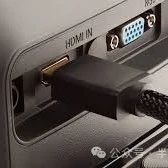
新版HDMI,有何不同?
半导体行业观察· 2025-04-11 00:55
Core Viewpoint - The article discusses the advancements in HDMI technology, particularly focusing on HDMI 2.1 and the newly announced HDMI 2.2, highlighting their features and implications for consumers and the industry [1][5]. Group 1: HDMI 2.1 Overview - HDMI 2.1 was officially announced in November 2017, significantly increasing bandwidth from 18 Gbps to 48 Gbps, allowing for higher video resolutions and refresh rates [3]. - It supports 120 Hz 4K video, 60 Hz 8K video, and even 10K video, along with advanced gaming features like Variable Refresh Rate (VRR) and Auto Low Latency Mode (ALLM) [3][4]. - HDMI 2.1b also includes features like HDMI eARC for lossless audio transmission and dynamic HDR support for scene-by-scene optimization [4]. Group 2: HDMI 2.2 Features - HDMI 2.2, announced at CES 2025, doubles the bandwidth to 96 Gbps, targeting commercial applications and advanced consumer technologies like AR and VR [5][6]. - It aims to enhance medical imaging and next-generation media production, with potential applications in machine vision for robotics and autonomous vehicles [6][7]. - A notable improvement is the Low Latency Indication Protocol (LIP) for better audio-video synchronization between devices [7]. Group 3: GPMI Development - The GPMI (General Purpose Media Interface) was developed by a coalition of over 50 Chinese companies, providing a unified multimedia interface solution [9][10]. - GPMI offers a bandwidth of up to 192 Gbps and a power delivery capability of 480W, addressing the complexity of multiple connections in traditional setups [10]. - It supports dual-directional control, allowing users to operate multiple devices through a single interface, enhancing user experience [10][11]. Group 4: Comparison with Existing Technologies - GPMI is positioned as a potential alternative to HDMI and DisplayPort, with specifications that surpass current standards in terms of bandwidth and power delivery [10][11]. - HDMI 2.1 and DisplayPort 2.1 have lower bandwidth capabilities compared to GPMI, which could lead to a shift in industry standards [10].