
AI算力

Search documents
特发信息年内飙涨超130%,连续多天换手率超30%背后,暗藏哪些玄机?
Hua Xia Shi Bao· 2025-12-04 00:49
Core Viewpoint - The communication equipment sector has become a core investment focus in the A-share market, with significant price increases driven by trends such as AI computing power and digital infrastructure development [1][4]. Group 1: Market Performance - As of December 3, 2025, the communication equipment sector has seen a price increase of over 100% this year, with many other sectors also experiencing gains of over 50% [1][2]. - Over 4,000 listed companies have seen their stock prices rise this year, with more than 400 companies achieving price increases exceeding 100% [2]. - Specifically, the stock price of TeFa Information (000070) has increased by 133.04% this year, with a notable rise of 43.11% in November 2025 alone [2][4]. Group 2: Company Performance - TeFa Information has reported significant fluctuations in its operating performance, with revenue peaking in 2022 at 4.192 billion yuan, followed by a decline in 2024 to 4.409 billion yuan, representing a year-on-year decrease of 10.69% [5][6]. - The company has faced consecutive losses in 2023 and 2024, but there are signs of improvement in 2025, with a net profit of 7.9961 million yuan in the first three quarters [6]. - Despite the losses, the company's cash flow from operating activities has shown consistent growth, reaching 3.73 million yuan in 2024 [6]. Group 3: Market Sentiment and Trading Activity - TeFa Information has experienced a high turnover rate, significantly exceeding the average for the communication equipment sector, with daily turnover rates surpassing 25% on multiple occasions [7]. - Investor sentiment regarding TeFa Information is mixed, with some believing that the stock may have peaked while others anticipate further price increases [7]. Group 4: Future Outlook - The communication equipment sector is expected to benefit from the ongoing AI industrial revolution, with optimistic projections for demand in areas such as optical modules and chips [8]. - The sector is anticipated to follow a dual growth trajectory focusing on "computing power infrastructure" and "aerospace integration breakthroughs" over the next two years [8].

超60只新产品定档12月发行 公募基金年底发行大战如火如荼
Zhong Guo Zheng Quan Bao· 2025-12-03 22:13
Group 1 - The issuance of new funds remains strong in December, with over 60 products starting or about to start issuance, including 28 new funds on December 1 alone [1][2] - A total of 1,450 new funds have been issued this year, surpassing last year's total of 1,143 and reaching a three-year high, with a combined issuance of 10,359.09 million units [4] - Equity products are the main focus of new fund issuances, with 795 stock funds and 251 equity-mixed funds issued this year, accounting for over 70% of total new funds [4] Group 2 - Major fund companies are leading the issuance of new products, with several firms launching multiple new funds in December, such as Ping An Fund and Penghua Fund, each with four new products [3] - Innovative products have been introduced in the public fund industry, including credit bond ETFs and floating rate funds, enhancing the investment landscape [5] - The public fund industry has seen significant investor interest due to the strong performance of the A-share market and the clear earning effects of public funds, leading to a continuous increase in new fund issuances [6] Group 3 - Market expectations regarding policy and economic growth are influencing investment strategies, with suggestions for balanced asset allocation to manage volatility [6][7] - The upcoming Federal Reserve meeting and potential interest rate cuts are expected to impact the A-share market positively, particularly for growth-oriented investments [7] - The bond market is anticipated to maintain a narrow fluctuation range due to the interplay of new sales regulations and interest rate expectations [7]
公募基金年底发行大战如火如荼
Zhong Guo Zheng Quan Bao· 2025-12-03 20:28
Group 1 - The issuance of new funds remains strong in December, with over 60 products starting or about to start issuance, and a total of more than 1400 new funds issued this year, surpassing last year's total of 1143 and reaching a three-year high [1][2] - Equity products are the main focus of new fund issuances, with 26 stock funds and 16 mixed funds launched in December, including several managed by well-known fund managers [1][2] - The majority of new funds are being issued by large and medium-sized institutions, with several companies launching multiple new products simultaneously [2][3] Group 2 - The total issuance of new funds this year has reached 1450, with a combined share of 10,359.09 million units, marking a significant increase compared to last year [2][3] - Among the newly issued funds, 795 are stock funds and 251 are equity-mixed funds, accounting for over 70% of the total, with index products dominating the market [3] - The public fund industry is innovating continuously, introducing various new products such as credit bond ETFs and floating rate funds, enhancing the investment landscape for investors [3] Group 3 - The outlook for the market remains positive, with expectations of economic improvement and a downward trend in risk-free interest rates, although short-term disturbances may still exist [4] - Fund companies suggest a balanced allocation strategy to navigate market volatility, with recommendations to increase exposure to stable dividend assets and sectors with growth potential [4] - The bond market is expected to maintain a narrow fluctuation pattern in the short term, influenced by new sales regulations and interest rate expectations [4]
科创ETF密集申报,A股科技赛道再迎增量资金
Di Yi Cai Jing Zi Xun· 2025-12-03 15:09
Group 1 - The A-share technology sector is experiencing an influx of capital as multiple semiconductor ETFs are being launched, indicating strong interest in AI, robotics, and semiconductor fields [2][3] - Since November 21, 49 new technology-focused ETFs have been reported, with the first batch of seven AI ETFs approved on the same date, reflecting a strategic positioning by public fund institutions [2][3] - The market response has exceeded expectations, with a potential influx of over 30 billion yuan if all ETFs reach their maximum fundraising limits [3] Group 2 - There is a noticeable market differentiation, with larger fund companies attracting more capital while smaller, homogeneous products struggle to gain traction, leading to a "good reputation but low sales" situation [4] - Investors prefer top-tier products with higher average daily trading volumes, which raises concerns about the liquidity and potential risks of smaller products [4] - The technology sector is currently in a critical phase of "expectation fulfillment" and "valuation digestion," necessitating a reassessment of market saturation as passive index products grow in size [5] Group 3 - Institutional investors' allocation to technology (TMT) has surpassed 40%, with semiconductor stocks becoming the largest holding sector, valued at over 250 billion yuan [6] - The valuation of technology stocks is under scrutiny, with significant disparities in price-to-earnings ratios across different sub-sectors, indicating potential overvaluation risks [6] - Unlike the 1990s tech bubble, current AI investments are supported by cash-rich, profitable large enterprises, with a strong commercial momentum and high data center utilization rates [6]


科创ETF密集申报,A股科技赛道再迎增量资金
第一财经· 2025-12-03 14:31
Core Viewpoint - The article highlights the influx of capital into the A-share technology sector, particularly focusing on the recent surge in the number of semiconductor and AI-related ETFs being launched, indicating a strategic positioning by public fund institutions in these high-demand areas [3][4]. Group 1: ETF Launch and Market Response - As of December 2, 49 new technology-focused ETFs have been reported since November 21, with a strong market response, exceeding expectations [3][5]. - The first batch of seven AI-themed ETFs was approved on November 21, with fundraising periods as short as three days, reflecting a rapid market entry strategy [3][6]. - If all initial ETFs reach their maximum fundraising limits, the sector could see over 30 billion yuan in new capital [6]. Group 2: Fundraising Dynamics and Market Differentiation - Different fund companies have set varying fundraising caps, with some like E Fund and Invesco setting limits at 8 billion units, while others like ICBC Credit Suisse have no cap [6]. - Smaller funds are facing challenges in fundraising, with a noticeable market differentiation where larger, well-positioned products attract more investor interest, while smaller, similar products struggle [7]. Group 3: Investment Trends and Market Sentiment - Institutional investors have increased their holdings in the technology sector, with TMT (Technology, Media, Telecommunications) positions exceeding 40% [10]. - The semiconductor industry has become the largest investment sector for public equity funds, with total holdings surpassing 250 billion yuan [10]. - Despite the enthusiasm for technology stocks, there are concerns about high valuations, particularly in software and semiconductors, where P/E ratios exceed 100, indicating potential overvaluation risks [11]. Group 4: AI Market Dynamics - The current AI investment landscape is supported by financially robust companies, contrasting with the 1990s tech bubble, as AI commercialization is progressing rapidly with strong cash flows [11]. - The demand for AI capabilities continues to outstrip supply, with data center utilization rates around 80%, suggesting a sustainable growth trajectory in the AI sector [11].

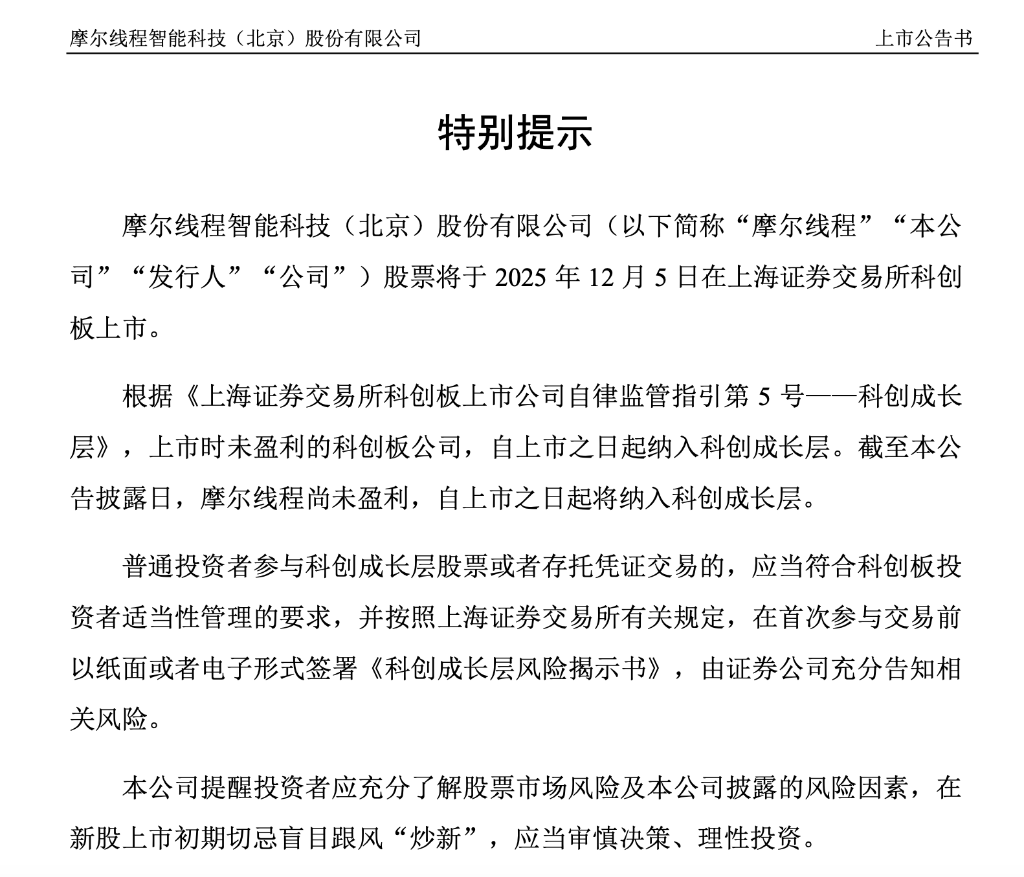
摩尔线程12月5日登陆科创板 为GPU行业发展注入新动力
Zheng Quan Shi Bao Wang· 2025-12-03 14:30
Core Viewpoint - The listing of Moores Threads on the Shanghai Stock Exchange's Sci-Tech Innovation Board on December 5, 2025, signifies a recognition of domestic computing chip enterprises in the capital market and injects new momentum into the GPU industry [1][2]. Group 1: Company Overview - Moores Threads, established in June 2020, focuses on the research, design, and sales of full-function GPU chips, including data center-level and desktop-level GPUs, along with related software systems [2]. - The company's self-developed MUSA architecture integrates four engines for AI computing acceleration and graphics rendering, with products like the MTT S4000 intelligent computing accelerator card supporting training of large models with hundreds of billions of parameters [2]. Group 2: Financial Performance - Revenue is projected to grow from 124 million yuan in 2023 to 438 million yuan in 2024, with 702 million yuan achieved in the first half of 2025 [2]. - The company has not yet achieved profitability, with net losses reported at -1.894 billion yuan, -1.703 billion yuan, and -1.618 billion yuan for the years 2022, 2023, and 2024, respectively [2]. Group 3: Fundraising and Use of Proceeds - The IPO will raise approximately 8 billion yuan through the issuance of 70 million new shares at a price of 114.28 yuan per share, with 20% allocated for strategic placement [1][2]. - The raised funds will primarily be directed towards three major chip R&D projects and to supplement working capital, including the development of next-generation AI training and inference chips, graphics chips, and AI SoC chips [2]. Group 4: Market Response and Trading Conditions - The initial subscription for the online issuance saw a high demand with a subscription multiple of 4126.49 times, resulting in a final issuance of 16.8 million shares and a low winning rate of 0.03635054% [1]. - Following the listing, there will be no price fluctuation limits for the first five trading days, and the initial circulating shares will be only 29.38 million, representing 6.25% of the total share capital, indicating potential liquidity risks [3]. Group 5: Industry Implications - The listing opens a direct financing channel for the domestic GPU industry, but the company's future growth will depend on technological breakthroughs and successful commercialization to address competitive and profitability challenges [3].

友山基金杜平:固收体系之下的多资产配置,锻造投资者所需的长期策略
Mei Ri Jing Ji Xin Wen· 2025-12-03 13:41
Core Insights - The forum highlighted the need for institutional investors to adapt their strategies in a low-interest, high-volatility macro environment, suggesting a shift from traditional pure bond strategies to a more dynamic approach that includes equity-like thinking in bond investments [1][2] Group 1: Investment Strategy - The company emphasizes the importance of capturing policy, industry, and market opportunities to enhance Alpha extraction, moving from a focus on coupon income to a dual approach of "trading enhancement" and "cross-market allocation" [1][2] - A robust internal credit evaluation system and in-depth research on issuers are crucial for precise pricing and risk management, allowing the company to maintain steady performance despite market fluctuations [2][3] Group 2: Market Conditions - The current market environment has amplified the impact of a single basis point (BP) on overall market dynamics, leading to varied risk appetites among different types of funds [3] - The central bank's interest rate cuts are expected to be limited, necessitating the inclusion of non-rate assets in portfolios to achieve excess returns [3] Group 3: Equity Market Focus - The company is exploring two main avenues for enhancing returns within its "fixed income plus" strategy: utilizing derivatives like options and increasing exposure to the equity market [4] - A dual framework of "defensive allocation + aggressive themes" is being constructed, focusing on sectors with reasonable valuations and lower price increases, such as dividend stocks, resource stocks, and financials [4] Group 4: Technology Sector Insights - The technology sector is identified as a key area for capturing excess returns, with strong performance metrics supporting continued investment opportunities despite recent price increases [4][5] - Three core competitive directions have been pinpointed for investment: AI applications and computing power, overseas supply chains, and domestic substitution industry chains, which are seen as future industry trends [5]
特发信息年内飙涨超130%,连续多天换手率超30%背后,暗藏哪些玄机
Xin Lang Cai Jing· 2025-12-03 13:20
Core Viewpoint - The communication equipment sector has become a core investment focus in the A-share market, with significant price increases driven by trends such as AI computing power and digital infrastructure development [2][3][19]. Market Performance - As of December 3, 2025, the communication equipment sector has seen a price increase of over 100% this year, with more than 4000 listed companies experiencing price rises, and over 400 companies seeing increases exceeding 100% [2][3]. - Specifically, the stock of TeFa Information has surged by 133.04% this year, with a notable increase of 43.11% in November 2025 alone [3][14]. Company Overview - TeFa Information operates in the optical communication field, with four main business segments: cables, smart services, integration, and property leasing. The company ranks among the top ten in China's optical fiber and cable industry [6][16]. - The company aims to become a comprehensive provider of next-generation information technology products and services, focusing on innovation to support high-quality industry development [6][16]. Financial Performance - TeFa Information's revenue has shown significant fluctuations, with revenues of 4.192 billion, 4.937 billion, and 4.409 billion yuan from 2022 to 2024, respectively, indicating a 10.69% decline in 2024 [7][17]. - Despite a net profit of 0.13 billion yuan in 2022, the company faced losses in 2023 and 2024, although there was a slight recovery in the first three quarters of 2025, with a net profit of 7.996 million yuan [7][17]. Valuation Metrics - As of November 27, 2025, TeFa Information's closing price was 14.44 yuan per share, with a static P/E ratio of -32.30 and a P/B ratio of 8.62, which are significantly different from the industry averages of 56.98 and 4.64, respectively [4][15]. Trading Activity - TeFa Information has experienced high trading volumes, with daily turnover rates exceeding the average for the communication equipment sector, reaching as high as 40% on certain days [8][18]. - Investor sentiment regarding the stock has been mixed, with some believing that the stock may have peaked while others anticipate further price increases [8][18]. Future Outlook - The communication equipment sector is expected to benefit from the ongoing AI industrial revolution, with optimistic projections for demand in areas such as optical modules and chips [19][20]. - The sector is anticipated to evolve with dual growth drivers: deepening computing infrastructure and breakthroughs in space-ground integration, particularly in satellite internet deployment [20].

国产GPU第一股,周五上市!
Hua Er Jie Jian Wen· 2025-12-03 12:23
Core Viewpoint - Moer Technology, known as the "first domestic GPU stock," is set to list its shares on the Shanghai Stock Exchange's Sci-Tech Innovation Board on December 5, 2025, after receiving approval from the exchange [1][6]. Group 1: IPO Details - The company initiated its IPO subscription on November 24, 2025, with an issuance price of 114.28 yuan per share, marking the highest issuance price for new A-shares in 2025 [3][6]. - The IPO attracted unprecedented attention from institutional investors, with an offline subscription multiple reaching 1572 times and over 700 billion shares applied for [3][4]. - The online issuance saw 4,826,579 valid subscription accounts, totaling 46,216,647,000 shares, resulting in a preliminary winning rate of 0.02423369% [3][4]. Group 2: Institutional Interest - A total of 267 institutional investors participated in the offline subscription, with 7555 management allocation objects and a total subscription of 704.06 billion shares [4]. - Notable participants included 86 public funds, 124 private funds, 30 brokerages, and 13 insurance institutions, indicating strong institutional interest [4][5]. - Southern Fund submitted applications through 404 products, aiming to acquire 5.285 billion shares, while other major funds also showed significant interest [5]. Group 3: Record-Breaking IPO Process - The IPO process set multiple records, taking only 122 days from acceptance to registration, making it the fastest listing project on the Sci-Tech Innovation Board this year [6]. - The total fundraising amount of 8 billion yuan is the highest for any new stock on the Sci-Tech Innovation Board, with issuance costs also reaching a record 424 million yuan [6]. - The company's actual controller, Zhang Jianzhong, holds a 36.36% stake, valued at approximately 5.82 billion yuan based on the issuance market value [6].
科创ETF密集申报 半导体、机器人等科技股再迎增量资金
Di Yi Cai Jing· 2025-12-03 12:10
Group 1 - The core viewpoint of the articles highlights a surge in new capital inflow into the A-share technology sector, particularly through the launch of multiple semiconductor and AI-focused ETFs, indicating strong institutional interest in these areas [1][2] - Since November 21, 49 new science and technology ETFs have been reported, focusing on popular fields such as semiconductors, robotics, and chips, with the first batch of AI ETFs approved and quickly reaching fundraising limits [1][2] - The market response has exceeded expectations, with a potential influx of over 30 billion yuan if all ETFs reach their maximum fundraising limits, although there is significant variation in fundraising caps set by different fund companies [2][5] Group 2 - There is a noticeable market differentiation, with larger funds attracting more attention and capital, while smaller, homogeneous products struggle to gain traction, leading to concerns about liquidity and potential risks of liquidation for smaller ETFs [2][3] - Institutional investors have increased their positions in technology sectors, with TMT (Technology, Media, and Telecommunications) holdings surpassing 40% of their portfolios, and semiconductor stocks becoming the largest sector by total market value [5] - Despite the enthusiasm for technology stocks, there are concerns about high valuations, particularly in sectors like software development and semiconductors, where P/E ratios exceed 100, while other sectors like batteries and consumer electronics remain below 50 [5] Group 3 - The current AI investment landscape is supported by large, cash-rich companies, contrasting with the 1990s tech bubble, as AI commercialization is progressing rapidly with high demand for computing power, maintaining data center utilization rates around 80% [6] - Morgan Fund suggests that while market enthusiasm may outpace reality, the financial strength of participating companies and the ongoing commercialization of AI technology mitigate the risks of overbuilding in the short term [6]
