
能源转型

Search documents
中美印发电量差距断崖:美国4.63万亿度,印度2.03万亿,中国呢?
Sou Hu Cai Jing· 2025-09-27 11:35
Core Insights - The article discusses the global electricity generation landscape, highlighting the contrasting energy policies and production capacities of the United States, India, and China, particularly in the context of climate change and energy transition [2][5][23]. Group 1: United States Energy Landscape - In 2024, the United States generated approximately 4.63 trillion kilowatt-hours of electricity, accounting for nearly 15% of global electricity generation [5][23]. - Coal's share in the U.S. electricity generation has drastically decreased from nearly 50% in 2005 to below 15% in 2024, marking a historic low [4][5]. - Natural gas has become the dominant source of electricity in the U.S., contributing about 43% to the total generation in 2024, largely due to the shale gas revolution [4][5]. - Renewable energy sources, including wind and solar, have surpassed coal for the first time, making up over 22% of total generation, with solar energy leading the growth [7][23]. Group 2: India's Energy Challenges - India generated approximately 2.03 trillion kilowatt-hours of electricity in 2024, representing 6.5% of global generation, but only about one-fifth of China's output [13][23]. - Coal remains the dominant energy source in India, accounting for 74.4% of the electricity generation mix, despite a slow increase in renewable energy to 12.1% [15][23]. - The Indian government aims to increase the share of renewable energy to 50% by 2030, while also planning to expand coal power capacity significantly in the coming years [15][18]. Group 3: China's Energy Transition - China achieved a record electricity generation of 10.09 trillion kilowatt-hours in 2024, representing nearly one-third of global electricity generation, surpassing the combined output of the U.S. and India [23][25]. - Wind power generation in China reached approximately 991.6 billion kilowatt-hours in 2024, accounting for 9.4% of total generation, a significant increase from 1.1% in 2010 [25][28]. - The rapid growth of renewable energy in China is supported by cost advantages and policy backing, with the country being the largest manufacturer of wind power equipment globally [25][28]. - China's energy structure is shifting, with coal's share decreasing from 74% in 2000 to 43% in 2024, while clean energy sources are growing at an irreversible pace [31][33].


14.1亿元!鸿富瀚拟投建非洲大型光伏储能项目
Ju Chao Zi Xun· 2025-09-27 00:49
Core Insights - Hongfuhuan announced plans to invest in a photovoltaic power station and energy storage system project in the Democratic Republic of the Congo (DRC) to expand its overseas market and create new growth points [1][2] - The total investment for the KAMOA project is approximately 1.41 billion yuan, with Hongfuhuan contributing no more than 1.128 billion yuan and its partner GW contributing up to 282 million yuan [1] - This project marks Hongfuhuan's entry into the overseas renewable energy infrastructure sector, utilizing photovoltaic and energy storage microgrid solutions to support energy transition in high-energy-consuming mining areas [1] Investment Strategy - Hongfuhuan has been actively developing its renewable energy business, establishing a photovoltaic division through its subsidiary Shenzhen Fuzhi New Energy Technology Co., Ltd., and collaborating with Huawei Digital Energy Technology Co., Ltd. to develop intelligent microgrid solutions [2] - The project in the DRC is a key step in implementing the company's "Energy+" diversification strategy, aimed at enhancing the stability and economic efficiency of power supply in mining areas while accumulating overseas project experience [2] Market Context - The DRC is rich in mineral resources but has weak electricity infrastructure, often relying on high-cost diesel generators due to power grid fluctuations, which severely limits production capacity [2] - Hongfuhuan's project aims to alleviate the electricity bottleneck in local mining operations by providing clean and stable power through photovoltaic generation and energy storage systems, reducing energy costs for mining companies and promoting low-carbon operations [2] Implementation and Goals - The project will be led by Hongfuhuan's wholly-owned subsidiary Hongfuhuan Technology Co., Ltd. (BVI), using a joint venture model to mitigate overseas investment risks and quickly enter mature application scenarios [2] - This initiative is expected to accelerate the company's overseas business expansion and create new profit sources through microgrid operations, achieving both strategic layout and performance growth objectives [2] Future Outlook - With the acceleration of global energy transition, Hongfuhuan's entry into the African photovoltaic energy storage market is anticipated to seize opportunities in the overseas renewable energy sector, laying a solid foundation for future international energy project expansion [2]
河南两大能源巨头筹划战略重组 能源领域国资改革持续发力
Shang Hai Zheng Quan Bao· 2025-09-26 18:27
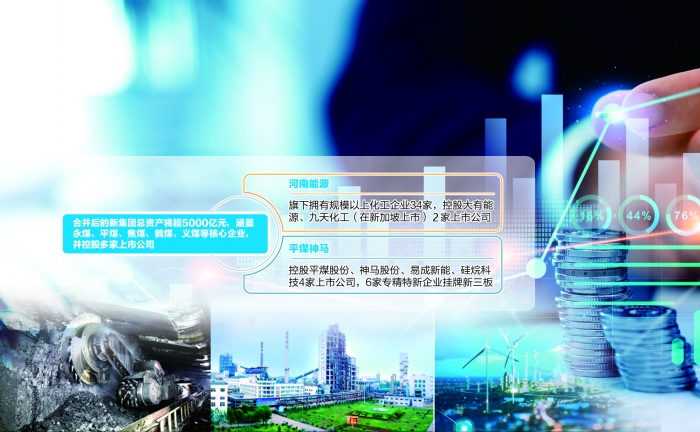
Core Viewpoint - The strategic restructuring of two major energy state-owned enterprises in Henan, namely Henan Energy Group and Pingmei Shenma Group, has commenced, leading to significant stock price increases for several related companies [2][4]. Group 1: Strategic Restructuring Details - The restructuring involves five listed companies: Dayou Energy, Pingmei Shares, Yicheng New Energy, Shenma Shares, and Silane Technology, with the control remaining under the Henan Provincial State-owned Assets Supervision and Administration Commission [2][3]. - The combined total assets of the new group will exceed 500 billion yuan, with nearly 300,000 employees and a restructuring of the energy landscape in Henan [4][6]. Group 2: Financial Performance - As of mid-2023, Pingmei Shenma's total assets reached 288.48 billion yuan, while Henan Energy's total assets were 263.65 billion yuan [4]. - In the first half of 2023, Pingmei Shenma reported revenue of 78.82 billion yuan, and Henan Energy reported revenue of 63.76 billion yuan [4]. Group 3: Industry Context and Implications - The restructuring is seen as a response to the complex dynamics in the coal industry, characterized by stable demand, optimized supply, and increasing transformation pressures [5][6]. - The merger aims to address issues such as resource depletion in certain mining areas and the inefficiencies of existing coal enterprises, promoting a "strong union" to enhance resource allocation and reduce costs [5][6]. Group 4: Broader Trends in Energy Sector - The restructuring aligns with national trends of consolidating energy enterprises to enhance energy security and competitiveness, as seen in other provinces like Hunan and Sichuan [7][8]. - This trend is expected to continue, with more provinces likely to adopt similar strong union restructuring models as part of state-owned enterprise reforms and energy transition efforts [8].


新股消息 | 中伟股份港股IPO获中国证监会备案
Zhi Tong Cai Jing· 2025-09-26 12:51
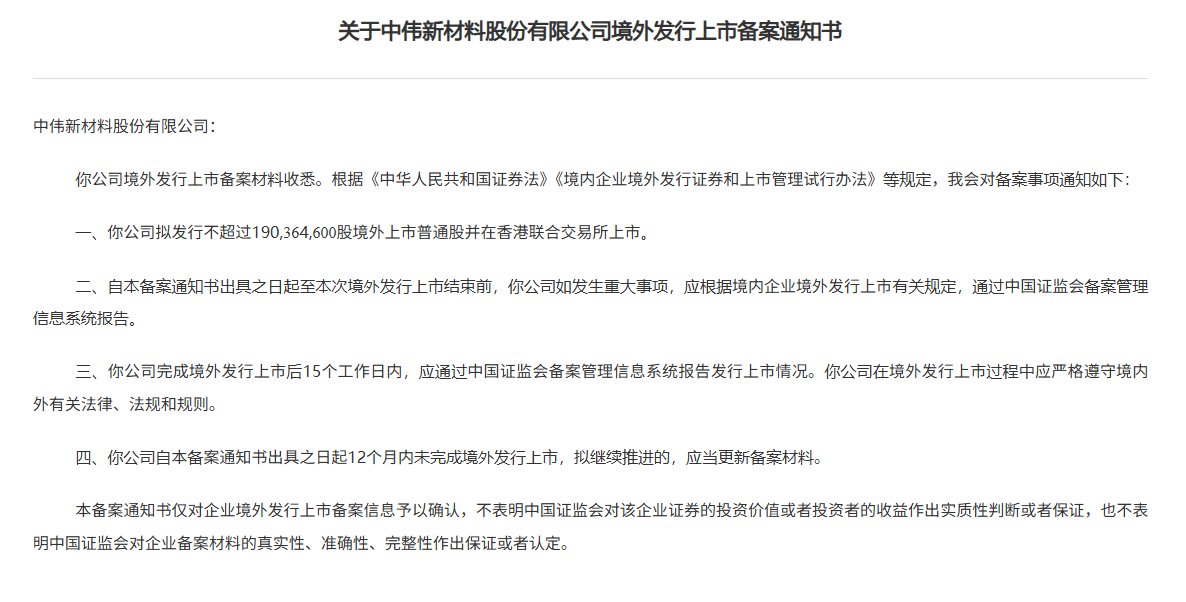
Core Viewpoint - Zhongwei New Materials Co., Ltd. is set to issue up to 190,364,600 overseas listed ordinary shares and list on the Hong Kong Stock Exchange, as announced by the China Securities Regulatory Commission on September 26 [1] Group 1: Company Overview - Zhongwei New Materials is an innovative company focused on new energy materials [3] - Since 2020, the company has been the global leader in the shipment volume of nickel and cobalt lithium-ion battery cathode active material precursors (pCAM) for five consecutive years [3] - By the first quarter of 2025, Zhongwei is expected to be the top supplier of phosphate pCAM in the global export market [3] Group 2: Business Focus and Operations - The company specializes in the research, development, production, and sales of new energy battery materials and new energy metal products [3] - Zhongwei aims to provide high-performance and environmentally friendly new energy materials across various sectors to achieve global low-carbon and energy transition [3] - The company has established an integrated operation system that covers upstream new energy metal mining, smelting, refining, production of new energy materials, and recycling [3]
中伟股份港股IPO获中国证监会备案
Zhi Tong Cai Jing· 2025-09-26 12:49
Core Viewpoint - Zhongwei New Materials Co., Ltd. is planning to issue up to 190,364,600 overseas listed ordinary shares and list on the Hong Kong Stock Exchange, indicating its growth strategy and international expansion efforts [1][3] Group 1: Company Overview - Zhongwei New Materials is an innovative company focused on new energy materials, particularly in the lithium-ion battery sector [3] - The company has been the global leader in the shipment volume of nickel and cobalt-based lithium-ion battery precursor materials (pCAM) for five consecutive years since 2020 [3] - By the first quarter of 2025, Zhongwei is expected to be the top supplier of phosphate-based pCAM in the global export market [3] Group 2: Business Operations - The company is dedicated to the research, development, production, and sales of new energy battery materials and new energy metal products [3] - Zhongwei aims to provide high-performance and environmentally friendly new energy materials across various sectors, contributing to global low-carbon and energy transition efforts [3] - The company has established an integrated operation model that encompasses upstream new energy metal mining, smelting, refining, production of new energy materials, and recycling [3]
新股消息 | 中伟股份(300919.SZ)港股IPO获中国证监会备案
智通财经网· 2025-09-26 12:48
Group 1 - The China Securities Regulatory Commission has issued a notice regarding Zhongwei New Materials Co., Ltd.'s application for overseas listing, allowing the company to issue up to 190,364,600 ordinary shares for listing on the Hong Kong Stock Exchange [1] - Zhongwei New Materials is an innovative company focused on new energy materials, leading the global shipment of nickel and cobalt lithium-ion battery cathode active material precursors (pCAM) for five consecutive years since 2020 [3] - By the first quarter of 2025, Zhongwei is expected to be the top supplier of phosphate pCAM in the global export market [3] Group 2 - The company is dedicated to the research, development, production, and sales of new energy battery materials and new energy metal products [3] - Zhongwei aims to provide high-performance and environmentally friendly new energy materials across various sectors, contributing to global low-carbon and energy transition efforts [3] - The company has established an integrated operation model that encompasses upstream new energy metal mining, smelting, refining, production of new energy materials, and recycling [3]
电力设备行业跟踪报告:电力设备出口:变压器出口高景气,电表电缆有所回调
Wanlian Securities· 2025-09-26 11:13
Investment Rating - The industry investment rating is "Outperform the Market" [4][41]. Core Viewpoints - In August 2025, China's power equipment exports remained stable, with a total export value of 7.92 billion yuan, a month-on-month increase of 0.81% and a year-on-year increase of 25.23%. Cumulative exports from January to August reached 56.949 billion yuan, up 34.60% year-on-year. The transformer exports continued to show high prosperity, particularly in the European market, while the meter and cable exports experienced a pullback [1][8]. Summary by Sections Transformers - The transformer market remains highly prosperous, with exports in August 2025 amounting to 4.718 billion yuan, reflecting a month-on-month increase of 9.50% and a year-on-year increase of 57.90%. Cumulative exports from January to August reached 29.711 billion yuan, up 51.42% year-on-year. The European market showed remarkable performance, with exports to Europe increasing by 138.03% year-on-year [2][12][13]. Electric Meters - Electric meter exports saw a year-on-year decline, with August 2025 exports valued at 873 million yuan, a month-on-month increase of 5.36% but a year-on-year decrease of 25.84%. Cumulative exports from January to August totaled 7.002 billion yuan, down 3.50% year-on-year. The Oceania market performed well, with a year-on-year increase of 150.72% [3][19][21]. Switches - Switch exports remained stable, with August 2025 exports amounting to 688 million yuan, a month-on-month decrease of 15.04% but a year-on-year increase of 37.55%. Cumulative exports from January to August reached 5.539 billion yuan, up 31.69% year-on-year. The African market showed strong performance, with significant year-on-year growth [24][27]. Cables - Cable exports experienced a month-on-month decline and a slight year-on-year decrease, with August 2025 exports valued at 1.642 billion yuan, down 14.02% month-on-month and 1.06% year-on-year. Cumulative exports from January to August reached 14.698 billion yuan, up 30.91% year-on-year. The African and Latin American markets showed high growth, with exports to Africa increasing by 87.40% year-on-year and to Latin America by 91.60% [8][31][32]. Investment Recommendations - In the context of energy transition, global renewable energy installations are rapidly increasing, coupled with stable growth in global grid investment. China's power equipment products possess technological and cost advantages, with expected continuous improvement in overseas market penetration. It is recommended to focus on leading companies with successful overseas market expansion and advanced technology [39].
构建新型能源体系的山西实践
Xin Hua She· 2025-09-26 07:17
Group 1: Energy Supply and Transition - Shanxi province is tasked with ensuring energy supply and promoting energy transition, focusing on both coal supply security and low-carbon development [1] - The province aims to build a new energy system by integrating wind, solar, and hydrogen energy alongside coal [1] Group 2: Technological Advancements in Coal Mining - Shanxi has established 298 intelligent coal mines and 55 green mining pilot projects to enhance coal supply quality and safety [2] - The province is pushing for the transformation of coal products from primary fuels to high-value products through advanced technologies [2] Group 3: Innovation and Research in Energy - Shanxi has built 12 national-level major innovation platforms and numerous provincial laboratories to drive technological breakthroughs in clean coal utilization [3] - New technologies in green and low-carbon energy are emerging, contributing to the province's high-quality energy development [3] Group 4: Growth of Renewable Energy - Since the 14th Five-Year Plan, renewable energy has become the main source of new installed capacity in Shanxi, with a 4309 MW increase in capacity over the past five years [5] - The share of renewable energy in total power generation has improved from 1/7 to 1/4, indicating a significant shift towards green energy [5] Group 5: Green Power Parks and Economic Impact - Shanxi is developing green power parks that provide competitive electricity prices and enhance product competitiveness for companies [6] - The number of green power park pilot projects has expanded from 3 to 13, showcasing the province's commitment to industrial transformation [6] Group 6: Market Reforms and Flexibility in Power Supply - Shanxi has implemented market reforms to enhance the flexibility of power supply, allowing companies to adjust their electricity usage based on real-time pricing [8][9] - The province has established nine virtual power plants, aggregating various resources to optimize electricity consumption and enhance system resilience [8][9] Group 7: Electricity Market Development - Shanxi has developed the first operational electricity spot market in the country, with rules continuously updated to improve efficiency and transparency [10] - The market prioritizes renewable energy, maintaining a utilization rate of over 97% for renewable electricity [10]
内蒙古储能系统运行高效 电力“稳定器”作用充分发挥
Xin Hua Cai Jing· 2025-09-26 05:46
据内蒙古自治区能源局相关负责人介绍,下一步,将通过强化技术创新、优化调度策略、健全保障措 施,确保储能机组在电力供需紧张、极端天气等关键时刻"顶得上、调得快、用得好",不断激发储能系 统的调节潜力与保供动能,持续发挥储能在能源转型中的重要作用,推动新型储能产业高质量发展。 (侯倩) 储能调用电量大幅增长的背后,是内蒙古储能装机规模的高速扩张,也反映出储能系统已深度融入内蒙 古电力调度体系,在平抑电网负荷波动、衔接新能源消纳等方面的作用持续增强,为优化区域能源配置 提供了有力支撑。 据介绍,今年"迎峰度夏"期间,面对用电负荷创新高、部分时段新能源出力不足的双重挑战,内蒙古储 能系统充分释放顶峰保供能力,成为电力保供的"重要抓手"。蒙西、蒙东两大电网储能系统的高效发 力,精准填补了用电缺口,有效缓解了用电紧张局面,为保障民生用电稳定、支撑工业生产有序开展提 供了可靠保障。 据内蒙古自治区能源局消息,截至目前,全区在运新型储能装机规模达到963万千瓦,从调用电量、调 用功率、调用频次三个核心维度来看,全区储能系统运行状态良好、应用效率突出,特别是在今年"迎 峰度夏"电力保供关键时段,储能系统凭借响应及时、调节高效的 ...
第三届萨拉热窝能源与气候周开幕
Shang Wu Bu Wang Zhan· 2025-09-26 02:44
波黑联邦能矿部长拉基奇表示,能源与气候周活动将讨论在波黑乃至全世界都极 其重要的议题,让能源、气候变化领域的专家们能够共同应对挑战,提出解决方案。 拉基奇指出,当前的国家电力法草案已通过部长会议审议,希望该法很快能在议会表 决通过,这将进一步为波黑获得CBAM豁免创造条件。 欧盟驻波黑代表团副团长巴巴吉德表示,欧盟已开始实施到2050年实现碳中和的 计划,波黑已通过签署一系列协议显示了其与欧盟计划相同步的决心。他认为,波黑 正处于一个特殊的十字路口:一方面煤炭仍然占主导地位,另一方面在利用可再生能 源和提高能源效率方面潜力巨大。欧盟国家将持续支持波黑能源转型,迄今为止,欧 盟已在波黑能源领域投资超1.6亿欧元。(驻波黑使馆经商处) (原标题:第三届萨拉热窝能源与气候周开幕) 波黑国家台9月22日报道。2025年第三届萨拉热窝能源与气候周开幕。波黑联邦总 理尼克希奇在开幕式上表示,波黑正在经历能源转型期,已经从电力出口国变成了电 力进口国。波黑当前需要采取紧急措施,包括保障火电站的煤炭供应充足。当前矿场 的煤炭产量无法满足电力公司的需求,导致波黑必须高价购买电力。尼克希奇强调了 投资水电和风电等可再生能源的重要 ...