商业航天

Search documents
热门产品掀起限购潮 基金公司差异化导购
Zhong Guo Zheng Quan Bao· 2026-01-18 20:56
Core Viewpoint - Fund companies are implementing purchase limits on popular products to avoid rapid scale expansion and protect existing investors' returns, reflecting a shift from scale-driven to investor return-driven strategies [1][4]. Group 1: Fund Purchase Limits - Several fund companies have initiated purchase limits on high-performing funds, particularly those focused on AI applications and commercial aerospace, due to increased market activity in these sectors [1][5]. - On January 12, 2026, following a surge in the AI application sector, Debon Fund announced a reduction in purchase limits for its popular fund from 10 million yuan to 100,000 yuan for A shares and from 1 million yuan to 10,000 yuan for C shares [2]. - Yongying Fund also limited large purchases for two of its actively managed equity funds starting January 14, 2026, due to their significant recent gains [2]. Group 2: Reasons for Limiting Purchases - Fund managers indicate that limiting purchases after a price increase is primarily to protect performance, as new inflows can dilute returns when the fund's net asset value is high [4]. - Limiting fund size helps avoid operational challenges associated with large capital inflows, which can hinder effective portfolio management and lead to unpredictable fluctuations in net asset value [4]. - The current trend shows a cautious approach to fund size expansion, contrasting with previous years when many new products were launched during market upswings [4]. Group 3: Alternative Investment Options - Fund companies are exploring other niche sectors and products like "fixed income plus" and FOFs to provide investors with balanced investment options amid crowded market segments [1][6]. - Some companies are focusing on promoting long-term high-performance products rather than popular sector funds, emphasizing their integrated research platforms to enhance fund manager capabilities [6].
热门产品掀起限购潮基金公司差异化导购
Zhong Guo Zheng Quan Bao· 2026-01-18 20:45
Core Viewpoint - Fund companies are implementing purchase limits on popular products to prevent rapid scale expansion and protect existing investors' returns, reflecting a shift from scale-driven to investor return-driven strategies [1][2][3] Group 1: Fund Purchase Limits - Several fund companies, including 德邦基金 and 永赢基金, have announced purchase limits on high-performing funds focused on AI applications and other hot sectors due to increased market interest [1][2] - 中欧基金 has also implemented purchase limits on three of its products, with one fund's net asset value capped at 2 billion RMB to control its scale [2] - 工银瑞信基金 announced limits on its FOF product, indicating a trend of limiting purchases even amid a hot market [2] Group 2: Reasons for Limiting Purchases - Fund managers indicate that limiting purchases is necessary to protect performance, as new inflows at high net asset values can dilute returns and lead to inefficient cash management [2][3] - Limiting fund size helps avoid operational challenges associated with large-scale funds, which can hinder effective portfolio management and lead to significant net asset value fluctuations [3] Group 3: Market Strategy Adjustments - Fund companies are exploring alternative investment options, such as "固收+" and FOF products, to provide investors with balanced choices amid crowded sectors like AI and commercial aerospace [1][3] - Marketing strategies are shifting focus from popular sectors to long-term high-performing products, with an emphasis on the company's integrated research platform rather than individual fund managers [4]
长城基金基金经理尤国梁:商业航天的远期空间与短期估值
Shang Hai Zheng Quan Bao· 2026-01-18 18:39
Core Viewpoint - The commercial aerospace sector has experienced a significant surge, but a market correction has occurred following this rise. The current adjustment is viewed as a potential phase of consolidation rather than a long-term downturn, given the upward industrial trend in the domestic commercial aerospace sector [1]. Group 1: Industry Trends - The commercial aerospace boom is attributed to multiple factors, including a notable increase in rocket launch frequency in the second half of 2025 and the successful orbiting of reusable rockets, which alleviated the domestic capacity bottleneck and laid the groundwork for commercialization [2]. - The "14th Five-Year Plan" emphasizes the goal of becoming a "space power," indicating the government's strategic focus on the aerospace sector [2]. - The commercial aerospace industry is seen as having substantial growth potential, with low-orbit satellite internet already connecting numerous users and the overseas "Starlink" business proving the viability of its business model [2]. Group 2: Market Dynamics - Concerns regarding the valuation of the commercial aerospace sector exist, as the overall industry valuation was already high before the 2025 market surge. The sector is currently at the early stage of an industrial inflection point, where anticipated increases in rocket and satellite launches may not immediately reflect in financial statements [3]. - The market's focus and rotation of funds align with the future development rhythm of the industry, initially concentrating on the rocket sector, which has seen the most significant changes and breakthroughs recently [3]. - Future market dynamics are expected to depend on which sector experiences major catalysts or industrial advancements, with ongoing performance across various directions including satellite manufacturing and operational services [3].
广发基金段涛:商业航天有望成为中长期主线
Shang Hai Zheng Quan Bao· 2026-01-18 18:24
Core Viewpoint - The commercial aerospace industry is expected to reach a critical inflection point in 2026, driven by policy support, technological advancements, breakthroughs in capital markets, and a consensus on commercialization potential [1][2]. Industry Trends - The commercial aerospace sector is transitioning from a conceptual phase to industrialization, becoming a significant focus in the capital market at the beginning of the year [2]. - Three core drivers of the current commercial aerospace market include: 1. The thematic heat similar to the robotics sector in 2025 2. Resonance between domestic and international industry and capital levels 3. Continuous event catalysts expected to last until at least the Chinese New Year [2]. Investment Focus - The industry is characterized by a complete market-driven value chain encompassing rockets, satellites, and applications, with the application segment further divided into space computing and ground operation services [2]. - Key bottlenecks in the industry are identified in the rocket segment, particularly the breakthrough of reusable rocket technology, which is essential for the practical application of low Earth orbit satellites [3]. Strategic Positioning - Institutional investors are beginning to systematically evaluate the long-term potential of the industry, focusing on segments with clear evolutionary directions within the value chain [4]. - Key areas of interest include: 1. Rocket segment: Focus on core components with technological barriers and potential asset integration opportunities, particularly in critical manufacturing processes like 3D printing 2. Satellite segment: Attention to high-barrier subfields such as payloads, with an emphasis on the increasing value and complexity of satellites as constellations evolve 3. Application segment: Recognized as the largest growth area, with significant potential demand in communication, navigation, and IoT as low Earth orbit constellation density increases 4. SpaceX supply chain: Anticipated growth in SpaceX user numbers from over 7 million to between 300 million and 500 million, with substantial increases in satellite launches [4]. Future Outlook - The global commercial aerospace sector is expected to develop four core trends by 2026: 1. Miniaturization of satellites, enabling mass networking and wide-area coverage 2. Giant constellations formed by small satellites becoming a global focus for building space infrastructure 3. Reusability of rockets significantly lowering launch costs, crucial for large-scale applications 4. Mainstreaming of applications, integrating aerospace services into daily life across various sectors [7].
重大预警,2026年春节前中国A股或将再现历史级行情
Sou Hu Cai Jing· 2026-01-18 18:16
Core Viewpoint - The A-share market is experiencing a significant surge in trading volume and financing, indicating a potential bull market, with major sectors like commercial aerospace and technology seeing substantial gains [1][4][7]. Group 1: Market Performance - The first week of 2026 saw a trading volume of 14.26 trillion, nearly breaking the record from August 2025, with financing balances surpassing 2.6 trillion for the first time [1]. - The Shenzhen Component Index reached 14,000 points, and the ChiNext Index hit a four-year high, with the commercial aerospace sector rising by 20% and aerospace equipment by 26% in just one week [1]. - The Shanghai Composite Index recorded a 16-day consecutive rise with a cumulative increase of 3.35%, while the Shenzhen and ChiNext indices rose by 5.59% and 4.93%, respectively, marking the strongest start to the year in nearly a decade [4]. Group 2: Capital Flow - Net financing purchases amounted to 79 billion, with the electronics sector receiving 24.1 billion, power equipment 12 billion, and defense and military industries 9.4 billion [3]. - Major funds have shifted over 600 billion into electronics and computer sectors, with mechanical and power equipment sectors also seeing inflows exceeding 500 billion [3]. Group 3: Policy Support - The government is actively promoting investment with the upcoming "14th Five-Year Plan," focusing on technology, consumption, and domestic demand, alongside direct financial incentives like birth subsidies [5][13]. - The recent policies are expected to stimulate consumer spending, benefiting sectors such as consumer goods and services [13]. Group 4: Sector Opportunities - The commercial aerospace sector is highlighted as a key growth area for 2026, with strong policy support and performance expectations similar to the rise of the new energy vehicle sector [7][10]. - AI applications are gaining traction, with companies in AI healthcare and education reporting significant revenue growth, indicating a shift towards commercial viability [10]. - The consumer sector shows signs of recovery, particularly in dining, tourism, and healthcare services, although disparities exist within sub-sectors like liquor and medical services [11]. Group 5: Historical Context and Future Outlook - Historically, the A-share market tends to rise before the Spring Festival, with the Shanghai Composite Index showing an average increase of 1.72% in the five trading days leading up to the holiday [8]. - The current market dynamics suggest a more rational participation from investors, with a higher proportion of long-term funds compared to speculative short-term trading [11].


商业航天 突传多条重磅消息!
Mei Ri Jing Ji Xin Wen· 2026-01-18 16:18
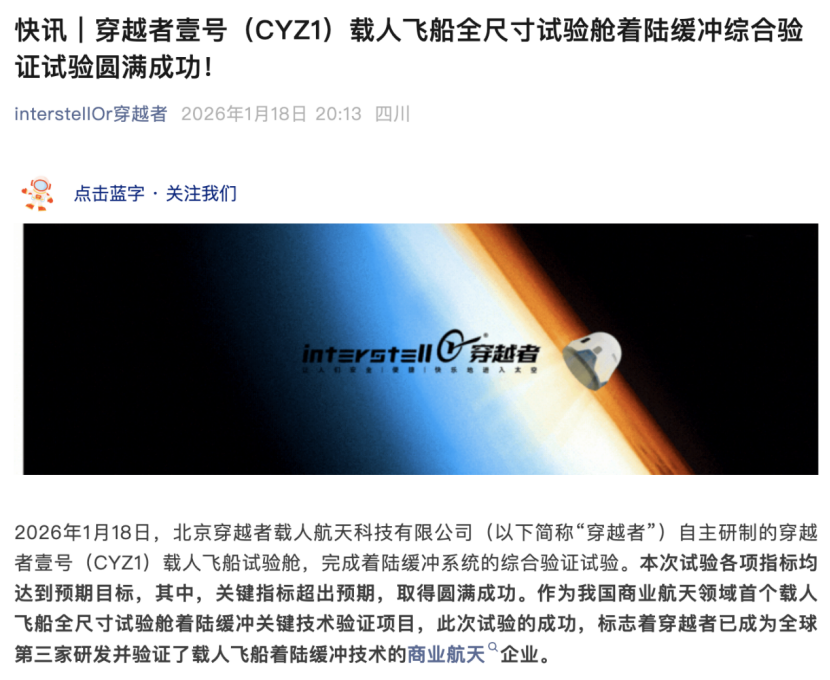
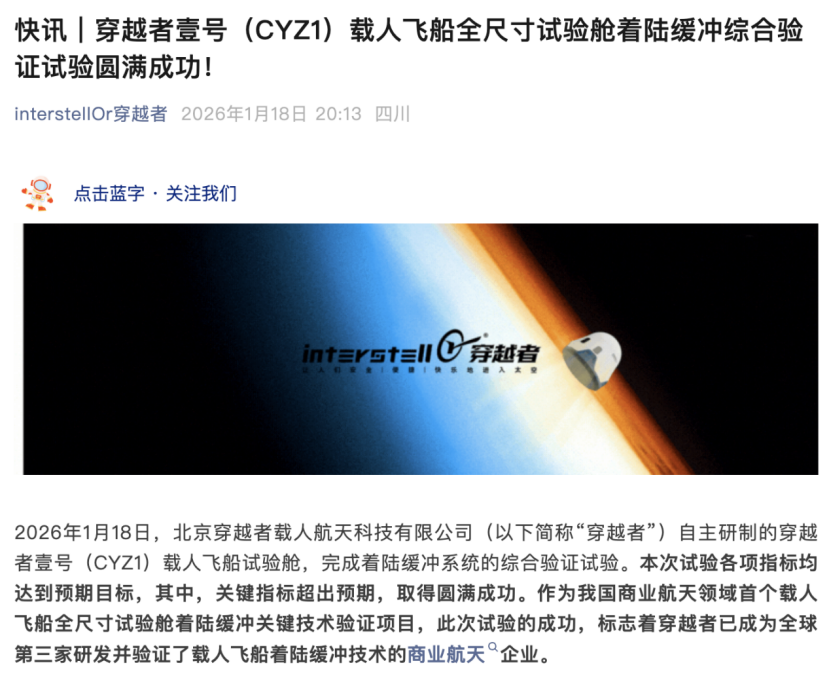
这是我国商业航天领域首个载人飞船全尺寸试验舱着陆缓冲关键技术验证项目,此次成功标志着穿越者已成为全球第 三家研发并验证了载人飞船着陆缓冲技术的商业航天企业。 据官方介绍,穿越者是国内首家集可重复使用飞船研制与太空旅游运营于一体的商业载人航天企业,是唯一获批国家 级商业载人航天项目立项的民企。公司致力于打造中国的"龙飞船",实现为国家和商业低成本送人送货。 1月18日,多条关于商业航天的重磅消息突然传来。 中国商业航天首次!载人飞船着陆缓冲技术获成功验证 1月18日晚间,穿越者官微"interstellOr穿越者"发文称,穿越者壹号(CYZ1)载人飞船试验舱,完成着陆缓冲系统的 综合验证试验。本次试验各项指标均达到预期目标,其中,关键指标超出预期,取得圆满成功。 集团公司党组书记、董事长陈锡明围绕"突出一个引领、聚焦三大业务、提升六个能力"对2026年重点任务作出具体部 署。强调要聚焦航天防务产业、航天防务国际化、航天防务技术应用三大业务,坚决扛起强军胜战顶梁之责,推动装 备性能和企业经济效益双提升,构建航天防务技术应用发展体系。要全面提升质量管控、技术基础、改革攻坚、经营 管理、风险管控、党建引领等六个方面的 ...
深夜!最火赛道,突传利好!
Zhong Guo Ji Jin Bao· 2026-01-18 16:16
Group 1 - The successful verification of the landing buffer technology for the manned spacecraft marks a significant milestone for China's commercial space industry, making it the first of its kind in the country [2][3] - The test involved a full-scale experimental capsule, weighing approximately 5 tons, which was dropped from a height of over 3 meters to simulate the descent speed after parachute deployment, achieving all expected performance indicators [3] - The landing buffer system utilized a reverse thrust engine to create a stable counter-thrust, effectively reducing the capsule's speed upon landing, demonstrating the feasibility and reliability of the "cloud sensing landing" system proposed by the company [3] Group 2 - The company, established in 2023, is the only private enterprise in China approved for a national-level commercial manned space project, focusing on reusable manned spacecraft and space tourism services [4] - Recent developments in the commercial space sector include both positive advancements, such as the successful test by the company, and setbacks, including the failure of two rocket launches on January 17 [7] - Regulatory bodies are emphasizing a cooling of the market rather than a complete halt, aiming to direct investments towards quality projects and core technologies, which reflects a broader confidence in the future of commercial space and AI applications [8]
深夜!最火赛道,突传利好!
中国基金报· 2026-01-18 16:07
Group 1 - The core viewpoint of the article highlights the successful verification of landing buffer technology for manned spacecraft by Beijing ChuanYueZhe Manned Space Technology Co., marking a significant milestone in China's commercial space sector [2] - The test involved a 5-ton experimental capsule dropped from over 3 meters, simulating the descent speed after parachute deployment, with the landing buffer system activating to provide stable reverse thrust [6] - ChuanYueZhe is noted as the only private enterprise in China approved for a national-level commercial manned space project, emphasizing its unique position in the industry [6] Group 2 - The China Aerospace Science and Industry Corporation and China Aerospace Science and Technology Corporation held meetings to outline their goals for 2026, focusing on technological innovation and the advancement of major aerospace projects [8] - Recent setbacks were reported with two rocket failures on January 17, indicating challenges in the current operational environment for the aerospace sector [9] - Regulatory measures are being implemented to cool down the commercial space market, aiming to direct investments towards quality projects rather than speculative ventures [9]

商业航天,突传多条重磅消息!
Mei Ri Jing Ji Xin Wen· 2026-01-18 15:56
Core Viewpoint - The recent developments in China's commercial space sector highlight significant advancements, particularly with the successful testing of the "CYZ1" manned spacecraft's landing buffer system, marking a milestone for the company "穿越者" as it becomes the third global entity to validate such technology in commercial spaceflight [1][4]. Group 1: Company Developments - "穿越者" has completed the comprehensive verification test of the landing buffer system for its "CYZ1" manned spacecraft, achieving all expected targets and exceeding key indicators [1][4]. - The company is recognized as the first domestic commercial manned space enterprise to integrate reusable spacecraft development with space tourism operations, and it is the only private enterprise approved for a national-level commercial manned space project [4]. - The successful test positions "穿越者" as a key player in the global commercial space industry, aiming to create China's version of the "Dragon" spacecraft for low-cost transportation of people and goods [4]. Group 2: Industry Trends - The China Aerospace Science and Industry Corporation (航天科工集团) and the China Aerospace Science and Technology Corporation (航天科技集团) held meetings to outline their goals and tasks for 2026, emphasizing the importance of strengthening the aerospace defense industry and enhancing technological capabilities [5][6]. - The focus for 2026 includes advancing reusable rocket technology, promoting the commercialization of space, and optimizing industrial structures to support new industries such as low-altitude economy and space digital intelligence [7][8]. - Both groups aim to enhance their innovation ecosystems and accelerate the development of significant projects like manned lunar missions and deep space exploration [8].
开年7股停牌核查 热点个股炒作降温
Bei Jing Shang Bao· 2026-01-18 15:25
Group 1 - A total of 7 A-share companies have announced stock suspension for review since the beginning of the year, including Liou Co., Ltd. and others, primarily due to market speculation and major shareholder changes [1][3] - The stocks involved are linked to hot concepts such as commercial aerospace and AI applications, indicating a trend of speculative trading in the market [1][4] - The suspension of trading is seen as a regulatory measure to guide rational investment and curb excessive speculation [8] Group 2 - ST Chengchang, a commercial aerospace concept stock, experienced a 68.64% increase over a period of 10 trading days before announcing a suspension for review [3] - Liou Co., Ltd. reported a stock price deviation of 96.77% from December 31, 2025, to January 15, 2026, leading to its suspension [4] - Zhi Te New Materials became the first stock to double in value this year, with a price increase of 198.57% before its suspension [4] Group 3 - Guosheng Technology and Jiamei Packaging have seen significant stock price increases without corresponding performance support, with Guosheng reporting continuous losses since 2020 [6][7] - Jiamei Packaging's net profit is expected to decline by 53.38% to 43.02% in 2025, attributed to a "small year" in the beverage industry [7] - The suspension of trading allows investors to reassess the valuation of these companies against their fundamental performance [8] Group 4 - Companies like Shangwei New Materials and Aerospace Hanyu have issued warnings about potential stock suspensions if prices continue to rise, indicating a broader concern about market volatility [9][10] - Aerospace Engineering clarified that it has no involvement in the commercial aerospace sector despite significant stock price increases, highlighting the disconnect between stock performance and actual business operations [11] - The overall trend of stock suspensions is viewed as a necessary measure to foster a culture of rational investment and prevent speculative bubbles in the market [11]