
世贸组织改革

Search documents
李成钢国际贸易谈判代表兼副部长会见世贸组织总干事伊维拉
Shang Wu Bu Wang Zhan· 2026-01-26 02:12
Group 1 - The core discussion involved WTO reform and preparations for the 14th Ministerial Conference of the WTO [2]

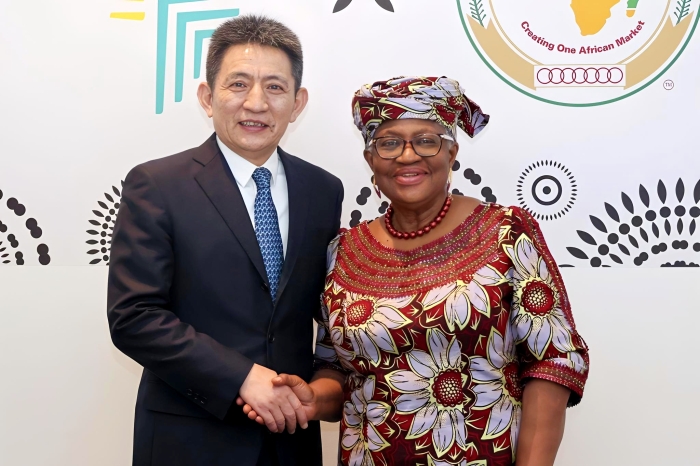
李成钢国际贸易谈判代表兼副部长会见欧盟委员会贸易和经济安全委员谢夫乔维奇
Shang Wu Bu Wang Zhan· 2026-01-26 02:04
Core Viewpoint - The meeting between China's Vice Minister of International Trade Negotiations, Li Chenggang, and EU Commissioner for Trade and Economic Security, Valdis Dombrovskis, focused on WTO reforms and bilateral trade issues, indicating a commitment to enhancing trade relations between China and the EU [1] Group 1 - The meeting took place on January 21, 2026, in Davos, Switzerland [1] - Discussions included preparations for the 14th WTO Ministerial Conference, highlighting the importance of multilateral trade frameworks [1] - Both parties expressed interest in addressing mutual concerns regarding bilateral economic and trade topics, suggesting ongoing collaboration [1]
中国—加拿大经贸合作路线图
Shang Wu Bu Wang Zhan· 2026-01-20 01:51
Core Viewpoint - China and Canada have reached a consensus on key economic and trade issues during Prime Minister Carney's visit to China in January 2026, aiming to establish a healthy, stable, and sustainable economic relationship under a new strategic partnership framework. Group 1: Strengthening Economic and Trade Cooperation - Both parties commit to enhancing the Economic and Trade Joint Committee, led by the Ministry of Commerce of China and the Department of Foreign Affairs, Trade and Development of Canada, as the main channel for promoting economic cooperation and resolving trade disputes [2] - The Economic and Trade Joint Committee will be elevated to a ministerial-level mechanism, meeting at least once a year and holding additional meetings as needed [2] - Both sides will effectively utilize working groups that report directly to the Economic and Trade Joint Committee [3] Group 2: Promoting Bilateral Economic Relations - Both parties reaffirm the importance of working within the framework of WTO rules and addressing challenges through cooperation and constructive dialogue, while striving to avoid unilateral measures in the future [5] - There is a commitment to encourage contact between relevant departments, business associations, and enterprises to promote bilateral trade and investment activities [5] - Both sides will support enhanced communication and cooperation in the field of small and medium-sized enterprises [6] Group 3: Agricultural and Food Cooperation - Both parties will maintain open communication channels to resolve outstanding agricultural trade issues [11] - They welcome the renewal of the memorandum of understanding on food safety and animal and plant health cooperation, committing to in-depth exchanges on food safety and technical cooperation [11] - Coordination to restart the China-Canada Agricultural Joint Committee is also promised [11] Group 4: Green and Sustainable Trade - Both parties commit to promoting sustainable trade and investment, including trade in green products [12] - They welcome the signing of a memorandum of understanding on cooperation in modern wood structure construction [12] Group 5: E-commerce Cooperation - Both sides will explore opportunities to strengthen dialogue in the e-commerce sector, including potential memorandums of understanding [13] - China welcomes Canada as the guest country at the sixth China International Consumer Products Expo [13] Group 6: Facilitating Personnel Exchanges - Both parties will promote the facilitation of personnel exchanges, business activities, and tourism cooperation under acceptable conditions [14] - They welcome the recent increase in direct flights and commit to discussions on gradually increasing direct flights within the framework of the aviation transport agreement [14] Group 7: Economic and Financial Cooperation - A China-Canada Financial Working Group will be established to enhance bilateral cooperation on financial policies, market stability, and global financial governance [15] Group 8: Multilateral and Regional Economic Cooperation - Both parties reaffirm their support for a rules-based multilateral trading system centered on the WTO and commit to collaboration in areas of mutual interest [16] - They will work together through the Asia-Pacific Economic Cooperation to promote trade investment and sustainable growth [16] - Canada appreciates China's efforts to join the Comprehensive and Progressive Agreement for Trans-Pacific Partnership [16]
商务部:加拿大将给予中国电动汽车每年4.9万辆配额,配额内关税降至6.1%
Sou Hu Cai Jing· 2026-01-17 07:45
Group 1 - The core point of the news is the formal visit of Canadian Prime Minister Carney to China, during which both countries reached a broad consensus on deepening economic and trade cooperation and signed the "China-Canada Economic and Trade Cooperation Roadmap" [1][2] - The "China-Canada Economic and Trade Cooperation Roadmap" is the first high-level cooperation document in the history of bilateral economic relations, marking an important milestone in the new strategic partnership between the two countries [2] - The roadmap includes specific arrangements to address trade issues in electric vehicles, steel and aluminum products, canola, and agricultural products, as well as agreements to increase direct flights and improve the business environment [2][3] Group 2 - Both parties agreed to elevate the China-Canada Economic and Trade Joint Committee from a vice-ministerial to a ministerial-level cooperation mechanism, enhancing dialogue on intellectual property and trade remedies [5] - The roadmap outlines cooperation in eight areas, including agriculture, food security, green and sustainable trade, e-commerce, and economic and financial cooperation, proposing 28 specific initiatives [5] - There is a mutual commitment to support a rules-based multilateral trading system centered around the WTO, with both sides expressing support for the upcoming APEC meeting hosted by China in 2026 [5] Group 3 - Canada will adjust its measures regarding the export of electric vehicles from China, providing an annual quota of 49,000 vehicles that will enjoy a 6.1% most-favored-nation tariff rate, eliminating the previously imposed 100% additional tax [4] - Both sides have reached a preliminary consensus on adjusting anti-dumping measures for canola and other agricultural products, indicating a spirit of cooperation to address trade concerns [6]
商务部:加拿大将给予中国电动汽车每年4.9万辆配额 配额内关税降至6.1%
Xin Lang Cai Jing· 2026-01-17 01:15
Group 1 - The core point of the news is the formal visit of Canadian Prime Minister Carney to China, during which both countries reached a broad consensus on deepening economic and trade cooperation and signed the "China-Canada Economic and Trade Cooperation Roadmap" [1][2] - The roadmap includes the elevation of the China-Canada Economic and Trade Joint Committee from a vice-ministerial to a ministerial-level cooperation mechanism, enhancing dialogue on intellectual property and trade remedy issues [1][2] - The roadmap outlines cooperation in eight areas, including agriculture, food security, green trade, e-commerce, and economic and financial cooperation, proposing 28 specific measures for collaboration in both traditional and new sectors [2] Group 2 - Both sides reached a preliminary joint arrangement to address trade issues concerning electric vehicles, steel, aluminum products, and agricultural products, indicating a significant step towards resolving bilateral trade concerns [2][4] - Canada announced a positive adjustment regarding tariffs on Chinese electric vehicles, providing an annual quota of 49,000 vehicles with a 6.1% most-favored-nation tariff rate, eliminating the previously imposed 100% additional tax [3] - Initial consensus was reached on adjusting anti-dumping measures on canola and agricultural products, with both sides committed to making positive adjustments to facilitate deeper industrial cooperation [4]
商务部解读中国加拿大经贸磋商成果
Xin Hua Wang· 2026-01-16 17:09
Core Points - The visit of Canadian Prime Minister Carney to China from January 14 to 17, 2026, resulted in a broad consensus on deepening economic and trade cooperation, culminating in the signing of the "China-Canada Economic and Trade Cooperation Roadmap" [1][2] Group 1: Economic Cooperation Framework - The "China-Canada Economic and Trade Cooperation Roadmap" is the first high-level cooperation document in the history of bilateral economic relations, marking a significant milestone [1] - Both parties agreed to elevate the China-Canada Economic and Trade Joint Committee from a vice-ministerial to a ministerial-level cooperation mechanism, enhancing dialogue on intellectual property and trade remedies [1][2] Group 2: Areas of Cooperation - The roadmap outlines cooperation in eight areas, including agricultural food security, green and sustainable trade, e-commerce, and economic and financial cooperation, proposing 28 specific initiatives [2] - The agreement aims to facilitate cooperation in traditional sectors like energy and agriculture, as well as new sectors such as advanced manufacturing and clean energy [2] Group 3: Multilateral Cooperation - Both sides expressed support for a rules-based multilateral trading system centered around the WTO, aiming for practical outcomes in WTO reform [2] - Canada has positively responded to China's hosting of the 2026 APEC meeting and its participation in the Comprehensive and Progressive Agreement for Trans-Pacific Partnership [2] Group 4: Bilateral Trade Issues - Recent discussions have led to preliminary arrangements to address bilateral trade issues, including electric vehicles, steel, aluminum products, and agricultural products [2][3] - Canada will adjust its measures on Chinese electric vehicle exports, providing an annual quota of 49,000 vehicles with a 6.1% most-favored-nation tariff rate, eliminating the previous 100% additional tariff [3] Group 5: Adjustments and Future Steps - Both parties are committed to finalizing details and action plans to implement the agreements, ensuring the outcomes are realized promptly [3] - Canada will make positive adjustments regarding its unilateral measures on electric vehicles and steel, while China will adjust anti-dumping measures on canola and certain agricultural products [4][5]
商务部部长王文涛:全面深入实施自贸试验区提升战略,高标准建设海南自由贸易港
Xin Hua She· 2025-12-05 11:27
Group 1 - The core viewpoint of the article is the approval of the "Suggestions for Formulating the 15th Five-Year Plan for National Economic and Social Development" by the 20th Central Committee, emphasizing the expansion of high-level opening-up and the construction of a strong domestic market [1] - The Ministry of Commerce plans to actively expand autonomous opening-up by aligning with international high-standard economic and trade rules, focusing on the service sector, and expanding market access [1] - The article outlines four key areas for enhancing opening-up work, including strengthening the Party's leadership, improving the level of opening-up, and expanding the development space for Chinese-style modernization [1] Group 2 - The article highlights the importance of expanding economic and trade cooperation, participating in WTO reforms, and accelerating the process of regional and bilateral trade investment agreements [1] - It mentions the signing of economic partnership agreements to implement zero-tariff measures for African diplomatic countries and the flexible signing of more bilateral and small multilateral trade investment agreements [1] - The establishment of high-standard free trade zones and the implementation of a free trade pilot zone enhancement strategy are emphasized, along with the development of national service trade innovation demonstration zones [1]
世贸组织副总干事:全球贸易体系压力中仍在持续扩张
Zhong Guo Xin Wen Wang· 2025-11-06 09:12
Core Insights - The global trade system is under significant pressure but continues to expand, demonstrating remarkable resilience despite challenges [1][2] - The World Trade Organization (WTO) forecasts a 2.4% growth in global merchandise trade for the year, which, while lower than the 2.7% expectation without tariffs, is an improvement from the earlier prediction of -0.2% [1] Group 1: Global Trade Dynamics - The global trade system is facing serious disruptions, with some countries attempting to reshape it, leading to challenges against long-standing agreements and norms [1] - Most economies have refrained from imposing escalated restrictions on each other's goods and services, indicating a commitment to maintaining trade relationships [1] Group 2: WTO Reform Principles - To address unilateralism and outdated rules, WTO reform has been prioritized, focusing on enhancing member recognition and trust, correcting ineffective areas, and adapting the system to current economic changes [2] - The WTO's latest report suggests that bridging the digital divide and improving labor skills could lead to a nearly 40% increase in global trade flow by 2040, driven by advancements in artificial intelligence [2] Group 3: China's Role in WTO - China's recent decision not to seek new special and differential treatment in current and future WTO negotiations has been praised as a demonstration of responsibility and a sign that reform is actively occurring [2]
(第八届进博会)世贸组织副总干事:全球贸易体系压力中仍在持续扩张
Zhong Guo Xin Wen Wang· 2025-11-06 08:21
Core Insights - The global trade system is under significant pressure but continues to expand, demonstrating remarkable resilience despite challenges [1][2] - The World Trade Organization (WTO) forecasts a 2.4% growth in global merchandise trade for the year, which is lower than the 2.7% expectation without tariffs but significantly better than the -0.2% prediction made in April [1] Group 1: Global Trade System - The global trade system is facing severe shocks, with some countries attempting to readjust it, leading to rewritten commitments and reshaped rules [1] - Despite these challenges, most economies have avoided escalating trade restrictions against each other and are expanding existing trade relationships [1] Group 2: WTO Reforms - WTO reforms are being prioritized to address unilateralism and outdated rules, with three principles proposed: enhancing member recognition and trust, correcting ineffective elements, and reshaping the system to adapt to current economic changes [2] - The WTO's latest report indicates that bridging the digital divide and improving labor skills could lead to a nearly 40% increase in global trade flow by 2040, driven by advancements in artificial intelligence [2] Group 3: China's Role - China's recent announcement not to seek new special and differential treatment in current and future WTO negotiations has been praised as a demonstration of responsibility and a sign that reforms are actively occurring [2]
第八届虹桥国际经济论坛“全球贸易重构与世贸组织改革”分论坛在上海举行
Zhong Guo Jing Ji Wang· 2025-11-06 05:06
Core Points - The eighth Hongqiao International Economic Forum focused on "Global Trade Restructuring and WTO Reform," emphasizing the need for multilateral trade cooperation and the importance of a resilient global supply chain [1][2] - China's commitment to expanding institutional openness and participating in WTO reforms was highlighted, aiming to inject momentum into global economic growth through its vast market [1][2] - The WTO's Deputy Director-General stressed the organization's irreplaceable role in global economic governance and the necessity for member countries to collaborate on reforms [1][2] Group 1 - The forum was attended by nearly 200 representatives from various sectors, including government, industry, academia, and media [3] - The Chinese government expressed its willingness to work with other nations to maintain the multilateral trade system and promote sustainable global supply chains [1][2] - Participants discussed the challenges and opportunities presented by the current trade turbulence, advocating for the modernization of trade rules and mechanisms to facilitate international competition [2]