
光伏行业发展

Search documents
202509光伏行业月度报告:8月光伏新增装机同比下降55.3%,组件、逆变器出口同比增长-20251010
Shanxi Securities· 2025-10-10 05:59
Investment Rating - The report maintains a "Market Perform" rating for the solar industry [1] Core Insights - The solar industry has experienced a significant decline in new installations, with August 2025 showing a 55.3% year-on-year decrease, totaling 7.4 GW. However, cumulative installations from January to August 2025 reached 230.61 GW, reflecting a 64.7% increase year-on-year [3][12] - Solar module exports in August 2025 amounted to 20.4% year-on-year growth, with a total export value of 20.95 billion yuan, and a month-on-month increase of 31.9%. Cumulatively, from January to August 2025, exports totaled 132.21 billion yuan, down 18.0% year-on-year [3][14] - Inverter exports also showed a year-on-year increase of 2.2% in August 2025, with a total export value of 6.29 billion yuan, despite a month-on-month decline of 3.4%. Cumulative inverter exports from January to August 2025 reached 43.4 billion yuan, up 8.0% year-on-year [4][22] - Solar power generation in August 2025 increased by 15.9% year-on-year, contributing to 5.75% of the total national power generation, which was 936.3 billion kWh, reflecting a 1.6% year-on-year increase [5][35] Summary by Sections New Installations - In August 2025, new solar installations in China were 7.4 GW, down 55.3% year-on-year and 33.3% month-on-month. Cumulative installations from January to August reached 230.61 GW, up 64.7% year-on-year [3][12] Exports - Solar module exports in August 2025 were valued at 20.95 billion yuan, showing a year-on-year increase of 20.4% and a month-on-month increase of 31.9%. Cumulative exports from January to August totaled 132.21 billion yuan, down 18.0% year-on-year [3][14] - Inverter exports in August 2025 were valued at 6.29 billion yuan, with a year-on-year increase of 2.2% and a month-on-month decrease of 3.4%. Cumulative inverter exports from January to August reached 43.4 billion yuan, up 8.0% year-on-year [4][22] Power Generation - Solar power generation in August 2025 was 53.82 billion kWh, reflecting a year-on-year increase of 15.9% and accounting for 5.75% of the total national power generation [5][35] Investment Recommendations - Key recommendations include companies focused on new technologies such as Aikang Co. and Longi Green Energy, supply-side companies like Daqo New Energy and Flat Glass Group, and companies with overseas layouts such as Bowei Alloy and Hengdian East Magnet. Additionally, companies in energy storage like Sungrow Power Supply and Deye Technology are highlighted [40]





大烨智能实控人协议转让上市公司8%股权 转让价款1.71亿元
Zheng Quan Shi Bao Wang· 2025-09-11 13:42
Core Viewpoint - The actual controller of Daye Intelligent, Chen Jie, is transferring 25.35 million shares (8% of total shares) to Zhongsheng Zhengying, with a transfer price of 6.75 yuan per share, totaling 171 million yuan. This transfer is due to changes in shareholding caused by company dividends and personal financial arrangements [1][2]. Group 1: Share Transfer Details - Chen Jie will reduce his direct shareholding from 115 million shares (36.39% of total shares) to approximately 89.97 million shares (28.39% of total shares) after the transfer [1]. - After the transfer, Zhongsheng Zhengying will hold 8% of the company's total shares, having not held any shares prior to this transaction [2]. - The transfer will not change the company's controlling shareholder or actual controller, nor will it significantly impact the company's governance structure, financial status, or ongoing operations [2]. Group 2: Financial Performance - In the first half of 2025, Daye Intelligent reported a revenue of 142 million yuan, a year-on-year decline of 39.55%, and a net profit attributable to shareholders of -43.22 million yuan, a decrease of 540.52% [3]. - The company's revenue primarily comes from smart distribution and photovoltaic businesses, with a focus on commercial rooftop distributed photovoltaic power stations [3]. - Despite the overall decline in performance, the company aims to capitalize on opportunities in the photovoltaic industry by establishing partnerships with local governments and commercial users [3].
数读A股光伏中报:13股过半收入来自境外,债务压力仍是挑战
Bei Jing Shang Bao· 2025-09-04 13:53
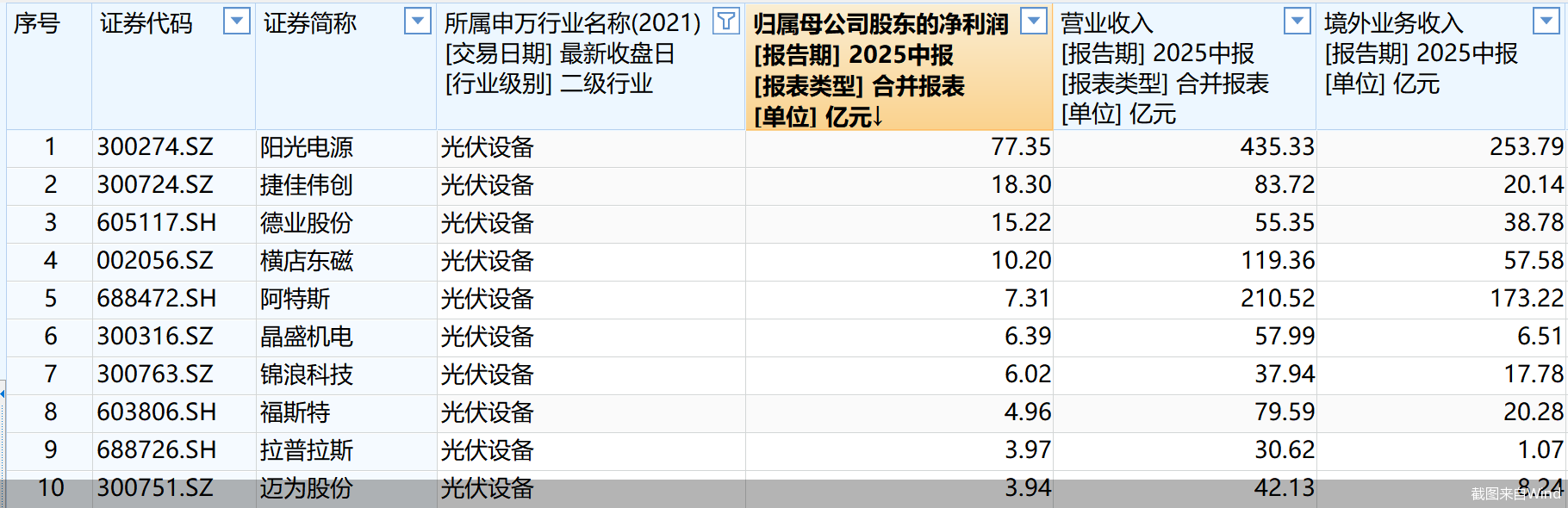
Core Viewpoint - The domestic photovoltaic industry is still facing challenges in the first half of 2025, with nearly half of the companies reporting net losses, indicating that the industry's "winter" has not yet ended [1][3]. Financial Performance - Among 70 photovoltaic companies, 34 reported net losses in the first half of 2025, accounting for approximately 48.57% [3][4]. - Notable losses include Tongwei Co. with approximately 4.96 billion yuan, TCL Zhonghuan with about 4.24 billion yuan, and Trina Solar with losses between 2.5 billion to 3 billion yuan [3][4]. - Conversely, 30 companies reported net profit growth, with MicroNano achieving the highest increase of 348.95% [3]. Debt Pressure - As of the end of the first half of 2025, 43 companies had asset-liability ratios exceeding 50%, representing about 61.43% of the total [5][6]. - Companies like *ST Jingang and ST Quan are in a precarious position with asset-liability ratios of 138.65% and 104.38%, respectively [6]. International Expansion - The trend of "going abroad" continues, with 13 companies reporting that over 50% of their revenue comes from international operations [8][9]. - Airo Energy leads with 97.14% of its revenue from overseas, focusing on markets in Europe, India, and Australia [9][10]. Market Capitalization - As of September 4, 2025, the market capitalization of leading companies includes Sunshine Power at 240.5 billion yuan, Longi Green Energy at 131.9 billion yuan, and Tongwei Co. at 103.4 billion yuan [7]. Capitalization Efforts - Several photovoltaic companies are pursuing dual listings, with Fulete and Junda already achieving "A+H" listings, while others like Sunshine Power and JA Solar are planning to list on the Hong Kong Stock Exchange [11].




两部门重磅印发,光伏领域迎利好,社保基金重仓股名单出炉
Zheng Quan Shi Bao Wang· 2025-09-04 10:53
Group 1 - The Ministry of Industry and Information Technology and the State Administration for Market Regulation issued a significant plan to promote high-quality development in the photovoltaic sector, aiming to eliminate "involution" competition and manage low-price competition legally [2] - The report from Huachuang Securities indicates that the installation capacity in the first half of 2025 is expected to double due to a surge in demand, although growth in the second half is anticipated to slow down [2] - The photovoltaic industry is gradually stabilizing, with improved market sentiment driven by policy adjustments and supply-demand expectations, suggesting a focus on leading companies with stable operations and profit recovery [2] Group 2 - A total of 14 photovoltaic concept stocks are held by the social security fund, with Junda Co., Zhengtai Electric, and Li New Energy having the highest shareholding ratios, all exceeding 3% [4] - Among the stocks held by the social security fund, companies like Hengdian East Magnetic, Airo Energy, Zhengtai Electric, and Shangneng Electric reported year-on-year growth in net profit for the first half of the year [4] - The average stock price of photovoltaic concept stocks in the A-share market has increased by 16.44% this year, with nine stocks rising over 50%, led by Xian Dao Intelligent with a 124.47% increase [3]


固德威:上半年亏损1659.8万元
Zheng Quan Shi Bao Wang· 2025-08-28 13:05
Core Viewpoint - Greeway (688390) reported a revenue of 4.086 billion yuan for the first half of 2025, marking a year-on-year growth of 29.8%, despite a net loss attributable to shareholders of 16.598 million yuan and a basic earnings per share of -0.07 yuan [1] Group 1 - The company's revenue growth is primarily driven by the favorable development of the photovoltaic industry [1] - Greeway has been actively expanding its photovoltaic market both domestically and internationally [1] - Sales of inverters and household systems have increased compared to the same period last year [1]

*ST沐邦: 江西沐邦高科股份有限公司2025年半年度报告
Zheng Quan Zhi Xing· 2025-08-27 14:13
Core Viewpoint - Jiangxi Mubang High-Tech Co., Ltd. reported a significant decline in revenue and net profit for the first half of 2025, primarily due to the volatility in the photovoltaic industry and intensified competition in the toy sector [1][9]. Group 1: Company Overview and Financial Performance - The company recorded an operating income of CNY 140,945,252.19, a decrease of 33.85% compared to the same period last year [2][9]. - The total profit for the period was -CNY 225,242,257.48, showing an improvement of 6.75% from -CNY 241,542,313.13 in the previous year [2][9]. - The net profit attributable to shareholders was -CNY 212,423,525.34, a slight improvement of 2.38% from -CNY 217,594,412.96 [2][9]. - The net cash flow from operating activities was -CNY 16,832,740.71, a significant improvement of 79.50% compared to -CNY 82,105,079.74 in the previous year [2][9]. Group 2: Industry Analysis - The photovoltaic industry is experiencing rapid growth, with China's newly installed photovoltaic capacity reaching 212 GW in the first half of 2025, a year-on-year increase of 54.1% [3][9]. - The total global silicon wafer production capacity reached approximately 1394.9 GW, with a year-on-year growth of 43.2% [3][9]. - N-type silicon wafers have become the mainstream in the market, with a market share of 72.5% as of the end of 2024, expected to rise to 90% by 2025 [3][9]. - The toy industry faces intense competition, with many small-scale manufacturers leading to price wars and reduced profit margins [5][9]. Group 3: Business Segments - The company's main business includes the production and sales of monocrystalline silicon rods and wafers, as well as educational toys [6][9]. - The subsidiary, Haoyuan Energy, focuses on the research, production, and sales of photovoltaic silicon wafers and rods, primarily producing solar monocrystalline silicon wafers [6][9]. - The toy segment generated revenue of CNY 14,926,304.46, with a net profit of -CNY 21,175,344.04, indicating a challenging market environment [9][12].

大全能源: 大全能源2025年半年度报告
Zheng Quan Zhi Xing· 2025-08-26 16:24
Core Viewpoint - The report highlights a significant decline in revenue and net profit for Xinjiang Daqo New Energy Co., Ltd. in the first half of 2025, primarily due to a substantial drop in polysilicon prices and a strategic reduction in production to mitigate market pressures [3][5][6]. Financial Performance - The company reported a revenue of 147,011.27 million RMB, a decrease of 67.93% compared to the same period last year [3][5]. - The net profit attributable to shareholders was -114,667.36 million RMB, with a net profit of -115,409.83 million RMB after deducting non-recurring gains and losses [3][5]. - The operating cash flow was a net outflow of -160,780.47 million RMB, reflecting a significant decrease in cash flow compared to -346,531.43 million RMB in the previous year [3][4]. Production and Sales - The company's polysilicon production for the first half of 2025 was 50,821 tons, a year-on-year decrease of approximately 60% [5][7]. - The average selling price per kilogram of polysilicon was 31.20 RMB, down 33.63% from the previous year [7]. - The unit cash cost decreased to 37.66 RMB/kg, a reduction of 6.6% compared to the previous year [7][8]. Market Position and Strategy - The company maintained an 8.52% share of the domestic polysilicon production market, positioning itself among the top players in the industry [4][5]. - A strategic reduction in production was implemented to alleviate market supply pressure and avoid intense competition, demonstrating the company's adaptability [5][8]. - The company plans to continue its production reduction strategy in the third quarter, with an expected output of 27,000 to 30,000 tons of polysilicon [8]. Financial Health - As of June 30, 2025, the company had a total cash reserve of 12.09 billion RMB and a low debt ratio of 8.04%, indicating a strong financial position [6][8]. - The absence of any interest-bearing debt provides the company with a solid foundation to navigate industry cycles [6]. Research and Development - The company invested 12,428.35 million RMB in R&D during the reporting period, a decrease of 59.92% compared to the previous year [16]. - Continuous investment in R&D and technological innovation is emphasized as a core competitive advantage, with a focus on enhancing production efficiency and reducing costs [9][10][16]. Industry Context - The domestic polysilicon market experienced a rebound in prices from late June to August 2025, influenced by government policies aimed at reducing irrational competition and promoting sustainable development in the photovoltaic industry [8][9]. - The company remains optimistic about the future development of the photovoltaic industry and product price trends [8].
英杰电气(300820.SZ):上半年新增光伏订单仅4000万元左右
Ge Long Hui· 2025-08-25 07:22
Group 1 - The core viewpoint of the article highlights that Yingjie Electric (300820.SZ) reported nearly 300 million yuan in revenue from its photovoltaic business in the first half of the year, with current goods dispatched amounting to approximately 1.4 billion yuan, including 500 million yuan from overseas projects [1] - The delay in project commencement by downstream customers has led to a backlog in acceptance, making the prompt recognition of photovoltaic sales revenue a key focus for the company in 2025 [1] - The new photovoltaic orders in the first half of 2025 were only around 40 million yuan, indicating a significant decline in order intake, which reflects the ongoing impact of the photovoltaic industry on the company [1] Group 2 - The overseas photovoltaic projects have been shipped, and payments have mostly been received; however, due to delays in customer project advancement, it is anticipated that revenue may not be recognized in 2025, with expectations pushed to 2026 [1]
上游原料价升、下游采买增加 硅片价格持续上涨
Mei Ri Jing Ji Xin Wen· 2025-08-06 16:51
Group 1 - The price of silicon wafers has increased due to the rebound in upstream polysilicon prices, with manufacturers setting prices to avoid losses rather than competing for sales [1][2] - In the last week of July, the average price of N-type G10L monocrystalline silicon wafers was 1.2 yuan/piece, up 9.09% week-on-week; N-type G12R wafers averaged 1.35 yuan/piece, up 8.00%; and N-type G12 wafers averaged 1.55 yuan/piece, up 7.64% [2] - The increase in silicon wafer prices is attributed to rising raw material costs and increased downstream orders, with manufacturers adhering to pricing guidelines [1][2] Group 2 - The production cost of silicon wafers has risen due to increasing polysilicon prices, which have gone from 35,000 yuan/ton to 45,000 yuan/ton [3] - The overall operating rate in the industry remained stable, with major companies operating at 50% and 40% capacity [2][3] - From the second half of 2024, pure silicon wafer producers are adopting a strategy of not pursuing high operating rates and focusing on sales-based production [2] Group 3 - The National Energy Administration reported that new renewable energy installations reached 268 million kilowatts in the first half of the year, a 99.3% increase year-on-year, with solar power installations doubling [3] - The Ministry of Industry and Information Technology has issued a notice to implement energy-saving inspections in the polysilicon industry, which may lead to a concentration of production capacity among leading companies [4] Group 4 - Major photovoltaic companies have reported expected losses for the first half of 2025, with Longi Green Energy forecasting a net loss of 2.4 to 2.8 billion yuan [6] - Despite the losses, the domestic component sector has begun to turn a profit, and new markets in the Middle East and Southeast Asia are showing significant growth [6][7] - The industry is expected to see a recovery in prices due to policy impacts on polysilicon, although achieving a balance between supply and demand remains challenging [6][7] Group 5 - The inventory of polysilicon in the industry has decreased by approximately 30,000 to 40,000 tons since the beginning of the year, with some inventory being consumed and some accumulated due to rising prices [8] - Currently, there is no new polysilicon production capacity, and some companies have halted production lines [8]
硅片价格持续上涨,专家:多晶硅价格回弹后,硅片制造以不亏本为底线
Mei Ri Jing Ji Xin Wen· 2025-08-05 11:45
Core Viewpoint - The increase in silicon wafer prices reflects a rebound in raw material polysilicon prices, with manufacturers pricing to avoid losses rather than competing for sales [1][2]. Group 1: Price Trends - The average price of N-type G10L monocrystalline silicon wafers increased by 9.09% week-on-week to 1.2 yuan per piece, while N-type G12R and G12 wafers saw increases of 8.00% and 7.64%, respectively [2]. - The overall increase in silicon wafer prices is attributed to rising raw material costs and increased purchasing orders from downstream [1][2]. Group 2: Industry Dynamics - The industry is experiencing a shift where pure silicon wafer manufacturers are focusing on not pursuing high operating rates or accumulating inventory, instead opting for production based on sales [2][3]. - The overall operating rate in the industry remained stable, with major companies operating at 50% and 40% rates, while integrated companies operated between 50% and 80% [2]. Group 3: Cost Implications - The rise in polysilicon prices from 35,000 yuan/ton to 45,000 yuan/ton is expected to increase costs in the component manufacturing sector by only 0.02 to 0.03 yuan/W, which is not significant [3]. - If polysilicon prices were to reach 60,000 yuan/ton, it would raise component costs by approximately 0.05 yuan/W, which downstream manufacturers would struggle to absorb [3]. Group 4: Market Outlook - The National Energy Administration reported that new renewable energy installations reached 268 million kilowatts in the first half of the year, a 99.3% year-on-year increase, with solar power installations doubling compared to the previous year [3]. - The forecast for solar installation capacity in 2025 has been adjusted upward to between 570 GW and 630 GW, indicating continued growth in the sector [7]. Group 5: Policy and Regulation - The Ministry of Industry and Information Technology has initiated energy-saving inspections for the polysilicon industry, which may limit outdated production capacity and concentrate production among leading companies [4]. - Policies are in place to prevent sales below cost, which helps stabilize price floors in the market [4]. Group 6: Company Performance - Longi Green Energy expects a net loss of 2.4 to 2.8 billion yuan for the first half of the year, although it has managed to significantly reduce losses compared to the previous year [6]. - Other major companies, such as Tongwei and JA Solar, also anticipate substantial losses, indicating a challenging market environment despite some segments beginning to show profitability [6][7].

