
国家自主贡献(NDC)

Search documents
COP30六大看点:“行动”号角吹响,全球气候治理迎终考
2 1 Shi Ji Jing Ji Bao Dao· 2025-10-27 09:51
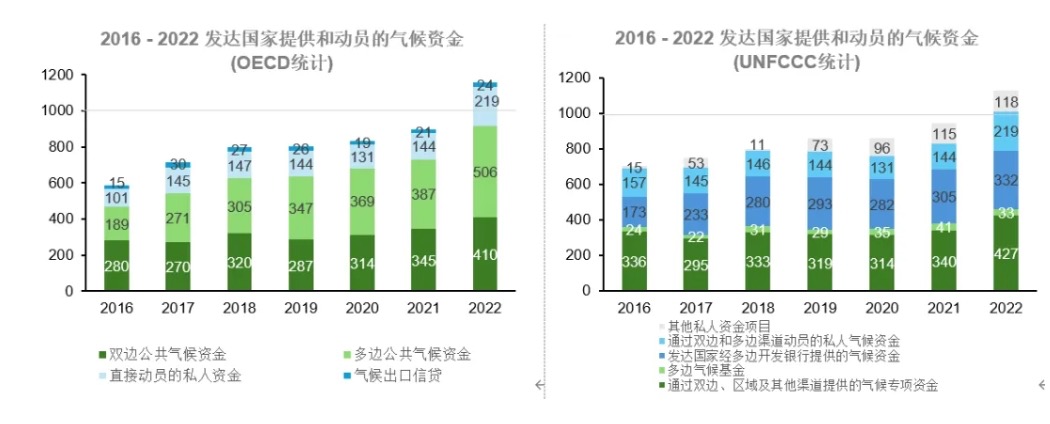
Core Viewpoint - The COP30, taking place in the Amazon rainforest, aims to transform climate commitments into actionable results, focusing on ambitious climate action plans, funding commitments, and the initiation of a global carbon market to maintain the 1.5°C temperature control target [1][2]. Group 1: Key Highlights of COP30 - COP30 is seen as a critical moment for translating the "Baku Climate Solidarity Pact" from consensus to action, with a focus on three main areas: ensuring equitable and transparent financing, refining international carbon market rules, and encouraging countries to submit more ambitious Nationally Determined Contributions (NDCs) [3][4]. - The year 2025 marks a milestone for the Paris Agreement, requiring countries to submit new, more ambitious NDCs. Currently, only 62 countries have submitted their NDCs, representing about 32% of the total parties, indicating a significant gap in ambition and progress [5][6]. - Brazil proposes a voluntary alliance to connect existing carbon pricing systems, which could enhance liquidity and reduce transaction costs in the global carbon market, thus supporting countries in achieving their NDC targets [7][8]. Group 2: Funding and Financial Mechanisms - The annual climate funding target set at $300 billion falls short of the estimated $1.3 trillion needed by developing countries, highlighting a significant funding gap for climate action [9][11]. - Innovative financing mechanisms are necessary to mobilize private capital effectively, including the establishment of frameworks to track financing progress and the promotion of blended finance and green bonds [12]. - The COP30's focus on nature and biodiversity emphasizes the need for integrated policies that link climate action with biodiversity conservation, potentially creating unified financing mechanisms [13]. Group 3: China's Role in Global Climate Governance - China's new NDC aims for a 7%-10% reduction in net greenhouse gas emissions by 2035, showcasing its commitment to global climate leadership and sustainable development [14].

“十五五”与碳达峰之一:碳达峰行业梳理:“碳达峰”将推动能源结构转型、产业低碳化和技术创新-20251023
Xiangcai Securities· 2025-10-23 11:20
Core Insights - The report emphasizes that China's "carbon peak" is closely related to the Nationally Determined Contributions (NDC) [3][11][12] - The third round of NDC announced by President Xi Jinping expands the scope to cover all economic sectors and sets absolute reduction targets for greenhouse gas emissions [13][12] - The report indicates that while China's carbon emissions continue to rise, the growth rate is showing signs of convergence [5][9] Industry Analysis - As of Q3 2025, certain industries such as cement, aluminum, electricity, and steel are nearing or have achieved carbon peaking, while sectors like transportation and petrochemicals face significant challenges [6][24][25] - The report outlines that achieving carbon peaking in high-energy-consuming industries will require deep decarbonization, technological innovation, and capacity optimization [27][30] - The transition to a cleaner energy system is highlighted as a priority, with increased investments in non-fossil energy sources, including large-scale wind and solar projects, and upgrades to smart grid systems [6][29] Investment Recommendations - The report suggests focusing on sectors that have undergone significant adjustments, such as banking and insurance, as well as areas related to environmental protection and renewable energy [30] - It is anticipated that carbon peaking-related investment directions will become a major focus as the "14th Five-Year Plan" is implemented [30]
新一轮国家自主贡献落地:2035年风光装机36亿千瓦
2 1 Shi Ji Jing Ji Bao Dao· 2025-09-25 14:34
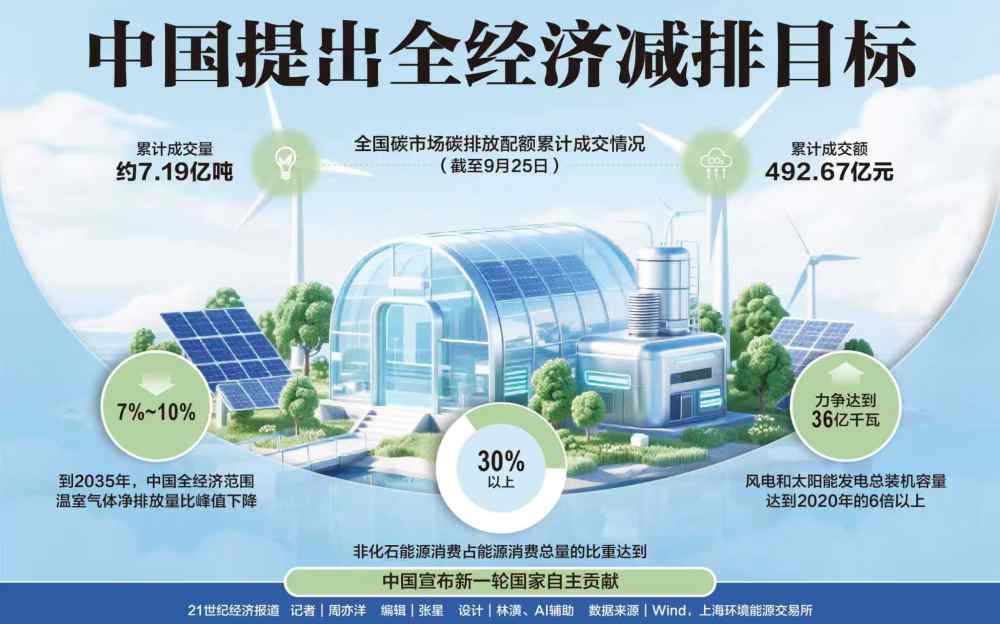
Core Viewpoint - China has announced a new round of Nationally Determined Contributions (NDC), aiming for non-fossil energy consumption to exceed 30% of total energy consumption by 2035, with wind and solar power installed capacity reaching over six times that of 2020, targeting 360 million kilowatts [2][4][8]. Group 1: NDC and Energy Transition Goals - The NDC is part of China's commitment under the Paris Agreement, with previous targets set in 2015 and 2020 focusing on carbon intensity and non-fossil energy share [3]. - The new NDC emphasizes the need for a new power system dominated by renewable energy, requiring coordinated development of energy sources, networks, loads, and storage [2][4][5]. Group 2: Energy Structure and Consumption - The transition to a green energy structure is accelerating, with non-fossil energy consumption expected to exceed the 20% target set for the 14th Five-Year Plan [4]. - Achieving the 30% target will involve a diversified approach to clean energy, including nuclear, hydropower, and biomass, alongside significant growth in renewable energy projects [6][7]. Group 3: Installed Capacity and Market Dynamics - The total installed capacity for wind and solar power has increased from 530 million kilowatts in 2020 to 1.68 billion kilowatts by July this year, with an annual growth rate of 28% [8][9]. - The ambitious target of 360 million kilowatts will require sustained high levels of new installations, supported by a robust supply chain and technological advancements [9][10]. Group 4: Technological and Policy Innovations - To support the integration of large-scale renewable energy, advancements in energy storage, grid flexibility, and smart grid technologies are essential [9][10]. - The development of a carbon market and electricity market synergy is crucial for enhancing the competitiveness of renewable energy [10].
新一轮国家自主贡献目标落地:2035年风光装机36亿千瓦
2 1 Shi Ji Jing Ji Bao Dao· 2025-09-25 14:15
Core Insights - China's new Nationally Determined Contribution (NDC) target aims for non-fossil energy consumption to exceed 30% of total energy consumption by 2035, with wind and solar power capacity reaching six times that of 2020, targeting 3.6 billion kilowatts [1][3][6] Group 1: NDC Goals and Energy Transition - The new NDC emphasizes the need for a new power system dominated by renewable energy, requiring coordinated development of sources, grids, loads, and storage [1][3] - The NDC sets ambitious targets for non-fossil energy, including a significant increase in wind and solar capacity, which is expected to drive industrial transformation and energy structure changes [3][6] - The transition to a green and low-carbon energy system is crucial for achieving the dual carbon goals, with a focus on enhancing the role of renewable energy in the energy mix [3][4] Group 2: Industry and Market Implications - The target of 3.6 billion kilowatts for wind and solar capacity is anticipated to significantly boost the manufacturing supply chain for these technologies, despite current overcapacity in the solar sector [8] - The development of flexible resources, such as pumped storage and new energy storage technologies, is essential for accommodating the large-scale integration of renewable energy into the grid [7][8] - The market mechanisms for green electricity and certificates need to be improved to ensure fair pricing and promote the consumption of renewable energy [5][7]
美媒记者:在南海渔船上望去,我看到清洁能源在中国迎来丰收时代
Sou Hu Cai Jing· 2025-09-12 12:38
Core Viewpoint - China's energy transition is at a critical turning point, which has significant implications for both China and the global landscape [3]. Group 1: Renewable Energy Development - China has achieved record-high installations of wind turbines and solar panels, contributing to a substantial increase in power generation capacity [5]. - In the first half of this year, the number of newly installed solar panels in China surpassed the total historical installations of Germany, France, and Spain combined [9]. - China's total electricity consumption in July reached 10,226 billion kilowatt-hours, marking an 8.6% year-on-year increase, and this was the first time monthly consumption exceeded one trillion kilowatt-hours globally [6][7]. Group 2: Global Impact and Comparisons - The advancements in China's renewable energy sector are expected to be key discussion points at upcoming international climate events, such as Climate Week NYC and COP30 [6]. - In contrast to the stagnation of electricity demand in the U.S., China's electricity demand has consistently grown due to industrial expansion and the rise of electric vehicles [6][10]. - The electricity peak in China this summer was approximately 100 gigawatts higher than the previous year, equivalent to the total output of all power plants in the UK [6]. Group 3: Strategic Goals and Future Plans - China is on track to achieve its carbon peak target five years ahead of schedule, with significant reductions in coal consumption due to increased renewable energy output [5]. - The upcoming announcement of China's 2035 climate goals and the new five-year plan will clarify the country's approach to balancing challenges and benefits in the energy transition [10]. - The recent joint statement with the EU emphasizes China's commitment to submitting a comprehensive 2035 national contribution target before COP30 [11].
中国新气候目标定了!2035年覆盖全经济范围及所有温室气体
2 1 Shi Ji Jing Ji Bao Dao· 2025-07-25 13:45
Core Points - China and the EU have jointly announced their commitment to submit the 2035 Nationally Determined Contributions (NDCs) before COP30, covering the entire economy and all greenhouse gases, in line with the Paris Agreement's temperature control requirements [1][3][9] - The 2035 NDC will expand the scope of carbon emission governance from specific sectors to the entire economy, indicating a shift towards broader sustainable development [4][6] - The new NDC aims to align with the long-term temperature goals of the Paris Agreement, specifically to limit global temperature rise to below 2°C and strive for a limit of 1.5°C [7][8] Summary by Sections Nationally Determined Contributions (NDCs) - China plans to submit its 2035 NDC before COP30, which will encompass all greenhouse gases and economic sectors, with a submission deadline set for November 10-21, 2024 [3][4] - Historical context shows that China's previous NDCs were submitted during the UN climate change conferences in 2015 and 2020, focusing on carbon intensity and specific reduction targets [3] Climate Governance and Sustainable Development - The shift to a full economic scope for greenhouse gas management indicates a broader approach to climate governance, moving beyond just carbon emissions to include various aspects of sustainable development [4][6] - The establishment of a comprehensive and transparent greenhouse gas emission data system is crucial for effective emission reduction strategies [4][5] International Cooperation and Climate Policy - The joint statement emphasizes the importance of maintaining continuity and stability in climate policies among major economies, particularly in light of challenges posed by unilateral actions from other countries [9][10] - The collaboration between China and the EU is seen as a model for developing countries, showcasing a cooperative approach to climate action and technology sharing [10][11] Green Finance and Industry Cooperation - Green finance is highlighted as a key area for cooperation, with both parties working on sustainable finance frameworks to facilitate cross-border green investments [12] - The need for alignment on carbon accounting methods and compliance standards is emphasized to provide clarity and support for businesses navigating new regulations [12]