
太空AI数据中心

Search documents
SpaceX大转向!马斯克改口:火星太远月球更快,十年内要建“月球城市”
Hua Er Jie Jian Wen· 2026-02-09 07:45
Core Viewpoint - SpaceX has shifted its strategic focus from Mars colonization to lunar missions, aiming for a moon landing by March 2027, marking a significant change in direction for the company [2][3][4]. Group 1: Strategic Shift - Elon Musk has emphasized that the moon was previously seen as a distraction, but practical considerations have led to this new focus on lunar exploration [3][5]. - The construction of a self-sustaining city on the moon is now prioritized, with a projected timeline of achieving this within 10 years, compared to over 20 years for Mars [4][5]. Group 2: Technological and Financial Integration - SpaceX has acquired xAI, leading to a valuation of $1.25 trillion, making it the most valuable private company globally [6]. - There are rumors of a potential IPO later this year, with fundraising efforts expected to reach $50 billion [6]. Group 3: Space AI and Computing Power - Musk envisions space as the most cost-effective location for deploying AI, predicting that within 36 months, space will become the cheapest site for AI operations, costing only 10% of ground-based operations [6][7]. - The company plans to launch approximately 100 gigawatts of solar and computing payloads annually, which could surpass the total AI computing power on Earth within five years [7]. Group 4: Manufacturing and Robotics - Musk has raised concerns about the decline of U.S. manufacturing, proposing the integration of humanoid robots (Optimus) and AI (xAI) as a solution [9]. - He describes Optimus as an "infinite money printer," highlighting the exponential growth in digital intelligence, AI chip capabilities, and mechanical dexterity [9]. Group 5: Challenges and Urgency - The timeline for the lunar mission is under pressure, with recent delays in NASA's Artemis 2 program serving as a warning for SpaceX [10]. - Musk acknowledges the need for rapid advancements in AI and robotics to meet the 2027 deadline, emphasizing the urgency of the situation [10].

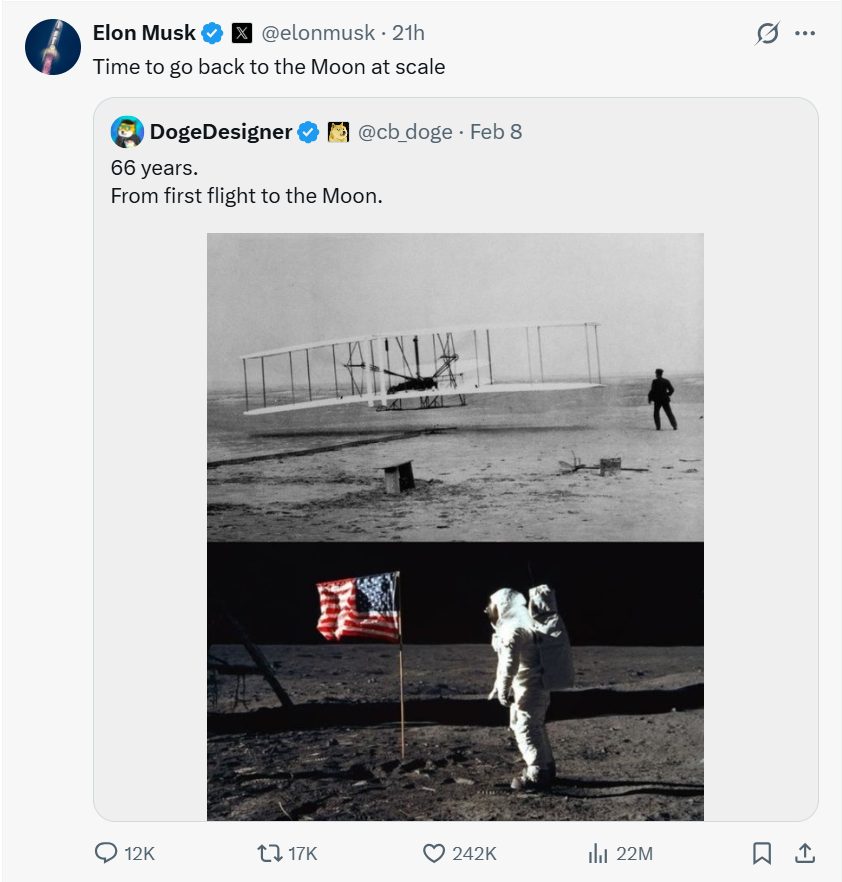
“是时候大规模重返月球了”,马斯克:将用10年时间建一座月球城市
Sou Hu Cai Jing· 2026-02-09 06:53
Core Viewpoint - SpaceX is shifting its focus to building a self-sustaining city on the Moon, aiming to achieve this goal within 10 years, while Mars colonization is projected to take over 20 years [2][4]. Group 1: Lunar City Development - SpaceX plans to construct a city on the Moon, with a construction iteration speed significantly faster than that for Mars, as lunar missions can occur every 10 days compared to Mars missions every 26 months [4]. - The company aims to initiate work on the lunar city within the next 5 to 7 years, despite still committing to Mars city development [4]. Group 2: Strategic Shift and Recruitment - SpaceX has delayed its planned Mars mission to prioritize NASA's lunar missions, with an unmanned lunar landing targeted for March 2027 [6][7]. - The company is actively recruiting engineers in Austin and Seattle to develop AI satellites and space data centers, indicating a strategic pivot towards AI integration in space operations [6]. Group 3: Collaboration with NASA - NASA has commissioned SpaceX to prepare a modified Starship vehicle for docking with its spacecraft near the Moon, which is a key component of NASA's Artemis program aimed at returning astronauts to the lunar surface [7]. - SpaceX has utilized billions in funding from NASA to assist in the development of the Starship, a fully reusable rocket over 400 feet tall [7]. Group 4: Financial Developments - SpaceX's recent acquisition of Elon Musk's startup xAI has led to a combined company valuation of $1.25 trillion, reflecting the company's growth and ambitions in the AI and space sectors [6]. - The company is also planning for an initial public offering (IPO), potentially launching as early as this summer [6].

马斯克:SpaceX已将重心转移至在月球建造城市,10年内有望实现,前往火星需要20年以上
Sou Hu Cai Jing· 2026-02-09 00:44
Group 1 - The core focus of SpaceX has shifted towards building a self-sustaining city on the Moon, with a target to achieve this within 10 years, while Mars exploration is projected to take over 20 years [1][3] - SpaceX plans to prioritize lunar missions, with a target for an unmanned lunar landing in March 2027, as it has postponed its previously scheduled Mars mission [5][6] - The company is actively hiring engineers in Austin and Seattle to develop AI satellites and space data centers, indicating a strategic expansion in technology [5] Group 2 - SpaceX has received significant funding from NASA to develop a modified Starship spacecraft for lunar missions, which is a key component of NASA's Artemis program aimed at returning astronauts to the Moon [6] - The merger with Elon Musk's startup xAI has resulted in a combined company valuation of $1.25 trillion, further enhancing SpaceX's financial position [5] - SpaceX is considering an initial public offering (IPO) that could potentially launch as early as this summer [5]
全球最贵独角兽诞生 SpaceX并购xAI构建天基算力网络
2 1 Shi Ji Jing Ji Bao Dao· 2026-02-03 23:49
Core Insights - SpaceX has officially announced the acquisition of AI startup xAI, marking a significant move towards vertical integration in its business empire, driven by the need to build AI data centers in space [1][10] - The merger aims to create a "vertical integration innovation engine" that combines artificial intelligence, launch vehicles, space-based internet, and real-time information platforms [1][10] - Elon Musk envisions that space will become the lowest-cost location for AI computing power within the next 2 to 3 years, as current AI development faces physical limitations due to energy demands [4][12] Company Overview - SpaceX, founded in 2002, is the largest commercial rocket launch service provider globally, with capabilities in manufacturing, launching, recovering, and reusing rockets [4][12] - xAI, established in 2023, focuses on AI development with a mission to "understand the true nature of the universe" and has launched significant projects like the Grok language model and the Colossus training cluster [5][12] - The merger positions the combined entity as a trillion-dollar non-public giant, with SpaceX's valuation at approximately $800 billion and xAI's post-funding valuation exceeding $230 billion [6][13] Strategic Vision - Musk emphasizes the necessity of transitioning resource-intensive computing tasks to space to alleviate energy bottlenecks, as terrestrial data centers cannot meet the global AI power demand [7][14] - The plan includes deploying a million satellites to create an orbital data center that can harness solar energy for computing, potentially adding 100 gigawatts of AI computing capacity annually [8][15] - Future plans involve establishing a permanent base on the Moon to manufacture satellites and support deep space missions, with projections of deploying 500 to 1000 terawatts of AI satellites annually [9][16] Market Position and IPO Plans - SpaceX is accelerating its IPO process, with expectations of raising over $50 billion, potentially making it one of the largest IPOs in history, with a valuation exceeding $1.5 trillion [10][17] - The company aims to time its IPO around Musk's 55th birthday in June 2026, marking a significant milestone in his business career [10][17]
马斯克将xAI并入SpaceX打造太空AI数据中心计划
Sou Hu Cai Jing· 2026-02-03 10:00
Core Viewpoint - Elon Musk announced that SpaceX has acquired its AI company xAI, and the two will collaborate to build space data centers powered by solar energy [2] Group 1: SpaceX and xAI Collaboration - The collaboration marks a new chapter for both SpaceX and xAI, aiming to create a perceptive solar system to understand the universe [2] - Musk believes that Earth’s resources cannot meet the demands of AI, necessitating the construction of data centers in space, where unlimited solar energy can power AI needs [2] Group 2: Cost and Capacity Projections - Musk estimates that within two to three years, the lowest cost for generating AI computing power will be in space, asserting that space-based AI is the only scalable solution in the long term [2] - SpaceX's Starship rocket is expected to eventually launch at a frequency of once per hour, carrying 200 tons of payload each flight [2] - The basic calculation suggests that launching 1 million tons of satellites annually could generate 100 gigawatts of AI computing capacity, potentially reaching 1 terawatt of computing power from Earth each year [2] Group 3: Moon and Deep Space Plans - Musk proposes that factories on the Moon could utilize lunar resources to manufacture satellites for deployment in deeper space, potentially launching 500 to 1,000 terawatts of AI satellites annually [3] - This concept aligns with similar ideas previously suggested by other tech leaders, including Jeff Bezos and Google, who have also explored the potential of space for AI development [3][4] Group 4: Ethical Considerations - The article does not address the ethical implications of Musk's ideas, despite previous controversies surrounding AI services provided by his companies [3]

昨夜,马斯克确认旗下SpaceX与xAI合并!
Sou Hu Cai Jing· 2026-02-03 09:09
Core Insights - SpaceX has officially confirmed the acquisition of xAI, creating a tech giant valued at $1.25 trillion, which aims to reshape the space and AI industries [2][3] - The merger is seen as a strategic move to integrate SpaceX's space exploration capabilities with xAI's artificial intelligence technology, enhancing both companies' growth potential [2][5] Company Overview - SpaceX, founded in 2002, has become the world's most active rocket launch company and operates the largest satellite internet system, Starlink, with unique advantages in low-cost and high-density space deployment [3] - xAI, established in 2023, focuses on developing general artificial intelligence that aligns with human long-term interests and has quickly risen to the forefront of AI development with its Grok chatbot integrated into the X social platform [5] Strategic Rationale - The merger aims to create a "space AI data center," leveraging space-based resources to meet the growing energy demands of AI, which currently relies heavily on terrestrial data centers [6] - SpaceX's strong cash flow from its Starlink and rocket launch businesses will provide financial support to xAI, allowing it to focus on technological breakthroughs without funding constraints [6][7] Technological Synergy - The integration will enable xAI to utilize SpaceX's orbital data center network, enhancing its AI model capabilities and positioning it competitively against giants like OpenAI and Google [7] - SpaceX will benefit from xAI's technology to optimize its core operations, including rocket launch control and satellite network management, facilitating deeper integration of AI in space exploration [7] Future Vision - The merger aligns with Musk's vision of utilizing space's vast energy to advance human civilization, aiming to establish a constellation of 1 million satellites to create a global orbital data center [8][11] - This ambitious plan is projected to generate significant AI computing power, potentially transforming the landscape of AI development and application [11] Market Implications - The merger is expected to enhance SpaceX's narrative ahead of its planned IPO in 2026, which aims to raise $50 billion and could become the largest IPO in history, with a projected market value exceeding $1.5 trillion [7][8] - The integration of AI into SpaceX's operations is anticipated to attract more investors by adding a critical dimension to its business model [7] Global Industry Impact - The merger is likely to reshape the global tech landscape, presenting both challenges and opportunities for China's commercial space and AI sectors, prompting a need for accelerated transformation and innovation [13][15] - China's commercial space industry, which began in 2015, is evolving but still faces significant gaps compared to SpaceX, highlighting the importance of technological breakthroughs and industry integration [15][16]
7万亿独角兽正式诞生,SpaceX正式宣布全资收购人工智能初创公司xAI
Xin Lang Cai Jing· 2026-02-03 06:05
Core Insights - SpaceX has officially acquired AI startup xAI, marking a significant step in Elon Musk's strategy for vertical integration within his business empire, particularly in the development of AI data centers in space [1][10] - The merger aims to create a "vertical integration innovation engine" that combines artificial intelligence, rocket technology, satellite internet, and real-time information platforms [1][10] Group 1: Acquisition Details - The acquisition is part of Musk's vision to utilize space-based energy networks to build a "stellar-level" AI computing infrastructure, overcoming the physical limitations of terrestrial energy sources [1][10] - SpaceX and xAI have not disclosed the specific terms of the merger [11] Group 2: Company Backgrounds - SpaceX, founded in 2002, is the largest commercial rocket launch service provider globally, with capabilities in manufacturing, launching, recovering, and reusing rockets [3][13] - xAI, established in 2023, focuses on AI development and aims to understand the true nature of the universe, collaborating with Musk's other ventures like Tesla and X platform [3][13] Group 3: Financial Implications - Following the merger, SpaceX's valuation is expected to reach approximately $1.25 trillion, while xAI's post-funding valuation has surpassed $230 billion [4][14] - The combined entity will enter the "trillion-dollar club," becoming the highest-valued private company globally [4][14] Group 4: AI Data Center Vision - Musk emphasizes that the current AI development faces physical limits, and space technology is the only long-term solution to expand AI capabilities [6][16] - He predicts that within 2 to 3 years, space will become the most cost-effective location for AI computing power [6][16] Group 5: Future Plans - SpaceX plans to deploy up to 1 million satellites in low Earth orbit to create a space-based data center, which will utilize solar energy for computing tasks [8][18] - The company aims to launch 100 tons of payload per hour, significantly increasing the capacity for AI computing [8][17] - SpaceX is also accelerating its IPO process, with potential fundraising exceeding $50 billion, and plans to list around Musk's 55th birthday in June 2026 [9][19]
7万亿独角兽正式诞生
21世纪经济报道· 2026-02-03 06:00
Core Viewpoint - SpaceX's acquisition of xAI aims to create a vertically integrated innovation engine that combines artificial intelligence, rocket technology, satellite internet, and real-time information platforms, addressing the limitations of ground-based energy for AI expansion [1][4][10]. Group 1: Acquisition Details - SpaceX officially announced the acquisition of xAI on February 2, 2026, as part of its strategy for vertical integration within its business empire [1]. - The merger is expected to leverage a space-based energy network to build a "stellar-level" AI computing infrastructure, overcoming physical limitations imposed by terrestrial energy sources [1][4]. - The specific terms of the acquisition have not been disclosed by either SpaceX or xAI [1]. Group 2: Company Backgrounds - SpaceX, founded in 2002, is the largest commercial rocket launch service provider globally, with capabilities in manufacturing, launching, recovering, and reusing rockets [4]. - xAI, established in 2023, focuses on AI development with a mission to understand the true nature of the universe, maintaining technical collaboration with platforms like X (formerly Twitter) and Tesla [5]. Group 3: Financial Implications - The merger is projected to create a trillion-dollar non-public company, with SpaceX's valuation reaching approximately $800 billion and xAI's post-funding valuation exceeding $230 billion [5][6]. - Following the merger, SpaceX's overall valuation is expected to rise to $1.25 trillion, making it one of the highest-valued private companies globally [6]. Group 4: Future Plans and Innovations - Musk envisions that space will become the most cost-effective location for AI computing power within the next 2 to 3 years, as current AI development faces physical limits due to energy demands [4][10]. - SpaceX plans to deploy a massive orbital data center system with up to 1 million satellites, which will utilize solar energy for AI computations, significantly reducing operational costs [11][12]. - The company aims to launch 100 tons of payload per hour and potentially deploy 500 to 1000 terawatts of AI satellites into deep space, supporting long-term goals of establishing a self-sustaining base on the Moon and advancing human civilization to Mars [11][12].
全球最贵独角兽诞生!SpaceX并购xAI构建天基算力网络
2 1 Shi Ji Jing Ji Bao Dao· 2026-02-03 04:17
Core Insights - SpaceX has officially acquired AI startup xAI to enhance its vertical integration strategy, driven by the demand for AI data centers in space [1][3] - The merger aims to create a "vertical integration innovation engine" that combines AI, rocket technology, satellite internet, and real-time information platforms [1][3] - The acquisition is expected to enable the construction of a "star-level" AI computing infrastructure utilizing space-based energy networks [1][3] Company Developments - SpaceX, founded in 2002, is the largest commercial rocket launch service provider globally, with capabilities in manufacturing, launching, recovering, and reusing rockets [3] - xAI, established in 2023, focuses on AI development and has launched its first large language model, Grok-1, showcasing unique real-time information processing capabilities [3][4] - The merger positions the combined entity as a trillion-dollar non-public giant, with SpaceX's valuation reaching approximately $800 billion and xAI's post-funding valuation exceeding $230 billion [4][6] Strategic Vision - Elon Musk emphasizes the need for space-based AI data centers to meet the growing global power demands of AI, which cannot be satisfied by terrestrial solutions [6][7] - Musk predicts that within 2 to 3 years, space will become the most cost-effective location for AI computing power, enabling unprecedented model training scales [7][8] - The plan includes launching a million satellites to create an orbital data center, which could generate significant AI computing capacity without ongoing operational costs [7][8] Future Plans - SpaceX aims to establish a permanent base on the Moon to utilize its resources for satellite manufacturing and deep space launches [8] - The company has submitted a proposal to the FCC to deploy up to 1 million satellites with advanced computing capabilities for AI model operations [8][9] - SpaceX's revenue for 2025 is projected to be between $15 billion and $16 billion, with a net profit of $8 billion, positioning the company for a potential IPO with a fundraising target exceeding $50 billion [9]
特斯拉(TSLA.US)CEO马斯克计划合并SpaceX与xAI 整体估值或高达1.25万亿美元
智通财经网· 2026-02-02 22:27
Core Insights - Tesla CEO Elon Musk is planning to merge SpaceX with AI startup xAI to consolidate resources for their ambitious expansion in AI and aerospace [1] - The merger is expected to price shares at approximately $527, with a total valuation potentially reaching $1.25 trillion [1] - This transaction would combine two of the largest private companies globally, with xAI's valuation at around $230 billion and SpaceX's at about $800 billion [1] Group 1 - The merger aims to provide xAI with increased capital, talent, and computational resources [2] - It may also advance Musk's concept of a "space AI data center" [2] - SpaceX is applying for permission to launch up to 1 million satellites into Earth orbit for this project [2] Group 2 - The merger further intertwines Musk's business ventures, following his acquisition of Twitter and the subsequent merger with xAI [1] - xAI is currently operating the chatbot Grok, which reportedly incurs monthly costs of about $1 billion [1]
