改革攻坚

Search documents
坚持改革攻坚 增强高质量发展动力活力
Xin Lang Cai Jing· 2026-01-20 09:49
Group 1 - The core viewpoint emphasizes that reform is essential for liberating and developing social productivity, serving as the fundamental driving force for national development [1][10] - The 20th Central Committee's Fourth Plenary Session highlights the necessity of comprehensive deepening of reforms during the "14th Five-Year Plan" period, with reform and innovation as the main driving forces [1][10] - The Central Economic Work Conference proposed a series of policy measures to enhance development momentum and confidence, ensuring a good start for the "14th Five-Year Plan" [1][10] Group 2 - Understanding the significance of reform is crucial, as it is seen as a key pathway to enhance high-quality development and achieve Chinese-style modernization [2][11] - The past 40 years of economic development in China have been achieved under open conditions, and future high-quality development must also occur in a more open environment [2][11] - Systematic and coordinated institutional innovation is necessary to address the complex challenges facing economic development, emphasizing the need for a high-quality development framework [3][12] Group 3 - The essence of reform is to confront and solve problems, with a strong focus on the needs and interests of the people [4][15] - The leadership of the Communist Party is identified as the greatest political advantage of the socialist system, ensuring the continuous advancement of comprehensive reforms [4][14] - Reform efforts must be interconnected and coordinated, avoiding isolated approaches to achieve greater overall effectiveness [5][14] Group 4 - The focus on enhancing high-quality development requires a commitment to innovation across all sectors, including state-owned, private, and foreign enterprises [3][12] - Establishing a unified national market and improving the business environment are critical for fostering competition and supporting the growth of various economic entities [3][12] - The development of new productive forces through technological innovation is essential for driving high-quality growth [6][16] Group 5 - A comprehensive approach to reform must prioritize social equity and the well-being of the people, addressing their immediate concerns and aspirations [8][18] - Employment must be prioritized, with support for industries and enterprises that can absorb labor effectively [8][18] - The coordination of macroeconomic governance is vital, ensuring that various policies work in harmony to promote stable and sustainable development [8][19]
新视野丨坚持改革攻坚 增强高质量发展动力活力
Zhong Yang Ji Wei Guo Jia Jian Wei Wang Zhan· 2026-01-20 00:37
Group 1 - The core viewpoint emphasizes the importance of reform as a key driver for social productivity and national development, highlighting the need for comprehensive deepening of reforms during the "14th Five-Year Plan" period [2][3] - The article discusses the necessity of systematic and coordinated institutional innovation to address existing challenges in economic development, particularly in light of complex internal and external environments [4][5] - It stresses that high-quality development is fundamentally driven by innovation across all sectors, including state-owned, private, and foreign enterprises, and calls for the establishment of a fair and open market environment [5][6] Group 2 - The article outlines the internal requirements for reform, emphasizing that reforms must be systematic and problem-oriented, with a focus on the leadership of the Communist Party to ensure effective implementation [6][7] - It highlights the need for a comprehensive approach to reform that considers the interconnections between various sectors, such as education, technology, and market economy [6][10] - The importance of addressing the needs and interests of the people in the reform process is underscored, ensuring that reforms lead to tangible benefits for the public [8][11] Group 3 - The article advocates for a focus on enhancing new quality productivity as a priority in reform efforts, particularly through technological self-reliance and innovation in key sectors [9][10] - It calls for the construction of a high-level socialist market economy, emphasizing the need to eliminate local protectionism and ensure equal opportunities for all market participants [10] - The need for proactive engagement in global economic integration and the expansion of international cooperation is highlighted, particularly in the context of the Belt and Road Initiative [10][11]

创新改革双轮驱动 山西晋城多点发力破局突围
Zhong Guo Xin Wen Wang· 2026-01-15 06:02
Group 1: Innovation-Driven Development - Jin City is focusing on innovation as a key driver for industrial upgrading, establishing the "Jinchuan Valley" to enhance its innovation capabilities, with 103 startups and 31 patent authorizations [2] - R&D expenditure in Jin City increased from 30.5 billion to 33.9 billion, with R&D intensity rising from 1.29% to 1.41%, ranking second in the province for two consecutive years [2] - By 2026, Jin City aims to strengthen technological innovation supply and promote deep integration of the "four chains" to generate more original achievements [2] Group 2: Reform Initiatives - Jin City is implementing a "city-county same rights" reform pilot, allowing 95 administrative approval items to be processed at the county level, improving efficiency for local businesses [4] - The city plans to advance 15 key reforms and 13 pilot reforms by 2025, focusing on optimizing resource allocation and enhancing systemic reform thinking [4] - Efforts will include low-efficiency land redevelopment trials and public utility price reforms, alongside fiscal system and zero-based budgeting reforms [4] Group 3: Strengthening Enterprises - Jin City's state-owned enterprises have total assets of 256.47 billion, ranking second in the province, with annual revenue of 66.55 billion and profit of 4.62 billion, reflecting a 45% and 52% increase respectively since reforms [5] - The private sector is also thriving, with 231,000 private business entities constituting 97.2% of the total market entities in Jin City [6] - The city has established a joint meeting system to promote private economic development, implementing 185 policies to support businesses and resolving 437 issues, facilitating 2.27 billion in financing [6]
2026,“干”字起笔
Xin Lang Cai Jing· 2026-01-13 19:51
Core Viewpoint - Inner Mongolia is poised for significant development and achievements in the "14th Five-Year Plan" period, emphasizing practical efforts and strategic initiatives to drive economic growth and innovation [1][4]. Group 1: Economic Development - The region is experiencing a vibrant economic atmosphere with increased production, accelerated investment attraction, and a booming consumer market [1]. - The "14th Five-Year Plan" marks a critical year for high-quality development and innovation-driven growth in Inner Mongolia [1][2]. Group 2: Confidence and Collaboration - Confidence is highlighted as the most crucial driving force for development, with a strong emphasis on unity and collaboration among the diverse populations of Inner Mongolia [2]. - The region aims to leverage its resources and strategic advantages to maintain positive development momentum and unlock its potential [2]. Group 3: Practical Implementation - Real progress is achieved through practical efforts rather than mere discussions, focusing on building a modern industrial system and enhancing technological self-reliance [3]. - There is a call for coordinated efforts across various sectors to ensure effective implementation of development strategies [3][4]. Group 4: Strategic Planning - The "1571" work deployment by the regional party is identified as a key framework for guiding development efforts, requiring systematic and precise execution [4]. - The need for a balance between bold exploration and steady progress is emphasized, advocating for adaptable strategies that respect local conditions [4].
锚定开局目标 凝聚奋进合力
Xin Lang Cai Jing· 2026-01-09 16:41
Group 1: Economic Development Strategy - The core focus for 2026 is to ensure a strong start for the "14th Five-Year Plan" with an emphasis on high-quality economic and social development [1] - The Central Economic Work Conference has prioritized eight key tasks, including domestic demand-led growth, innovation-driven development, and reform initiatives [1][2] Group 2: Domestic Demand and Investment - The emphasis on domestic demand aims to build a robust domestic market, with policies targeting both investment and consumption [2] - Measures to stabilize investment include increasing government investment, implementing major engineering projects, and stimulating private investment [2] - Consumption strategies involve optimizing policies for replacing old consumer goods, expanding service consumption, and improving the quality of consumer supply [2] Group 3: Urban Development and Infrastructure - The focus on urban renewal includes implementing a specialized plan for urban updates and conducting city assessments [3] - Key infrastructure projects will include the renovation of gas pipelines and the construction of comprehensive underground utility corridors [3] Group 4: Innovation and Technology - The strategy emphasizes innovation-driven growth, with a focus on fostering new productive forces through technological advancements and industrial upgrades [4] - Specific initiatives include enhancing industrial technology capabilities, supporting emerging industries, and promoting the integration of artificial intelligence [5] Group 5: Data and Digital Economy - The year 2026 is designated as the "Year of Data Element Value Release," focusing on integrating data into economic value creation [6] - Efforts will be made to enhance data flow, promote data technology innovation, and support the development of digital industry clusters [6] Group 6: Reform and Market Dynamics - The reform agenda aims to eliminate systemic barriers to high-quality development, with a focus on creating a unified national market [7] - Financial reforms will enhance market supervision and facilitate cross-border financial services [7] Group 7: Social Welfare and Employment - The strategy includes measures to improve employment and social welfare, focusing on enhancing public services and ensuring stable prices for essential goods [9][10] - Specific actions will target skill development, social insurance coverage, and support for vulnerable groups [10][11]
五大关键词看好中国经济新一年
Jin Rong Shi Bao· 2026-01-05 02:33
Core Viewpoint - In 2025, China's economy demonstrated remarkable resilience and vitality, achieving a GDP growth of 5.2% year-on-year in the first three quarters, surpassing initial forecasts by institutions like the IMF and ranking among the top global economies. The year marked a significant "system upgrade" in growth momentum, characterized by accelerated development of new productive forces and a series of targeted macro policies aimed at enhancing future competitiveness and laying the groundwork for the 15th Five-Year Plan [2][4]. Group 1: Economic Growth and Structure - China's GDP growth of 5.2% in 2025's first three quarters reflects strong economic performance, driven by industrial upgrades and the expansion of emerging industries [2]. - The government implemented targeted macro policies focusing on digital economy and AI, supporting urban renewal and enhancing consumption through equipment upgrades and trade-in programs [2]. - The 15th Five-Year Plan emphasizes high-quality development with quantifiable goals such as maintaining economic growth within a reasonable range and improving residents' consumption rates [2]. Group 2: Domestic Demand and Investment - The 2025 Central Economic Work Conference prioritized "domestic demand as the main driver" for economic work in 2026, aiming for qualitative improvements and reasonable growth through multi-dimensional efforts in consumption, investment, and industry [3]. - Investment structure is set to optimize, focusing on new infrastructure, public services, and industrial upgrades, with significant government support in education, healthcare, and technology sectors [5]. Group 3: Innovation and Technology - The emphasis on "innovation-driven" development is crucial for addressing global economic uncertainties, with a systematic enhancement of China's innovation capabilities expected by 2026 [6][7]. - In 2024, R&D expenditure reached 36,326.8 billion yuan, an increase of 8.9% from the previous year, indicating a shift from following to leading in technological innovation [6]. Group 4: Reform and Market Integration - The construction of a unified national market is a key reform focus for 2026, aiming to eliminate market barriers and ensure fair competition through standardized regulations [8][9]. - Data shows that inter-provincial trade sales accounted for 41.1% of national sales revenue from January to November 2025, reflecting deepening trade connections and progress in market integration [8]. Group 5: Institutional Opening and Foreign Investment - The 2025 Central Economic Work Conference called for steady progress in institutional opening, with a focus on expanding service sector access and optimizing free trade zone layouts [11][12]. - From January to October 2025, 53,782 new foreign-invested enterprises were established, a 14.7% increase year-on-year, supported by various measures to attract foreign investment [11]. Group 6: Green Transformation - The commitment to a "dual carbon" strategy aims to drive comprehensive green transformation, with significant investments projected in climate adaptation and zero-carbon industries over the next decade [13][15]. - By August 2025, China's installed capacity for wind and solar power exceeded 1.69 billion kilowatts, tripling since 2020, highlighting the shift towards renewable energy [15][16]. - The establishment of a green financial support system aims to unify standards and enhance funding for green projects, with a notable increase in market confidence reflected in the green industry prosperity index [17].
【申万宏源脱水研报】中央经济工作会议的十大亮点——12月中央经济工作会议学习理解
申万宏源研究· 2025-12-24 02:56
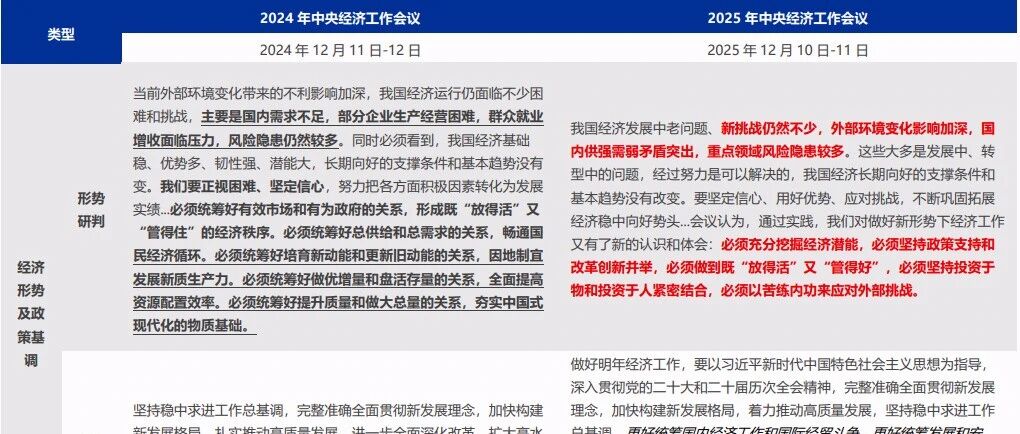
Core Viewpoint - The article presents a more optimistic outlook on the fiscal and monetary policy statements from the recent economic work conference compared to market expectations, highlighting the expanded role of the central bank in promoting economic stability and reasonable price increases [1]. Summary by Sections Economic Policy Direction - The 2025 Central Economic Work Conference emphasizes five "musts" that align with the 2024 "overall" strategies, focusing on tapping economic potential and policy reform coordination, addressing the core issue of "strong supply but weak demand" [2]. - The fiscal policy continues to adopt a "more proactive" stance, maintaining necessary deficits and debt levels while focusing on local fiscal challenges and debt resolution [2]. - Monetary policy aims to stabilize growth and promote reasonable price increases, with plans to flexibly use tools like reserve requirement ratio (RRR) cuts and interest rate reductions [2]. Internal Demand and Reform - The conference underscores the importance of domestic demand, proposing measures to increase residents' income, enhance service consumption, and expand budgetary investments to stabilize consumption and investment [2]. - Deepening reform remains a priority, with initiatives to advance the construction of a unified national market and address "involution" competition [2]. Risk Management - The article discusses proactive measures to mitigate risks in key areas, particularly in real estate, with a three-pronged approach to address challenges and focus on active debt management and restructuring [2]. Comparison of Economic Work Conference Statements - A comparison of the statements from the December 2024 and December 2025 conferences reveals a consistent acknowledgment of the challenges posed by insufficient domestic demand and external environmental changes, while also highlighting the resilience and potential of the Chinese economy [3]. Fiscal and Monetary Policy Details - The fiscal policy will continue to be proactive, increasing the fiscal deficit rate and ensuring sustained fiscal strength, with a focus on enhancing spending in key areas and issuing special bonds [3]. - The monetary policy will maintain a moderately loose stance, utilizing various tools to ensure ample liquidity and support for key sectors such as technology innovation and small and micro enterprises [3]. Domestic Market and Innovation - The article emphasizes the need to build a strong domestic market by enhancing consumption and investment efficiency, implementing special actions to boost consumption, and increasing the income of low- and middle-income groups [3]. - It also highlights the importance of technological innovation in driving new productive forces and developing a modern industrial system [3]. Reform and Opening Up - The conference calls for significant reforms to enhance the vitality of high-quality development, including the deepening of state-owned enterprise reforms and the promotion of private sector growth [3]. - It stresses the importance of expanding high-level opening up to stabilize foreign trade and investment, while also promoting cooperation in various fields [3]. Urbanization and Rural Revitalization - The article discusses the need for coordinated development between urbanization and rural revitalization, emphasizing the importance of maintaining agricultural productivity and enhancing the competitiveness of the agricultural sector [3].
【央视快评】坚持改革攻坚 增强高质量发展动力活力
Nan Fang Du Shi Bao· 2025-12-15 15:07
Group 1 - The core message emphasizes the commitment to high-quality development as a driving force for China's modernization, as highlighted in the Central Economic Work Conference [1][2] - The conference outlines key tasks for the upcoming year, including high-quality urban renewal, development of key industrial chains, and promoting high-quality development in various sectors such as the Belt and Road Initiative and marine economy [1][2] - The importance of addressing existing economic challenges and risks through a focus on high-quality development is underscored, indicating that this approach is essential for sustainable economic growth [1][3] Group 2 - The "14th Five-Year Plan" emphasizes high-quality development as a central theme, with significant weight given to achieving substantial results in this area [2] - The conference identifies "reform as a key path" to enhance the vitality of high-quality development, with specific measures aimed at addressing current issues in the economy [2][3] - There is a call for systemic and coordinated efforts across all regions and sectors to implement high-quality development, focusing on overcoming institutional barriers and promoting deep reforms [3]
【央视快评】坚持改革攻坚,增强高质量发展动力活力
Yang Shi Wang· 2025-12-15 11:56
Group 1 - The core viewpoint emphasizes the importance of reform to enhance the momentum and vitality of high-quality development [1] Group 2 - The commentary suggests that persistent efforts in reform are essential for driving economic growth and improving overall productivity [1] - It highlights the need for innovation and structural adjustments to adapt to changing market conditions [1] - The piece calls for a collective commitment to reform initiatives to ensure sustainable development in the long term [1]
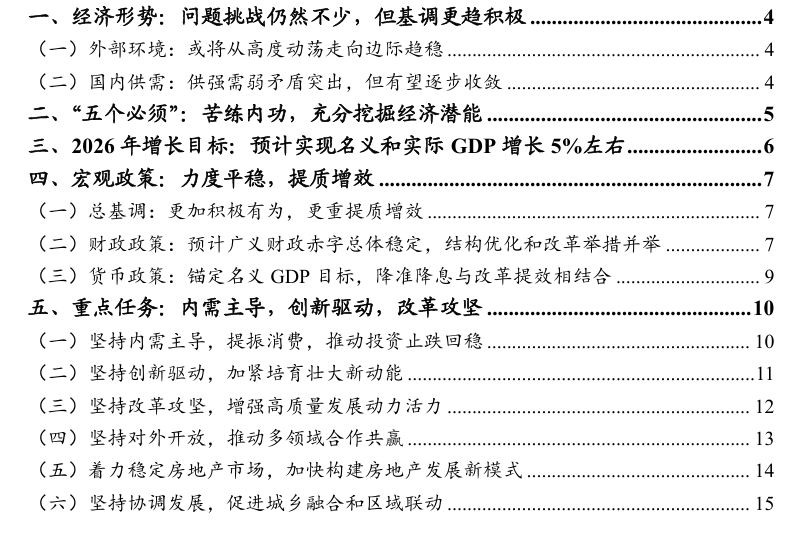
目标积极务实,政策提质增效,内需主导强化——2025年中央经济工作会议解读
Sou Hu Cai Jing· 2025-12-15 03:58
Economic Situation - The economic situation is characterized by persistent challenges, but the overall tone is becoming more positive. The external environment is expected to stabilize marginally, while domestic supply-demand imbalances are highlighted as significant issues [2][10][14]. Five Musts - The meeting outlined "Five Musts" to enhance economic potential, emphasizing the need for internal strengthening to address external challenges, and the importance of policy support and reform innovation [2][16][17]. 2026 Growth Target - The nominal and real GDP growth target for 2026 is set at around 5%. This target aligns with the need for a good start to the 14th Five-Year Plan and is slightly above the lower limit of the expected growth for the next decade [3][18][19]. Macro Policy - The macro policy framework is shifting from "promoting stability through growth" to "enhancing quality and efficiency," indicating a focus on structural optimization and effectiveness rather than just scale and intensity [4][22][25]. Fiscal Policy - The fiscal policy is expected to maintain a broad deficit rate of around 4%, with a focus on optimizing the expenditure structure and increasing investment in social welfare [4][26][28][29]. Monetary Policy - The monetary policy will continue to be moderately loose, with expectations for one rate cut and one reserve requirement ratio reduction in 2026. The focus will be on stabilizing nominal GDP and supporting key sectors [4][32][33][36]. Key Tasks - The emphasis is on domestic demand, innovation-driven growth, and reform efforts. Specific strategies include boosting consumption, stabilizing investment, and enhancing innovation capabilities [5][38][45]. Domestic Demand - The strategy prioritizes domestic demand, with a focus on increasing consumer income and optimizing supply. Retail sales growth is projected to recover to around 4.5% in 2026 [5][38][43]. Innovation - Innovation is positioned as a key task, with plans to strengthen the integration of education, technology, and talent development, and to establish major international technology innovation centers [5][45][46]. Reform - Key reforms will target the elimination of "involution" in competition, the clearing of overdue corporate debts, and the enhancement of the financial supply-side structure to support high-quality development [5][52][53][54]. Opening Up - The commitment to opening up remains strong, with a focus on expanding institutional openness and optimizing the business environment for foreign investment [5][55][56].