效率驱动

Search documents
科学管理、技术提效深入“毛细血管”,贝壳开启加速跑模式
第一财经· 2025-08-29 09:37
Core Viewpoint - Beike demonstrates resilience and growth during the real estate adjustment period, with a total transaction volume of 878.7 billion, net income of 26 billion, and adjusted net profit of 1.821 billion in Q2 2025, indicating a strong performance despite industry challenges [1] Financial Performance - In Q2 2025, Beike's GTV for existing housing reached 583.5 billion, with net income of 6.7 billion, while new housing GTV was 255.4 billion, showing a year-on-year growth of 8.5% and net income of 8.6 billion, also reflecting an 8.6% increase [3] - Non-property transaction service revenue accounted for 41% of total net income, with home decoration and rental services contributing significantly to growth [8] Technological Empowerment - Beike is leveraging AI technology to enhance operational efficiency, with tools like the AIGC marketing intelligence system and AI CRM helping agents improve customer acquisition and conversion rates [4][5] - The AI online service assistant "Pudding" provides consumers with market analysis and property comparisons, showing a 59% increase in conversation volume from May to July [6] New Growth Areas - Beike is expanding into home decoration and rental services, with home decoration revenue reaching 4.6 billion in Q2, a 13% increase, and rental service revenue growing by 78% to 5.7 billion [8] - The company is transitioning towards a "one-stop new living service platform," enhancing product offerings and operational capabilities in home decoration and rental services [9][12] Community Engagement - Beike is shifting from broad market strategies to deep community engagement, establishing community-based service centers and optimizing operations to better understand local market demands [14][15] - The company aims to reduce the physical and psychological distance between services and users, evolving from a city-level service provider to a community-level partner [15] Operational Efficiency - Beike is refining its platform management and operational strategies to enhance agent performance and transaction conversion rates, focusing on scientific management and community governance [16] - The company is committed to continuous innovation through technology, product iteration, and community engagement, positioning itself for future growth in the evolving real estate landscape [16]



营收与利润双增长,顾家家居半年报释放高质量增长信号
Jing Ji Guan Cha Wang· 2025-08-23 11:10
Core Viewpoint - The home furnishing industry in China is experiencing a significant transformation due to the decline in the real estate market since 2021, leading to a shift in consumer preferences towards experience and service rather than just product functionality. This has resulted in a restructuring of the competitive landscape, with companies needing to adapt to these changes to sustain growth [1]. Group 1: Company Performance - Kuka Home reported a strong performance in its mid-year results for 2025, achieving a revenue of 9.801 billion yuan, a year-on-year increase of 10.02%, and a net profit of 1.021 billion yuan, up 13.89%. The net cash flow from operating activities reached 1.094 billion yuan, showing a substantial increase of 71.89% [1][2]. - The growth in operating cash flow outpaced both net profit and revenue, indicating improved operational resilience and profitability quality in a challenging environment [2]. Group 2: Retail Transformation - Kuka Home has shifted its retail strategy from a focus on scale to a more systematic approach centered on user needs, marking a significant transformation in the traditional home furnishing industry [3]. - The company has seen remarkable results from its retail transformation, with smart product sales increasing 18 times compared to the second half of 2024, and custom retail orders growing by 13% [3][4]. Group 3: Integrated Home Business - Kuka Home's evolution from a single product manufacturer to a comprehensive home furnishing retailer is marked by its "integrated home" strategy, which aims to meet consumer demands for a better home life through a full-chain capability upgrade [6][7]. - The company has opened 377 integrated home stores, with a 10% increase in sales efficiency, indicating a structural leap in its integrated home strategy [7]. Group 4: Global Expansion - Kuka Home has established a global presence by building overseas manufacturing bases in Vietnam, Mexico, and the United States, totaling over 650,000 square meters, enhancing its supply chain resilience [8][9]. - The company has also expanded its self-owned brand KUKA HOME, opening 15 new stores in the first half of 2025, bringing the total to 43 stores across various countries [9][10]. Group 5: Efficiency and Management - Kuka Home has adopted a "quality and efficiency improvement" strategy, empowering frontline teams and implementing lean management practices to enhance operational efficiency [11]. - The average unit productivity has improved by over 20% year-on-year, demonstrating the effectiveness of the company's initiatives in maintaining healthy and sustainable growth [11]. Conclusion - Kuka Home's performance in the first half of 2025 reflects its successful transition across multiple dimensions, including retail transformation, integrated home business, global supply chain development, and operational efficiency, positioning the company for future growth amid industry challenges [12].

7月份重卡销量同比增长42%“四连涨”背后行业结构加速演化
Zheng Quan Ri Bao· 2025-08-01 15:39
Group 1 - The heavy truck industry in China experienced a significant sales increase in July, with a year-on-year growth rate of 42%, totaling approximately 83,000 units sold, marking the second-highest level in the past eight years for the same period [1] - The surge in sales is driven by policy support and structural market demand, particularly due to the implementation of old vehicle replacement policies that have led to a spike in demand from May to July [2] - The export market also showed robust growth, with a predicted year-on-year increase of over 20% in heavy truck exports for July, supported by strong performance in key regions such as Africa and Southeast Asia [2] Group 2 - The heavy truck market is entering a replacement cycle, with many trucks sold between 2017 and 2021 now reaching the end of their operational life, which is expected to release significant replacement demand [2] - The penetration rate of new energy heavy trucks continues to rise, with July sales exceeding 15,000 units, representing a year-on-year increase of over 120% and a penetration rate surpassing 26% [4] - The industry is witnessing a shift from diesel to new energy and natural gas trucks, with expectations that the market will eventually be divided among diesel, natural gas, and new energy vehicles over the next 3 to 5 years [4] Group 3 - Companies like Weichai Power are optimistic about the heavy truck industry's development and are focusing on enhancing product competitiveness and market expansion [3] - The structural changes in logistics demand, policy direction, and technological advancements are identified as key drivers for the heavy truck industry's future growth [3] - The improvement in fast-charging technology and charging infrastructure is enhancing the competitiveness of new energy heavy trucks in medium to long-distance transportation [5]

山姆“变阵”与“扩张”
3 6 Ke· 2025-06-05 23:34
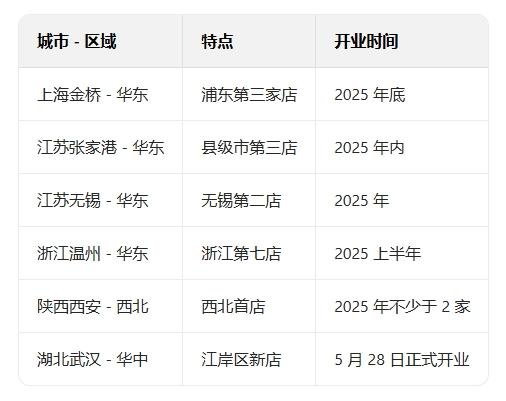
Core Insights - Sam's Club is undergoing a significant organizational restructuring, increasing its regions from six to seven, with the addition of Jiangsu and Zhejiang, while eliminating the original Eastern region. This change reflects a new phase of "scale efficiency" under the leadership of Jane Ewing, who has been in position for only 100 days [1][4]. Expansion Strategy - Sam's Club is rapidly expanding, with plans to open 11 new stores in 2025, surpassing the original target of eight. By June, six new stores had already opened, bringing the total to 56 nationwide. The expansion is heavily concentrated in the East China region, where 70% of the new stores are planned [2][4]. - The expansion strategy focuses on "high net worth sinking" into county-level markets, targeting affluent areas rather than just first-tier cities. For instance, Zhangjiagang, with a projected GDP per capita of 218,000 yuan (approximately $31,000) in 2024, exemplifies this approach [4][12]. Store Distribution and Characteristics - The planned new store openings include: - Shanghai Jinqiao - Third store in Pudong, opening by the end of 2025 - Jiangsu Zhangjiagang - Third store in a county-level city, opening in 2025 - Jiangsu Wuxi - Second store in Wuxi, opening in 2025 - Zhejiang Wenzhou - Seventh store in Zhejiang, opening in the first half of 2025 - Shaanxi Xi'an - First store in Northwest China, with at least two stores planned for 2025 - Hubei Wuhan - New store in Jiang'an District, opened on May 28 [3][4]. Organizational Restructuring - The restructuring into seven regions is seen as a crucial step towards "efficiency-driven" management. This change aims to enhance local competition and organizational vitality, particularly in the densely populated East China region, which houses nearly 40% of Sam's stores [5][12]. Performance and Operational Efficiency - Sam's Club is projected to exceed 100 billion yuan in sales in 2024, with top-performing stores achieving annual sales of 3.67 billion yuan, significantly outperforming traditional hypermarkets [6][12]. - The company's unique growth model is supported by three core engines: product selection, rapid delivery through front warehouses, and strong member trust. The product strategy involves a streamlined SKU count of around 4,000, with a focus on high-quality, exclusive items [6][8][11]. Supply Chain and Delivery Network - The integration of front warehouses allows for over 50% of sales to come from online channels, with 80% of orders delivered within an hour. This efficient delivery network is crucial for member acquisition and retention [10][11]. - The "first warehouse, then store" model has been validated in cities like Hefei, where online sales began before the physical store opened, demonstrating the effectiveness of this strategy [10][11]. Member Engagement and Trust - Membership revenue grew by 35% during the 2025 Spring Festival sales season, with average annual spending per member exceeding 10,000 yuan and a renewal rate of 92%. This high level of trust among members is a significant competitive advantage for Sam's Club [11][12].

独家对话美的方洪波:我只是一个过客,不需要被任何人记住
晚点LatePost· 2025-05-19 03:46
Core Viewpoint - The essence of a company's longevity lies in sound corporate governance rather than reliance on a single individual [5][54]. Group 1: Leadership and Transformation - Since taking over as chairman 13 years ago, the company has quadrupled its revenue from 100 billion to 400 billion and increased its market value eightfold, now ranking third among A-share private enterprises [4][5]. - The chairman, Fang Hongbo, emphasizes his role as a transitional figure, focusing on reform and innovation rather than personal glorification [4][6]. - The company has successfully transformed from a traditional appliance manufacturer to a technology-driven diversified group with global reach [4][5]. Group 2: Management Philosophy - Fang advocates for a work culture that discourages unnecessary overtime, promoting a balance between work and personal life [7][8]. - The company aims to simplify operations to enhance growth, addressing the complexities that arise from expansion [8][9]. - The management approach includes a willingness to cut unprofitable segments and streamline operations to focus on core competencies [9][10]. Group 3: Competitive Landscape - The company acknowledges the competitive threat from Xiaomi and other emerging players, viewing their entry into the appliance market as a positive challenge [15][16]. - Fang emphasizes the importance of maintaining a proactive stance against competition while also being open to learning from rivals [16][17]. Group 4: Innovation and Future Strategy - The company is focused on establishing a second growth curve through investments in technology and innovation, particularly in robotics and healthcare [21][24]. - Fang believes that successful transformation requires a long-term perspective and the ability to adapt to changing market conditions [48][49]. - The company is committed to internationalization and localizing operations to enhance its global competitiveness [25][26]. Group 5: Corporate Governance and Culture - The company prioritizes employee welfare, placing employees above customers and shareholders in its hierarchy [54][55]. - Fang's leadership style is characterized by transparency and accountability, with a focus on constructive criticism rather than praise [57][58]. - The company has developed a robust talent management system to ensure effective leadership and governance [59][60].


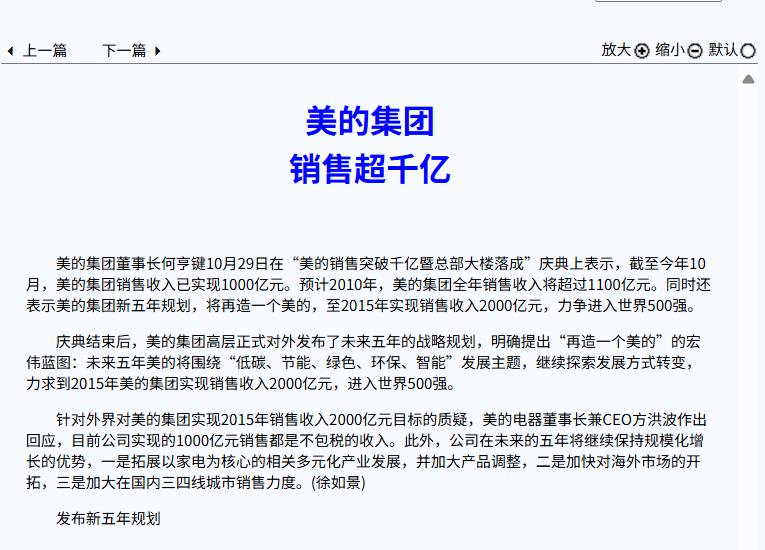
美的方洪波,士为知己者死
3 6 Ke· 2025-05-19 00:45
Group 1 - The core viewpoint of the article emphasizes the significant transformation and growth of Midea Group under the leadership of Fang Hongbo, highlighting his strategic reforms and focus on innovation and technology [1][12][15] - Midea's revenue reached 409.1 billion in 2024, with a net profit of 38.5 billion, marking a year-on-year growth of 9.5% and 14.3% respectively compared to 2023 [2][12] - Under Fang Hongbo's leadership since 2012, Midea's revenue has increased sixfold and net profit has grown over elevenfold, showcasing a remarkable turnaround from a struggling company to a market leader [2][15] Group 2 - Fang Hongbo's initial challenges included overcoming a legacy of poor performance and a lack of competitive edge against rivals like Haier and Gree, which required a fundamental restructuring of the company [4][5][12] - The company underwent significant internal reforms, including a reduction in product models from 22,000 to 15,000 and a workforce reduction of 70,000 employees, which allowed Midea to streamline operations and focus on core competencies [7][8][9] - Midea's R&D investment has dramatically increased, reaching 16.2 billion in 2024, positioning the company as a leader in innovation compared to competitors [11][12] Group 3 - Midea's strategic shift towards global expansion has resulted in overseas revenue of approximately 169 billion, accounting for 41.52% of total revenue, indicating a successful international growth strategy [13][15] - The company has also diversified its business model, with the commercial and industrial solutions segment generating 104.5 billion in revenue in 2024, contributing 25.5% to overall revenue [15] - Fang Hongbo's leadership has been characterized by a strong partnership with founder He Xiangjian, which has fostered an environment of trust and enabled significant strategic changes [15][16]