
模型即服务(MaaS)

Search documents
智谱上市 一场关于AGI商业化的资本测试
Bei Jing Shang Bao· 2026-01-08 15:45
Core Viewpoint - The listing of Zhiyuan on the Hong Kong Stock Exchange marks a significant milestone as the first publicly traded Chinese AI large model company, attracting considerable attention from the capital market and highlighting the commercialization path of domestic large models [1][3][4]. Financial Performance - Zhiyuan's revenue and losses have both increased from 2022 to the first half of 2025, with revenue reaching 191 million yuan in the first half of 2025, a year-on-year growth of 325%, while the adjusted net loss expanded to 1.752 billion yuan, a 70% increase year-on-year [1][4]. - The company's revenue for 2022, 2023, and 2024 was 57.41 million yuan, 125 million yuan, and 312 million yuan, respectively, with a compound annual growth rate of 130% [4]. Market Position - Zhiyuan is recognized as the largest independent large language model vendor in China and the second largest overall, holding a market share of 6.6%, trailing behind iFlytek at 9.4% [8]. Research and Development Investment - Zhiyuan's R&D expenditures from 2022 to the first half of 2025 totaled 4.4 billion yuan, with a significant increase in the ratio of R&D spending to revenue, reaching 835.4% in the first half of 2025 [6]. - The majority of R&D spending is directed towards computing power procurement and talent acquisition, with computing service fees accounting for 71.8% of R&D expenses in the first half of 2025 [6]. Business Model - Zhiyuan's core monetization strategy is based on the MaaS (Model as a Service) platform, which provides access to a matrix of models and various intelligent tools. The local deployment model contributes approximately 85% of revenue, while the cloud deployment model accounts for 15.2% [9]. - The local deployment model has a gross margin of 59.1%, whereas the cloud deployment model has a negative gross margin of -0.4% due to competitive pricing strategies [9]. Competitive Landscape - The competitive environment among domestic AI large model companies is intensifying, with Zhiyuan leading the way in public offerings, while other companies like MiniMax and Moonlight are also navigating their paths in the market [7][9].


魔搭社区首届AI开源公益赛事落幕,近800个团队455个创新作品参赛
Jing Ji Guan Cha Wang· 2025-12-30 11:58
Core Insights - The first "Small Opportunities" AI Open Source Public Welfare Innovation Challenge, co-hosted by Modao Community and Alibaba Public Welfare, showcased 455 AI innovation projects from nearly 800 teams in just three months [1][2] - The event highlighted the application of AI in addressing social issues, particularly in rural education, elderly care, autism support, and accessibility for disabled individuals [1][3] Group 1: Event Overview - The challenge featured four main tracks: AI Teaching Assistant for Rural Classrooms, Autism Children's Picture Book LoRA Training, AI Innovations for Elderly Living, and Accessibility Innovations [2] - A total of 42 projects reached the finals, with 16 winning awards, including initiatives like "Smart Drawing Science Popularization" and "AI Memoirs for the Elderly" [1][2] Group 2: Participant Contributions - Participants included developers, creators, students, and individuals from disabled communities, showcasing diverse backgrounds and experiences [1][3] - Notable projects included a traffic light recognition model tailored for visually impaired individuals and 14 picture books designed to enhance attention for children with autism [2][3] Group 3: Support and Resources - Modao Community provided 100 hours of free GPU computing power and access to over 130,000 open-source models and 5,500+ MCP services for participants [3] - The community aims to create an effective experimental platform for independent developers, startups, public welfare organizations, and students, fostering collaboration and innovation [3][4] Group 4: Community Impact - Modao Community, as China's largest AI open-source community, focuses on lowering AI development barriers and promoting open-source accessibility, serving over 20 million users globally [4] - The community operates under the "Model as a Service" (MaaS) concept, offering a comprehensive suite of services for AI developers across various fields [4]
智谱率先冲刺港股换取规模增长时间
Xin Lang Cai Jing· 2025-12-26 21:02
Core Viewpoint - Beijing Zhiyu Huazhang Technology Co., Ltd. (Zhiyu) has passed the hearing and published its IPO prospectus, becoming the first among the "Six Little Dragons" of large models to enter the IPO process, potentially becoming the "first stock of global large models" [2] Financial Performance - Zhiyu's revenue from 2022 to 2024 is projected to be 57.4 million, 125 million, and 312 million respectively, with a compound annual growth rate (CAGR) of 130%. In the first half of 2025, revenue is expected to reach 191 million, a year-on-year increase of 325% [2] - The losses for Zhiyu from 2022 to 2024 are 144 million, 788 million, and 2.958 billion respectively, with a loss of 2.358 billion recorded in the first half of 2025 [3] - R&D expenditures for Zhiyu from 2022 to 2024 are 84.4 million, 529 million, and 2.195 billion, accounting for 147%, 425%, and 703% of revenue respectively. In the first half of 2025, R&D spending is 1.595 billion, representing 835% of total revenue [3] - Zhiyu's gross margins from 2022 to 2024 and the first half of 2025 are 54.6%, 64.6%, 56.3%, and 50% respectively [4] Business Model and Market Position - Zhiyu operates a MaaS (Model as a Service) platform, with revenue primarily from localized private deployments, which contributed 95.5% of revenue in 2022, decreasing to 84.5% in 2024. In the first half of 2025, this segment is expected to contribute 84.8% of total revenue [4] - The Chinese large language model market is projected to reach 5.3 billion in 2024, with Zhiyu holding a market share of 6.6%, ranking second among domestic large language model providers [6] Industry Trends and Future Outlook - The global large model market is in its early commercialization stage, with projections indicating rapid growth from 10.7 billion in 2024 to 20.65 billion by 2029 [6] - The "Six Little Dragons" are facing increased pressure for commercialization, with investors focusing on profitability prospects. Companies like Zhiyu and MiniMax are leading the IPO charge, while others may need to consider mergers, privatization, or transformation [9][10] - Experts suggest that Zhiyu must increase its cloud deployment revenue share to achieve high valuations in the secondary market [10]
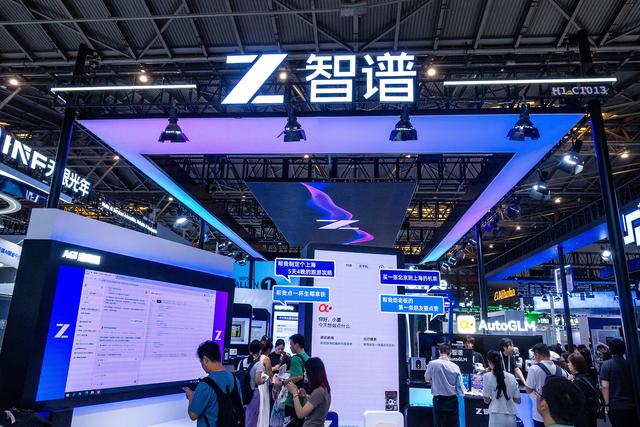
“全球大模型第一股”要来了
华尔街见闻· 2025-12-20 15:09
Core Viewpoint - The article discusses the public offering of Beijing Zhipu Huazhang Technology Co., Ltd. (referred to as "Zhipu") and its potential to become the "first global large model stock" ahead of its competitor MiniMax, which has yet to release its prospectus [2][22]. Financial Performance - Zhipu's revenue projections for 2022 to 2024 are 57.4 million, 125 million, and 312 million respectively [6]. - The primary revenue source is from providing private AI models, expected to generate 264 million in 2024, accounting for over 80% of total revenue [8]. - The company is currently operating at a loss, with losses of 144 million, 788 million, and 2.958 billion from 2022 to 2024, totaling 3.89 billion [15]. Business Model - Zhipu's business model includes two main deployment types: local and cloud-based services [7]. - Local deployment is characterized as a "one-time project," with high pricing based on model type, scale, and implementation costs [9][10]. - The top five clients contributed 1.42 billion in revenue in 2024, representing 45.5% of total revenue [11]. - Cloud deployment is based on token consumption and subscription duration, but currently accounts for less than 20% of revenue [12]. Technological Advancements - Zhipu has made significant advancements in technology, with its GLM series models undergoing upgrades every 3 to 6 months, leading the industry in iteration efficiency [17]. - The GLM model has achieved top performance in code generation, ranking alongside leading models from Anthropic and OpenAI [18]. - The company has gained recognition in the international academic and industrial sectors, with its ChatGLM model highlighted as a prominent representative of Chinese foundational models [19]. Client Base and Funding - As of September 30, 2025, Zhipu's GLM model serves 12,000 enterprise clients, over 80 million end-user devices, and more than 45 million developers, making it the largest independent general-purpose large model provider in China [20]. - Since its inception, Zhipu has completed eight rounds of financing, raising over 8.3 billion RMB, with investments from top-tier capital and notable industry players [21].

智谱冲刺“全球大模型第一股” AGI梦想背后 高增长与高投入并行
Mei Ri Jing Ji Xin Wen· 2025-12-20 15:00
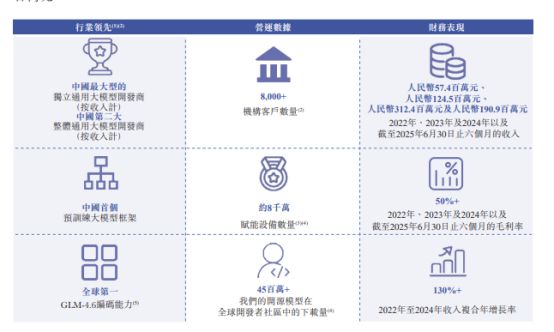
在AGI(通用人工智能)的全球竞赛中,中国大模型独角兽企业的资本化进程终于迈出了实质性的一 步。 12月19日晚间,北京智谱华章科技股份有限公司(简称智谱)披露招股书(申请版本,下同),宣布赴 港冲刺"全球大模型第一股"。 这家成立于2019年的公司,由清华大学技术成果转化而来。招股书显示,智谱的营收在过去三年实现年 均复合增长率超过130%。不过,在营收高歌猛进的同时,作为一家典型技术驱动型企业的智谱也面临 着巨额研发投入带来的亏损挑战。 MaaS支撑下收入高速增长,毛利率高达50% 从财务数据看,近几年,智谱的收入增长呈现出明显的加速态势。 2022年至2024年,智谱收入分别为5740万元、1.25亿元和3.12亿元,年均复合增长率超130%。收入增速 在2025年上半年进一步放大,2025年上半年,智谱实现营收1.91亿元,较2024年同期的4490万元同比增 长325.39%。 毛利率层面,2022年至2024年,智谱的毛利率分别是54.6%、64.6%、56.3%,2025年上半年毛利率为 50.0%。 收入的扩张,与其商业模式高度相关。 招股书显示,智谱的商业模式以模型即服务(MaaS)平台为核 ...
高盛点评“中国AI大厂之战”:阿里 vs 腾讯 vs 字节
华尔街见闻· 2025-11-29 13:26
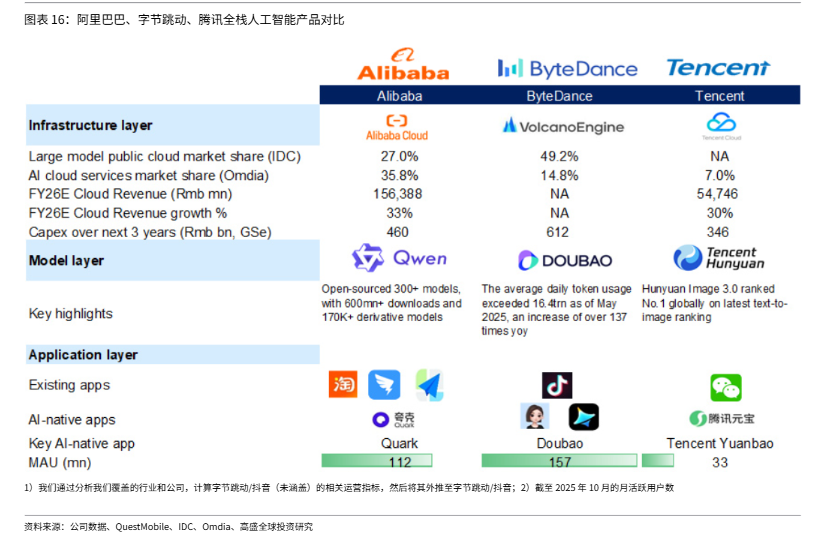
Core Viewpoint - The article discusses the competitive landscape of China's AI industry, highlighting the strategic choices of major players like Alibaba, ByteDance, and Tencent as they navigate a battle for capital efficiency, infrastructure dominance, and traffic entry points. Group 1: Alibaba's Strategy - Alibaba is adopting a "full-stack" approach similar to Google's, with a significant capital expenditure increase of 80% year-on-year, reaching 32 billion RMB in the September quarter [2] - The company's cloud revenue grew by 29% year-on-year, with AI-related revenue achieving triple-digit growth for the ninth consecutive quarter, and is expected to accelerate to 38% growth in the December quarter [3] - Alibaba aims to establish a "full-stack" barrier in the AI market, positioning itself as a dominant player through heavy asset investment [4] Group 2: ByteDance's Approach - ByteDance leverages its massive traffic advantage, with a daily token consumption of 30 trillion, approaching Google's 43 trillion, significantly outpacing competitors like Baidu and DeepSeek [7] - The company's app "Doubao" leads in domestic AI application activity, while its overseas education app Gauth saw a 394% year-on-year revenue increase [8] - ByteDance's strategy creates substantial inference demand, allowing it to encroach on traditional cloud giants in the Model as a Service (MaaS) sector, capturing 49.2% of the public cloud market share for large models [11] Group 3: Tencent's Strategy - Tencent maintains a conservative approach, reducing capital expenditures while focusing on seamlessly integrating AI capabilities into its extensive social and payment ecosystem [12][14] - The company has integrated its AI assistant "Yuanbao" into WeChat Pay, enhancing operational efficiency for small and medium-sized businesses [14] - Tencent's strategy emphasizes high implementation certainty despite lower capital expenditure figures compared to competitors [14] Group 4: Competitive Dynamics - The competition between China and the U.S. in AI has entered a "dynamic alternation" phase, with Chinese models rapidly iterating and catching up within 3-6 months after significant advancements in U.S. models [4][17] - Chinese companies exhibit resilience through unique "Chinese speed" and open-source ecosystems, with 80% of AI startups utilizing open-source models [17] - Cost control is a competitive advantage for Chinese models, as seen with Kuaishou's "Kling" video generation model, which offers significantly lower prices than global counterparts [17] Group 5: Valuation Insights - Goldman Sachs analysts assert that the Chinese AI sector is not in a bubble, with projected P/E ratios for Tencent and Alibaba at 21x and 23x for 2026, respectively, lower than those of major U.S. tech companies [18]
高盛点评“中国AI大厂之战”:阿里 vs 腾讯 vs 字节
Hua Er Jie Jian Wen· 2025-11-29 09:18
Core Insights - The report by Goldman Sachs highlights the intense competition in China's AI sector, focusing on the strategic choices of major players like Alibaba, ByteDance, and Tencent, and suggests a new normal of "dynamic alternation" in the US-China AI competition [1][2] Group 1: Alibaba's Strategy - Alibaba is adopting a "full-stack" approach similar to Google's, with a significant increase in capital expenditure, which surged by 80% year-on-year to reach 32 billion RMB in the September quarter [3][4] - The company's cloud revenue grew by 29% year-on-year, with AI-related revenue achieving triple-digit growth for the ninth consecutive quarter, and is expected to accelerate to 38% growth in the December quarter [4][6] Group 2: ByteDance's Approach - ByteDance is leveraging its massive traffic advantage, with a daily token consumption of 30 trillion, approaching Google's 43 trillion, and significantly surpassing competitors like Baidu [9][13] - The company's application "Doubao" leads in domestic AI application activity, while its overseas education app Gauth saw a 394% year-on-year increase in monthly revenue [9][13] Group 3: Tencent's Strategy - Tencent is maintaining a conservative approach, reducing capital expenditure while focusing on seamlessly integrating AI capabilities into its extensive social and payment ecosystem [14][15] - The company has integrated its AI assistant "Yuanbao" into WeChat Pay, enhancing operational efficiency for small and medium-sized businesses [15] Group 4: US-China AI Competition - The report outlines a "dynamic catch-up" cycle in the US-China AI competition, where Chinese models typically follow significant advancements in US models within 3-6 months [16][17] - Chinese companies are noted for their resilience and aggressive cost control, with many leveraging open-source models to enhance their capabilities [17] Group 5: Valuation Insights - Goldman Sachs indicates that the current state of the Chinese AI sector does not reflect a bubble, with projected P/E ratios for Tencent and Alibaba at 21x and 23x respectively, lower than those of major US tech companies [18]


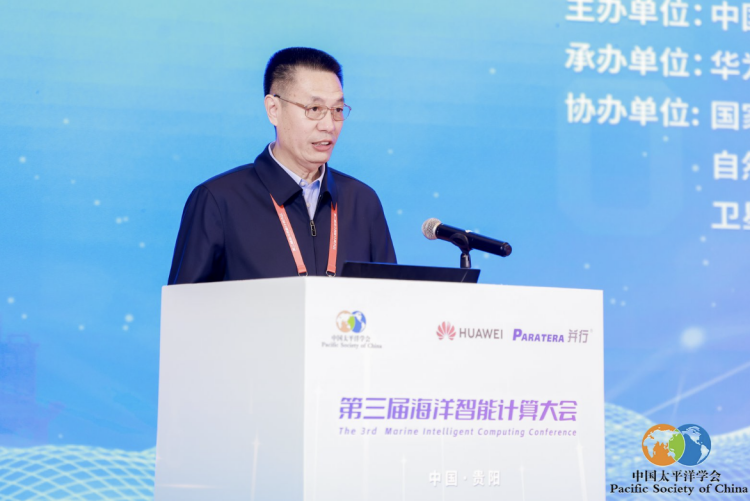
第三届海洋智能计算大会:技术创新推动海洋科学研究智能化转型
Huan Qiu Wang· 2025-11-08 08:53
Core Insights - The third Marine Intelligent Computing Conference was held in Guiyang from November 5 to 7, focusing on the integration of high-performance computing and artificial intelligence in marine science [1][3] - The conference aimed to create a global and open platform for technology and academic exchange, gathering experts and leaders in the field [1][3] Group 1: Importance of Marine Intelligent Computing - The ocean is a critical strategic space for national development, covering 71% of the Earth's surface, and marine intelligent computing is essential for understanding and managing marine resources [3] - High-performance computing and AI are transforming marine research paradigms, shifting from "observation-driven" to "computation-driven" and "intelligence-driven" approaches, enhancing capabilities in disaster warning, resource development, and environmental management [3][5] Group 2: Innovations and Applications - The integration of high-performance computing and AI with marine science has led to groundbreaking innovations, such as AI-driven storm surge disaster risk warning systems and high-resolution marine forecasting models [5][6] - The conference featured discussions on marine big data, intelligent forecasting, and new domestic software and hardware technologies, promoting key technological innovations and applications [5][6] Group 3: Expert Contributions and Research - Experts presented cutting-edge research, including advancements in storm surge disaster studies, marine satellite technology, and four-dimensional marine monitoring techniques [6] - The development of large models for marine forecasting is highlighted, showcasing their importance in various applications, including marine environment analysis and ice prediction [6] Group 4: Future Directions and Infrastructure - The demand for computational power in the marine sector is increasing, prompting the need for a robust ecological architecture for new computational bases to support marine model development [8] - The concept of Model as a Service (MaaS) is introduced, allowing users to access AI models as standardized cloud services, significantly lowering the barriers to AI adoption in marine applications [6][8]
小度AI眼镜将开启预售;高通推出人工智能芯片
Mei Ri Jing Ji Xin Wen· 2025-10-28 23:21
Group 1 - Baidu's "Xiao Du AI Glasses" will start pre-sale on November 1, with official release on November 10, featuring functions like AI translation, AI object recognition, AI reminders, and AI recording [1] - The initial release will include the Boston sunglasses model, with other styles to follow, indicating a strategic approach to market entry and product diversification [1] - The product's success will depend on continuous updates and enhancements to meet the evolving expectations of consumers in the smart wearable device market [1] Group 2 - Qualcomm has launched AI chips, the AI200 and AI250, aiming to compete with AMD and NVIDIA, with commercial use expected in 2026 and 2027 respectively [2] - NVIDIA currently holds approximately 70% market share in the AI inference market, primarily through its H100 and H200 GPUs, highlighting the competitive landscape [2] - Qualcomm's shift from mobile to data center with dedicated inference chips is expected to intensify competition in the data center AI chip market and challenge NVIDIA's dominance [2] Group 3 - IDC reported that China's MaaS market experienced explosive growth in the first half of 2025, reaching 1.29 billion RMB, a year-on-year increase of 421.2% [3] - The AI large model solution market also showed significant growth, with a market size of 3.07 billion RMB, reflecting a 122.1% year-on-year increase [3] - The rapid growth of MaaS and AI large model solutions is attributed to continuous breakthroughs in AI technology, making deployment more accessible and cost-effective for businesses [3]


10.28犀牛财经晚报:飞天茅台批发价首次跌破1700元/瓶 三星HBM3E芯片猛砍30%价格
Xi Niu Cai Jing· 2025-10-28 10:32
Group 1: Gold and Liquor Market Trends - Domestic gold jewelry prices have dropped significantly, with Chow Tai Fook's price adjusted to 1198 RMB per gram, down 25 RMB from the previous day, and Luk Fook's price falling to 1189 RMB per gram, down 34 RMB [1] - The wholesale price of Moutai has fallen below 1700 RMB per bottle for the first time, with a reference price of 1690 RMB, marking a cumulative decline of over 31% from its initial price [1] Group 2: Market Growth and Technology Developments - The Chinese MaaS market experienced explosive growth in the first half of 2025, reaching 1.29 billion RMB, a year-on-year increase of 421.2% [2] - The AI large model solution market also saw significant growth, with a market size of 3.07 billion RMB, up 122.1% year-on-year [2] - Samsung has cut the price of its HBM3E chips by 30% to regain market share amid rising demand for AI technologies [2] Group 3: Corporate Developments and Legal Matters - Hesai Technology has filed a lawsuit against Tudatong for patent infringement related to its products showcased at CES 2025 [3] - Zhongtong Express has committed to comprehensive inspections and rectifications following a regulatory interview regarding its operational practices [4] Group 4: Financial Performance Reports - China Satellite reported a net profit of 14.81 million RMB for the first three quarters of 2025, marking a turnaround from losses [6] - Kang En Bei's net profit increased by 12.65% year-on-year to 584 million RMB in the first three quarters [7] - Zhongwei Semiconductor's net profit grew by 36.78% year-on-year to 152 million RMB in the first three quarters [8] - Jiao Cheng Ultrasonic reported a remarkable net profit increase of 359.81% year-on-year, reaching 94.03 million RMB [10] - Keda Li's net profit rose by 16.55% year-on-year to 1.185 billion RMB in the first three quarters [11] - Xian Da's net profit surged by 3064.56% year-on-year to 196 million RMB [12] - Longxin General's net profit increased by 75.45% year-on-year to 1.577 billion RMB [13] - China Ceramics Electronics reported a net profit growth of 20.07% year-on-year to 443 million RMB [14] - Haixing's net profit rose by 41.41% year-on-year to 147 million RMB [15] - Tiancheng Control's net profit increased by 91.73% year-on-year to 50.33 million RMB [16] - Suli's net profit skyrocketed by 1522.38% year-on-year to 139 million RMB [17] Group 5: Market Performance Overview - The market experienced a pullback with all major indices turning negative, while the Shanghai Composite Index briefly surpassed 4000 points [18] - The market saw rapid rotation of hotspots, with significant gains in the Fujian sector and active performance in the nuclear power and robotics sectors [19]
