
电网投资

Search documents
美国电力2025年财报:业绩超预期,资本支出计划扩大
Jing Ji Guan Cha Wang· 2026-02-13 16:58
项目进展公司宣布将五年(2026-2030年)资本支出计划扩大至超过720亿美元,较此前计划增长超30%, 以强化电网投资并支持长期增长。该计划近90%的投资预计可通过监管机制回收,增强了财务可见性。 资金动向截至2026年1月,公司于2025年启动的价值28.2亿美元的输电资产出售交易已进入收尾阶段, 为资本计划提供资金支持。同时,公司致力于通过股息增长向股东返还资本,2025年每股派息为3.74美 元。 行业政策与环境美国能源部预测2025-2026年用电量增速或达3%(高于历史平均水平),且能源部长于 2025年10月拟议加速大型负荷项目并网审批,可能进一步刺激电网投资需求,为AEP等公用事业公司提 供长期增长潜力。 以上内容基于公开资料整理,不构成投资建议。 经济观察网美国电力(AEP.US)于2026年2月11日盘后公布了2025年第四季度及全年财报,其中包含以下 主要亮点: 业绩经营情况根据经济观察网报道,2025年第四季度营收达53.1亿美元,高于分析师预期的49.9亿美 元;调整后每股收益为1.19美元,亦超过预期的1.14美元。超大型企业(如AI数据中心)电力需求激增被 公司指出是业绩增长的 ...

美国电力股价创历史新高,业绩超预期驱动
Jing Ji Guan Cha Wang· 2026-02-12 20:20
经济观察网2026年2月12日,美国电力(AEP.US)股价上涨4.51%,报收127.76美元,盘中最高触及128.92 美元,创历史新高。当日成交额约5.29亿美元,换手率0.78%,显著高于近期平均水平。同期道琼斯指 数下跌0.75%,能源电力板块上涨1.83%,公司股价表现突出。 股价异动原因 股价创新高的直接原因是前一日(2月11日)盘后公布的2025年第四季度业绩超预期。根据格隆汇报道, 第四季度营收达53.1亿美元,高于分析师预期的49.9亿美元;调整后每股收益为1.19美元,亦超过预期 的1.14美元。公司指出,超大型企业(如AI数据中心)电力需求激增是业绩增长的核心动力。同时,公司 宣布将五年资本支出计划扩大至超过720亿美元,强化市场对长期增长的信心。 截至2025年第三季度,公司营收165.61亿美元(同比增长10.22%),净利润30.91亿美元(同比增长 33.81%)。当前市盈率(TTM)为18.73倍,股息率2.94%,处于公用事业板块合理区间。 行业政策现状 以上内容基于公开资料整理,不构成投资建议。 行业层面存在结构性利好:美国能源部预测2025-2026年用电量增速或达3% ...
海兴电力业绩回暖股价震荡,多重因素叠加影响市场表现
Jing Ji Guan Cha Wang· 2026-02-12 09:22
Core Viewpoint - The company HaiXing Electric (603556) is experiencing a recovery in performance, but its stock price is volatile due to multiple factors including structural differentiation in performance, short-term fluctuations in capital, technical pressure, valuation adjustments, and mixed industry policies alongside competitive pressures [1]. Financial Performance - In Q3 2025, the company reported a revenue of 1.445 billion yuan, a year-on-year increase of 25.12%, and a net profit attributable to shareholders of 336 million yuan, up 30.21%. This performance significantly outperformed the overall results for the first three quarters, which saw a revenue decline of 1.19% and a net profit drop of 7.48% [2]. Capital Situation - Since February 2026, there has been a net outflow of main funds, with notable outflows of 6.9885 million yuan on February 2 and 6.4358 million yuan on February 11. However, a net inflow of 15.16 million yuan was observed on February 12 amid a market rebound. The fluctuation in capital has contributed to stock price volatility, with a range of 10.86% from February 2 to 12 and a turnover rate fluctuating between 0.62% and 1.18% [3]. Valuation - As of February 12, the stock price was below the middle band of the Bollinger Bands at 38.97 yuan, with a negative MACD histogram value of -0.781 and a KDJ indicator in the oversold range (K value of 19.1), indicating short-term technical weakness. However, the current price-to-earnings ratio (TTM) is 19.58, which is lower than the industry average for power grid equipment, suggesting potential for valuation recovery [4]. Industry Policy and Environment - The State Grid's "14th Five-Year" investment plan amounts to 4 trillion yuan, a 40% increase from the previous plan, with clear demand in areas such as ultra-high voltage and smart grid. However, intense competition in domestic grid bidding has led to a decline in gross margin by 6.08 percentage points to 39.89% in the first three quarters of 2025, and the renewable energy business is still in the cultivation phase, accounting for about 3% of revenue, limiting short-term profit growth [5]. Business Progress - The company's overseas electricity business is gradually recovering, with positive developments such as the commissioning of a smart water meter factory in South Africa and orders for transformers in Central Asia. However, overseas revenue accounts for over 60%, and fluctuations in exchange rates (with a foreign exchange loss of 129 million yuan in 2024) and geopolitical risks continue to disrupt performance. The stock price volatility is attributed to the need to verify the sustainability of performance recovery, short-term capital divergence, technical pressure, and intensified industry competition. In the long term, the benefits of grid investment policies and the expansion of overseas business still provide supportive logic [6].

电网设备板块持续走高,思源电气、四方股份盘中创新高
Jin Rong Jie· 2026-02-12 02:56
Group 1 - The electric grid equipment sector is experiencing significant growth, with companies like Suyuan Electric and Sifang Co. reaching new highs, while Shun Sodium, Senyuan Electric, and Wangbian Electric hit the daily limit, and Xinte Electric and Yinen Power rose over 10% [1] - Global investment in electric grids is witnessing a positive trend, driven by China's planned investment of 4 trillion yuan in the State Grid during the 14th Five-Year Plan, representing a 40% increase compared to the previous plan, with a focus on UHV construction and distribution network upgrades [1] - In the U.S., the Department of Energy has launched the "Power Acceleration Plan" to expedite grid infrastructure development, addressing the electricity demand created by AI advancements [1] Group 2 - The surge in AI computing power has intensified the supply-demand tension for electric equipment, leading to significantly extended delivery times for products like transformers, which presents substantial overseas opportunities for Chinese electric grid equipment companies with complete industrial chains and efficient delivery capabilities [1]


全球电网投资,迎景气共振!出海概念股获基金抢筹
券商中国· 2026-02-12 01:20
Core Viewpoint - The global power grid is facing unprecedented pressure and opportunities due to the simultaneous arrival of the energy revolution and computing power revolution, with significant investments expected in the coming years [1] Group 1: Global Power Grid Investment - In China, the State Grid announced a fixed asset investment of 4 trillion yuan for the 14th Five-Year Plan period (2026-2030), a 40% increase from the previous plan, with an average annual investment of 800 billion yuan [2] - Southern Power Grid plans to invest 180 billion yuan in fixed assets in 2026, marking a continuous five-year high with an average growth rate of 9.5% [2] - The urgent need for energy infrastructure upgrades and the challenges posed by high-density computing power are driving accelerated grid construction to keep pace with power supply developments [2][3] Group 2: Global Electricity Shortage - Developed economies, particularly in Europe and North America, are facing severe aging of power grid infrastructure, with average service years reaching 50 years in Europe and 40 years in North America [3] - The U.S. Department of Energy reported a 60% increase in power outages from 2013 to 2023, with outage durations nearly doubling, and projections suggest a further 100% increase in outages by 2030 [2][3] Group 3: AI and Power Demand - The AI computing revolution is reshaping electricity demand, with significant power consumption expected from AI model training and inference [5] - For instance, training OpenAI's GPT-3XL model could consume up to 1.183 billion kilowatt-hours annually, highlighting the substantial energy requirements of AI applications [5][6] - The U.S. data center capacity is projected to reach 245 GW by October 2025, with an expected annual growth rate of 2%-3% in electricity demand driven by AI [6] Group 4: Investment Opportunities in Power Equipment - Fund managers are increasingly investing in the power equipment supply chain, with notable increases in holdings for companies like Siyi Electric, TBEA, and Jinpan Technology [7] - Siyi Electric's overseas revenue share reached 33.68% in the first half of 2025, while TBEA secured a local procurement project in Saudi Arabia worth approximately 16.4 billion yuan [7] - The demand for transformers and switches in North America presents a significant opportunity for Chinese power equipment manufacturers, who have surpassed U.S. companies in technology and cost competitiveness [8]



AI算力缺电现象不断深入,电网设备ETF(159326)冲击4连阳,全市场最“纯”电网指数
Mei Ri Jing Ji Xin Wen· 2026-02-11 07:21
Group 1 - The A-share market showed mixed performance on February 11, with the Shanghai Composite Index slightly up while the Shenzhen Component and ChiNext Index retreated. The electric grid equipment sector rose against the trend, with the electric grid equipment ETF (159326) increasing by 0.17% and achieving a transaction volume of 683 million yuan. Key stocks such as Huaming Equipment hit the daily limit, while Ping An Electric, Hangdian Co., Mingyang Electric, State Grid Information, and Dongcai Technology also saw gains [1] - The global AI computing power surge has led to electricity shortages, particularly in North America, which has become a systemic challenge affecting generation, transmission, and end-use. Reports indicate that the global AI computing infrastructure is entering an explosive growth phase, with transformers becoming core components of this infrastructure. In regions like Guangdong and Jiangsu, transformer factories are operating at full capacity, with some orders for data center-related businesses extending to 2027 [1] - According to China International Capital Corporation (CICC), global investment in electric grids is entering a prosperous cycle, driven by the need for upgrades in Europe and North America, which aligns with China's "14th Five-Year Plan" investments. This opens up long-term growth opportunities for the industry. Domestic electric grid equipment companies possess technological and cost advantages, with potential for overseas expansion, particularly for those with high overseas revenue ratios and well-established overseas production capacities. Additionally, the demand for grid upgrades driven by AI computing power is underestimated, with expectations that global data center-related grid investments will exceed 500 billion USD from 2026 to 2030, benefiting related power equipment and dispatch system companies [1] Group 2 - The electric grid equipment ETF (159326) is the only ETF tracking the China Securities Electric Grid Equipment Theme Index, with over 78% of its holdings in the electric grid equipment sector. It has the highest weightings in smart grid (90%) and ultra-high voltage (67%) among all market indices. This ETF provides exposure to leading companies such as TBEA, China XD Electric, Baobian Electric, Siyuan Electric, Guodian NARI, and Igor, which are prominent players in overseas markets [2]
长缆科技接受机构调研,披露2025年业绩预告及新业务进展
Jing Ji Guan Cha Wang· 2026-02-11 06:35
Core Viewpoint - Changlan Technology (002879) expects a significant increase in net profit for 2025, projecting between 130 million to 160 million yuan, representing a year-on-year growth of 74.07% to 114.24% [1] Group 1: Company Performance - The company has highlighted its subsidiary, Shuangjiang Energy, which has established technological and customer advantages in the natural ester insulating oil sector, successfully applied in projects like the 110kV transformer for Shandong Electric Power [1] - The company's 2025 performance forecast indicates substantial profit growth driven by increased investment in the power grid and new business expansions, with a notable impact from the reversal of employee stock ownership plan expenses [4] - The Q3 2025 report shows revenue of 1.031 billion yuan, a year-on-year increase of 32.21%, but a decline in gross margin to 30.25%, leading to a 39.86% drop in net profit attributable to shareholders [4] Group 2: Market Sentiment and Institutional Research - Recent institutional research activities have focused on the company, indicating a high frequency of interest from various institutions [2] - Despite the increased interest, institutional ratings remain neutral, with an average forecast from four institutions predicting a 132.72% year-on-year increase in net profit and a 54.42% increase in revenue for 2025, surpassing the company's official forecast range [5] - The stock price of Changlan Technology is currently at 21.97 yuan, with a slight decline of 0.81% on the latest trading day, and the stock is experiencing a short-term oscillation [3]

国际能源署最新报告预计: 全球电力需求将保持强劲增长
Jing Ji Ri Bao· 2026-02-10 01:49
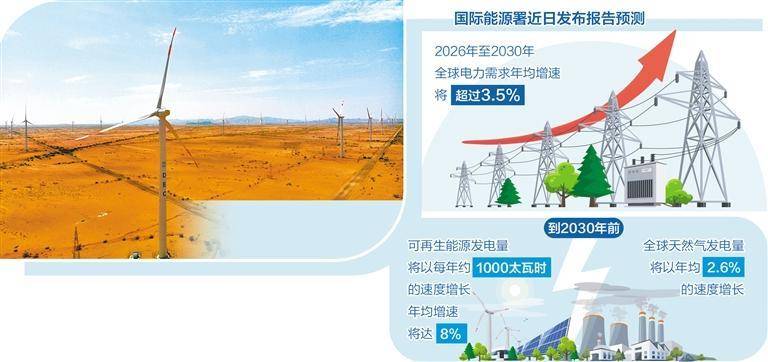
Core Insights - The International Energy Agency (IEA) predicts strong global electricity demand growth, with an average annual growth rate exceeding 3.5% from 2026 to 2030, driven by industrial, electric vehicle, air conditioning, and data center electricity consumption [1][2] - By 2030, renewable energy and nuclear power are expected to account for 50% of the global electricity mix, with significant contributions from emerging economies, particularly China and India [1][2] Group 1: Global Electricity Demand - Global electricity demand is projected to grow by 3% year-on-year in 2025, with the growth rate expected to be 50% higher than the average of the past decade over the next five years [1] - Emerging economies will contribute nearly 80% of the new electricity demand by 2030, with China alone accounting for about 50% of this increase [1] - India's and Southeast Asia's share of electricity demand growth in emerging economies is expected to rise significantly due to economic growth and increasing air conditioning demand [1] Group 2: Renewable Energy and Nuclear Power - By 2030, approximately half of the global electricity will come from renewable energy and nuclear power, with renewable energy generation expected to grow at an annual rate of 8%, driven by solar photovoltaic power [2] - In 2025, global nuclear power generation is anticipated to reach a historical high, supported by increased nuclear capacity in countries like France, China, and India [2] Group 3: Coal and Natural Gas - Despite the decline of coal power, it will remain the largest source of electricity globally until 2030, with regional disparities in coal usage [3] - Global natural gas generation is expected to grow at an annual rate of 2.6% by 2030, driven by rising electricity demand in the U.S. and a shift from oil to gas in the Middle East [3] Group 4: Electricity Infrastructure and Investment - The report emphasizes the need for rapid and efficient expansion of the electricity grid to integrate changing generation structures and high-load demands from electric vehicles and data centers [4] - To meet the electricity demand by 2030, global grid investments need to increase by at least 50% from the current $400 billion, alongside enhancements in supply chain capabilities [4] Group 5: Carbon Emissions and Pricing - Global electricity sector carbon emissions are expected to stabilize in 2025, with a projected decline in carbon intensity by 14% compared to a decade ago, accelerating further as low-carbon generation increases [5] - Electricity price disparities among regions continue to create competitive pressures, with rising prices in the EU and U.S. due to high natural gas costs, while countries like Australia and India see price decreases [5] Group 6: Electricity Security - Recent large-scale power outages highlight the importance of electricity security, making it a priority for countries to enhance the resilience of their power systems [6] - The report suggests that modernizing operational frameworks and updating grid regulations are essential to meet evolving electricity demands and mitigate risks [6]
全球电力需求将保持强劲增长
Sou Hu Cai Jing· 2026-02-10 00:01
Core Insights - The International Energy Agency predicts strong global electricity demand growth, with an average annual increase of over 3.5% from 2026 to 2030, driven by industrial, electric vehicle, air conditioning, and data center electricity consumption [2] - By 2030, renewable energy and nuclear power are expected to account for 50% of the global electricity mix, with significant contributions from emerging economies, particularly China and India [3][4] Group 1: Global Electricity Demand - Global electricity demand is projected to grow by 3% year-on-year by 2025, with the growth rate expected to exceed the economic growth rate in the coming years [2] - Emerging economies will contribute nearly 80% of the new electricity demand by 2030, with China accounting for about 50% of the incremental demand [2] - China's average annual growth rate for new electricity is expected to reach 4.9% over the next five years [2] Group 2: Renewable Energy and Nuclear Power - By 2030, approximately half of the global electricity will come from renewable energy and nuclear power, with renewable energy generation expected to grow at an annual rate of 8% [3] - Solar photovoltaic generation is anticipated to increase by over 600 terawatt-hours annually, contributing significantly to the overall growth of renewable energy [3] - Global nuclear power generation is expected to reach a historical high by 2025, driven by increased capacity in countries like France, China, and India [3] Group 3: Coal and Natural Gas - Despite the decline of coal power, it will remain the largest source of electricity globally until 2030, with regional disparities in coal usage [4] - Natural gas generation is projected to grow at an annual rate of 2.6% by 2030, primarily due to rising electricity demand in the U.S. and a shift from oil to gas in the Middle East [4] Group 4: Electricity Infrastructure and Investment - To meet the electricity demand by 2030, global grid investments need to increase by at least 50% from the current $400 billion, alongside significant supply chain expansions [5] - The report emphasizes the need for enhanced grid flexibility and modernization of operational frameworks to adapt to changing electricity demands [5] Group 5: Carbon Emissions and Environmental Impact - Global electricity sector carbon emissions are expected to stabilize by 2025, with a projected decline in carbon intensity by 14% compared to a decade ago [5] - The electricity production sector remains the largest source of energy-related carbon emissions, generating approximately 13.9 billion tons of CO2 annually [5] Group 6: Electricity Pricing and Competition - Electricity price disparities continue to exist globally, with rising prices in regions like the EU and the U.S. due to higher natural gas prices, while countries like Australia and India see price declines [6] - Recent large-scale power outages highlight the importance of electricity security, making it a priority for nations to enhance the resilience of their power systems [6]
国际能源署最新报告预计——全球电力需求将保持强劲增长
Jing Ji Ri Bao· 2026-02-09 22:33
Group 1: Global Electricity Demand Growth - The International Energy Agency predicts strong global electricity demand growth, with an average annual growth rate exceeding 3.5% from 2026 to 2030, driven by industrial, electric vehicle, air conditioning, and data center electricity consumption [1] - By 2025, global electricity demand is expected to grow by 3% year-on-year, with the growth rate surpassing economic growth becoming a common trend in the coming years [1] - Emerging economies will contribute nearly 80% of the new electricity demand by 2030, with China being the main driver, accounting for nearly 50% of the incremental demand [1] Group 2: Renewable Energy and Nuclear Power - By 2030, approximately half of the global electricity will come from renewable energy and nuclear power, with renewable energy generation expected to grow at an annual rate of 8% [2] - Solar photovoltaic generation is projected to increase significantly, with an annual increment exceeding 600 terawatt-hours [2] - Global nuclear power generation is expected to reach a historical high by 2025, driven by increased capacity in countries like France, China, and India [2] Group 3: Coal and Natural Gas Generation - Despite the decline of coal power, it will remain the largest source of electricity globally until 2030, with regional disparities in coal usage [3] - Natural gas generation is expected to grow at an annual rate of 2.6% by 2030, driven by rising electricity demand in the U.S. and a shift from oil to gas in the Middle East [3] Group 4: Electricity Infrastructure and Flexibility - The report emphasizes the need for rapid and efficient expansion of the electricity grid to integrate changing generation structures and demand [4] - Global investment in electricity grids needs to increase by at least 50% from the current $400 billion to meet the 2030 electricity demand [4] - The importance of large battery storage systems is growing in ensuring supply security as battery costs decline and technology matures [4] Group 5: Carbon Emissions and Electricity Prices - Global electricity sector carbon emissions are expected to stabilize in 2025, with a further acceleration in the reduction of carbon intensity anticipated by 2030 [5] - Electricity price disparities among regions continue to exist, with rising prices in the EU and U.S. due to high natural gas prices, while countries like Australia and India see price declines [5] Group 6: Electricity System Security - Recent large-scale power outages highlight the importance of electricity system security, making it a priority for countries [6] - The electricity system faces risks from aging infrastructure, extreme weather events, and cyber threats, necessitating enhanced protection and monitoring systems [6] - A modern operational framework is needed to adapt to changing electricity demands, including updated grid standards and regulatory frameworks [6]