确定性溢价

Search documents
港股异动 | 中国白银集团(00815)涨超4% 现货白银突破此前纪录高位 市场连续第五年出现结构性短缺
Zhi Tong Cai Jing· 2025-12-17 02:14
Core Viewpoint - The silver market is experiencing a structural shortage for the fifth consecutive year, driven by limited mining output and increasing consumption in renewable energy, electronics, and other industrial sectors [1] Group 1: Company Performance - China Silver Group (00815) saw its stock price rise over 4%, currently trading at 0.7 HKD with a transaction volume of 5.3 million HKD [1] Group 2: Market Trends - Spot silver prices have surged above 65 USD per ounce, marking one of the strongest rebounds in commodities for 2025 [1] - Analysts from Guosen Futures highlight that the rapid development of new energy and electronics industries is expanding the industrial applications of silver, intensifying concerns over the supply-demand gap [1] Group 3: Economic Indicators - Everbright Futures anticipates the upcoming non-farm payroll data to guide future Federal Reserve monetary policy, maintaining a cautiously optimistic outlook on silver [1] - China International Capital Corporation (CICC) notes that the international trade situation in 2025 is expected to disrupt the global macro environment, benefiting precious metals like gold and silver amid uncertainty [1]
今日视点:ESG质量“重新定义”上市公司估值体系
Zheng Quan Ri Bao· 2025-11-20 23:11
Core Insights - The enhancement of ESG ratings among A-share listed companies indicates a significant shift in operational philosophy and management practices, reflecting the increasing importance of ESG quality in the capital market [1][2] Group 1: Restructuring Valuation Logic - ESG quality is becoming a key metric for assessing sustainable growth potential, moving beyond traditional financial indicators like profit and revenue [2] - Improved ESG ratings signify authoritative recognition in areas such as environmental compliance and employee rights, enhancing operational resilience and sustainable growth [2] - The focus on ESG is shifting valuation logic towards a balance between financial quality and sustainable development [2] Group 2: Risk Pricing Logic - High-quality ESG performance serves as an effective tool for reducing risk premiums, as poor ESG ratings often lead to higher perceived risks and increased discount rates [3] - Enhanced ESG ratings create a risk management framework that mitigates potential penalties and internal governance issues, thereby lowering overall risk levels [3] - This reduction in risk contributes to a decrease in valuation discount rates, ultimately increasing the company's fair valuation [3] Group 3: Capital Cost Impact - Companies with strong ESG performance are more likely to attract long-term capital from major investment institutions, leading to lower financing costs [4] - Regulatory bodies are increasingly emphasizing ESG disclosure requirements, giving companies with superior ESG performance an advantage in capital market activities [4] - The widening of financing channels and reduction in capital costs directly enhance corporate value, establishing ESG as a tangible financial competitive edge [4] Group 4: Market Consensus and Investment Narrative - A growing consensus among investors suggests that companies with high ESG ratings are better positioned for sustainable growth and regulatory compliance [5] - This consensus drives capital towards high ESG-rated companies, creating a positive cycle of quality ratings, capital inflow, and valuation enhancement [5] - The establishment of a "certainty premium" for leading ESG companies reinforces their weight in the valuation system, highlighting the importance of integrating ESG into corporate strategy and operations [5]
当寒武纪股价超越茅台
Sou Hu Cai Jing· 2025-09-01 23:07
Core Viewpoint - The rise of Cambrian Technology, surpassing Kweichow Moutai, symbolizes a shift in market sentiment from valuing stable consumer stocks to pursuing high-growth technology stocks [2][3] Group 1: Market Dynamics - Cambrian Technology's stock price surge has positioned it as the "highest-priced stock," reflecting a celebration of technology stocks and a deeper questioning of market logic [2] - Kweichow Moutai has historically represented a value anchor, symbolizing brand strength, cash flow, and dividend security, while Cambrian's ascent indicates a willingness to invest in future potential over current certainty [2] Group 2: Investment Culture - The comparison between Cambrian and Moutai signifies a self-refinement of the Chinese capital market, where Moutai has demonstrated certainty premium over decades, and Cambrian is attempting to establish technology growth as a new certainty [3] - The true test for Cambrian lies in its ability to sustain performance over the long term, which would not only mark a stock price phenomenon but also signify a transformation in A-share investment culture [3] Group 3: Risks and Expectations - Cambrian's performance shows a growth curve supported by AI trends and policy benefits, but high valuations imply low tolerance for error, with potential for significant price corrections if expectations are not met [2]




首页当寒武纪股价超越茅台
He Nan Ri Bao· 2025-09-01 22:51
Group 1 - The rise of Cambrian has led to it becoming the "first high-priced stock," symbolizing a shift in market logic from stable consumer stocks to high-growth technology stocks [2] - Moutai represents a benchmark for investors, and surpassing it is seen as a sign of a new order in the market, while falling from this position indicates a bubble's burst [2] - Cambrian's performance shows a growth curve, supported by the AI trend and policy benefits, raising questions about whether it can be an exception among tech companies [2] Group 2 - The comparison between Cambrian and Moutai reflects the self-cultivation of the Chinese capital market, with Moutai demonstrating certainty premium over decades and Cambrian attempting to establish tech growth as a new certainty [3] - If Cambrian can sustain its performance over the long term, it would signify not just a stock price miracle but also a transformation in A-share investment culture [3] - The true test for Cambrian is not just about surpassing Moutai but about maintaining its position at the peak in the long run [3]

全球大类资产半年度复盘与展望
天天基金网· 2025-06-30 11:38
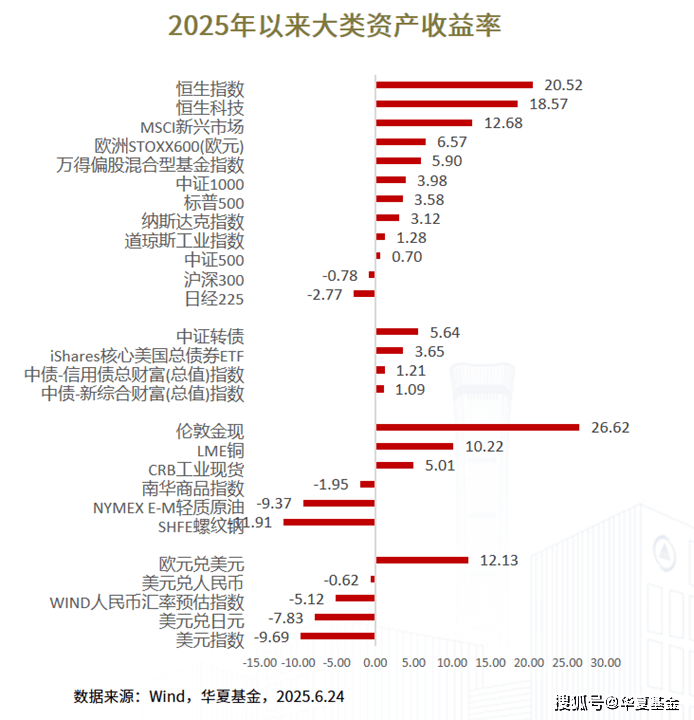
Group 1 - The article discusses the significant rebalancing of global assets and the shift towards multi-asset allocation in response to geopolitical tensions and economic uncertainties [2][3][20] - Gold has emerged as a star asset with a 26% increase, driven by geopolitical conflicts and a decline in dollar credibility, alongside a collective move towards "de-dollarization" [6][24] - The bond market shows mixed signals, with US Treasury yields fluctuating above 4.0% while China's 10-year government bond yields have dropped to a historical low of 1.65% [7][8][19] Group 2 - The Chinese equity market has demonstrated resilience, with the Hang Seng Index leading global markets with a 20.5% increase, supported by liquidity from southbound capital and narratives around AI and new consumption [12][13] - The article highlights the strong performance of the AI sector and the rapid rise of credit bond ETFs, reflecting a shift in investor preferences towards stable income assets [9][21] - The article emphasizes the importance of asset allocation strategies, suggesting a "barbell strategy" that balances undervalued, high-dividend stocks with growth sectors driven by AI [30][31] Group 3 - The article identifies three key underlying market logic shifts: the rising premium for certainty, the revaluation of industry narratives, and the rebalancing of global asset allocations [20][21][23] - The article notes that the current market environment requires investors to focus on both quantifiable certainty variables and the potential for disruptive technological breakthroughs [38][39] - The outlook for various asset classes suggests that while US equities face risks from high valuations and profit growth slowdowns, Chinese assets may benefit from their growth resilience and policy support [34][36][37]

下一站,多元资产配置|全球大类资产半年度复盘与展望
Sou Hu Cai Jing· 2025-06-30 10:31
Group 1 - The first half of 2025 has seen a significant rebalancing of global funds, characterized by a "funding boom and asset scarcity" [2][4] - Gold has emerged as a star asset, with a 26% increase in international spot gold prices, driven by geopolitical conflicts and a weakening dollar [5][37] - The Chinese central bank has increased its gold reserves for seven consecutive months, reaching 73.83 million ounces, indicating a collective move towards "de-dollarization" [5][37] Group 2 - The bond market is experiencing volatility, with U.S. Treasury yields fluctuating above 4.0%, while China's 10-year government bond yields have dropped to a historical low of 1.65% [6][7] - Credit bond ETFs have rapidly gained popularity, with a total market size exceeding 210 billion yuan, reflecting a shift towards stable income assets [8] - The divergence in economic cycles between the U.S. and China is evident, with the U.S. experiencing a slowdown while China is bottoming out [8] Group 3 - The Hong Kong stock market has shown resilience, with the Hang Seng Index leading global markets with a 20.5% increase, supported by liquidity from southbound funds [10] - The A-share market has seen strong sector rotation, particularly in the AI industry and consumer sectors, indicating a lack of a consistent overarching theme [11][15] - The current market is driven by liquidity, with expectations of a stabilization in earnings, suggesting a potential return to value-based investing [15] Group 4 - Three key underlying logics have emerged in the market: the continuous rise of certainty premiums, the revaluation of industrial narratives, and the rebalancing of global asset allocation [16][19] - The demand for certainty is reflected in the strong performance of gold and high-dividend assets, as investors seek visible cash flows amid macro uncertainties [17] - The AI industry is transitioning from concept to performance, with significant growth in cloud business revenues and capital expenditures among leading tech firms [18] Group 5 - The outlook for major asset classes in the second half of 2025 emphasizes the importance of strategic asset allocation amid increasing market volatility [23][24] - A diversified asset allocation strategy is recommended, with a focus on both undervalued, high-dividend value stocks and growth sectors driven by AI [27][28] - The U.S. stock market faces risks from high valuations and downward adjustments in earnings expectations, necessitating caution [32]