
红筹架构

Search documents
福建云安全独角兽估值已近30亿,战略大调整疑冲刺港股IPO
创业邦· 2025-11-20 04:01
Core Viewpoint - The Chinese cybersecurity industry is undergoing a new cycle of change, driven by the comprehensive penetration of AI, the rapid expansion of attack surfaces due to cloud computing, and the inadequacy of traditional defense methods to keep pace with evolving complex attacks. The next competitive focus in the industry is expected to revolve around "AI proactive defense," "multi-scenario security collaboration," and "cloud-based security capabilities" [2]. Group 1: Company Overview - KuaiKuai Network, a cloud security company based in Fujian, has recently become a focal point in the capital market, with its valuation estimated between 2 billion to 3 billion yuan, indicating significant growth potential [3]. - The company is reportedly in contact with multiple institutions and has undergone a high-level organizational restructuring, with founder Lin Sihong focusing on internationalization and business in Shenzhen [3][4]. - KuaiKuai Network is establishing a new R&D center and accelerating incentive system reforms, indicating a trend towards capital readiness and potential IPO preparation [4][20]. Group 2: Technological Capabilities - KuaiKuai Network initially entered the security market through DDoS protection, gaining recognition for its high defense and cloud protection capabilities [7]. - The company has been highlighted in the latest report by the China Academy of Information and Communications Technology, emphasizing its strong technical stability as the only DDoS protection vendor listed, showcasing its AI-driven protection system [8]. - The integration of AI into its protection framework has allowed KuaiKuai Network to evolve from basic traffic recognition to a next-generation protection solution, enhancing its stability against high-intensity attacks [10]. Group 3: Business Growth and Market Position - KuaiKuai Network's security products now cover public, private, and hybrid cloud environments, expanding its service scenarios from traditional sectors to diverse industries such as finance, gaming, e-commerce, education, healthcare, manufacturing, and government [12]. - The company differentiates itself from major competitors like Qihoo 360 and Sangfor by focusing on small and medium-sized clients and adapting to niche scenarios, such as compliance and DDoS protection [15]. - The shift from a single protection product to a multi-scenario security service system aligns with market expectations for security enterprises, allowing KuaiKuai Network to maintain growth amidst industry consolidation [15]. Group 4: Organizational Changes - Significant changes occurred in July 2023, with founder Lin Sihong appointed as Chief Strategy Officer, focusing on internationalization and capital operations, indicating a new development phase for the company [18]. - The company is implementing a partner system and stock option incentive reforms, typical actions taken by firms preparing for an IPO, enhancing its organizational structure [20]. - KuaiKuai Network is also establishing a new AI R&D center in Shenzhen to attract technical talent, reflecting its commitment to organizational capability enhancement [20]. Group 5: Market Environment and Future Outlook - The Hong Kong stock market for technology companies has been recovering since 2024, with increased institutional investment and improved trading activity, making it a potential destination for growth-oriented tech firms [28]. - The shift towards intelligent and predictive defense systems in the cybersecurity industry aligns with KuaiKuai Network's product structure, which has integrated AI into its protection systems [30]. - If KuaiKuai Network enters the capital market, it could represent a new generation of Chinese cloud security companies, while continued independent growth remains a viable path [30].


纳斯达克上市流程五个阶段:第2-6步 从红筹架构到递交招股说明书
Sou Hu Cai Jing· 2025-10-30 12:00
Core Viewpoint - The article outlines the steps for companies to prepare for an IPO on NASDAQ, emphasizing the importance of a well-structured framework and compliance with regulatory requirements, particularly in light of recent changes in approval processes for Chinese companies [4][6][18]. Group 1: IPO Process Overview - The NASDAQ listing process consists of five key stages, which typically take one to two months and are crucial for determining the success of the IPO [4]. - A red-chip structure is recommended for companies, as it allows for a robust offshore listing framework that is widely recognized by the SEC [4][5]. - The VIE structure is mentioned as an alternative for industries with foreign investment restrictions, but it faces significant approval limitations, with only three approvals per year from the Chinese regulatory body [7]. Group 2: Structural Framework - The initial step involves establishing a holding company in the Cayman Islands, which will control a Hong Kong company that, in turn, forms joint ventures or wholly foreign-owned enterprises with domestic companies [5]. - This structure facilitates offshore consolidation, fundraising, and risk isolation, creating a clear chain from the founding team to investors [6]. Group 3: Audit and Legal Compliance - Auditors can begin their work concurrently with the accounting process, which typically takes one to three months depending on the complexity of the business [7]. - Legal opinions from both Chinese and Cayman lawyers are necessary, especially for sensitive industries, to ensure full disclosure of regulatory attitudes and potential impacts [8][9]. Group 4: SEC Submission Strategy - The submission of the prospectus should be done confidentially to avoid delays caused by potential whistleblower reports, which can halt the review process [18][20]. - Companies must ensure that all risks, even minor ones, are disclosed to demonstrate responsibility to U.S. investors, as the SEC focuses on the authenticity of the information provided [12][14]. Group 5: Final Steps and Future Considerations - Once the fourth step is 30% to 50% complete, the fifth step can commence, involving due diligence by U.S. brokers and the submission of the listing application [15][16]. - Companies should consider their stock code carefully, as it can impact future global operations and fundraising efforts [17].

红筹架构设立步骤拆解:企业境外上市的流程
Sou Hu Cai Jing· 2025-10-16 07:10
Core Insights - The red-chip structure has become the preferred option for Chinese companies to access overseas capital markets due to its flexible financing channels and efficient listing paths [1] Group 1: Preparation Phase - The foundation of the structure involves compliance checks and entity planning, including a thorough review of domestic assets, business qualifications, intellectual property ownership, and related party transactions to avoid equity flaws or compliance risks [3] - Companies must determine the registration location of the offshore holding entity based on the regulatory requirements of the intended listing destination, with common choices being tax-friendly regions like the Cayman Islands and British Virgin Islands (BVI) [3] - It is essential to clarify the shareholder structure in advance, specifying the equity ratios and exit mechanisms for the founding team and investors to facilitate the subsequent structure setup [3] Group 2: Core Setup Phase - The first step involves registering two layers of Special Purpose Vehicles (SPVs) in the chosen offshore region, with the top layer as the listing entity (usually registered in the Cayman Islands) and the lower layer as the holding entity (typically registered in BVI), creating a control chain of "Cayman Company → BVI Company → Domestic Entity" [3] - Control over domestic operations can be achieved through "Variable Interest Entity (VIE)" agreements or equity acquisitions, with VIE being common in light asset and foreign-restricted industries (e.g., internet, education) to transfer operational decision-making and profit rights [3] - For industries with relaxed foreign access, direct equity acquisition of domestic entities by the offshore SPV can complete the equity control loop, while ensuring compliance with foreign exchange registration (e.g., ODI filing) for cross-border fund flows [3] Group 3: Finalization Phase - The focus during this phase is on compliance review and structure optimization, requiring companies to engage cross-border legal and accounting teams to audit structural documents (e.g., articles of association, control agreements, acquisition agreements) to ensure adherence to domestic and foreign regulatory requirements [4] - Companies must also complete financial statement consolidation and tax planning to ensure the structure operates efficiently during subsequent financing and listing processes [4] - The establishment of a red-chip structure involves multiple professional fields, including cross-border law, foreign exchange, and taxation, making the process complex with a low margin for error [4]

红筹上市梦碎只因少做一步ODI备案?
Sou Hu Cai Jing· 2025-10-15 11:06
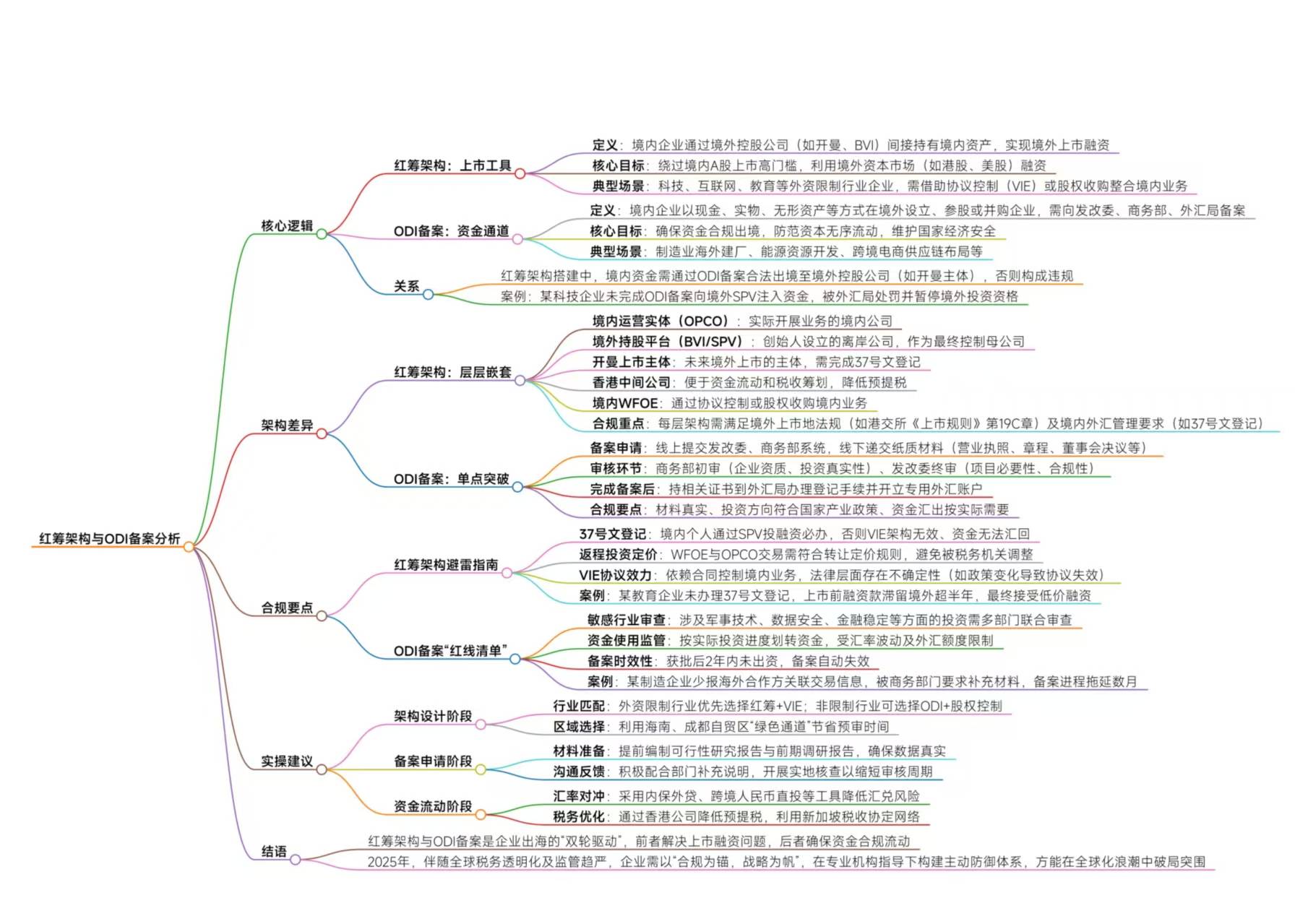
Core Viewpoint - The red-chip structure and ODI (Overseas Direct Investment) filing are independent yet closely related processes essential for companies seeking to go public and ensure compliant capital outflow [1][16]. Red-chip Structure - Definition: Domestic enterprises utilize offshore holding companies (e.g., Cayman Islands, BVI) to indirectly hold domestic assets for overseas listing and financing [3]. - Core Objective: To bypass the high barriers of domestic A-share listings and leverage overseas capital markets (e.g., Hong Kong, US) for financing [3]. - Typical Scenarios: Companies in restricted sectors such as technology, internet, and education use variable interest entity (VIE) agreements or equity acquisitions for domestic business integration [3]. ODI Filing - Definition: Domestic enterprises establish, invest in, or acquire foreign companies using cash, physical assets, or intangible assets, requiring filing with the National Development and Reform Commission (NDRC), Ministry of Commerce, and State Administration of Foreign Exchange [4]. - Core Objective: To ensure that funds can exit the country legally, prevent capital disorder, and maintain national economic security [5]. - Typical Scenarios: Overseas factory establishment in manufacturing, resource development in energy, and cross-border e-commerce supply chain layout [5]. Relationship Between Red-chip Structure and ODI Filing - Relationship: In establishing a red-chip structure, domestic funds must go through ODI filing to legally exit to the offshore holding company; failure to do so results in violations [6]. - Example: A technology company that failed to complete ODI filing before injecting funds into an offshore SPV faced penalties from the foreign exchange bureau, leading to a suspension of its overseas investment qualifications [6]. ODI Filing Process Design - Filing Application: Online submission to NDRC and Ministry of Commerce systems, followed by offline submission of physical documents (e.g., business license, articles of association, board resolutions) [9]. - Review Stages: Initial review by the Ministry of Commerce (enterprise qualifications, investment authenticity) and final review by NDRC (project necessity, compliance) [9]. - Post-filing: After completing the filing, companies must register with the foreign exchange bureau and open a dedicated foreign exchange account [9]. Compliance Risks in Red-chip Structure - Compliance Focus: Each layer of the structure must meet the regulations of the overseas listing location (e.g., Hong Kong Stock Exchange Listing Rules) and domestic foreign exchange management requirements [11]. - 37 Document Registration: Required for domestic individuals investing through SPVs; failure to register invalidates the VIE structure and prevents fund repatriation [12]. - Case Study: An education company that did not complete the 37 document registration faced delays in financing due to funds being stuck overseas for over six months [12]. Compliance Risks in ODI Filing - Risk Areas: Risks exist in the architecture design phase, filing application phase, and fund flow phase [14]. - Sensitive Industry Review: Investments in military technology, data security, and financial stability require joint reviews by multiple departments [15]. - Timeliness of Filing: If funds are not contributed within two years of approval, the filing automatically loses its validity [15]. Strategic Recommendations - Companies should adopt a compliance-centric approach while leveraging strategic frameworks to navigate the complexities of red-chip structures and ODI filings [16]. - Emphasis on proactive defense mechanisms and professional guidance is crucial for success in the global market [16].
红筹架构 | 拼多多美股上市红筹架构深度解析
Sou Hu Cai Jing· 2025-10-14 06:56
Core Viewpoint - The article discusses the significance of the red-chip structure in enabling Chinese companies, particularly Pinduoduo, to access international capital markets while navigating complex cross-border regulations. Pinduoduo's red-chip structure serves as a benchmark for the Variable Interest Entity (VIE) model, effectively addressing foreign ownership restrictions in the internet information services sector and ensuring compliance with regulatory requirements in both China and the U.S. [2][12] Summary by Sections Red-chip Structure Breakdown - The essence of the red-chip structure is to achieve overseas financing for industries with restricted foreign investment through layered control by offshore entities. Pinduoduo's design exemplifies a clear cross-border control loop with five key entities [6]. Core Structure Levels - The VIE entity, Hangzhou Aimei Technology Co., Ltd., operates the Pinduoduo platform and holds essential licenses that restrict foreign ownership. The ownership structure reveals that the founding team holds 91.1% of the shares, with Tencent's affiliate holding 8.9% [7]. Agreement Control System - Pinduoduo established a legal control chain through ten core contracts between Hangzhou Weimi and the VIE entity, achieving "substantial control without equity." This includes various agreements that ensure decision-making, profit transfer, and operational control [8][9]. Compliance Key Nodes - Pinduoduo completed essential compliance procedures before its 2018 IPO, including foreign exchange compliance and offshore listing registration with the China Securities Regulatory Commission (CSRC). These steps were crucial for ensuring the legality of the VIE structure and the repatriation of profits [10]. SEC Information Disclosure - Pinduoduo's prospectus includes a dedicated section on "Contractual Arrangements and Risks," providing detailed disclosures to meet SEC requirements. This includes evidence of substantial control over the VIE and the financial implications of the agreements [13]. Risk Management Strategies - To mitigate delisting risks following the implementation of the Holding Foreign Companies Accountable Act (HFCAA), Pinduoduo took significant actions, including submitting evidence of independent operations and compliance with U.S. auditing standards [13]. Timeline of Structure Development - The construction of Pinduoduo's red-chip structure took three years, closely tied to its business growth and financing processes, following a rhythm of "structure first, financing follows, compliance concludes" [15][16]. Nature of the Structure - The core intelligence of Pinduoduo's red-chip structure lies in achieving "dual compliance" with both Chinese and U.S. regulations, allowing for effective capital flow while adhering to legal frameworks [18].


张亮麻辣烫股权生变:创始人股权 “隐身” 香港,藏着上市关键布局?
Sou Hu Cai Jing· 2025-09-30 06:48
Core Viewpoint - The recent equity change involving Zhang Liang's company has sparked industry attention, indicating a strategic move towards capitalizing and globalizing the brand, while also highlighting the common challenges faced by the hot pot category in going public [2] Group 1: Equity Restructuring - The equity adjustment is not a withdrawal but a pre-IPO structural upgrade, with Zhang Liang maintaining control through a Hong Kong company, which facilitates foreign investment and aligns with Hong Kong's requirements for clear ownership [3] - This restructuring aims to isolate risks by legally separating personal and corporate assets, addressing public confusion over brand identity linked to the founder [3] Group 2: Expansion and Quality Control - Zhang Liang's brand has over 6,000 global stores as of April 2025, with operations in nearly 60 cities across 20 countries, although expansion growth has slowed due to funding gaps and competition from leading rivals [4] - The brand relies heavily on a franchise model, with less than 2% of stores being company-owned, which has led to quality control issues as franchisees face supply chain cost pressures [5] Group 3: Challenges in Going Public - The brand faces three main challenges in its IPO pursuit: low profitability due to reliance on franchise fees, trust issues related to food safety, and valuation concerns in a market that is becoming cautious towards the hot pot category [6][7] - Despite efforts to improve supply chain management and reduce costs for franchisees, the overall profitability structure remains weak, and the brand's ability to replicate overseas success is uncertain [7][8]
红筹架构搭建:37号文与ODI备案的“黄金顺序”指南
Sou Hu Cai Jing· 2025-09-29 04:43
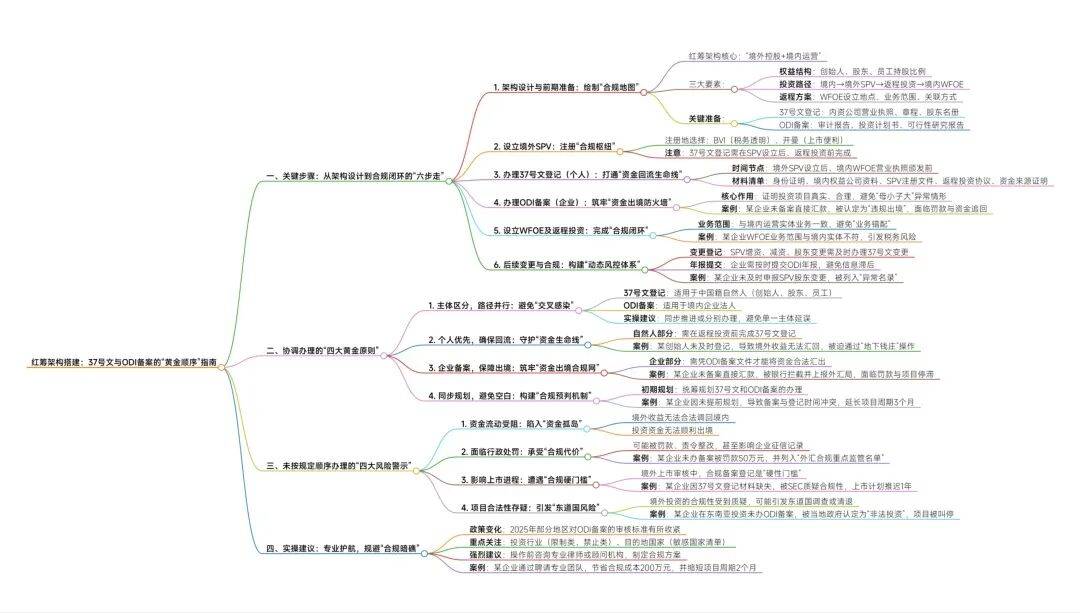
Core Viewpoint - The red-chip structure, due to its flexibility and compliance advantages, has become an excellent choice for companies seeking overseas financing and listing amid globalization. However, the process is complex and requires careful navigation of regulatory requirements to avoid potential pitfalls [1]. Key Steps: "Six Steps" from Structure Design to Compliance Loop - The core of the red-chip structure is "overseas holding + domestic operation," utilizing offshore SPVs (such as BVI or Cayman Islands) to hold equity in domestic WFOEs, ultimately leading to overseas listings [3]. - Three key elements must be clarified in advance: equity structure, investment path, and return plan [6]. - The overseas SPV serves as the "core hub," typically registered in BVI (tax transparency, strong confidentiality) or Cayman (high international recognition, ease of listing) [5]. Coordination Principles: "Four Golden Principles" - The 37th document registration is applicable to Chinese individuals (founders, shareholders, employees) to address compliance issues related to overseas holdings [10]. - ODI registration is required for domestic corporate entities to ensure compliance for overseas direct investments [10]. - It is advisable to synchronize the processing of 37th document registration and ODI registration materials to avoid delays in overall progress [10]. Practical Recommendations: Professional Guidance to Avoid Compliance Pitfalls - The establishment of a red-chip structure and compliance with cross-border investment regulations involves multiple areas, including foreign exchange management, business approvals, and tax planning [20]. - Companies are encouraged to consult professional lawyers or advisory firms to develop compliance plans tailored to their specific situations, potentially saving significant costs and time [20].
红筹还是VIE?一文读懂中国企业海外上市的两种核心路径
Sou Hu Cai Jing· 2025-09-24 11:16
Core Insights - The article discusses the different corporate structures (Red Chip vs. VIE) that companies are adopting for their listings, highlighting the strategic choices made by various firms in response to regulatory environments and industry characteristics [1][3][10]. Group 1: Corporate Structure Choices - Bawang Tea Ji opted for a traditional Red Chip structure instead of the VIE structure, reflecting the non-restricted nature of the new tea beverage industry, which allows for direct equity control [1][8]. - Yuanrong Qihang is building a Red Chip structure following Alibaba's exit, indicating a potential preparation for future overseas listings [1][8]. - Megvii Technology dismantled its VIE structure to facilitate a strategic shift towards domestic listing on the Sci-Tech Innovation Board, despite its subsidiary facing foreign investment restrictions [1][8]. Group 2: Factors Influencing Structure Selection - The choice between Red Chip and VIE structures is primarily influenced by industry attributes and the intended listing destination, with fully open industries favoring Red Chip structures and restricted industries leaning towards VIE [3][12]. - Regulatory scrutiny is more stringent for VIE structures, as evidenced by the longer approval times for VIE companies compared to non-VIE counterparts [5][9]. Group 3: Listing Pathways and Regulatory Considerations - Different listing pathways exist, including H-share direct listings for compliant companies, Red Chip structures for restricted industries, and A-share spin-offs for existing listed companies [11]. - Red Chip structures are generally easier to navigate for listings, while VIE structures face higher regulatory risks and complexities, impacting their acceptance in international markets [15][16]. Group 4: Control and Stability - Red Chip structures provide more stable control through direct equity ownership, while VIE structures rely on contractual agreements, which can introduce uncertainties regarding control stability [16][22]. - The regulatory environment and market conditions are dynamic, necessitating ongoing adjustments to corporate structures to align with strategic goals and compliance requirements [10].

不止避税!腾讯、阿里、百度为何都选择开曼群岛?
Sou Hu Cai Jing· 2025-09-10 16:10
Core Viewpoint - The news discusses the reasons behind Chinese companies, including Evergrande, registering in the Cayman Islands for bankruptcy protection and the broader implications of this trend in corporate strategy [1][2]. Group 1: Reasons for Preference for Cayman Islands - Tax benefits are a significant factor for companies choosing the Cayman Islands, as it does not impose corporate tax, income tax, or capital gains tax, only requiring a minimal annual license fee [4]. - The legal framework in the Cayman Islands is well-established and recognized internationally, making it an attractive location for companies seeking to list overseas [6]. - The "red-chip structure" allows domestic companies to transfer assets to a Cayman-registered entity, facilitating a smoother and quicker listing process on foreign exchanges [8]. Group 2: Advantages of Cayman Islands - The absence of foreign exchange controls in the Cayman Islands allows for free movement of capital, which is appealing for companies engaged in international transactions [9]. - Political stability and a secure business environment are key advantages, as the Cayman Islands is a British Overseas Territory with a good social order [11]. - The strict confidentiality laws in the Cayman Islands protect sensitive information about shareholders and company operations, enhancing privacy for businesses [11]. Group 3: Regulatory Challenges - The Cayman Islands has strengthened regulations in response to global tax transparency initiatives, requiring companies to meet economic substance requirements [12]. - Non-compliance with these new regulations could result in significant penalties or even the removal of companies from the registry, indicating a shift in the ease of offshore registration [12]. Group 4: Strategic Considerations - Registering in the Cayman Islands is part of a broader strategy that includes tax optimization, ease of listing, capital mobility, confidentiality, and global market positioning [13]. - The example of Bawang Tea's "Cayman-Singapore-China" structure illustrates how companies can navigate geopolitical risks while optimizing tax liabilities and maintaining control [13]. - As globalization deepens, the trend of offshore registration may become more common, necessitating careful consideration of the associated risks and benefits [15].

9.5犀牛财经晚报:多家券商保证金产品短暂下调管理费率 华夏银行被罚8725万元
Xi Niu Cai Jing· 2025-09-05 10:32
Group 1 - Several brokerage firms have recently adjusted management fees for margin products in response to declining yields, with Shenyin Wanguo Asset Management announcing a management fee adjustment to 0.30% for its money market fund starting September 2 [1] - The adjustment of management fees is closely related to the decline in yields, as many asset management contracts stipulate that fees will be adjusted if the calculated yield falls below twice the current deposit rate [1] - Brokerage margin products are favored for their liquidity services, including T+0 real-time redemption and unlimited withdrawals, which enhance their competitive edge in the market [1] Group 2 - The domestic silicon wafer production plan for September has been raised for the first time, with an overall output increase compared to August, as many silicon wafer companies raise their operating rates due to price increases [2] - The global battery cell production is expected to reach approximately 60GW in September, a 2.3% increase from August, with domestic production also showing a similar increase [2] - The semiconductor industry is experiencing a structural recovery, with the analog chip sector seeing a significant rebound in profitability, with a nearly fourfold increase in net profit in the second quarter compared to the previous quarter [2] Group 3 - A new study has identified a weak point in certain blood cancers that can be targeted by drugs, potentially allowing for the selective elimination of cancer cells without harming healthy cells [3] - The research emphasizes the urgent need for new drugs with fewer side effects and stronger targeting capabilities, particularly for conditions like myelodysplastic syndromes [3] Group 4 - Deep Insight Technology announced that its subsidiary has received regulatory approval for a mobile MRI system, making it the first company in China to master and register this core technology [4] - The latest version of the Kimi K2 model has been released, extending the context length to 256K and supporting high output speeds [4] Group 5 - Alibaba and other shareholders have exited Yuanrong Qihang, with the company stating that this is part of its restructuring process [5] - White Elephant's e-commerce subsidiary has been fined for false advertising, highlighting regulatory scrutiny in the sector [5] Group 6 - Zhongshan Securities' Hefei branch has been ordered to rectify its operations due to violations related to investor solicitation activities [6] - Huaxia Bank has been fined 87.25 million yuan for imprudent management of loans and related business [7] Group 7 - Hangzhou Bank's approval for a shareholding change has been revoked due to failure to complete the change within the stipulated time [8] - Yunnan Energy Investment's subsidiary has received a subsidy of 309 million yuan for renewable energy, contributing to its total subsidies of 591 million yuan for the fiscal year [15] Group 8 - The market saw a significant increase in the ChiNext index, with a rise of 6.55%, driven by strong performance in the solid-state battery sector [17] - The overall market showed a positive trend with over 4,800 stocks rising, while only a small number of stocks declined [17]
