
美国核心CPI

Search documents
美国7月CPI同比 2.7%不及预期,核心CPI同比 3.1%
Hua Er Jie Jian Wen· 2025-08-12 12:34
Group 1 - The core point of the article is the release of the U.S. Consumer Price Index (CPI) data for July, indicating inflation trends [1] - The U.S. July CPI increased by 0.2% month-over-month, matching expectations and down from a previous value of 0.3% [1] - The core CPI year-over-year for July was reported at 3.1%, slightly above the expected 3% and higher than the previous value of 2.9% [1] - The month-over-month core CPI for July was 0.3%, in line with expectations and an increase from the previous value of 0.2% [1]
美国核心CPI低于预期 疑或加剧美联储降息分歧
news flash· 2025-07-15 12:50
Core Insights - The U.S. core CPI has seen its fifth consecutive month of lower-than-expected growth, primarily influenced by declining automobile prices [1] - Prices for categories heavily impacted by tariffs, such as toys, furniture, appliances, and clothing, have shown strong performance, indicating that companies are beginning to pass higher import costs onto consumers [1] - The lower-than-expected CPI data raises questions about the extent to which tariffs introduced by Trump will affect consumer prices [1] Economic Implications - Some companies have managed to protect consumers from price increases by stockpiling inventory before tariffs were imposed or absorbing some additional costs at the expense of profit margins [1] - This unexpected data may intensify calls from Trump for the Federal Reserve to lower interest rates [1] - Despite some officials expressing willingness to consider a rate cut in the upcoming meeting, there remains a division among policymakers regarding whether tariffs will lead to a one-time price shock or have more lasting effects, which may result in maintaining current interest rates [1]
美国6月CPI数据速评
news flash· 2025-07-15 12:39
Core Insights - The core CPI in the U.S. has experienced a lower-than-expected increase for the fifth consecutive month, primarily influenced by a decline in automobile prices [1] - Swap rates indicate that traders believe there is a 62% probability that the Federal Reserve will cut interest rates by 25 basis points in September, with expectations of nearly two cumulative cuts by the end of the year [1]
美国CPI点评:美国核心CPI会连续走低吗?
Huafu Securities· 2025-06-12 09:44
Economic Indicators - In May, the U.S. CPI rose slightly by 0.1 percentage points year-on-year to 2.4%, while the core CPI remained flat at 2.8% for the third consecutive month[2] - The month-on-month increases for May were 0.08% for CPI and 0.13% for core CPI, indicating a slight decline from April's figures[2] Inflation Dynamics - The core CPI's stagnation is attributed to the decline in durable goods prices and a cooling rental market, influenced by lower energy prices and temporary tariff impacts[3] - Core durable goods prices fell by 0.11% month-on-month in May, marking the lowest level this year, primarily due to OPEC+ production increases affecting international oil prices[3] Future Projections - Despite the current low inflation rates, the potential for core inflation to rebound remains due to sustained high wages and the anticipated passage of the "Big and Beautiful" plan, which could boost consumer demand[3] - The rental market saw a month-on-month increase of 0.26% in May, reflecting a lagging effect from previous interest rate peaks, suggesting potential upward pressure on housing prices and inflation in the future[3] Monetary Policy Outlook - The market's expectations for a Federal Reserve rate cut have increased, but the necessity for aggressive cuts is diminished due to low unemployment and high wage growth[3] - If the fiscal expansion plan is fully implemented, it may lead to a gradual increase in the dollar index and potential depreciation pressures on the RMB, limiting the People's Bank of China's monetary easing options[3] Risks - There is a risk that the Federal Reserve may cut rates faster than anticipated, which could impact market dynamics[4]
美国核心CPI连续第四个月低于预期 关税“寒意”尚未传导至消费端
智通财经网· 2025-06-11 13:26
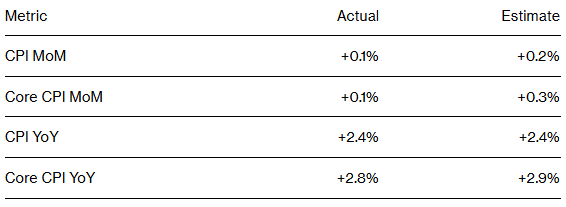
Group 1 - The core point of the article is that the US Consumer Price Index (CPI) data for May showed a month-on-month increase of 0.1% and a year-on-year increase of 2.4%, which met expectations, while the core CPI also rose 0.1% month-on-month and 2.8% year-on-year, both below market expectations [1][2] - The report indicates that the prices of goods excluding food and energy remained flat month-on-month, suggesting that the cost increases from tariffs have not yet been passed on to consumers [2][3] - Energy prices fell by 1%, while prices for new and used cars decreased by 0.3% and 0.5%, respectively, and clothing prices dropped by 0.4%, indicating a downward trend in key goods that were expected to be affected by tariffs [2][3] Group 2 - Following the release of the data, US Treasury prices rose, the dollar weakened, and S&P 500 futures increased, reflecting market reactions to the lower-than-expected inflation data [3] - The report comes amid ongoing trade negotiations by the Trump administration, which has implemented a 10% tariff on a wide range of imported goods, raising concerns about potential inflationary pressures from these tariffs [3] - Economists predict that if high tariff policies continue, companies may struggle to shield consumers from cost pressures, leading to a potential significant increase in price growth in the coming months [3]

无人预测美国核心CPI增长0.1%
news flash· 2025-06-11 12:56
Core Insights - The core Consumer Price Index (CPI) in the U.S. increased by only 0.1%, which was unexpected by analysts [1] - No respondents in a Bloomberg survey of 73 participants predicted the 0.1% growth, with expectations ranging from 0.2% to 0.5% [1]
美国5月CPI速评
news flash· 2025-06-11 12:46
Core Insights - The U.S. Consumer Price Index (CPI) for May increased by 2.4% year-over-year, meeting expectations, with the previous value at 2.3% [1] - The core CPI for May rose by 2.8% year-over-year, which is below the expected value of 2.9%, and the previous value was also 2.8% [1] - The core CPI has now shown a lower-than-expected increase for four consecutive months, indicating that companies are attempting to limit the transfer of rising costs from tariffs to consumers [1]