
美式民主

Search documents
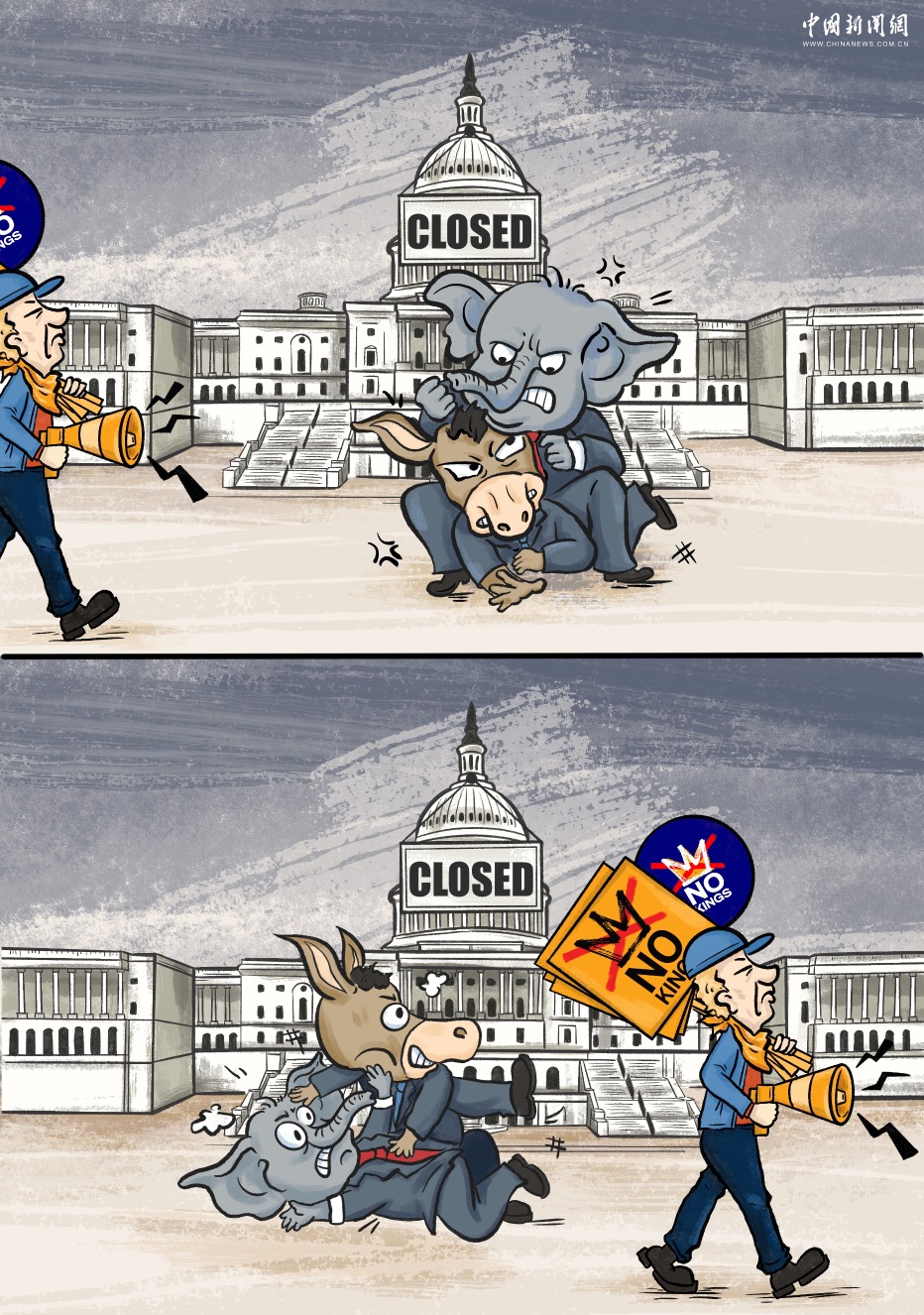
美式民主的日常|新漫评
Zhong Guo Xin Wen Wang· 2025-10-25 00:59
Core Viewpoint - The article discusses widespread protests across the United States against various policies of the Trump administration, highlighting a significant disconnect between public sentiment and political actions in Washington [2]. Group 1: Protests and Public Sentiment - Over 2,700 towns across the U.S. have seen protests, with millions of people holding "No Kings" signs, opposing violent immigration policies and other measures by the Trump administration [2]. - The protests are a continuation of the nationwide "No Kings" movement that began on June 14, indicating a sustained public outcry against government actions [2]. Group 2: Political Landscape - The article illustrates a stark contrast between the rising public protests and the ongoing partisan conflicts in Washington, suggesting a significant divide between political principles and practical governance [2]. - The imagery of the political struggle is depicted as a "cartoon," emphasizing the absurdity of the situation where the real issues are overshadowed by party conflicts [2].

美国民主已成“僵尸”?
Hu Xiu· 2025-09-28 06:58
Core Points - The article discusses the transformation of American democracy into a "zombie democracy," where the external structures of democracy remain, but the internal mechanisms have been hollowed out by power, apathy, and technology [2][3][5] - It highlights the intertwining of political authoritarianism and technological dominance, suggesting that democracy is no longer a shield against tyranny but may become a tool for maintaining control [4][5][6] Group 1 - The article describes the superficial continuation of civil society in the U.S., which is likened to a "zombie" existence, making the erosion of freedom difficult to detect [3][6] - It emphasizes the role of artificial intelligence in reshaping information access and understanding, potentially further diminishing independent thought and public engagement [4][6] - The piece warns that the combination of political and technological authoritarianism poses a significant threat to democratic values and individual freedoms [5][6] Group 2 - The article reflects on the historical context of authoritarianism, noting that modern forms differ from past examples, as they often maintain the facade of democratic institutions while eroding their effectiveness [9][10] - It discusses how the erosion of democracy is characterized by the loss of independent institutions, where loyalty to leaders supersedes professional competence [11][12] - The narrative suggests that the current political climate in the U.S. is marked by a lack of meaningful checks on power, leading to a situation where leaders can act with impunity [18][19] Group 3 - The article points out the dangers of societal polarization and the manipulation of public discourse through social media and algorithms, which contribute to a climate of distrust and disengagement [17][28] - It highlights the role of education in fostering democratic values and the need for active public participation to counter authoritarian tendencies [36][37] - The piece concludes with a call for individuals to resist the encroachment of both political and technological authoritarianism, emphasizing the importance of maintaining human agency and critical thinking [39][40]
美国法治双标现场,财长贝森特违规没事,美联储理事却死咬不放!
Sou Hu Cai Jing· 2025-09-19 09:55
Core Points - The article discusses the contrasting treatment of Treasury Secretary Becerra and Federal Reserve Governor Cook regarding mortgage fraud allegations, highlighting a double standard in political accountability [1][5][20] - It emphasizes the political implications of the "primary residence" designation in U.S. tax law and how it can be manipulated for financial benefits [3][6][14] - The article suggests that the independence of the Federal Reserve is being undermined by political interference, particularly from the Trump administration [17][20] Summary by Sections Political Accountability - Becerra's dual designation of two properties as "primary residences" was downplayed by experts, while Cook faced severe scrutiny for similar actions [1][3][5] - The article questions the motivations behind the Trump administration's focus on Cook, suggesting it is politically motivated rather than a genuine concern for legal integrity [5][8][20] Mortgage Fraud Allegations - The concept of "primary residence" is crucial for tax benefits, and Becerra's actions in 2007 are framed as a manipulation of this system [3][6] - Cook's designation of her Atlanta home as a "vacation home" while claiming tax benefits in Michigan led to accusations of fraud, despite local tax authorities finding no violations [5][11] Federal Reserve Independence - The article argues that the Federal Reserve's independence is increasingly compromised by political pressures, particularly from the Trump administration, which seeks to control the institution for political gain [17][20] - The rapid appointment and voting behavior of newly appointed officials like Milan raise concerns about the politicization of the Federal Reserve [10][17] Broader Implications - The manipulation of mortgage policies for political purposes is framed as a historical pattern that could lead to systemic financial issues, similar to the 2008 financial crisis [15][20] - The article concludes that the erosion of legal standards and accountability in political actions ultimately harms the general public [20]
美政府关税官司缠身折射治理乱象
Ren Min Ri Bao Hai Wai Ban· 2025-09-18 10:05
Core Points - The U.S. Supreme Court will review the legality of the government's tariffs, marking the first time it will assess a core policy of the current administration, with oral arguments scheduled for the first week of November [1][2] - The ongoing lawsuits regarding tariff policies reflect significant domestic controversy over their effectiveness and the procedures used to implement them, highlighting deeper issues within the U.S. political system [1][3] Summary by Sections Tariff Policy and Legal Challenges - The tariffs under review include the 10% "baseline tariff" imposed globally and higher tariffs on trade partners without agreements, as well as the "fentanyl tariff" [2] - The U.S. International Trade Court ruled that the President lacks the authority to impose these tariffs under the International Emergency Economic Powers Act, a decision upheld by the U.S. Court of Appeals [2][3] - The legal basis for these tariffs has been challenged, with arguments that the President's actions bypassed Congress, which constitutionally holds the power to levy taxes [3][4] Economic Impact - The effective tariff rate on imported goods has reached nearly 19%, the highest since the Great Depression, significantly above the typical 2-3% rate [4] - Increased tariffs are estimated to cost American households an additional $2,400 annually, contributing to rising inflation and economic strain [4] Political and Judicial Implications - The Supreme Court's decision could either affirm the President's unilateral power in trade policy or reinforce Congressional authority, impacting future trade negotiations and fiscal stability [5][7] - The current political climate, characterized by intense partisan conflict, has led to numerous lawsuits against the administration, raising questions about judicial independence and the effectiveness of the political system [9][10] - The ongoing legal battles reflect a broader struggle over the balance of power among the branches of government, with potential implications for the future of U.S. governance [6][10]
《2024年美国侵犯人权报告》发布!
证券时报· 2025-08-17 14:16
Core Viewpoint - The report reveals that under the collusion of power and capital, American-style human rights have been distorted into tools for political spectacle and chips in the power casino, deviating from the core values and essential requirements of human rights [1] Section Summaries Introduction - The report discusses the year 2024 as a critical year for American citizens to exercise political rights, but highlights that money controls politics, political manipulation of the judiciary occurs, election rules suppress voters, and political violence is rampant, leading to widespread disappointment among the American public regarding American democracy [2] American Democracy: The Carnival of Money and Power - The report emphasizes that high inflation exacerbates the wealth gap, with middle and low-income families facing catastrophic impacts, and the number of homeless individuals reaching new highs [2] Welfare of the People: Struggles of the Underprivileged - It points out that the expensive and inefficient healthcare and insurance systems have triggered public outrage, while drug abuse poses a significant threat to public health [2] Racism: The Shackles of Minority Groups - The report indicates that racist rhetoric is rampant in the U.S., with a judicial system that perpetuates systemic racism, leading to widespread discrimination and exclusion of minority groups in various aspects of life [2] Vulnerable Groups: The Helplessness of Women and Children - It highlights the significant expansion of workplace gender discrimination, persistent issues of sexual violence, escalating domestic violence, and the failure to protect women's health rights and children's rights [2] The Deadly Journey: The Tragedy of Undocumented Immigrants - The report notes the worsening humanitarian crisis at the U.S. border, where immigrants face torture and inhumane treatment, and immigrant children are exploited [3] American Hegemony: The Nightmare of Human Rights in Other Countries - It argues that the U.S. has long pursued hegemony and unilateralism, grossly violating international law and basic principles of international relations, severely threatening global peace, security, and development [3]

中方发布涉美重磅报告
第一财经· 2025-08-17 12:09
Core Viewpoint - The report highlights the distortion of human rights in the U.S. under the collusion of power and capital, transforming human rights into tools for political spectacle and bargaining chips in a power casino, deviating from the core values and essential requirements of human rights [3][4]. Section Summaries Introduction - The report serves as a critical examination of the state of human rights in the U.S., emphasizing the manipulation of political rights by money and the resulting disillusionment among the American populace [3]. American Democracy: A Carnival of Money and Power - The report indicates that in 2024, a crucial year for exercising political rights, money controls politics, political violence is rampant, and election rules suppress voters, leading to widespread disappointment in American democracy [3]. Welfare of the People: Struggles of the Underprivileged - High inflation exacerbates the wealth gap, with low- and middle-income families facing catastrophic impacts, and homelessness reaching new highs. The healthcare and insurance systems are criticized for being expensive and inefficient, triggering public outrage [3]. Racism: Shackles of Minority Groups - The report reveals rampant racial discrimination in the U.S., with minorities facing widespread discrimination in work and life, and environmental racism raising new concerns. The judicial system is described as having a full chain of racial discrimination, with AI perpetuating these biases in more covert forms [3]. Vulnerable Groups: The Helplessness of Women and Children - Gender discrimination in the workplace has significantly worsened, with persistent issues of sexual violence and domestic abuse. The report highlights the failure to protect women's health rights and the alarming abuse of children within the judicial system [4]. The Deadly Journey: The Tragedy of Undocumented Immigrants - The humanitarian crisis at the U.S. borders is worsening, with immigrants facing torture and inhumane treatment. The report criticizes the intertwining of immigration policy with political elections, where immigrants are scapegoated for social issues, leading to severe human rights violations [5]. American Hegemony: A Nightmare for Human Rights in Other Countries - The report accuses the U.S. of long-term hegemony and unilateralism, violating international law and basic principles of international relations, which poses serious threats to global peace, security, and development [5].
2024年美国侵犯人权报告
Xin Hua Wang· 2025-08-17 08:33
Core Viewpoint - The 2024 report on human rights violations in the United States highlights systemic issues such as economic inequality, racial discrimination, and the struggles of vulnerable groups, emphasizing the disconnect between political rhetoric and the lived experiences of many Americans [1][2][3]. Group 1: Economic and Social Inequality - The report indicates that economic and social inequality in the U.S. is worsening, with over 40 million people living in poverty and more than 700,000 homeless individuals [1][2]. - Inflation has severely impacted low- and middle-income families, with 13.5% of households facing food shortages, an increase from 12.8% in 2022 [1][2]. - The wealth gap is stark, with the top 10% of households holding 67% of total wealth, while the bottom 50% possess only 2.5% [8][9]. Group 2: Racial Discrimination - Systemic racism is pervasive, with African Americans being three times more likely to be killed by police than white individuals [2][12]. - The report notes that 61% of children sentenced to life without parole are African American, highlighting racial disparities in the justice system [12][13]. - Environmental racism disproportionately affects minority communities, with 80% of waste incinerators located in areas predominantly inhabited by African Americans and Latinos [11][12]. Group 3: Vulnerable Groups - Women and children face significant rights violations, with the U.S. being the only country not to ratify the Convention on the Elimination of All Forms of Discrimination Against Women [14][15]. - Approximately 40% of working women have experienced sexual harassment, and domestic violence rates exceed 40% in 11 states [16][17]. - The report highlights that over 500,000 women live in areas without obstetric services, exacerbating health risks [16][17]. Group 4: Immigration Issues - The humanitarian crisis at the U.S. border continues to worsen, with undocumented immigrants facing torture and inhumane treatment [17][18]. - The report emphasizes that immigration policies are often used as political tools, leading to the scapegoating of immigrants and violations of their rights [17][18].
受权发布丨2024年美国侵犯人权报告
Xin Hua Wang· 2025-08-17 08:12
Core Viewpoint - The report highlights the deteriorating human rights situation in the United States, emphasizing systemic issues such as economic inequality, racial discrimination, and the plight of vulnerable groups, particularly in the context of the 2024 political climate [1][2][3]. Group 1: Economic Inequality - The report indicates that over 40 million Americans live in poverty, with more than 700,000 homeless and 13.5% of households facing food shortages [1][2]. - The wealth gap is stark, with the top 10% of households holding 67% of total wealth, while the bottom 50% possess only 2.5% [8]. - Inflation has severely impacted low-income families, leading to record credit card debt of $1.14 trillion by Q2 2024 [9][10]. Group 2: Racial Discrimination - Systemic racism is pervasive, with African Americans being three times more likely to be killed by police compared to whites [12]. - The report notes that 61% of children sentenced to life without parole are African American, highlighting racial disparities in the justice system [12]. - Environmental racism disproportionately affects minority communities, with 80% of waste incinerators located in areas predominantly inhabited by African Americans and Latinos [12]. Group 3: Vulnerable Groups - Women and children face significant rights violations, with the U.S. being the only country not to ratify the UN Convention on the Elimination of All Forms of Discrimination Against Women [15]. - Approximately 40% of working women have experienced sexual harassment, and domestic violence rates exceed 40% in 11 states [16][17]. - The report highlights that the U.S. has the highest infant mortality rate among developed countries, with significant racial disparities in health outcomes [15][16]. Group 4: Immigration Issues - The humanitarian crisis at the U.S. border continues to worsen, with rising deaths among undocumented immigrants, particularly in Texas where fatalities increased from 72 in 2022 to 168 in 2024 [2][18]. - Immigrants face torture and inhumane treatment in detention facilities, which have been described as "black jails" [2][18]. - Political rhetoric surrounding immigration has fueled societal divisions, with immigrants often scapegoated for broader social issues [18].
从“杰利蝾螈”到“特朗普蝾螈”——起底美国选区划分党争怪象
Xin Hua Wang· 2025-08-13 05:48
Core Viewpoint - The ongoing conflict between the Republican and Democratic parties over the redistricting of congressional districts in Texas is primarily driven by the Republican desire to gain additional seats in the House of Representatives for the upcoming midterm elections, with the process being directly influenced by former President Trump [1][4][5]. Group 1: Redistricting Conflict - The Texas Senate passed a bill to redraw congressional districts, aiming to increase Republican seats in the House [1][2]. - The last redistricting occurred approximately five years ago, which is unusual as states typically redistrict every ten years following the census [2]. - Currently, Texas has 38 congressional seats, with Republicans holding 25 and Democrats 12, and the proposed changes could potentially add five more seats for Republicans [2]. Group 2: Democratic Resistance - Over 50 Democratic state legislators have left Texas to prevent the House from reaching a quorum necessary for legislative work, effectively halting proceedings [2][3]. - The Republican leadership has threatened various actions to compel the return of the absent Democratic legislators, including civil arrest warrants and daily fines [2]. Group 3: Political Violence and Tensions - The political tensions have escalated to the point of threats of violence, as evidenced by a bomb threat at a hotel where Democratic legislators were staying [3]. - The Democratic walkout has drawn significant media attention and mobilized Democratic voters, despite the challenges in stopping the redistricting [3]. Group 4: Trump's Influence - Trump has been a key figure in pushing for the redistricting, suggesting that it could secure five additional congressional seats for Republicans [4][5]. - His influence extends beyond Texas, as he has encouraged other Republican-led states to consider similar redistricting efforts ahead of the midterm elections [4]. Group 5: Broader Implications - The redistricting battle is part of a larger trend where both parties are engaging in aggressive tactics to reshape the political landscape in their favor, with Democrats planning countermeasures in blue states [6][7]. - The term "gerrymandering" has evolved, with both parties openly acknowledging their intent to manipulate district boundaries for electoral advantage, reflecting a decline in trust in the democratic process [10][11].