资本博弈

Search documents
CEO:六边形战士
3 6 Ke· 2025-12-05 05:51
Core Insights - The article emphasizes the importance of the "CEO's touch," which is developed through practice, reflection, and evolution in a complex business environment [3][4][29] Dimension Summaries Dimension 1: Inner Mastery - CEOs must recognize themselves as ordinary individuals, with the role of CEO being just one aspect of their identity [6] - Emphasizing authenticity and self-awareness allows CEOs to draw energy from their passions and motivations [7] Dimension 2: Determining Direction - CEOs should cultivate a three-dimensional perspective, alternating between macro, meso, and micro views to gain unique insights [8] - This involves understanding global trends, industry dynamics, and customer needs to identify strategic opportunities [8] Dimension 3: Organizational Restructuring - Building an organization is akin to nurturing a tree, where the roots represent inner mastery, and the trunk symbolizes direction [9][10] - The organization must align with the strategic vision and empower individual contributions while maintaining resilience [9][10][11] Dimension 4: Team Renewal - The competition among enterprises ultimately hinges on the collective strength of their teams [13] - CEOs should prioritize shared values and complementary skills when assembling teams, ensuring alignment in purpose [13][14] Dimension 5: Corporate Governance - The board of directors should act as strategic partners rather than mere overseers, with a focus on collaborative decision-making [16][19] - Establishing specialized committees enhances the board's effectiveness in guiding long-term strategies [16][22] Dimension 6: Diplomatic Network - CEOs must build a robust ecosystem centered around the enterprise, enhancing personal branding and fostering community engagement [23][26] - Effective crisis management and community involvement are essential for maintaining trust and corporate reputation [25][26]

金价走势大跳水!水贝今日金价详情全知道
Sou Hu Cai Jing· 2025-10-30 19:26
Core Points - The recent drop in gold prices is attributed to the Federal Reserve's decision to cut interest rates by 25 basis points, leading to significant market volatility [1][3] - The current price of gold in the domestic market is 901.24 CNY per gram, which is lower than the international price of approximately 920 CNY per gram, primarily due to processing fees [5][6] - There is a notable increase in trading volume for paper gold, with a 30% surge as retail investors panic sell amid uncertainty [3][6] Market Reaction - Gold prices fell sharply, with international gold dropping to a low of 3916 USD per ounce, reflecting a 0.8% decline [1][3] - The market is experiencing confusion among investors regarding whether to buy the dip or sell off their holdings [1][3] - The volatility in gold prices is seen as a result of capital market dynamics rather than fundamental changes in gold's value as a safe haven [6] Historical Context - Compared to the same period last year, gold prices have increased from 850 CNY per gram to 901.24 CNY, indicating a significant year-on-year rise despite recent declines [3][5] - Historical data shows that gold prices were around 3800 USD per ounce in 2024, marking a 3% increase, but with much higher volatility [5] Investment Strategy - The article suggests that investors should be cautious and avoid following market trends blindly, advocating for a long-term view on gold as a hedge against inflation [3][6] - It emphasizes the importance of timing investments, recommending that investors wait for clearer signals from the Federal Reserve before making decisions [3][6]

网约车大战背后,有什么样的资本博弈?
Hu Xiu· 2025-10-13 08:35
Core Insights - The article discusses the journey of Didi, founded by Cheng Wei after leaving Alibaba, starting with only 16 drivers and evolving to dominate the ride-hailing market in China [1] Company Overview - Didi merged with Kuaidi, which helped it to effectively compete against Uber in China [1] - The company successfully navigated the competitive landscape dominated by major players like BAT (Baidu, Alibaba, Tencent) [1] Industry Impact - Didi's rise signifies a shift in the ride-hailing industry, showcasing how a startup can challenge and overcome established giants [1] - The article highlights the strategic moves made by Didi to consolidate its position in the market and expand its services [1]
晚上市公司动态,6家利好公告引关注,3家公司面临挑战
Sou Hu Cai Jing· 2025-09-17 21:27
Core Viewpoint - On September 15, 2025, a complex scenario unfolded in the capital market where six listed companies released positive signals, while three others disclosed negative news, creating a juxtaposition of optimism and caution in the market [1][3]. Group 1: Company Actions - Six listed companies attempted to ignite market enthusiasm by releasing positive announcements, while three companies followed with negative disclosures, indicating a mixed market sentiment [1]. - Jianghuai Microelectronics' executives reduced their holdings by a mere 0.0123%, which, despite being a small percentage, raised concerns about underlying issues [3]. - Guomai Technology disposed of repurchased shares for the first time, accounting for 0.04%, signaling a potential shift in management's strategy [3]. - Lingrui Pharmaceutical's board proposed to reduce holdings by up to 0.0353%, leaving room for future actions and raising market vigilance [3]. Group 2: Market Dynamics - The simultaneous release of positive and negative news from these companies reflects the intricate dynamics of capital market competition, where executive buybacks are often seen as strong endorsements of future company performance, while subsequent sell-offs raise doubts [5]. - Technical indicators showed a bearish signal as the 10-day moving average crossed below the 20-day moving average, prompting short-term investors to consider retreating, amplifying bearish sentiment [5]. - The market's reaction to these announcements is influenced by macroeconomic factors, including global supply chain initiatives and a slight recovery in smartphone shipments, which provide a backdrop for market sentiment [9]. Group 3: Investor Sentiment - A private equity trader expressed skepticism about the sincerity of buyback announcements, emphasizing the need to trace the source of funds and calculate exit prices upon seeing sell-off news [7]. - A reminder from a brokerage employee to a retail investor highlighted the reality that announcements are merely clues and not guarantees of performance, underscoring the need for caution [11]. - The market exhibited a pattern of localized capital activity alongside overall fragmentation, indicating potential short-term technical corrections while long-term trends depend on actual company performance and macro liquidity changes [11].
汇源大股东拖欠8.5亿投资款1年 汇源管理层喊话对大股东夺权
Di Yi Cai Jing· 2025-08-14 12:58
Core Viewpoint - A significant conflict is unfolding between Beijing Huiyuan Beverage and Food Group Co., Ltd. and its major shareholder, Zhuji Wenshenghui Investment Co., Ltd., over an unpaid investment of 850 million yuan that has been overdue for a year, leading to management's call for limiting the major shareholder's powers [1] Group 1 - The management of Beijing Huiyuan has issued a rare public letter accusing the major shareholder of failing to fulfill its capital contribution obligations, specifically the overdue investment of 850 million yuan [1] - The major shareholder is attempting to implement a capital reserve plan to cover losses, which may effectively deprive creditors of their rights [1] - The conflict between management and the major shareholder has also affected another shareholder, Guozhong Water, which has seen a significant decline in investment returns and has temporarily shelved its control plans [1] Group 2 - Communication with Zhuji Wenshenghui revealed a lack of understanding regarding the situation, while attempts to contact Beijing Huiyuan went unanswered [1] - Guozhong Water's representatives stated that the issue is an internal matter for Beijing Huiyuan, emphasizing that their interests will take precedence [1] - The handling of the situation regarding the investment agreement will be determined based on the relevant terms upon expiration [1]
“立邦之父”传奇落幕!从贫民窟到亚洲漆王,留下132亿美元资产
创业邦· 2025-08-13 10:11
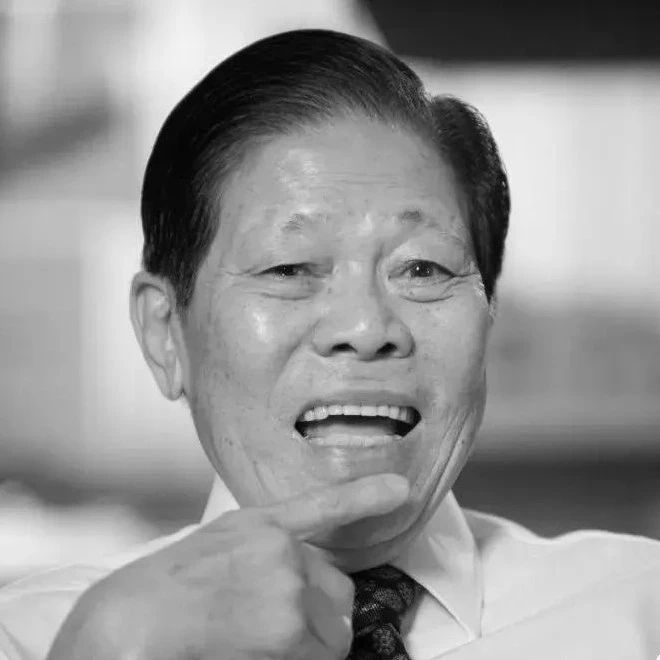
Core Viewpoint - The article highlights the life and achievements of Wu Qingliang, a self-made billionaire known as the "Asian Paint King," who built a vast paint empire from humble beginnings in Singapore, emphasizing his contributions to the industry and his philanthropic efforts in China [3][5][12]. Group 1: Background and Early Life - Wu Qingliang was born in 1927 in Singapore to a poor family and started working at the age of 14, initially selling fishing nets and later venturing into various businesses [7][8]. - He founded a small paint workshop in 1949 after gaining experience as a paint salesman, eventually creating his own brand of paint called "Dove Paint" [8][9]. Group 2: Business Expansion and Achievements - Wu Qingliang established the Nippon Paint Group in partnership with a Japanese company in 1962, which led to rapid expansion in the Asian paint market [15]. - The company, now known as Nippon Paint, has become a leading paint manufacturer and service provider globally, ranking fourth in the world [9][12]. - As of 2024, the company has built 74 production bases in China, employing nearly 11,000 people [9][20]. Group 3: Capital Battles and Corporate Governance - The article details a long-standing capital struggle between Wu Qingliang's family and Nippon Paint Holdings, which involved various strategic maneuvers over decades [14][18]. - Wu Qingliang's family successfully regained control of the company through a series of stock exchanges and acquisitions, culminating in Wu's son becoming the chairman of Nippon Paint Holdings in 2018 [18]. Group 4: Philanthropy and Legacy - Wu Qingliang invested over 100 million RMB in building infrastructure in his hometown, including hospitals and schools, demonstrating his commitment to giving back to the community [19][20]. - His legacy is marked by his entrepreneurial spirit and dedication to his roots, inspiring many in the business world [20].
两个月狂赚70%+:看小鱼盈通盘面的力量?
Zhi Tong Cai Jing· 2025-08-12 13:57
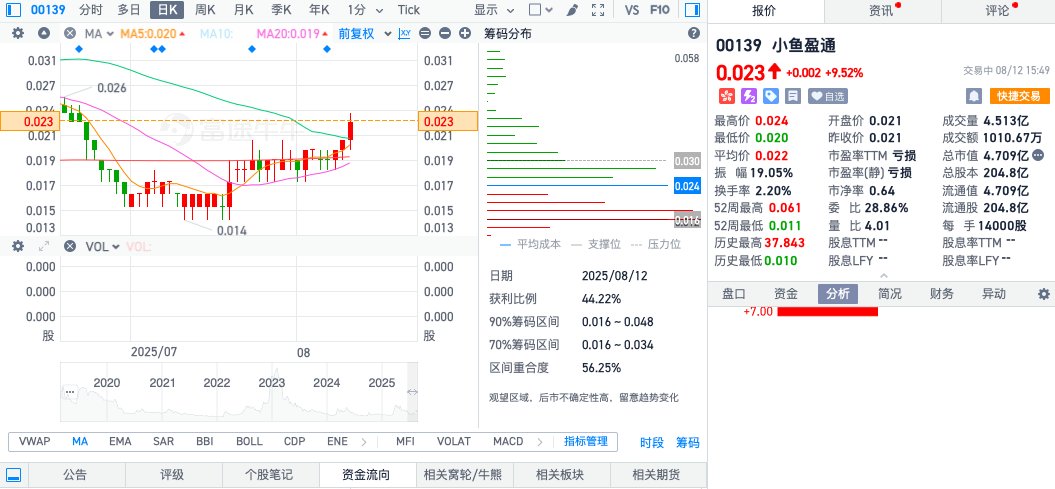
Core Viewpoint - The stock of Xiaoyu Yingtong (00139) experienced a dramatic fluctuation, dropping over 38% before surging by 60% within two months, showcasing a remarkable capital game in the market [1][12]. Group 1: Stock Performance Phases - The capital game can be divided into three distinct phases: a decline phase from June 18 to June 30, a consolidation phase from July 2 to July 18, and a rally phase from July 21 to August 12 [3][12]. - During the decline phase, the stock fell 38.46% over nine trading days, with a significant volume of 28.472 billion, indicating a strong bearish control [4][6]. - The consolidation phase saw price stagnation with a volatility of approximately 25%, where the stock price fluctuated but did not break the 0.018 resistance level [7][9]. - The rally phase resulted in a 60% increase over 16 trading days, characterized by a strong bullish volume, with 80% of the volume being positive [12][13]. Group 2: Trading Strategies and Volume Analysis - In the decline phase, the strategy involved a significant redistribution of shares, with a high replacement rate of 82% for high-position shares [5][6]. - The consolidation phase demonstrated a controlled trading environment, where the main players maintained a high frequency of small upward movements to test retail investor psychology [9][10]. - The rally phase was marked by a perfect rhythm of volume and price, with a notable increase in shares held at lower price levels, indicating effective capital management [12][14]. Group 3: Market Psychology and Investor Behavior - The initial drop was designed to break the psychological defenses of investors, followed by a period of patience-testing through minimal price movements [10][12]. - The final surge attracted observers to chase prices, highlighting the effectiveness of the capital strategy employed [12][14].
两个月狂赚70%+:看小鱼盈通(00139)盘面的力量?
智通财经网· 2025-08-12 11:10
Core Viewpoint - The stock of Xiaoyu Yingtong (00139) experienced a dramatic fluctuation, dropping over 38% before surging by 60% within two months, showcasing a remarkable capital game in the market [1][12]. Group 1: Stock Performance Phases - The capital game can be divided into three distinct phases: a sharp decline from June 18 to June 30, a consolidation phase from July 2 to July 18, and a strong rally from July 21 to August 12 [3][12]. - During the decline phase, the stock fell 38.46% over nine trading days, with a total trading volume of 2.8472 billion, indicating a significant dominance of short sellers [4][6]. - The consolidation phase saw the stock price stabilize with a zero net change, despite high volatility, indicating a balance of power between buyers and sellers [7][9]. Group 2: Trading Volume and Strategy - In the decline phase, the trading volume was heavily skewed towards selling, with a net institutional sell-off of 520 million, while a large block trade of 380 million at an 8% discount indicated a strategic accumulation by certain players [5][6]. - The consolidation phase featured a high trading volume of 799.9 million, but the price remained stagnant, suggesting that the main players were using small trades to mask larger sell orders [9][10]. - The rally phase was characterized by a significant increase in trading volume, with 28.488 billion in buying volume compared to 7.011 billion in selling volume, demonstrating a strong upward momentum [12][13]. Group 3: Price Movements and Market Psychology - The stock's price movements reflected a strategic manipulation of market psychology, with a "nine consecutive declines" pattern designed to break down investor confidence [12][14]. - The consolidation phase was marked by a series of small upward movements that tested retail investor psychology while maintaining a strong hold on positions [9][10]. - The final rally phase saw a 60% increase, with the stock price moving from 0.014 to 0.024, indicating a well-executed strategy to attract momentum traders and capitalize on market sentiment [12][14].
电影《戏台》背后,陈佩斯的资本博弈
Hu Xiu· 2025-08-06 09:33
Core Viewpoint - The article discusses how Chen Peisi, at the age of 71, has made a significant comeback in the film industry with his production "The Stage," which has become a box office success despite the challenges posed by capital investment [1] Group 1 - Chen Peisi has mortgaged his property to invest 100 million yuan in the production, showcasing his commitment and belief in the project [1] - The film "The Stage" has emerged as a dark horse in the box office, indicating a strong audience reception and potential for profitability [1] - The article highlights the competitive nature of the film industry and the risks associated with large capital investments, particularly for older filmmakers [1]
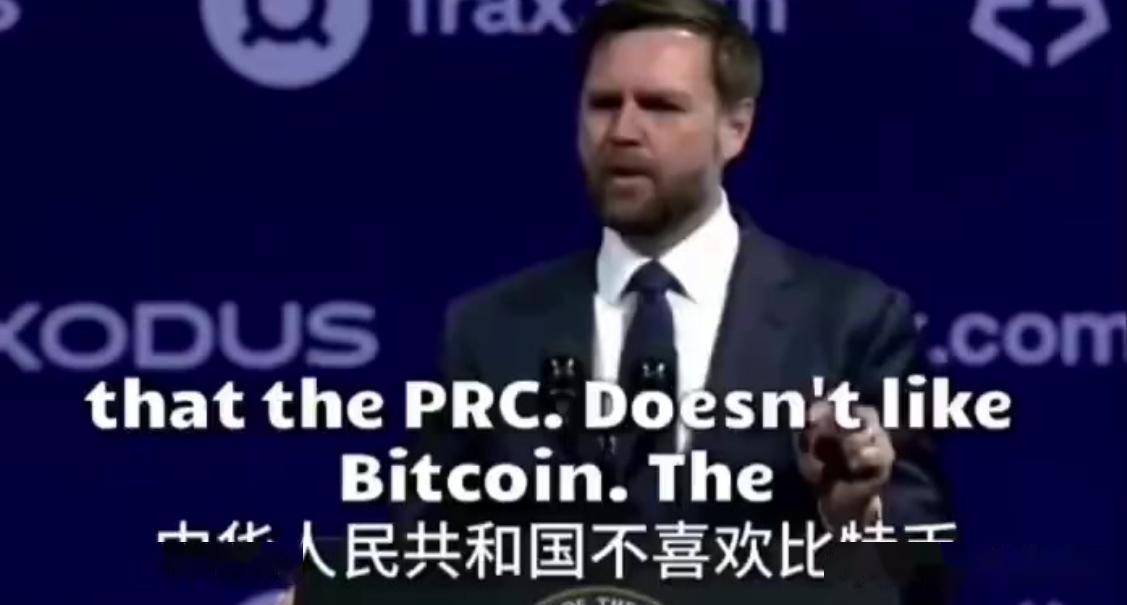
副总统万斯最近说了句大实话,直接把比特币这层窗户纸捅破了
Sou Hu Cai Jing· 2025-06-05 01:31
Core Viewpoint - The recent developments surrounding Bitcoin indicate a significant geopolitical struggle, particularly between the United States and China, with Bitcoin serving as a focal point in this larger game [1][5]. Group 1: Bitcoin's Market Dynamics - Bitcoin's rise and fall are closely tied to the U.S. dollar's cycles, suggesting a strong correlation between the two [3]. - The U.S. has historically dominated Bitcoin's development, with key players and mining companies primarily based in the country [3]. - The market for Bitcoin is currently chaotic, with regulatory actions from the SEC and the U.S. Treasury indicating a lack of confidence in the cryptocurrency's stability [5][9]. Group 2: Regulatory and Strategic Implications - China's early crackdown on Bitcoin in 2017, including halting ICOs and shutting down trading platforms, is viewed as a strategic decision rather than mere regulation [5]. - The U.S. appears to be employing a dual strategy: promoting Bitcoin to enhance the dollar's influence while simultaneously suppressing any potential competitors that could threaten its dominance [5][9]. - The increasing regulatory scrutiny in the U.S. reflects an underlying distrust in the cryptocurrency market, raising concerns about the potential risks for ordinary investors [9]. Group 3: Historical Comparisons - The situation surrounding Bitcoin is likened to the historical tulip bubble in the Netherlands, where speculative investment was driven by hype rather than intrinsic value [7]. - Bitcoin is portrayed as a symbol of future finance, yet it lacks tangible backing, leading to continuous market volatility [7].