资本市场双向开放

Search documents
证监会:抓紧推动合格境外投资者优化方案落地
Huan Qiu Wang· 2026-01-17 00:50
会议明确2026年资本市场五方面工作任务。一是坚持稳字当头,巩固市场稳中向好势头。二是坚持改革攻坚,不断提高服务高质量发展质效。三是坚持依法 从严,着力提升监管执法有效性和震慑力。四是坚持固本强基,促进上市公司价值成长和治理提升。五是坚持做强主场,推动资本市场双向开放迈向更深层 次、更高水平。 【环球网财经综合报道】1月16日,证监会官网消息,1月15日,中国证监会召开2026年系统工作会议,总结2025年工作,分析当前形势,研究部署2026年工 作。 具体来看,提到全方位加强市场监测预警,及时做好逆周期调节,强化交易监管和信息披露监管,进一步维护交易公平性,严肃查处过度炒作乃至操纵市场 等违法违规行为,坚决防止市场大起大落。继续深化公募基金改革,持续拓宽中长期资金来源渠道和方式,推出各类适配长期投资的产品和风险管理工具, 积极引导长期投资、理性投资、价值投资,全力营造"长钱长投"的市场生态。 此外,还提到持续提升上市公司规范运作水平,加快推动出台上市公司监管条例,全面落地新修订的上市公司治理准则,加强对控股股东、实际控制人的行 为约束,完善分红回购、股权激励和员工持股等制度安排。激发并购重组市场活力,完善重 ...

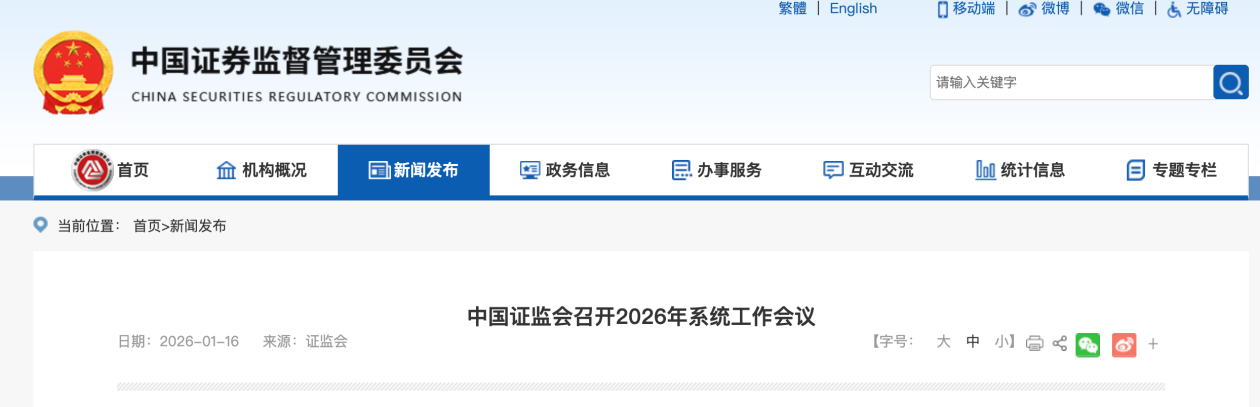
巩固市场稳中向好势头坚决防止市场大起大落
Shang Hai Zheng Quan Bao· 2026-01-16 18:34
Regulatory Effectiveness - The focus is on enhancing regulatory enforcement effectiveness and deterrence by strictly adhering to laws and regulations, targeting financial fraud, price manipulation, and insider trading [1] - The mechanism for administrative and criminal connection is to be streamlined, promoting more representative lawsuits and advance compensation cases [1] - Industry institutions are urged to concentrate on their core business, improve governance, and develop in a differentiated manner [1] Corporate Governance and Value Growth - Continuous improvement of the operational standards of listed companies is emphasized, with the introduction of new regulatory guidelines for listed companies [1] - Strengthening constraints on the behavior of controlling shareholders and actual controllers, and improving systems for dividends, buybacks, equity incentives, and employee stock ownership [1] - The aim is to stimulate the vitality of mergers and acquisitions, enhancing the regulatory framework for the entire restructuring process to promote high-quality development of listed companies [1] Capital Market Openness - The initiative aims to deepen and elevate the two-way opening of the capital market, with a focus on optimizing the qualified foreign investor program and expanding the range of specific futures products [1] - Enhancements in cross-border investment and financing convenience are prioritized, along with the improvement of regulations for overseas listings to ensure standardized and transparent management [1] - The ability to regulate and prevent risks in an open environment is to be strengthened, with active participation in international financial governance [1] Party Governance and Anti-Corruption - The meeting calls for higher standards and practical measures to advance the comprehensive and strict governance of the China Securities Regulatory Commission [2] - Emphasis is placed on normalizing and institutionalizing the rectification of central inspections, establishing a clear focus on practical results and effectiveness [2] - Targeted measures are to be developed to prevent and combat new forms of corruption and hidden corruption in the capital market [2]
巩固市场稳中向好势头 坚决防止市场大起大落
Xin Lang Cai Jing· 2026-01-16 18:01
Core Viewpoint - The China Securities Regulatory Commission (CSRC) emphasizes the need to consolidate the market's stable upward trend while addressing illegal activities such as excessive speculation and market manipulation, aiming to prevent significant market fluctuations [1][3]. Group 1: Market Stability and Regulation - The CSRC aims to strengthen market monitoring and timely counter-cyclical adjustments to maintain fairness in trading and information disclosure, while strictly addressing illegal market behaviors [3][4]. - In 2025, the CSRC handled 701 cases of securities and futures violations, imposing fines totaling 15.47 billion yuan, indicating enhanced regulatory effectiveness [2]. - The market has shown resilience and vitality, with significant breakthroughs in attracting medium- and long-term capital, contributing to a warming market trend [2][3]. Group 2: Reform and Development - The CSRC is committed to deepening reforms in the ChiNext board and enhancing the adaptability and competitiveness of the capital market to achieve qualitative improvements and reasonable growth [3][4]. - The total amount of cash dividends and buybacks by listed companies reached 2.68 trillion yuan in 2025, reflecting a focus on high-quality development [2]. - The CSRC plans to promote the integration and high-quality development of the Beijing Stock Exchange and the New Third Board [4]. Group 3: Legal and Governance Enhancements - The CSRC emphasizes strict enforcement of market discipline, targeting financial fraud, price manipulation, and insider trading, while improving the regulatory framework for private equity funds [4][5]. - There is a focus on enhancing the governance of listed companies, including the introduction of new regulations and guidelines to improve operational standards [4][5]. - The CSRC aims to strengthen the supervision of major shareholders and actual controllers to ensure better governance and value growth of listed companies [4]. Group 4: Internationalization and Open Market - The CSRC is working to enhance the openness of the capital market, including optimizing the Qualified Foreign Institutional Investor (QFII) scheme and expanding the range of futures products available for foreign investment [5]. - Efforts are being made to improve the regulatory framework for overseas listings, ensuring standardized and transparent management [5]. - The CSRC is committed to participating in international financial governance while enhancing its regulatory and risk prevention capabilities in an open environment [5].

证监会最新部署!
Zheng Quan Ri Bao Wang· 2026-01-16 10:18
Core Viewpoint - The China Securities Regulatory Commission (CSRC) emphasizes the need to consolidate the positive momentum in the capital market while addressing complex challenges posed by intertwined internal and external risks [2][5]. Group 1: Market Stability and Development - The CSRC aims to strengthen market monitoring and regulation to maintain fairness and prevent excessive speculation, ensuring a stable market environment [2][5]. - The focus is on deepening public fund reforms and expanding long-term investment channels to foster a "long money, long investment" market ecosystem [2][5]. Group 2: Reform and High-Quality Development - The CSRC plans to enhance the inclusiveness and adaptability of the multi-tiered equity market, implementing reforms in the ChiNext and STAR Market to facilitate high-quality development [3]. - Efforts will be made to improve the quality and structure of the bond market, including the smooth rollout of REITs in commercial real estate [3]. Group 3: Regulatory Enforcement - The CSRC is committed to strict enforcement against financial fraud, price manipulation, and insider trading, enhancing the effectiveness of regulatory measures [3][7]. - A comprehensive punishment and prevention system for financial fraud will be established, with a focus on increasing the number of cases handled and penalties imposed [5][6]. Group 4: Capital Market Opening - The CSRC aims to deepen and elevate the two-way opening of the capital market, optimizing the Qualified Foreign Institutional Investor (QFII) scheme and expanding the range of futures products available for foreign investment [4]. Group 5: Governance and Party Leadership - The CSRC emphasizes the importance of strengthening the Party's leadership in the capital market, enhancing accountability, and combating corruption within the regulatory framework [7]. - Continuous improvement of the regulatory team’s capabilities and integrity is prioritized to ensure effective market supervision [7].
证监会明确2026年资本市场五方面工作任务
Xin Hua Wang· 2026-01-16 09:47
Core Viewpoint - The China Securities Regulatory Commission (CSRC) emphasizes the need for risk prevention, strong regulation, and promotion of high-quality development in the capital market, which is currently stable but faces complex challenges [1][2]. Group 1: Market Stability and Regulation - The CSRC plans to enhance market monitoring and regulation, focusing on preventing excessive speculation and market manipulation to maintain stability [1]. - There will be a continued reform of public funds, introducing products and risk management tools suitable for long-term investment [1]. Group 2: High-Quality Development - The CSRC will implement reforms in the Growth Enterprise Market and continue to promote the Science and Technology Innovation Board, improving refinancing convenience and flexibility [1]. - Efforts will be made to enhance the quality of the bond market and ensure the smooth launch of commercial real estate REITs [1]. Group 3: Regulatory Effectiveness - The CSRC aims to combat financial fraud, price manipulation, and insider trading, improving the effectiveness and deterrence of regulatory enforcement [1]. - There will be a focus on facilitating administrative and criminal connections, promoting representative litigation and advance compensation cases [1]. Group 4: Corporate Governance and Value Growth - The CSRC will expedite the introduction of regulations for listed companies and strengthen constraints on controlling shareholders and actual controllers [2]. - Initiatives will be taken to improve dividend repurchase, equity incentives, and employee stock ownership systems [2]. Group 5: Capital Market Openness - The CSRC is pushing for deeper and higher-level opening of the capital market, optimizing the qualified foreign institutional investor scheme [2]. - There will be an expansion of the open range for specific futures products and improvements in cross-border investment and financing convenience [2].
切实增强市场内在稳定性 证监会召开2026年工作会议明确五大任务
Zhong Guo Jing Ying Bao· 2026-01-16 09:13
Core Viewpoint - The China Securities Regulatory Commission (CSRC) emphasizes the need for steady progress in the capital market while addressing complex challenges, focusing on risk prevention, strong regulation, and high-quality development to support employment and market stability [1] Group 1: Market Stability - The CSRC aims to consolidate the positive momentum in the market by enhancing monitoring and early warning systems, implementing counter-cyclical adjustments, and strengthening trading and information disclosure regulations to maintain fairness in trading [1] - There will be a continued effort to deepen public fund reforms and broaden channels for long-term capital, promoting products and risk management tools suitable for long-term investment [1] Group 2: Reform and Development - The CSRC plans to enhance the inclusiveness and adaptability of the multi-tiered equity market, initiating reforms in the ChiNext and promoting the implementation of reforms in the Sci-Tech Innovation Board [2] - Efforts will be made to improve the quality and structure of the bond market, ensuring the smooth launch of commercial real estate REITs [2] Group 3: Regulatory Enforcement - The CSRC will intensify market discipline and combat severe violations such as financial fraud and insider trading, while improving the connection between administrative and criminal mechanisms [2] - There will be a focus on enhancing the regulatory framework for private equity funds and leveraging technology to improve regulatory capabilities [2] Group 4: Corporate Governance - The CSRC aims to enhance the operational standards of listed companies and expedite the introduction of new regulations for corporate governance, focusing on the behavior of controlling shareholders and improving systems for dividends, buybacks, and employee stock ownership [2] Group 5: Market Openness - The CSRC is committed to advancing the dual opening of the capital market, optimizing the Qualified Foreign Institutional Investor (QFII) scheme, and expanding the range of futures products available for foreign investment [3] - There will be efforts to improve regulations for overseas listings and enhance the transparency of the filing management process [3]
中国证监会:抓紧推动合格境外投资者优化方案落地
Sou Hu Cai Jing· 2026-01-16 08:03
来源:人民财讯 1月15日,中国证监会召开2026年系统工作会议。会议强调,坚持做强主场,推动资本市场双向开放迈 向更深层次、更高水平。抓紧推动合格境外投资者优化方案落地,扩大期货特定品种开放范围,提升跨 境投融资便利性。完善境外上市法规制度,提升备案管理规范化、标准化和透明度。增强开放环境下监 管和风险防范能力,积极参与国际金融治理。 ...
中国证监会召开2026年系统工作会议,提及五项发展要求
Bei Jing Shang Bao· 2026-01-16 08:01
Core Viewpoint - The China Securities Regulatory Commission (CSRC) held a meeting to summarize the work of 2025 and plan for 2026, emphasizing the need for risk prevention, strong regulation, and high-quality development in the capital market [1][2]. Group 1: Achievements in 2025 - The CSRC highlighted significant progress in risk management, with a focus on building a stable market mechanism and attracting long-term capital, resulting in a recovery trend in the market [2]. - A total of 701 cases of securities and futures violations were investigated, with fines amounting to 15.47 billion yuan, indicating enhanced regulatory effectiveness [2]. - The total cash dividends and buybacks from listed companies reached 2.68 trillion yuan, showcasing the accumulation of high-quality development momentum [2]. - The total amount of IPOs and refinancing was 1.26 trillion yuan, while the bond market issued various bonds totaling 16.3 trillion yuan, demonstrating the effective functioning of a multi-level capital market [2]. Group 2: Future Directions for 2026 - The CSRC aims to maintain market stability while addressing complex challenges, focusing on risk prevention, strong regulation, and promoting high-quality development [3]. - There will be an emphasis on enhancing market monitoring and timely counter-cyclical adjustments to prevent market volatility and promote long-term investment [3]. - The CSRC plans to deepen reforms in public funds and broaden channels for long-term capital, encouraging a market ecosystem that supports long-term and value investments [3]. Group 3: Regulatory and Reform Initiatives - The CSRC will enhance the inclusiveness and adaptability of the multi-tiered equity market, implementing reforms in the ChiNext and promoting the integration of the Beijing Stock Exchange and the New Third Board [4]. - There will be a focus on strict enforcement of market discipline, targeting financial fraud, price manipulation, and insider trading, while improving the regulatory framework for private equity funds [4]. - The CSRC aims to strengthen the governance of listed companies, enhance operational standards, and stimulate the merger and acquisition market to promote high-quality development [4]. Group 4: Opening Up the Capital Market - The CSRC is committed to advancing the opening of the capital market, optimizing the Qualified Foreign Institutional Investor (QFII) scheme, and expanding the range of futures products available for foreign investment [5]. - There will be improvements in the regulatory framework for overseas listings, enhancing transparency and standardization in the management of foreign investments [5]. - The CSRC aims to strengthen regulatory and risk prevention capabilities in an open environment and actively participate in international financial governance [5].
证监会:坚持稳字当头,巩固市场稳中向好势头
财联社· 2026-01-16 07:54
Core Viewpoint - The China Securities Regulatory Commission (CSRC) emphasizes the importance of risk prevention, strong regulation, and promoting high-quality development in the capital market, aiming to enhance market resilience and vitality amidst multiple challenges [2][3]. Group 1: Market Stability and Development - The CSRC aims to strengthen market stability by enhancing monitoring and early warning systems, ensuring fair trading, and preventing market manipulation, while promoting long-term investment strategies [4]. - In 2025, the total amount of cash dividends and buybacks by listed companies reached 2.68 trillion yuan, indicating a focus on high-quality development [2]. - The total amount of IPOs and refinancing in 2025 was 1.26 trillion yuan, with the bond market issuing various bonds totaling 16.3 trillion yuan, showcasing the effective functioning of a multi-level capital market [2]. Group 2: Regulatory Enhancements - The CSRC has intensified its regulatory framework by establishing a comprehensive punishment and prevention system for financial fraud, with 701 cases of securities and futures violations handled, resulting in fines totaling 15.47 billion yuan [2]. - The CSRC is committed to improving the effectiveness and deterrence of regulatory enforcement by strictly addressing financial fraud, price manipulation, and insider trading [4]. Group 3: Reform Initiatives - The CSRC is advancing comprehensive reforms in investment and financing, including the implementation of the "1+6" policy for the Sci-Tech Innovation Board and the introduction of a third set of standards for the Growth Enterprise Market [2][4]. - The CSRC is focused on enhancing the inclusiveness and adaptability of the multi-tiered equity market, promoting the integration of the Beijing Stock Exchange and the New Third Board for high-quality development [5]. Group 4: Legal and Governance Improvements - The CSRC is working on strengthening the legal framework for capital markets, including the issuance of guidelines for protecting the rights of small and medium investors, thereby enhancing the investor protection "safety net" [2][5]. - The CSRC is also focused on improving corporate governance and operational standards for listed companies, with plans to introduce new regulations to enhance accountability and governance practices [5].

证监会:巩固市场稳中向好势头
Wind万得· 2026-01-16 07:54
Core Viewpoint - The China Securities Regulatory Commission (CSRC) emphasizes the importance of risk prevention, strong regulation, and promoting high-quality development in the capital market, aiming for stability and growth amidst various challenges [3][4]. Group 1: 2025 Achievements - The CSRC has made significant progress in stabilizing the market, with a notable increase in medium to long-term capital entering the market, leading to a recovery trend [3]. - A total of 701 cases of securities and futures violations were investigated, resulting in fines totaling 15.47 billion yuan, indicating enhanced regulatory effectiveness [3]. - The total cash dividends and buybacks from listed companies reached 2.68 trillion yuan, reflecting a focus on high-quality development [3]. - The IPO and refinancing activities amounted to 1.26 trillion yuan, while the bond market issued various bonds totaling 16.3 trillion yuan [3]. Group 2: Future Directions - The CSRC plans to strengthen market monitoring and regulation to maintain stability, prevent excessive market fluctuations, and promote long-term investment [5]. - Reforms will continue to enhance the adaptability and inclusiveness of the multi-tiered equity market, including the implementation of the "1+6" policy for the Sci-Tech Innovation Board [5]. - The regulatory framework will be tightened to combat financial fraud, price manipulation, and insider trading, with a focus on improving the effectiveness of enforcement [5]. Group 3: Governance and Party Leadership - The CSRC is committed to strengthening party leadership and governance within the commission, ensuring that high-quality development is guided by strong party principles [4][7]. - There will be a focus on enhancing the capabilities of the regulatory team and improving accountability mechanisms to combat corruption and promote integrity [7]. - The CSRC aims to foster a culture of practical results and effective governance, addressing issues of formalism and bureaucratism [7].