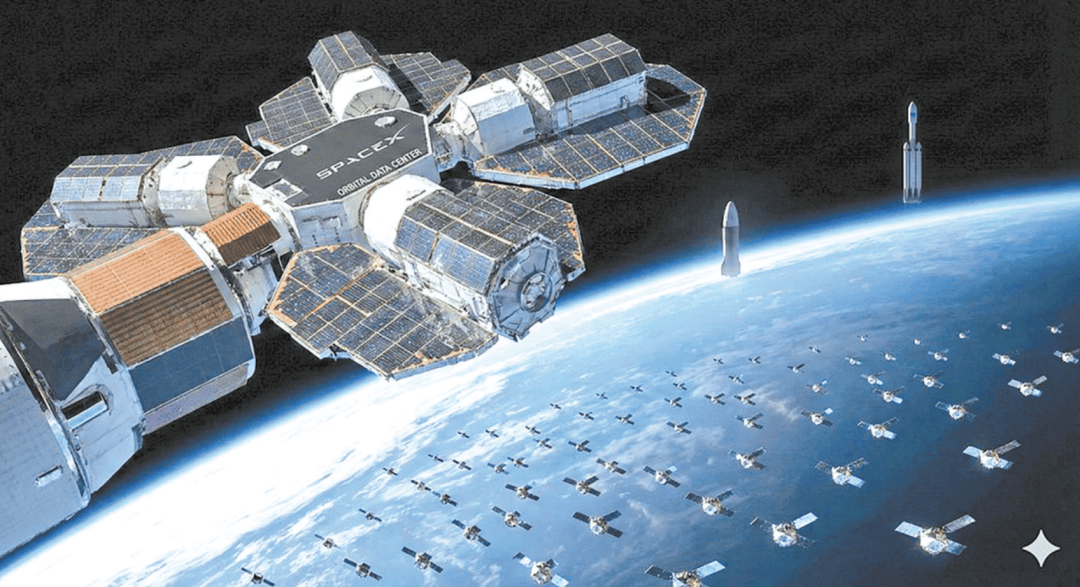
轨道数据中心

Search documents
SpaceX收购xAI,剑指太空算力
Xin Jing Bao· 2026-02-03 12:43
Core Viewpoint - SpaceX has acquired xAI to integrate artificial intelligence with its existing technologies, emphasizing the importance of space-based AI for scalability [1][3] Group 1: Acquisition and Integration - SpaceX announced the acquisition of xAI, aiming to merge AI with rocket technology, satellite internet, and mobile device connectivity [1] - The integration is expected to leverage space-based resources to enhance computational capabilities [3] Group 2: Technological Advancements - The announcement highlights that current AI advancements rely heavily on large ground-based data centers, which consume significant power and cooling resources [1] - Space-based AI is presented as the only viable long-term solution for achieving scalability in AI applications [1] Group 3: Satellite Deployment Plans - SpaceX plans to launch up to 1 million satellites to create an "orbital data center" that will support large-scale AI inference and data center applications [3] - The initiative aims to utilize nearly perpetual solar energy to significantly reduce operational and maintenance costs for satellite operations [3]

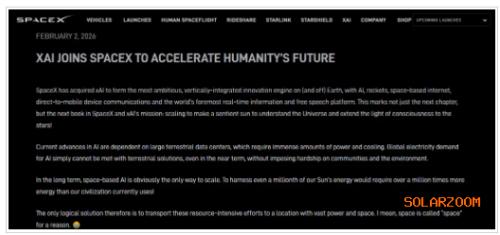
为更有效建造“轨道数据中心”,SpaceX收购xAI
Xin Lang Cai Jing· 2026-02-03 12:35
Group 1 - Elon Musk's SpaceX has acquired xAI, an artificial intelligence startup also owned by Musk, to enhance the construction of "orbital data centers" powered by solar energy [1][2] - The acquisition is part of Musk's ambitious plan to leverage AI capabilities in space, with a focus on generating AI computing power in a cost-effective manner over the next 2 to 3 years [2] - Both SpaceX and xAI are currently facing urgent cash needs, with xAI reportedly burning through approximately $9.5 billion in the first nine months of 2025 [2][5] Group 2 - SpaceX is considering an initial public offering (IPO) in June, aiming to raise up to $50 billion, which could provide a significant funding source for its operations [5] - The integration of xAI into SpaceX is seen as a strategic move to stabilize xAI's financial situation while capitalizing on investor interest in AI assets [5] - A recent incident involving a Falcon 9 rocket, which experienced a rare failure during a mission, highlights ongoing operational challenges for SpaceX [5]
SpaceX计划部署由100万颗卫星组成的「轨道数据中心系统」
Xin Lang Cai Jing· 2026-02-03 12:24
Group 1 - SpaceX has submitted its initial public offering (IPO) application, aiming to enhance its competitive position in the AI sector through a potential merger with xAI [1] - The company plans to deploy a satellite network consisting of up to 1 million satellites to provide solar-powered data centers, addressing the growing demand for AI computing capabilities [2][3] - Currently, there are approximately 15,000 satellites in orbit globally, making the feasibility of launching 1 million satellites relatively low, as previous applications for satellite launches have exceeded actual deployment [5] Group 2 - The proposed orbital data center system aims to significantly reduce operational and maintenance costs by utilizing near-continuous solar energy, thus improving cost and energy efficiency while minimizing environmental impact [5] - SpaceX emphasizes that the orbital data center will be the most effective way to meet the increasing demand for AI computing power, especially as energy costs for terrestrial data centers continue to rise [5][6] - The Starship rocket program, which has completed 11 test flights since 2023, is crucial for launching advanced satellites and expanding the Starlink network, potentially alleviating ground power shortages and reducing carbon footprints [6]
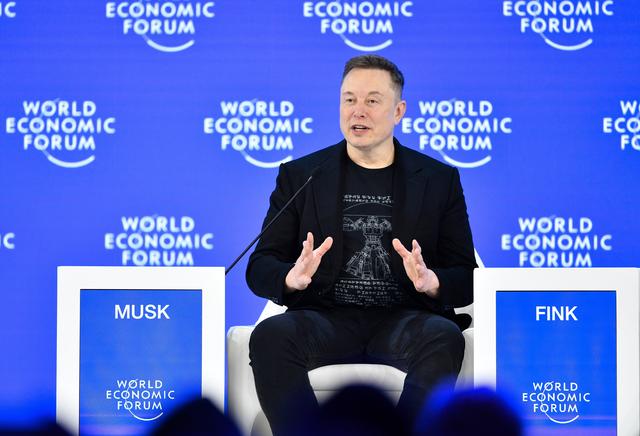
SpaceX合并xAI,马斯克打造第二家万亿美元公司
Sou Hu Cai Jing· 2026-02-03 08:37
Core Insights - Elon Musk's SpaceX has completed the acquisition of AI company xAI, creating a new entity valued at approximately $1.25 trillion, with shares priced around $527 each [2] - The merger aims to integrate SpaceX's rocket capabilities and Starlink communication network with xAI's model training capabilities, forming a vertically integrated tech entity covering the entire industry chain from computing power to space transportation [2][3] - The acquisition is seen as a crucial step towards SpaceX's initial public offering (IPO), with the combined entity expected to address significant capital expenditure needs [4] Group 1 - The merger combines SpaceX's and xAI's strengths, addressing energy and cooling bottlenecks faced by ground data centers, which cannot meet the exponential growth in AI demand [2] - SpaceX's "orbital data center" plan will deploy high-energy computing facilities in near-Earth orbit, leveraging abundant solar energy and natural cooling conditions to overcome physical limitations [3] - The integration of xAI's technology into SpaceX's Starlink satellites will transform them into edge computing nodes capable of processing data in orbit, reducing reliance on ground bandwidth [3] Group 2 - The merger is expected to create a new asset with independent energy, network, and computing facilities, potentially providing a solution to funding gaps through capital markets [4] - SpaceX's annual expenditures on Starship development and Starlink deployment are estimated to be between $5 billion and $7 billion, while xAI's capital expenditures on high-end GPU chips and model training are projected to be between $5 billion and $8 billion [4] - The market anticipates that the merger will enhance the valuation of the combined entity, reflecting a premium expectation for the synergy between commercial space and AI [4] Group 3 - There have been speculations about a potential merger between Tesla and SpaceX, driven by the synergy between Tesla's battery technology and SpaceX's space operations [5] - Despite the logical industrial synergy, significant challenges exist due to differences in corporate structure, valuation systems, and financial transparency requirements between the publicly traded Tesla and the private SpaceX [5] - A merger of this scale could trigger antitrust scrutiny and legal challenges from Tesla's minority shareholders regarding potential conflicts of interest [5]
马斯克宣布SpaceX合并xAI!1.25万亿美元火箭AI巨兽诞生
Sou Hu Cai Jing· 2026-02-03 08:01
Core Insights - The merger between SpaceX and xAI is expected to create a new company with a share price of $526.59 and a total valuation of $1.25 trillion [2] - Elon Musk envisions this merger as a significant step towards creating a highly integrated innovation engine that spans artificial intelligence, rocket technology, and space internet [2][4] - The long-term goal is to deploy a million satellites to establish orbital data centers, which Musk believes is essential for scaling AI development and advancing human civilization [4][6] Company Overview - Following the acquisition, xAI will become a wholly-owned subsidiary of SpaceX, allowing it to operate with less financial pressure and focus on its AI development [9] - SpaceX is recognized as one of Musk's most successful and stable ventures, with profitable operations from its rocket launch and satellite internet businesses [10] - The merger is anticipated to enhance xAI's access to computational resources, enabling it to accelerate AI model training and technological advancements [10] Strategic Vision - Musk predicts that the deployment of AI in space will be the most cost-effective approach, leveraging solar energy and natural cooling advantages [4] - The plan includes launching a million satellites, which is not merely a concept but a concrete application that SpaceX has already applied for [8] - The projected annual increase in AI computing power could reach 1 terawatt (1TW), significantly impacting the future of AI applications [7][8]
马斯克再下一盘大棋:SpaceX与xAI合并,万亿美元级IPO浮出水面
Jin Shi Shu Ju· 2026-02-03 03:51
Group 1 - Elon Musk is merging his rocket manufacturer SpaceX with AI startup xAI, preparing for an unprecedented IPO with an estimated valuation of approximately $1.25 trillion [1] - The merger represents the largest integration in Musk's extensive business portfolio, combining two companies that have seen soaring valuations in the private market, with SpaceX valued at $800 billion and xAI at $230 billion [1] - The latest round of xAI financing included investors such as Nvidia, Cisco Investments, and several firms that have historically supported Musk's ventures [2] Group 2 - SpaceX currently holds significant government contracts worth billions, far surpassing xAI in terms of defense contracting scale [3] - SpaceX was founded in 2002 and has become a leading provider of orbital launch services, while xAI was launched in 2023 as a potential competitor to OpenAI [4] - SpaceX is projected to achieve revenues of approximately $15 billion to $16 billion by 2025, with estimated profits around $8 billion, while xAI is struggling financially as it builds costly infrastructure to compete in the AI space [4] Group 3 - Musk describes the merger as part of a future strategy to build data centers in space, with plans to launch up to 1 million satellites as part of its "orbital data center" project [5] - The company estimates that within 2 to 3 years, the lowest cost method for acquiring AI computing power will be achieved in space, which could accelerate technological advancements and understanding of physics [6]
SpaceX收购xAI,剑指太空算力
Bei Ke Cai Jing· 2026-02-03 02:05
Core Viewpoint - SpaceX has announced the acquisition of xAI, aiming to integrate artificial intelligence with its existing technologies, including rockets and satellite communications [1] Group 1: Acquisition and Integration - SpaceX has officially acquired xAI, with plans to merge its capabilities in artificial intelligence with rocket technology and satellite internet [1] - The integration is expected to enhance the company's ability to utilize AI in space, leveraging satellite technology for data processing [1] Group 2: Future of AI and Space - The announcement highlights that current advancements in AI rely heavily on large ground-based data centers, which consume significant power and cooling resources [1] - Elon Musk stated that space-based AI is the only viable long-term solution for scaling AI capabilities [1] Group 3: Satellite Deployment Plans - SpaceX has submitted an application to the Federal Communications Commission to launch up to 1 million satellites, aiming to create an "orbital data center" [1] - This initiative is designed to support the computational needs for large-scale AI inference and data center applications [1]
SpaceX确认:与xAI合并
财联社· 2026-02-03 01:08
Core Viewpoint - The merger between SpaceX and xAI aims to create a vertically integrated innovation engine that encompasses artificial intelligence, rocket technology, satellite internet, direct mobile communication, and a leading platform for real-time information and free speech [6][9]. Group 1: Merger Confirmation and Background - SpaceX has confirmed its merger with xAI, putting to rest recent market rumors about the negotiations [4]. - SpaceX, founded by Elon Musk in 2002, specializes in rockets and satellites, while xAI is Musk's AI venture established in 2023 [5]. Group 2: Strategic Vision and Technological Advancements - The merger is expected to enable the establishment of data centers in space, addressing the limitations of terrestrial data centers that consume significant power and cooling resources [8][10]. - Musk envisions that utilizing solar energy in space could provide a million times more energy than current human consumption, making space-based AI the most logical solution for scalable development [10]. Group 3: AI Computing Capacity and Cost Efficiency - Musk estimates that launching 1 million satellites, each generating 100 kW of computing power, could add 100 GW of AI computing capacity annually [11]. - Within two to three years, generating AI computing power in space is projected to become the most cost-effective method, enabling unprecedented speed and scale in AI model training and data processing [11]. Group 4: Financial Implications and Market Position - The merger will strengthen xAI's capabilities by leveraging SpaceX's satellite network and provide financial support, as xAI is projected to burn through billions in 2024 [13]. - SpaceX plans to raise up to $50 billion in its upcoming IPO, while xAI recently completed a funding round valuing it at $230 billion [13]. - Post-merger, the company is expected to have a share price of approximately $527, leading to a valuation of $1.25 trillion [14].
官宣了!马斯克的SpaceX收购xAI,估值1.25万亿美元
Sou Hu Cai Jing· 2026-02-03 00:58
Core Viewpoint - SpaceX has officially merged with AI startup xAI, creating a new entity valued at $1.25 trillion, which is expected to pursue an IPO potentially raising up to $50 billion, marking a significant milestone in the tech industry [2][6]. Group 1: Merger Background and Strategic Synergy - The merger aims to integrate SpaceX's rocket launch capabilities and Starlink satellite network with xAI's AI technologies, particularly its Grok chatbot, to accelerate advancements in both fields [3][4]. - The merger is driven by the need for substantial computational power and resources for AI development, which SpaceX can provide through its infrastructure and innovative concepts like orbital data centers [3][4]. Group 2: Market Reaction and Historical Significance - The announcement has generated excitement in global capital markets, with analysts noting that this integration aligns with Musk's strategy of synergizing multiple companies [6]. - The merger is seen as a transformative event that could reshape the landscape of space exploration, artificial intelligence, and capital markets for the next decade [6]. Group 3: Orbital Data Centers and Future Prospects - The plan includes relocating GPU clusters to space to overcome terrestrial limitations, utilizing Starlink for low-latency global data transmission, and creating a unified talent and resource pool [4][10]. - The envisioned orbital data centers could significantly enhance AI computational capabilities, with projections of launching one million tons of satellites annually, potentially generating 100 gigawatts of AI computing power [12][13].

马斯克“百万AI卫星”计划引争议,近地轨道拥挤程度将是现在100倍!去年一颗“星链”卫星与9颗中国卫星擦肩而过,险些相撞
Sou Hu Cai Jing· 2026-02-03 00:17
Core Viewpoint - Elon Musk warns that the immense energy demands of computing centers pose a significant barrier to the future development of artificial intelligence (AI). SpaceX plans to build an unprecedented constellation of up to 1 million satellites to support "orbital data centers" as a solution to this issue [1][4]. Group 1: Orbital Data Center Concept - SpaceX has applied to launch 1 million satellites into Earth's orbit to create "orbital data centers," claiming this is the most economical and energy-efficient way to meet the growing demand for AI computing power [4]. - The satellites will operate at altitudes between 500 to 2000 kilometers, with a 30-degree orbital inclination, utilizing nearly constant solar energy to reduce operational costs and environmental impact [4][5]. - The concept aims to leverage solar energy to avoid the need for an overburdened terrestrial power grid, potentially allowing AI computations to be generated in space at unprecedented speed and scale [5][11]. Group 2: Technical and Operational Challenges - The system will rely on inter-satellite laser links for communication and will use Ka-band frequencies for telemetry, tracking, and control [5]. - There are significant technical challenges, including effective heat dissipation in the vacuum of space and ensuring stable operation of chips in a high-radiation environment [11][12]. - SpaceX has not provided detailed plans or cost estimates for the deployment of the orbital data center satellites, raising questions about the feasibility and timeline of the project [12]. Group 3: Collision Risks and Concerns - The proposed satellite constellation could increase collision risks significantly, with experts warning that a failure of any satellite could lead to catastrophic chain reactions in space debris [7][8]. - Currently, there are about 11,000 satellites in orbit, and the addition of 1 million could exacerbate the risk of collisions, potentially rendering low Earth orbit unusable in the future [7][8]. - The increase in satellite numbers has already raised concerns among astronomers regarding the impact on astronomical observations due to the bright trails left by satellites [7]. Group 4: Market and Financial Implications - SpaceX's plans for the orbital data center may be influenced by its intention to conduct an initial public offering (IPO), suggesting a strategic move to attract investment [13].