
金融市场开放

Search documents
上海清算所首次 向境外机构直接提供中央对手清算服务
Jin Rong Shi Bao· 2025-11-27 03:05
Core Insights - Bank of China (Hong Kong) has become the first overseas clearing member of Shanghai Clearing House, successfully launching RMB interest rate swaps, standard bond forwards, and standard interest rate swap self-clearing services [1][2] - This initiative marks a historic step in the internationalization process of Shanghai Clearing House, enhancing the offshore RMB market and providing more risk hedging tools for overseas institutions [2][3] Group 1 - The introduction of overseas clearing members for interest rate derivatives self-clearing is a significant milestone for Shanghai Clearing House [2] - The initiative aims to create a new offshore RMB asset pool and leverage Bank of China (Hong Kong)'s strategic advantages as a global custodian and RMB clearing bank [2] - The new model allows direct trading and clearing, enabling overseas institutions to manage interest rate risks effectively [1][2] Group 2 - Shanghai Clearing House plans to accelerate its international development and expand its network of overseas clearing members [3] - The goal is to establish itself as a key hub for connecting to international financial markets during the 14th Five-Year Plan period [3] - This initiative is expected to enhance the competitiveness and influence of Shanghai as an international financial center [3]

财政部在卢森堡发行欧元主权债券 向投资者释放中国高水平开放积极信号
Jin Rong Shi Bao· 2025-11-21 00:30
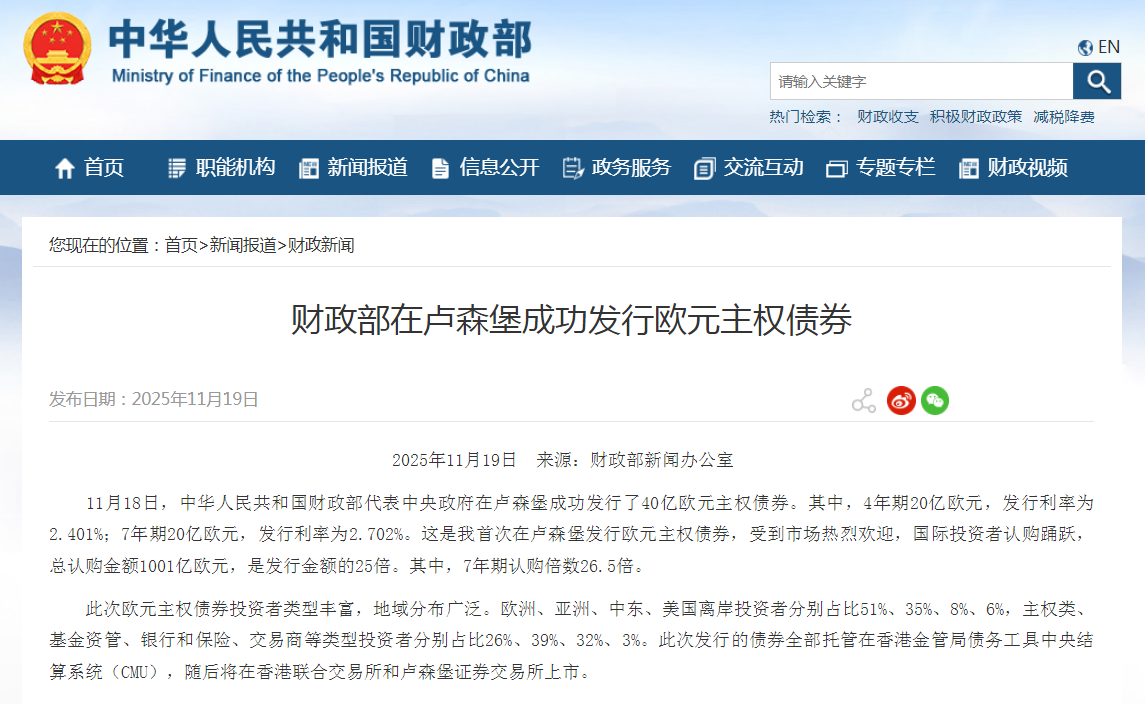
Core Insights - The Ministry of Finance of the People's Republic of China successfully issued €4 billion in sovereign bonds in Luxembourg, marking the first issuance of euro-denominated sovereign bonds by China in this market [1][2] - The issuance received strong market interest, with total subscriptions reaching €100.1 billion, 25 times the issuance amount, and a subscription multiple of 26.5 times for the 7-year bonds [1] - The bonds will be listed on the Hong Kong Stock Exchange and the Luxembourg Stock Exchange, with all bonds held in the Hong Kong Monetary Authority's Central Moneymarkets Unit [1] Investor Demand and Distribution - The investor base for the euro-denominated bonds was diverse, with geographical distribution as follows: Europe (51%), Asia (35%), the Middle East (8%), and offshore investors from the United States (6%) [1] - The types of investors included sovereign entities (26%), fund management (39%), banks and insurance companies (32%), and dealers (3%) [1] Market Implications - The successful issuance of euro bonds is seen as a positive signal of China's high-level openness and deeper integration into international financial markets, enhancing future financial cooperation between China and Europe [2] - The issuance reflects international investors' confidence in China's economic resilience and vitality, reinforcing China's commitment to further financial market openness and connectivity with global markets [2] - The issuance coincided with the fourth high-level financial dialogue between China and Germany, highlighting global investors' trust in China's sovereign credit and macroeconomic fundamentals [2]
25倍认购!财政部首次在卢森堡发行40亿欧元主权债券
Guo Ji Jin Rong Bao· 2025-11-19 11:55
Core Viewpoint - The successful issuance of €4 billion sovereign bonds by the Ministry of Finance of the People's Republic of China in Luxembourg demonstrates strong international investor confidence in China's economic resilience and commitment to financial market openness [1][5]. Group 1: Bond Issuance Details - The issuance included €2 billion in 4-year bonds at an interest rate of 2.401% and €2 billion in 7-year bonds at an interest rate of 2.702% [1]. - The total subscription amount reached €100.1 billion, which is 25 times the issuance amount, with the 7-year bonds having a subscription multiple of 26.5 times [1][4]. Group 2: Investor Composition and Distribution - The investor base was diverse, with geographical distribution as follows: Europe (51%), Asia (35%), the Middle East (8%), and offshore investors from the United States (6%) [4]. - The types of investors included sovereign entities (26%), fund management (39%), banks and insurance companies (32%), and trading firms (3%) [4]. Group 3: Market Implications and Future Outlook - The issuance is seen as a benchmark for future euro financing by Chinese entities, reinforcing international market confidence in China's sovereign credit and economic outlook [5][6]. - The bonds will be listed on the Hong Kong Stock Exchange and the Luxembourg Stock Exchange, further enhancing financial cooperation between China and Luxembourg [4].


三季度末“互换通”业务累计清算8.58万亿元 产品体系不断丰富
Jin Rong Shi Bao· 2025-11-12 02:01
Core Insights - The "Swap Connect" business has accumulated a clearing volume of 8.58 trillion yuan since its launch, with 1.41 trillion yuan cleared in Q3 2025, reflecting a quarter-on-quarter growth of 22.6% and a year-on-year growth of 45.7% [1] - The product offerings have expanded to include LPR interest rate swap contracts, addressing the risk management needs of the loan market [1][2] - The mechanism allows foreign investors to directly participate in the domestic interest rate derivatives market, providing efficient tools for managing RMB interest rate risks [1][2] Group 1 - The "Swap Connect" business has seen a significant increase in participation, with 103 financial institutions from 15 countries and regions involved [1] - The clearing volume of "Swap Connect" accounted for 11.64% of the total clearing volume in the interbank interest rate swap market in Q3 2025 [1] - The trading structure shows a dominance of the 7-day repo rate (FR007), with a growing diversification in investors' term choices towards medium to long-term products [1] Group 2 - The demand for interest rate risk management among foreign investors is becoming more diversified and refined [2] - Recent enhancements to the "Swap Connect" mechanism include extending the interest rate swap contract duration to 30 years and introducing LPR-based interest rate swap contracts [2][3] - The addition of new market makers and an increase in daily trading limits from 20 billion yuan to 45 billion yuan aims to meet the growing risk management needs of foreign investors [3] Group 3 - The Shanghai Clearing House emphasizes the importance of a robust central counterparty (CCP) clearing mechanism, which has ensured the safe and stable operation of "Swap Connect" amid market volatility [3] - The continuous optimization of the "Swap Connect" business is expected to enhance the international appeal of RMB assets and signify a higher level of financial market openness in China [4] - The ongoing expansion of the RMB interest rate derivatives market is seen as a key driver for the internationalization of the RMB and the establishment of a high-level financial openness framework [4]
国际清算银行总经理:亚洲各国经济依然展现韧性
Zhong Guo Xin Wen Wang· 2025-10-27 16:14
Core Insights - Asia is increasingly becoming a key pillar of the global financial system, contributing over half of global economic growth despite external demand uncertainties [1] - The region's economies show resilience, with moderate inflation pressures allowing for greater monetary policy flexibility compared to other regions [1] Financial Market Developments - The Asian market has significantly deepened, with expanding domestic currency bond and stock markets, and increasing liquidity [1] - International investor activity in the region continues to rise [1] Non-Bank Financial Institutions - Although the Asian financial system is still bank-dominated, non-bank financial institutions have developed rapidly over the past decade [1] China's Financial Market Reforms - China exemplifies regional trends with initiatives like Bond Connect, interbank bond market access mechanisms, and the recent launch of Swap Connect, enhancing market depth and liquidity [1] - These reforms have significantly improved market efficiency and openness, providing broader access channels for international investors [1]
刘斌:从三方面入手提升上海跨境金融服务能级
Jing Ji Guan Cha Wang· 2025-10-23 13:15
Core Viewpoint - The National Foreign Exchange Administration aims to enhance Shanghai's cross-border financial services by establishing a more convenient, open, secure, and intelligent foreign exchange management system, supporting the city's development as an international financial center [1][2]. Group 1: Expansion of Foreign Exchange System - The administration plans to steadily expand high-level institutional openness in the foreign exchange sector, focusing on the integration of RMB internationalization and high-quality capital account opening [1]. - There will be an emphasis on facilitating foreign financial institutions' investment in China while deepening the development of the foreign exchange market [1]. - The administration will explore issues related to long-term, multi-variety, and small currency foreign exchange market development, enhancing the financial infrastructure and services of the foreign exchange trading center [1]. Group 2: Promotion of Cross-Border Trade and Investment - The administration will continue to innovate foreign exchange management reforms based on market demand and national conditions, providing higher convenience for compliant entities [1]. - There is encouragement for Shanghai to implement pioneering and integrated exploratory policies, utilizing technologies such as artificial intelligence and big data to offer smarter, more efficient, and secure foreign exchange services [1]. Group 3: Balancing Financial Openness and Security - The relationship between financial openness and security will be carefully managed, ensuring that convenience and openness are predicated on safety [2]. - The administration will strengthen the dual management of macro-prudential and micro-regulation in the foreign exchange market to prevent risks across regions, markets, and borders [2].
上海市基金同业公会:海外资管机构赴上海投资指南(2025版)
Sou Hu Cai Jing· 2025-10-22 01:33
Core Insights - The "Overseas Asset Management Institutions Investment Guide to Shanghai (2025 Edition)" serves as an official reference for foreign asset management institutions looking to invest in Shanghai, detailing the investment environment, industry dynamics, and regulatory policies in China and Shanghai [1][3][13]. Group 1: Economic Overview - China is a significant engine of global economic growth, with a projected GDP of 134.91 trillion yuan in 2024, contributing approximately 30% to global economic growth [1][21]. - The asset management market in China is expected to reach 154 trillion yuan in 2024, reflecting a robust demand for wealth management services among high-net-worth individuals [1][24][26]. Group 2: Shanghai's Financial Landscape - Shanghai, as a leading financial hub, boasts a GDP of 5.39 trillion yuan in 2024 and a high per capita disposable income, supported by a comprehensive financial market system and a favorable business environment [2][12]. - The city has 75 public fund management institutions managing 12.74 trillion yuan, accounting for nearly 40% of the national total, and 3,701 private fund managers with a management scale of 5.10 trillion yuan [2][12]. Group 3: Regulatory Framework and Support - The guide outlines the legal and regulatory framework for fund operations, including application processes for various fund types, tax policies, and resources for fund service providers, facilitating a comprehensive understanding for foreign asset managers [3][13][20]. - Recent policy updates include the expansion of investment scopes for Qualified Foreign Institutional Investors (QFII/RQFII) and the optimization of pilot programs for Qualified Foreign Limited Partners (QFLP) [13][30][40]. Group 4: Investment Opportunities - The guide emphasizes the growing wealth management needs in China, with the private banking sector's asset management scale exceeding 24 trillion yuan by the end of 2023, indicating a strong market for asset management services [1][24][26]. - The continuous improvement of cross-border investment mechanisms, such as the Stock Connect programs and the Bond Connect, enhances the accessibility of Chinese markets for foreign investors [30][36][39].

央行最新发声!
券商中国· 2025-10-17 09:44
Core Viewpoint - The People's Bank of China (PBOC) aims to create a favorable environment for domestic and foreign entities to hold and use the Renminbi, focusing on enhancing services for the real economy, deepening the currency's financing functions, and promoting high-level financial market openness [1][2]. Group 1: Enhancing Services for the Real Economy - The PBOC plans to better serve the real economy by facilitating trade and investment, optimizing cross-border trade policies, and improving the management of funds for companies listed abroad [1]. - There will be an emphasis on enhancing the cross-border financial service capabilities of commercial banks, including streamlining processes and improving the efficiency of Renminbi fund transactions [1]. Group 2: Deepening Renminbi Financing Functions - The PBOC will continue to refine Renminbi financing support policies and tools, leveraging the central bank's currency swap mechanisms to support cross-border use of the Renminbi [1]. - Encouragement will be given to more eligible foreign institutions to issue Panda bonds in China, enhancing the currency's international financing capabilities [1]. Group 3: Promoting High-Level Financial Market Openness - The PBOC aims to enhance the transparency, regulatory framework, and predictability of financial markets to improve trading efficiency and liquidity [1]. - There will be efforts to attract more foreign institutions to invest in domestic markets, supporting the development of Shanghai as an international financial center and a hub for Renminbi asset allocation and risk management [1]. Group 4: Supporting Offshore Renminbi Market Development - The PBOC will improve cross-border Renminbi liquidity arrangements and optimize the layout of clearing banks, providing ongoing support for liquidity policies [2]. - There will be a focus on supporting various institutions to issue and trade Renminbi assets abroad, including regular issuance of central bank bills to enhance liquidity management and risk management tools [2].
热点资讯 | 9月外储再超3.3万亿美元 央行连续11个月增持黄金
Sou Hu Cai Jing· 2025-10-16 02:25
Core Insights - China's foreign exchange reserves reached $3,338.7 billion by the end of September, increasing by $16.5 billion or 0.5% from August, marking the 22nd consecutive month above $3.2 trillion and demonstrating a stable performance above $3.3 trillion [2][4] Group 1: Foreign Exchange Reserves - The growth in foreign reserves in September was influenced by global monetary policy adjustments and asset price fluctuations, with the U.S. Federal Reserve's interest rate cuts leading to a more accommodative global liquidity environment [4] - The U.S. dollar index slightly decreased by 0.03% in September, contrasting with previous significant depreciation, which reduced the impact of currency conversion effects on reserve growth [4] - The sustained high level of foreign reserves reflects China's strong external payment capacity and resilience against external shocks, providing a buffer for macroeconomic stability [4] Group 2: Gold Reserves - The central bank has increased its gold holdings for 11 consecutive months, viewing gold as a hedge against inflation and currency devaluation amid rising geopolitical risks [6] - The strategy of increasing gold reserves aims to diversify risks associated with a high proportion of dollar assets and to prepare for potential long-term risks from loose global monetary policies [6] Group 3: Economic Fundamentals - The stability of foreign reserves is supported by a solid macroeconomic foundation, with a focus on trade and financial market openness [6][7] - The international trade environment has become less uncertain, and China's strategy of diversifying trade partners and optimizing export structures has strengthened the inflow of foreign exchange [7] - The attractiveness of China's financial markets has increased due to the gradual opening up of these markets, enhancing the long-term confidence of foreign investors in Chinese assets [7]
债券回购市场进一步对外开放措施落地
Jin Rong Shi Bao· 2025-09-30 01:16
Core Points - The People's Bank of China, the China Securities Regulatory Commission, and the State Administration of Foreign Exchange have announced measures to support foreign institutional investors in the Chinese bond market, specifically regarding bond repurchase transactions [1][2] - Starting from September 29, the China Foreign Exchange Trade System and National Interbank Funding Center expanded the channels and scope for foreign institutional investors to conduct bond repurchase transactions [1] - On the first day of trading, 18 foreign institutional investors completed 44 buyout repurchase transactions totaling 3.95 billion yuan, while 12 foreign institutional investors engaged in 12 buyout repurchase transactions totaling 1.87 billion yuan [1] Summary by Sections Expansion of Services - The trading center has broadened the service channels for foreign institutional investors to include all types of investors under the settlement agency channel for bond repurchase transactions [1] - Collaboration with foreign third-party platforms like Bloomberg has been established to facilitate participation in bond repurchase transactions under the Bond Connect program [1] Initial Trading Activity - The first day of trading saw participation from various types of foreign institutions, including offshore RMB clearing banks, foreign banks, and offshore asset management products [1] - The types of bonds involved in the transactions included government bonds, policy financial bonds, interbank certificates of deposit, and ordinary financial bonds from commercial banks [1] Future Developments - The trading center plans to continue building a high-quality service system and enhance cooperation with domestic and foreign financial infrastructures and electronic trading platforms [2] - Ongoing improvements to trading tools and mechanisms for foreign institutions are aimed at supporting the high-quality development and high-level opening of the Chinese financial market [2]