高净值人群

Search documents
高净值人群未来投资首选黄金,爱听王菲的歌,去年预测股指与实际只差4%
Yang Zi Wan Bao Wang· 2026-01-31 07:32
神秘的高净值人群,日常生活是什么模样?1月30日,胡润研究院发布的《2026胡润中国高净值人群品质生活报告》,为他 们提供了最新"画像"。这是胡润研究院连续第22年发布此报告。 | 上午最青睐的茶叶类型 | | 下一最青睐的茶叶类型 | | 傍晚最青睐的茶叶类型 | | | --- | --- | --- | --- | --- | --- | | 红茶 | 28% | 绿茶 | 20 % | 熟普洱茶 | 17% | | 绿茶 | 23% | 熟普洱茶 | 19 % | 红茶 | 17% | | 熟普洱茶 | 20% | 岩茶(大红袍、肉桂) | 16 % | 白茶 | 16% | | 白茶 | 17% | 红茶 | 15 % | 绿茶 | 15% | | 岩茶(大红袍、肉桂) | 15% | 白茶 | 14 % | 岩茶(大红袍、肉桂) | 13% | | 生普洱茶 | 11% | 陈皮 | 9% | 陈皮 | 7% | | 陈皮 | 10% | 生普洱茶 | 9 % | 生普洱茶 | 7% | | 黑茶 | 1% | 黑茶 | 4 % | 黑茶 | 5% | | 其他茶 | 2% | 其他茶 | 1 % ...

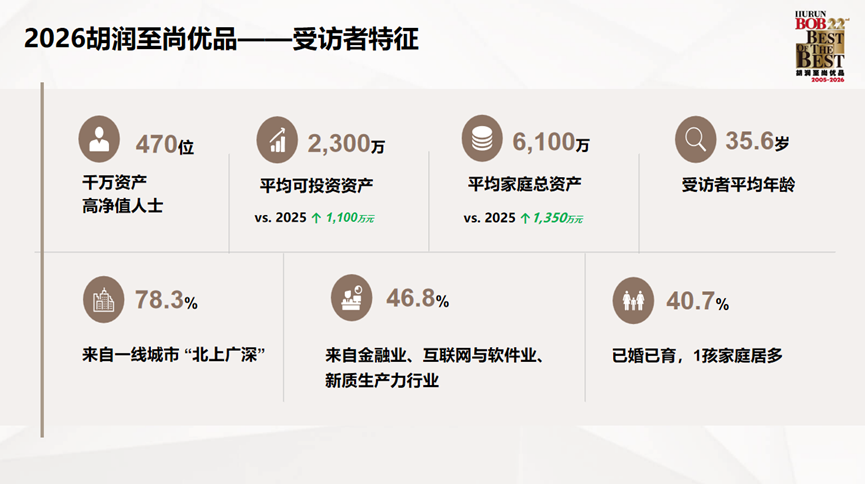
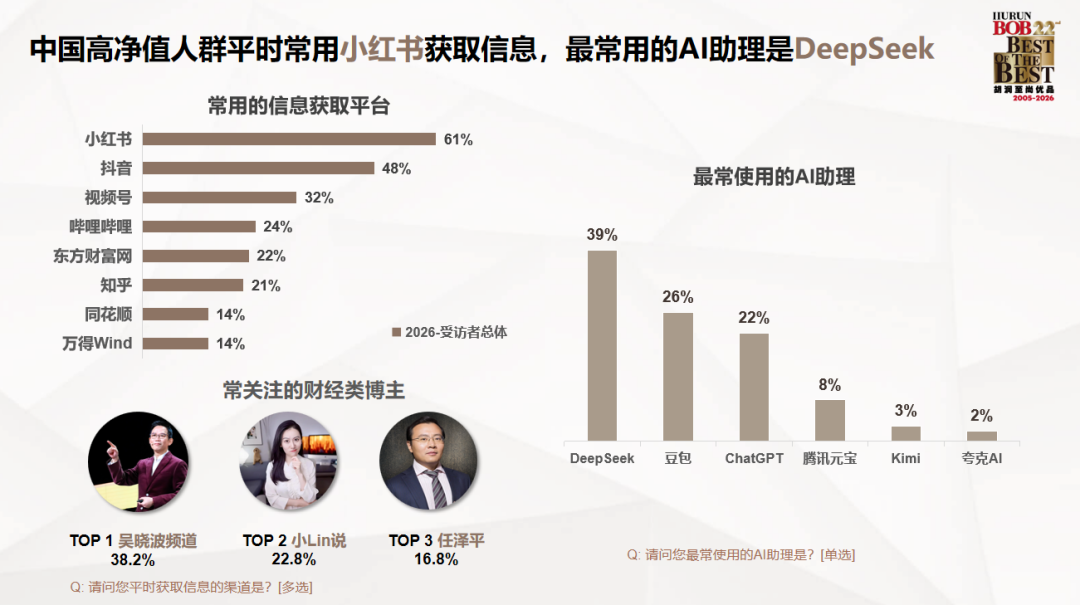
胡润报告:高净值人群常用信息获取平台是小红书和抖音,最常关注财经博主前三名是吴晓波频道、小Lin说和任泽平
Jin Rong Jie· 2026-01-30 07:32
Core Insights - The report by Hurun Research Institute reveals that 61% of high-net-worth individuals frequently use Xiaohongshu for information, which is 13 percentage points higher than Douyin [1] - The most popular financial influencers among high-net-worth individuals are Wu Xiaobo Channel (38%), Xiao Lin Says (23%), and Ren Zeping (17%) [1] Group 1: Information Sources - 61% of surveyed high-net-worth individuals regularly use Xiaohongshu for information, surpassing Douyin by 13 percentage points [1] - 32% of high-net-worth individuals frequently watch WeChat Video Accounts, while 24% use Bilibili [1] - Over 20% of respondents engage with Dongfang Wealth and Zhihu, while Tonghuashun and Wind Information receive 14% engagement [1] Group 2: Age Demographics - Over 70% of individuals under 25 (U25) prefer Xiaohongshu and Douyin as their primary information sources, while those aged 40 and above favor WeChat Video Accounts [1] - Professional investment software like Dongfang Wealth, Wind Information, and Tonghuashun are more popular among individuals aged 35 (U35) and 40 (U40) [1] Group 3: AI Assistants - The most commonly used AI assistants among high-net-worth individuals are DeepSeek and Doubao [1] - U25 individuals predominantly use ChatGPT, while those aged 30 to 45 typically prefer DeepSeek, and respondents over 45 favor Doubao [1]
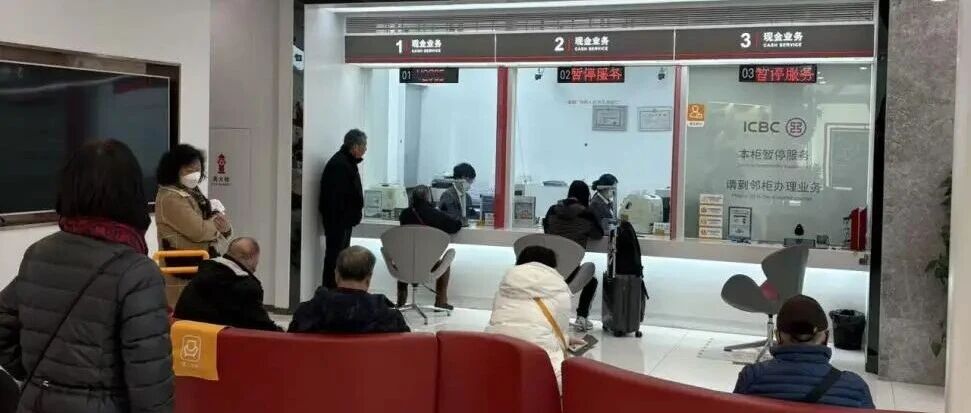
多家银行“一箱难求”!黄金大涨带火银行保险柜租赁,甚至有银行仅特供给百万大客户
中国基金报· 2026-01-13 12:23
Core Viewpoint - The surge in gold prices has significantly increased the demand for bank safe deposit box rentals, leading to a situation where many banks are experiencing shortages, with some only offering services to high-net-worth clients [1][10][12]. Group 1: Market Demand and Trends - The rising gold prices have prompted individuals to invest in gold bars and coins, resulting in a heightened demand for safe deposit boxes to store these assets [3][10]. - Data indicates that gold prices have increased by approximately 68% in 2025, while silver prices have surged by about 148%, driving consumer interest in purchasing gold [10][11]. - The global demand for gold reached a record high of 1,313 tons in Q3 2025, with a total value of $384 billion, reflecting a 41% year-on-year increase [11]. Group 2: Bank Policies and Client Requirements - Many banks have implemented financial asset thresholds for clients wishing to rent safe deposit boxes, with some requiring a minimum of 1 million yuan in assets [5][6]. - The rental fees for safe deposit boxes vary, with small boxes costing around 280 to 500 yuan annually, while larger boxes can range from 1,000 to 3,000 yuan [8][11]. - The availability of safe deposit boxes is influenced by location, with some areas experiencing more shortages than others, particularly in high-demand commercial districts [6][11]. Group 3: Future Outlook - The increasing number of high-net-worth individuals in China, now totaling 470,000, is expected to sustain the demand for safe deposit boxes as these individuals seek secure storage for their assets [12]. - Analysts predict that if gold and silver prices remain high, the demand for bank safe deposit boxes will continue to grow, although supply constraints may persist due to limited physical space and regulatory considerations [12].
税务严查高收入、高净值人群:1818人补税15亿
Di Yi Cai Jing· 2025-12-08 04:14
Core Insights - The National Taxation Administration has intensified scrutiny on high-income and high-net-worth individuals, identifying 1,818 such individuals, including celebrities and internet influencers, and recovering tax payments totaling 1.523 billion yuan [1] Group 1: Tax Regulation and Enforcement - The term "double high" refers to individuals with annual incomes exceeding 1 million yuan or investable assets over 10 million yuan, which includes top celebrities and internet influencers [1] - The regulatory focus on "double high" individuals has been reinforced, with specific measures outlined in the 2021 policy document aimed at enhancing tax service and oversight for this demographic [1] - The tax authorities have increased the scrutiny of tax evasion methods, including income concealment and false cost declarations, particularly among celebrities and internet influencers [1][2] Group 2: Case Studies and Penalties - A notable case involved internet influencer Chen Zhen, who was found to have underreported income and evaded personal income tax totaling 1.1867 million yuan, resulting in a total penalty of 2.4748 million yuan [2] - Chen Zhen's case highlighted the significant discrepancy between his high income and low tax payments, prompting tax authorities to investigate further [2] Group 3: Policy Implementation and Compliance - The implementation of the "Internet Platform Enterprises Tax Information Reporting Regulations" has led to over 7,000 domestic and foreign platforms fulfilling their tax reporting obligations, improving tax compliance among platform operators and employees [3] - The new regulations have contributed to a reduction in practices such as "order brushing" that artificially inflate performance metrics, thereby enhancing the orderliness of the platform economy [3]
已有7家银行私银客户超10万户
2 1 Shi Ji Jing Ji Bao Dao· 2025-11-12 05:45
Core Insights - The private banking sector has seen significant growth in the first three quarters of this year, with seven listed banks reporting over 100,000 private banking clients as of September 30, 2023, indicating a rising demand for wealth management services among high-net-worth individuals [2][4][5] Group 1: Growth in Private Banking Clients - Multiple banks reported a client growth rate exceeding 10%, with Minsheng Bank, Beijing Bank, and Nanjing Bank showing increases over 15% [4] - Minsheng Bank had the fastest growth, reaching 73,409 private banking clients, an increase of 18.21% from the end of last year [5] - Beijing Bank reported 20,586 private banking clients, up 17.9%, and an asset under management (AUM) of 224 billion yuan, a 14.39% increase [5][6] Group 2: Market Position of Major Banks - State-owned banks continue to dominate the private banking market, with Agricultural Bank of China leading at 279,000 clients, followed by China Construction Bank and Bank of China [6] - China Merchants Bank and Ping An Bank have also joined the "100,000 club," with Ping An Bank reaching 103,300 clients, marking its first entry into this category [6][7] Group 3: Challenges and Opportunities in Wealth Management - The growth in private banking clients is attributed to the expanding base of high-net-worth individuals and the upgrading of banking services [9] - The Hu Run Wealth Report indicates that the total wealth of China's 6 million affluent families has reached 150 trillion yuan, with ultra-high-net-worth families holding 87 trillion yuan, an increase from 56% to 58% of total wealth [9] - The private banking sector is facing challenges such as economic shifts, declining risk-free returns, and reduced investor confidence, necessitating a transformation in wealth management services [10][11]







Here’s the Minimum Net Worth You Need To Be in the Top 1% in Your 50s
Yahoo Finance· 2025-10-22 14:08
Group 1 - The top 1% net worth in one's 50s is influenced by various factors including income, saving discipline, investment strategies, and sometimes luck [4][5] - For individuals aged 50 to 54, a net worth of approximately $13.23 million is required to be in the top 1% of that age group, while for those aged 55 to 59, the threshold is about $15.37 million [5][6] - Economic conditions and market fluctuations can significantly impact net worth accumulation and the thresholds for the top 1% [3][4] Group 2 - High-net-worth individuals often benefit from long-term investments, home price appreciation, and business equity, which can lead to substantial wealth growth over time [4][5] - Family wealth transfers, such as inheritances or gifts, can accelerate the process of reaching high net worth brackets [5][6] - Effective debt management, particularly avoiding high-interest debt, allows for more capital to be allocated towards saving and investing [6]
“高净值”准入门槛 600万金融净资产
Nan Fang Du Shi Bao· 2025-08-12 23:10
Core Insights - The report from Hurun Research Institute indicates that high-net-worth individuals have increased their focus on health by nearly 10% and the importance of "money" has risen by 15% over the past four years, reflecting a rational choice for "cash flow safety" [3] - The path to becoming a private banking VIP is becoming increasingly steep, as the wealth threshold continues to rise and the composition of high-net-worth individuals becomes more complex [3][4] - Transitioning from "earning quick money" to "managing money well" involves a significant upgrade in wealth thinking and asset management strategies [3][7] Wealth Thresholds - The entry threshold for private banking clients is generally set at 6 million yuan, with some banks raising it to 8 million or even 10 million yuan [5][6] - As of January 1, 2024, there are approximately 2.066 million high-net-worth families in China, with 1.089 million families having investable assets exceeding 10 million yuan [5] Wealth Management Strategies - High-net-worth individuals differ from the affluent in their risk tolerance, income sources, and focus on wealth transfer and global asset allocation [7][8] - Achieving high-net-worth status requires not just an increase in asset value but also a comprehensive upgrade in wealth management philosophy and practices [8][11] Investment Approaches - High-net-worth individuals employ a "wealth lighthouse model" that categorizes wealth stages into "wealth creation," "wealth preservation," and "wealth transfer," each requiring different asset allocation strategies [9] - Global asset allocation is crucial for high-net-worth individuals to enhance value over time and mitigate risks through diversified investments [10] Evolving Wealth Mindset - The shift from millionaires to high-net-worth individuals necessitates a clearer understanding of wealth stages, systematic asset allocation, and a long-term wealth management perspective [11] - The ultimate goal of wealth management transcends mere numerical growth, aiming instead for a life characterized by control, security, and freedom [11]

100万存款是终点还是起点?读懂高净值人群的游戏规则
Nan Fang Du Shi Bao· 2025-08-08 07:51
Group 1 - The core viewpoint of the articles highlights the evolving consumption mindset and behaviors of high-net-worth individuals (HNWIs) in China, indicating a shift towards valuing health and cash flow security [2][3][4] - The report from Hurun Research Institute shows that the importance of health among HNWIs has increased by nearly 10% over the past four years, while the significance of money has risen by 15% year-on-year [2] - The threshold for being classified as a high-net-worth individual in China is generally recognized as having a financial net asset of 6 million RMB, with some banks setting the bar even higher at 8 million or 10 million RMB [3][4][5] Group 2 - The number of high-net-worth families in China with assets exceeding 10 million RMB reached 2.066 million as of January 1, 2024, with 1.089 million families having investable assets of 10 million RMB or more [4] - The transition from being a millionaire to a high-net-worth individual involves not just an increase in asset numbers but also a significant upgrade in wealth management thinking and strategies [7][9] - High-net-worth individuals typically have a higher risk tolerance and a more diversified income source, focusing on wealth inheritance, tax planning, and global asset allocation [7][10] Group 3 - The investment strategies of high-net-worth individuals emphasize global asset allocation to enhance value over time and mitigate risks [10][11] - A notable trend among Chinese investors is the increasing interest in sustainable investments, with current allocations at 26% and plans to raise this to 38% [11] - The journey from "high value" to "high net worth" requires a clear understanding of wealth stages, systematic asset allocation capabilities, and a long-term wealth management perspective [13]