微信视频号

Search documents
微信:已封禁相关账号
券商中国· 2026-03-18 23:19
Core Viewpoint - The WeChat Video Account is committed to providing a quality user experience and maintaining a safe, orderly, and green platform ecosystem. Recent findings revealed that some short drama institutions engaged in illegal activities such as fake orders and inflated views, which disrupt the platform's ecological order and harm the legitimate rights of users and institutions [1]. Group 1: Governance Actions - The platform has initiated governance actions to combat various behaviors that disrupt transaction order through illegal content and improper means [1]. - Actions taken against verified accounts engaging in such activities include penalties based on the severity of the violations, which may involve account suspension, restrictions on video uploads, and the removal of illegal earnings [2]. Group 2: Specific Violations - Specific violations include maliciously inflating orders, views, and followers to gain unjust traffic and revenue, as well as actions that disrupt the platform's billing and settlement order [2]. - Examples of institutions and accounts that have been banned for high-frequency malicious activities include 河x雪xxx, 安x尚xxx, 许x京xxx, and others, with specific dramas like 《女xxx》 and 《唯xxx》 being removed for containing inappropriate content [2].



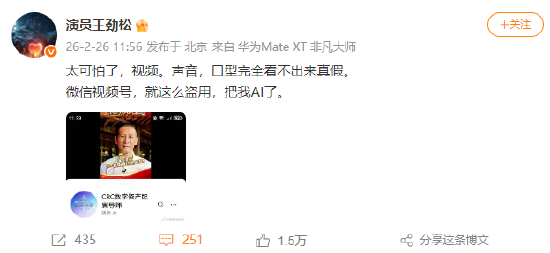
演员王劲松称有微信视频号账号使用AI盗用其形象,“完全看不出来真假,太可怕了”
Xin Lang Cai Jing· 2026-02-26 09:29
Core Viewpoint - Actor Wang Jinsong expressed concerns over AI-generated impersonation on WeChat video accounts, highlighting the potential for more sophisticated and harmful AI portrait infringement used for scams [1][5][7]. Group 1: Incident Description - Wang Jinsong reported that an AI was used to create a video that impersonated him, making it difficult to distinguish between real and fake [1][5]. - He stated that the video had accurate lip-syncing and voice, which raised alarms about the authenticity of such content [1][5]. Group 2: Legal and Ethical Concerns - Wang Jinsong worries about the future implications of AI portrait infringement, questioning whether legal frameworks are prepared to handle such issues [7][2]. - He emphasized the need for laws to evolve alongside technology to prevent misuse and protect individuals from potential scams [2][7]. Group 3: Actions Taken - Wang Jinsong has reported the AI infringement video to the WeChat video team, and the content has since been deleted or suspended from recommendations [7][12]. - The complaint was officially acknowledged by the video team, indicating a process for addressing such issues [11][12].
胡润报告:任泽平位列高净值人群最常关注财经博主前三
泽平宏观· 2026-02-20 16:05
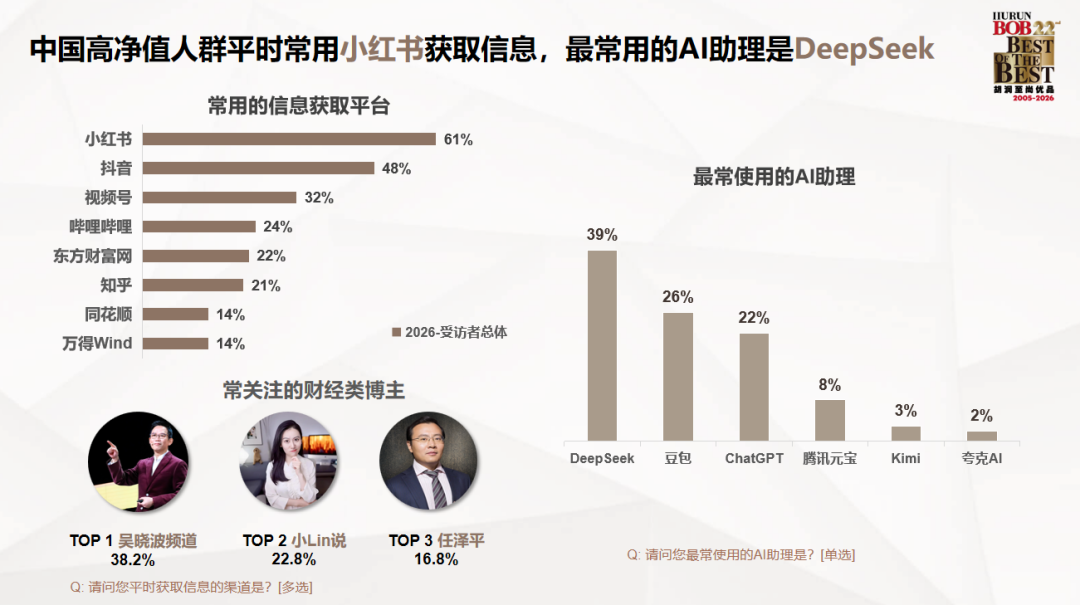
Group 1 - The report by Hurun Research Institute reveals that 61% of high-net-worth individuals frequently use Xiaohongshu for information, which is 13 percentage points higher than Douyin [2] - Among high-net-worth individuals, 32% regularly watch WeChat Video Accounts, while 24% frequently use Bilibili. Other platforms like Dongfang Caifu and Zhihu have engagement levels exceeding 20%, with Tonghuashun and Wind gaining 14% [2] - For the U25 age group, over 70% use Xiaohongshu and Douyin as their primary information sources, while U40 and individuals over 45 prefer video accounts. Professional investment software like Dongfang Caifu, Wind, and Tonghuashun are more popular among U35 and U40 demographics [2] Group 2 - The most commonly used AI assistants among high-net-worth individuals are DeepSeek and Doubao. The U25 group primarily uses ChatGPT, while DeepSeek is favored by U30, U35, U40, and U45 age groups. Individuals over 45 prefer Doubao [3]
胡润报告:任泽平位列高净值人群最常关注财经博主前三
泽平宏观· 2026-02-11 16:07
Group 1 - The report by Hurun Research Institute reveals that 61% of high-net-worth individuals frequently use Xiaohongshu for information, which is 13 percentage points higher than Douyin [2] - Among high-net-worth individuals, 32% regularly watch WeChat Video Accounts, while 24% frequently use Bilibili. Other platforms like Eastmoney and Zhihu have engagement levels exceeding 20%, with Tonghuashun and Wind gaining 14% [2] - Over 70% of individuals aged 25 and under (U25) prefer Xiaohongshu and Douyin as their primary information sources, while those aged 36 to 40 (U40) and above 45 years old favor video accounts [2] Group 2 - The most commonly used AI assistants among high-net-worth individuals are DeepSeek and Doubao. For the U25 age group, ChatGPT is the most popular, while DeepSeek is favored by U30, U35, U40, and U45 age groups. Individuals over 45 years old predominantly use Doubao [3]
胡润报告:任泽平位列高净值人群最常关注财经博主前三
泽平宏观· 2026-02-10 16:00
Group 1 - The report by Hurun Research Institute reveals that 61% of high-net-worth individuals frequently use Xiaohongshu for information, which is 13 percentage points higher than Douyin [2] - Among high-net-worth individuals, 32% regularly watch WeChat Video Accounts, while 24% frequently use Bilibili. Other platforms like Eastmoney and Zhihu have engagement levels exceeding 20%, with Tonghuashun and Wind gaining 14% [2] - Over 70% of individuals aged 25 and under (U25) prefer Xiaohongshu and Douyin as their primary information sources, while those aged 36-40 (U40) and above 45 years old favor video accounts [2] Group 2 - The most commonly used AI assistants among high-net-worth individuals are DeepSeek and Doubao. For the U25 age group, ChatGPT is the most popular, while DeepSeek is favored by U30, U35, U40, and U45 age groups. Individuals over 45 years old predominantly use Doubao [3]
胡润报告:任泽平位列高净值人群最常关注财经博主前三
泽平宏观· 2026-02-09 16:07
Group 1 - The report by Hurun Research Institute reveals that 61% of high-net-worth individuals frequently use Xiaohongshu for information, which is 13 percentage points higher than Douyin [2] - Among high-net-worth individuals, 32% regularly watch WeChat Video Accounts, while 24% frequently use Bilibili. Other platforms like Eastmoney and Zhihu have engagement levels exceeding 20%, with Tonghuashun and Wind gaining 14% [2] - Over 70% of individuals aged 25 and under (U25) prefer Xiaohongshu and Douyin as their primary information sources, while those aged 36-40 (U40) and above 45 years old favor video accounts. Professional investment software like Eastmoney, Wind, and Tonghuashun are more popular among individuals aged 31-35 (U35) and U40 [2] Group 2 - The most commonly used AI assistants among high-net-worth individuals are DeepSeek and Doubao. For the U25 age group, ChatGPT is the most frequently used, while DeepSeek is preferred by U30, U35, U40, and U45 age groups. Individuals over 45 years old primarily use Doubao [3]
《胡润2026中国高净值人群品质报告》:吴晓波频道成为最常关注的财经博主
吴晓波频道· 2026-02-02 00:30
Wealth Characteristics - The survey covered 470 high-net-worth individuals in China, with an average family total asset of 61 million yuan and an average investable asset of 23 million yuan. Wealth sources include investments (28%), salary (22%), business dividends (21%), inheritance (16%), and rental income (13%) [4] - 78% of respondents are from first-tier cities (Beijing, Shanghai, Guangzhou, Shenzhen), with an average age of 36 years, and a gender distribution of 47% male and 53% female. 26% of respondents have "very high confidence" in the Chinese economy, while 59% have "some confidence" [6] Investment and Self-Improvement - The most favored method for self-improvement among high-net-worth individuals is reading books/professional journals (20%), followed by online learning platforms (15%) and MBA/EMBA/DBA courses (13%) [8] - 61% of high-net-worth individuals frequently use Xiaohongshu for information, surpassing Douyin by 13 percentage points. The top three financial bloggers followed are Wu Xiaobo Channel (38%), Xiao Lin Says (23%), and Ren Zeping (17%) [10] Future Investment Directions - In the coming year, high-net-worth individuals plan to increase investments in gold, overseas investments, funds, and insurance, with net growth intentions of 15% for gold, 7% for overseas investments, and 6% for both funds and insurance. There is a clear inclination towards increasing investments overall [13] - Conversely, there is a net decrease intention of 21% for real estate investments, 10% for art and collectibles, and 3% for A-shares [14] Basic Consumption Trends - The top three categories of planned increased spending for the coming year are travel, health and wellness, and children's education [18] - Over half of high-net-worth individuals plan to reduce spending on daily luxury goods, indicating a more rational and pragmatic consumption mindset [21] - The average expected reduction in material consumption for high-net-worth families is 242,000 yuan, with specific reductions in watch (123,000 yuan), collectibles (86,000 yuan), and jewelry (55,000 yuan) spending [22] Consumption Characteristics - There is a significant decline in enthusiasm for high-end brands, dropping by 12 percentage points, while interest in practical clothing (focused on comfort, not brand) has risen by 14 percentage points [25] - Interest in alcoholic beverages has decreased, with 18% of respondents indicating they do not drink alcohol. Among preferred alcoholic beverages, baijiu remains the most popular (19%), followed by whiskey and wine (16% each) [27] Health Management - The overall satisfaction score regarding health management across five aspects (exercise, nutrition, sleep, emotional well-being, preventive healthcare) is 7.8 [33] - 81% of respondents have a weekly exercise plan, with 57% planning to exercise for over 2 hours weekly [36] - 68% of respondents undergo regular health check-ups, and 31% visit wellness centers for specialized care [37] Leisure Activities - The most favored leisure activity among high-net-worth individuals is travel (32%), followed by food (21%) and family activities [42] - The average number of international trips taken in the past year is 2.1, with Sanya, Yunnan, and Xinjiang being the top domestic travel destinations [49]

胡润报告:任泽平位列高净值人群最常关注财经博主前三
泽平宏观· 2026-01-31 16:06
Group 1 - The report by Hurun Research Institute reveals that 61% of high-net-worth individuals frequently use Xiaohongshu for information, which is 13 percentage points higher than Douyin [2] - Among high-net-worth individuals, 32% regularly watch WeChat Video Accounts, while 24% frequently use Bilibili. Other platforms like Eastmoney and Zhihu have engagement levels exceeding 20%, with Tonghuashun and Wind gaining 14% [2] - Over 70% of individuals aged 25 and under (U25) prefer Xiaohongshu and Douyin as their primary information sources, while those aged 36-40 (U40) and above 45 years old favor video accounts. Professional investment software like Eastmoney, Wind, and Tonghuashun are more popular among individuals aged 31-35 (U35) and U40 [2] Group 2 - The most commonly used AI assistants among high-net-worth individuals are DeepSeek and Doubao. For the U25 age group, ChatGPT is the most frequently used, while DeepSeek is preferred by U30, U35, U40, and U45 age groups. Individuals over 45 years old primarily use Doubao [3]
胡润报告:高净值人群常用信息获取平台是小红书和抖音,最常关注财经博主前三名是吴晓波频道、小Lin说和任泽平
Jin Rong Jie· 2026-01-30 07:32
Core Insights - The report by Hurun Research Institute reveals that 61% of high-net-worth individuals frequently use Xiaohongshu for information, which is 13 percentage points higher than Douyin [1] - The most popular financial influencers among high-net-worth individuals are Wu Xiaobo Channel (38%), Xiao Lin Says (23%), and Ren Zeping (17%) [1] Group 1: Information Sources - 61% of surveyed high-net-worth individuals regularly use Xiaohongshu for information, surpassing Douyin by 13 percentage points [1] - 32% of high-net-worth individuals frequently watch WeChat Video Accounts, while 24% use Bilibili [1] - Over 20% of respondents engage with Dongfang Wealth and Zhihu, while Tonghuashun and Wind Information receive 14% engagement [1] Group 2: Age Demographics - Over 70% of individuals under 25 (U25) prefer Xiaohongshu and Douyin as their primary information sources, while those aged 40 and above favor WeChat Video Accounts [1] - Professional investment software like Dongfang Wealth, Wind Information, and Tonghuashun are more popular among individuals aged 35 (U35) and 40 (U40) [1] Group 3: AI Assistants - The most commonly used AI assistants among high-net-worth individuals are DeepSeek and Doubao [1] - U25 individuals predominantly use ChatGPT, while those aged 30 to 45 typically prefer DeepSeek, and respondents over 45 favor Doubao [1]
新BAT十年战争
3 6 Ke· 2026-01-28 11:39
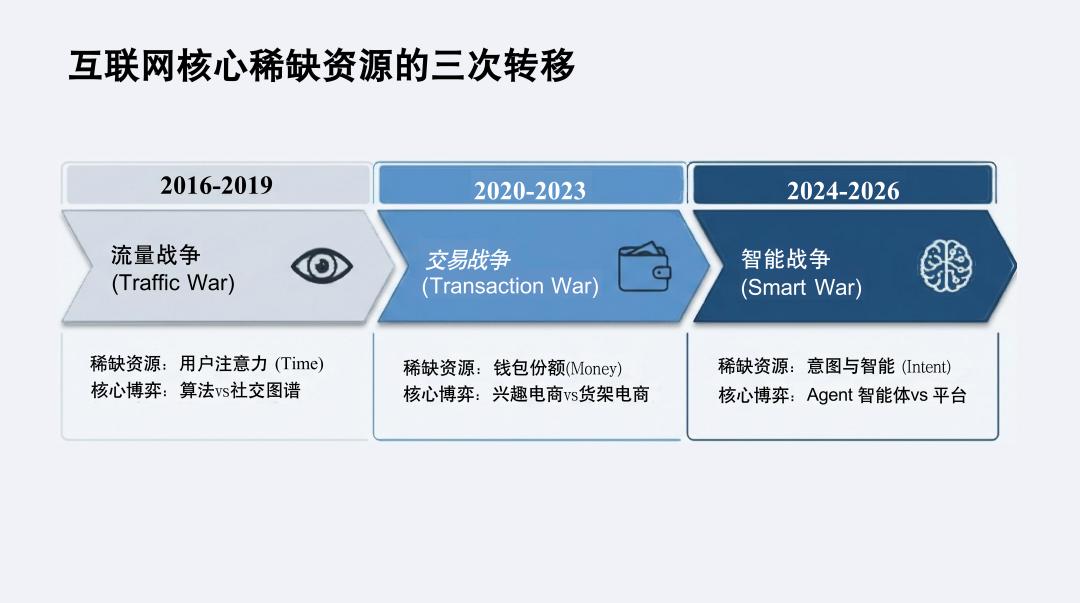
Core Insights - ByteDance's valuation is currently estimated at $480 billion, surpassing Alibaba and posing significant competition to both Alibaba and Tencent in various sectors [1][2]. - The traditional "BAT" (Baidu, Alibaba, Tencent) framework has been disrupted, with ByteDance emerging as the new center of gravity in the tech landscape [4]. Group 1: Historical Context and Competition - The competition has evolved from a focus on user attention (2016-2019) to a battle for consumer spending (2020-2023), and is expected to shift towards AI-driven competition (2024-2026) [6][45]. - ByteDance's rise began with its innovative recommendation engine, which allowed it to capture user engagement more effectively than traditional platforms [12][26]. - By 2019, ByteDance's digital advertising revenue surpassed Baidu's, marking the end of the old BAT era [17]. Group 2: Market Dynamics - The transition to "transaction wars" saw ByteDance establish a significant presence in e-commerce, with its GMV skyrocketing from approximately 500 billion yuan in 2020 to 2.6 trillion yuan by 2023 [32]. - During this period, Alibaba faced severe challenges, including regulatory issues and competition from both ByteDance and Pinduoduo, leading to a significant decline in its market position [34][33]. - Tencent's response to the competition included the launch of WeChat Video Accounts, which integrated various services within its ecosystem, allowing for a more seamless user experience [38][41]. Group 3: Future Outlook - The upcoming "intelligent wars" will focus on AI capabilities, with companies vying for control over user intent through advanced AI agents [45][46]. - ByteDance is rapidly advancing in AI, launching its AI assistant "Doubao," which has gained over 100 million daily active users, showcasing its potential in the AI space [54]. - Alibaba is also pivoting towards AI, with its open-source model gaining traction among developers, while Tencent is restructuring to enhance its AI capabilities [66][60]. Group 4: Key Metrics - As of now, Tencent leads in monthly active users with 1.4 billion on WeChat, while ByteDance boasts two products (Douyin and TikTok) with over 1 billion monthly active users each [71]. - In e-commerce, Alibaba remains the leader with a GMV of approximately 8 trillion yuan, but ByteDance's e-commerce segment has reached around 3 trillion yuan, significantly impacting Alibaba's market share [71].