
AI芯片国产化

Search documents
港股芯片半导体爆发!中芯国际、华虹半导体联袂大涨
Xin Lang Cai Jing· 2025-11-27 02:35
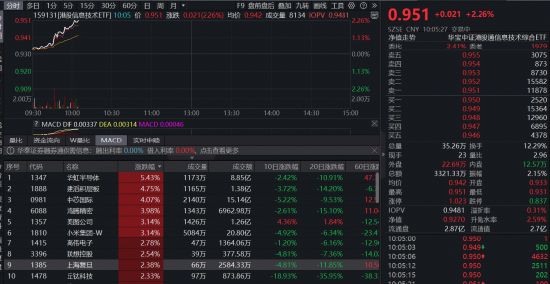
Core Viewpoint - The Hong Kong semiconductor industry chain is experiencing a significant upward trend, with various stocks showing notable gains, indicating a potential recovery in the market [1]. Group 1: Market Performance - The Hang Seng Technology Index rose nearly 1%, with notable increases in stocks such as Hua Hong Semiconductor (over 5% increase), SMIC and Jiantao Laminated Board (over 4% increase), and others like Hong Teng Precision, Meitu, and Xiaomi Group (over 3% increase) [1]. - The first Hong Kong ETF focusing on the semiconductor industry (159131) saw a price increase of 2.26%, confirming a rebound pattern, with real-time transaction volume exceeding 330 million yuan [1]. Group 2: Industry Insights - The semiconductor market is entering a new cycle driven by AI demand, with a recommendation to monitor inventory and pricing data closely [2]. - The China Semiconductor Industry Association predicts that the total sales of the chip design industry will reach 835.73 billion yuan by 2025, reflecting a 29.4% growth compared to 2024 [3]. - The domestic chip development is seen as a long-term trend, with current conditions viewed as the best time for growth in advanced process manufacturing and chip architecture upgrades [5]. Group 3: Valuation and Investment Opportunities - Many Chinese tech companies are valued at only one-third to half of their U.S. counterparts, despite offering competitive AI products, making the Hong Kong tech sector particularly attractive for investment [6]. - The Hong Kong Information Technology ETF (159131) is structured with a focus on hardware (70%) and software (30%), covering 42 hard-tech companies, with significant weights in SMIC (20.27%), Xiaomi Group (9.11%), and Hua Hong Semiconductor (5.64%) [8].


ETF盘中资讯 | “AI芯片霸主”紧急发声:GPU仍领先行业一代!首只聚焦“港股芯片”产业链的港股信息技术ETF(159131)持续上涨
Sou Hu Cai Jing· 2025-11-26 03:00
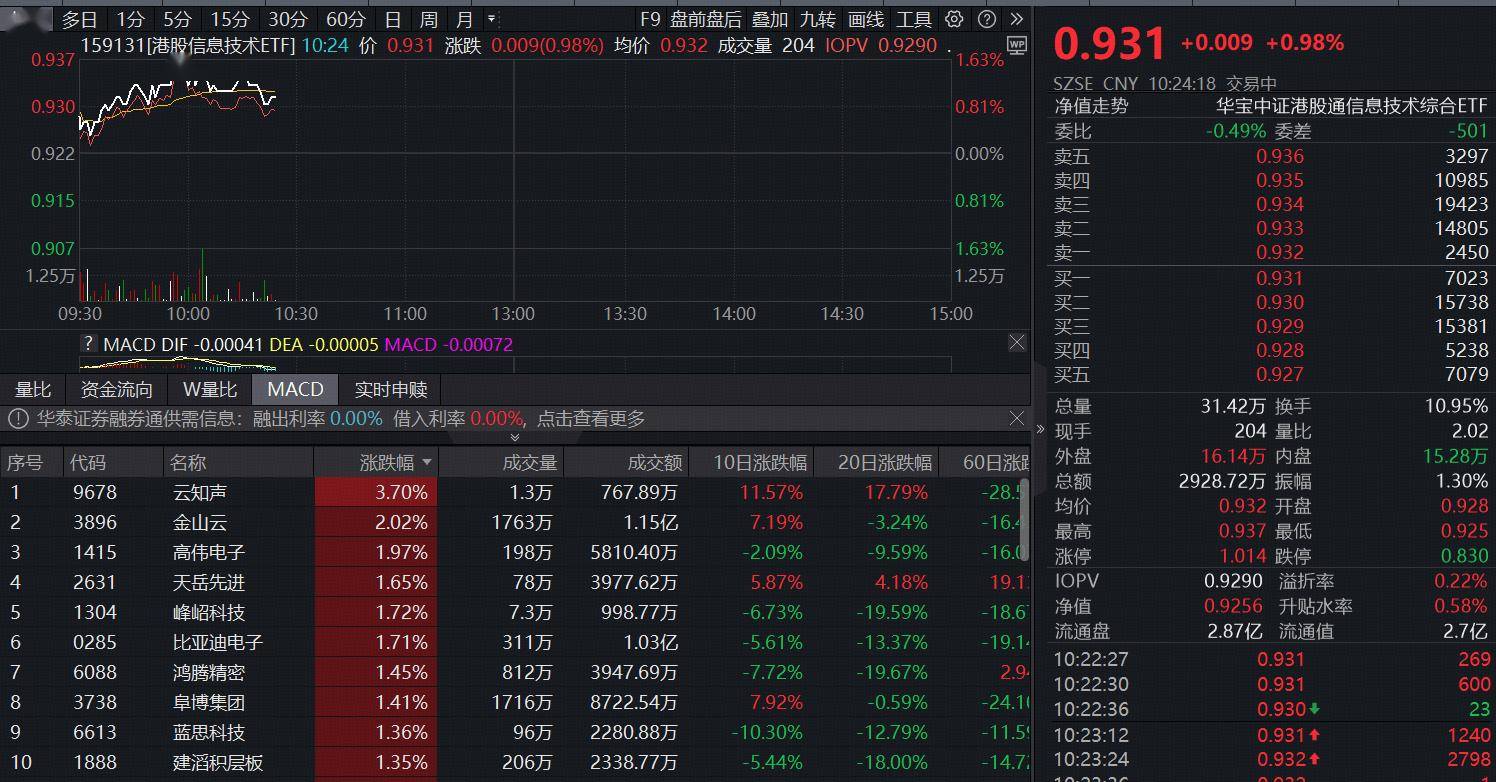
Core Insights - The Hong Kong stock market's chip industry chain is experiencing a significant upward trend, with the first ETF focused on this sector showing a price increase of over 1.6% at one point, currently up by 0.98% [1] - Nvidia has publicly defended its leading position in the AI chip market against challenges from Google, which is negotiating to use TPU chips in its data centers, potentially capturing 10% of Nvidia's annual revenue [3] - The valuation of many Chinese tech companies is significantly lower than their US counterparts, with Hong Kong tech stocks showing even more attractive valuations compared to the broader market [4] Industry Overview - The newly launched Hong Kong Information Technology ETF (159131) focuses on the chip industry, comprising 70% hardware and 30% software, and includes 42 hard-tech companies, with notable weights in SMIC (20.27%), Xiaomi (9.11%), and Hua Hong Semiconductor (5.64%) [6] - The ETF aims to capture the potential of the Hong Kong chip supercycle, excluding major internet companies like Alibaba and Tencent to enhance focus on AI hard-tech [6] - The domestic AI chip development is seen as a long-term trend, with current conditions viewed as optimal for the growth of local chip manufacturers [3]
AI芯片霸主紧急发声:GPU仍领先行业一代!首只聚焦“港股芯片”产业链的港股信息技术ETF(159131)持续上涨
Xin Lang Ji Jin· 2025-11-26 02:45
Group 1 - The Hong Kong stock market's chip industry chain is experiencing an upward trend, with the first ETF focused on this sector (159131) seeing a price increase of over 1.6% at one point, currently up by 0.98% and achieving a trading volume exceeding 29 million CNY [1] - The ETF is designed to track the "70% hardware + 30% software" index, heavily investing in semiconductor, electronics, and computer software sectors, including major companies like SMIC (20.27% weight) and Xiaomi (9.11% weight) [6][7] - The valuation of many Chinese tech companies is significantly lower than their US counterparts, with Hong Kong tech stocks showing even more attractive valuations, as evidenced by the CSI Hong Kong Technology Index's PE valuation percentile being around 39%, compared to 84% for the ChiNext Index and 73% for the Nasdaq 100 [4] Group 2 - Nvidia has publicly asserted its leading position in the GPU market, responding to concerns about competition from Google in the AI chip sector, particularly regarding Google's TPU chips [3] - Google is negotiating with Meta to use TPU chips worth billions in its data centers, which could potentially capture 10% of Nvidia's annual revenue, translating to billions in additional income for Google [3] - The trend towards domestic chip production in China is seen as a long-term necessity, with current conditions viewed as optimal for the development of domestic chips, driven by advancements in manufacturing processes and chip architecture [3]




谷歌挑战英伟达AI芯片霸主地位,国产GPU加速发展,数字经济ETF(560800)盘中上涨0.42%
Sou Hu Cai Jing· 2025-11-26 02:12
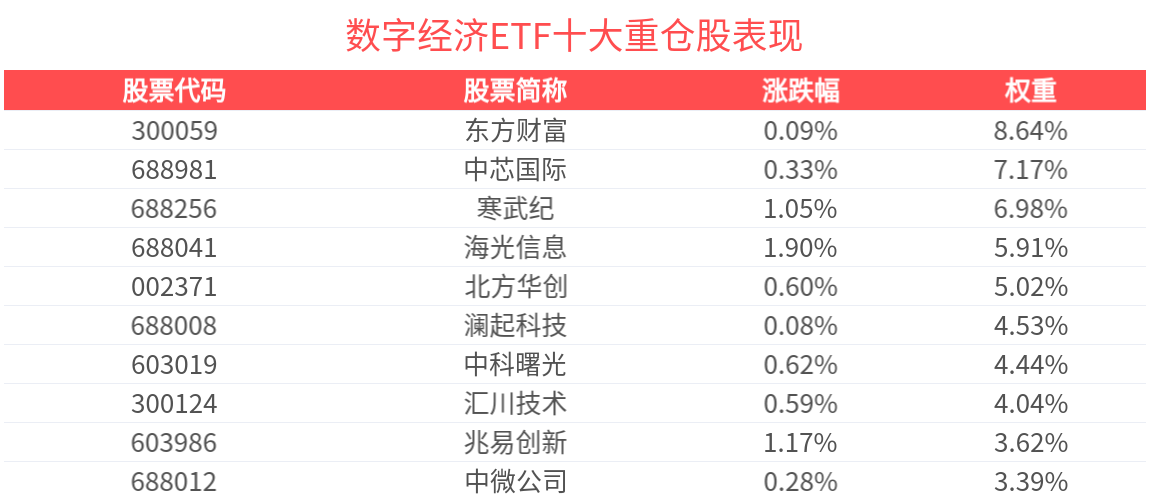
Group 1 - The core viewpoint of the articles highlights the positive performance of the digital economy sector, with the China Securities Digital Economy Theme Index rising by 0.57% and significant gains in constituent stocks such as Runze Technology and Inspur Information [1][2] - The Digital Economy ETF (560800) has seen a 200,000 share increase in the last two weeks, indicating strong market interest and liquidity, with a total net inflow of 24.32 million yuan over 11 out of the last 17 trading days [1][2] - The IPO of domestic GPU leader Moore Threads has set a record for the fastest approval on the Sci-Tech Innovation Board, reflecting strong market support for hard technology enterprises [2] Group 2 - Nvidia's stock experienced a significant drop following Google's advancements in AI models, which could potentially allow Google to capture 10% of Nvidia's annual revenue, translating to billions in new income for Google [1] - The top ten weighted stocks in the China Securities Digital Economy Theme Index account for 53.93% of the index, with companies like Dongfang Wealth and Cambricon leading the list [2][4] - The ongoing trend towards domestic AI chip production is seen as a long-term necessity, with expectations for advancements in manufacturing processes and chip architecture to enhance the overall domestic computing power [2]
跳空高开涨逾3%!港股芯片产业链集体拉升,港股信息技术ETF(159131)触底大幅反弹
Mei Ri Jing Ji Xin Wen· 2025-11-25 02:14
Group 1 - The Hong Kong stock market's semiconductor industry chain experienced a collective surge, with the first Hong Kong ETF focused on the semiconductor sector (159131) opening significantly higher, showing a price increase of over 3.3% at one point during the session, indicating strong buying interest [1] - The net inflow of funds into the Hong Kong Information Technology ETF (159131) exceeded 17 million yuan in a single day [1] - The chairman of the Integrated Circuit Design Branch of the China Semiconductor Industry Association, Wei Shaojun, projected that the total sales of China's chip design industry will reach 835.73 billion yuan by 2025, representing a growth of 29.4% compared to 2024 [1] Group 2 - The Hong Kong Information Technology ETF (159131) is composed of a benchmark index made up of 70% hardware and 30% software, heavily investing in semiconductor, electronics, and computer software sectors, covering 42 Hong Kong hard-tech companies [2] - Notably, SMIC holds a weight of 20.27%, Xiaomi Group-W has a weight of 9.11%, and Hua Hong Semiconductor has a weight of 5.64% in the ETF [2] - The ETF excludes major internet companies like Alibaba, Tencent, and Meituan, allowing for a sharper focus on capturing the trends in Hong Kong's AI hard-tech market [2]
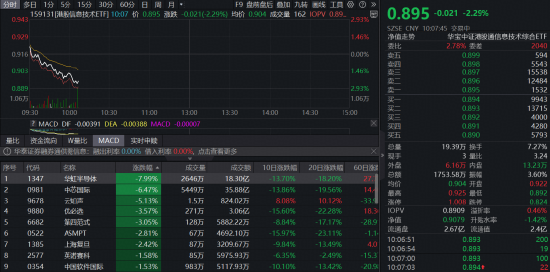
中芯国际跌逾6%,“抄底”港股芯片?159131盘中获资金净申购1800万份
Xin Lang Ji Jin· 2025-11-24 02:23
Group 1 - The Hong Kong stock market experienced a significant pullback in the semiconductor sector, with notable declines in companies such as Hua Hong Semiconductor, which fell nearly 8%, and SMIC, which dropped over 6% [1] - The first ETF focusing on the Hong Kong semiconductor industry has been launched, tracking the "CSI Hong Kong Technology Comprehensive Index," which consists of 70% hardware and 30% software, including 42 Hong Kong tech companies [4][6] - The Chinese semiconductor industry is projected to see a sales increase of 29.4% in 2025, reaching approximately 835.73 billion yuan compared to 2024 [2] Group 2 - The current moment is seen as an optimal time for the development of domestic chips in China, with a long-term trend towards the localization of AI chips [3] - The ETF mentioned above has significant weightings in key companies, with SMIC at 20.27%, Xiaomi Group at 9.11%, and Hua Hong Semiconductor at 5.64%, excluding major internet firms like Alibaba and Tencent [4] - The ETF has seen a real-time net subscription of 18 million units, indicating strong market interest despite the current downturn [2]
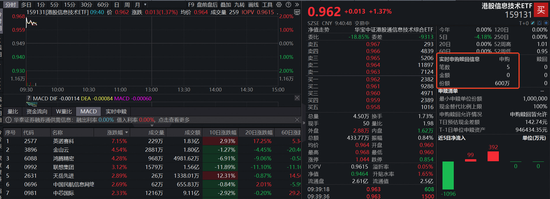
英伟达财报炸裂,芯片行情再爆发!首只聚焦“港股芯片”产业链的港股信息技术ETF(159131)上涨超1%
Xin Lang Ji Jin· 2025-11-20 01:50
Group 1 - The core viewpoint of the news highlights the strong performance of AI-related stocks in the Hong Kong market, with significant gains observed in companies like InnoCare, Kingsoft Cloud, and SMIC, indicating a bullish sentiment in the AI sector [1][3] - Nvidia reported impressive financial results, with a net profit of $31.91 billion, a year-on-year increase of 65%, which has boosted market confidence in the continuation of the AI cycle [3] - The launch of the first Hong Kong ETF focused on the semiconductor industry, which tracks the "Hong Kong Technology Comprehensive Index," is seen as a strategic move to capitalize on the growing AI and semiconductor market [3][5] Group 2 - The new ETF (159131) has a composition of 70% hardware and 30% software, heavily investing in semiconductor and electronic companies, with significant weights assigned to SMIC (20.27%), Xiaomi (9.11%), and Hua Hong Semiconductor (5.64%) [3] - The ETF excludes major internet companies like Alibaba, Tencent, and Meituan, allowing for a sharper focus on AI hard technology trends in the Hong Kong market [3] - The current timing is viewed as optimal for the development of domestic chips, with expectations for advancements in manufacturing processes and chip architecture to enhance overall domestic computing power [3]
美股AI巨震,瑞银:是时候将目光投向中国了!“港股芯片”估值吸引力亮眼
Xin Lang Ji Jin· 2025-11-19 02:53
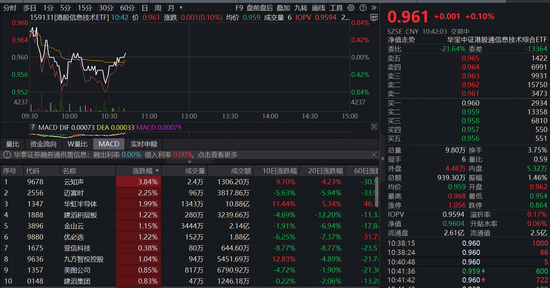
Group 1 - The core concern is the increasing worries about an "AI bubble" leading to significant sell-offs in US tech stocks, with debates on whether AI has driven the market to a bubble state [1] - Pessimists argue that high valuations prompt a tendency to cash out, while optimists, including management from AMD and Nvidia, assert that the demand for AI data centers is real and growing rapidly, distinguishing it from the 2000 internet bubble [1] - UBS Global Wealth Management's Jason Draho suggests that the Chinese tech sector offers an attractive way to balance US tech stock holdings due to the high valuations in the US market [1] Group 2 - Many large Chinese tech companies are valued at only one-third to half of their US counterparts, yet they are launching competitive AI products [1] - The Chinese tech sector, particularly the Hong Kong market, is attracting investors due to its valuation advantages, with the Hong Kong tech index showing a PE ratio around 40% over the past three years, significantly lower than the NASDAQ [1] Group 3 - The first ETF focusing on the Hong Kong chip industry has been launched, comprising 70% hardware and 30% software, and includes 42 Hong Kong tech companies, with significant weights in companies like SMIC and Xiaomi [4] - The ETF aims to capture the potential of the Hong Kong AI hard tech market, excluding large internet firms like Alibaba and Tencent for a sharper focus [4] Group 4 - The ongoing trend of domestic AI chip localization is seen as a long-term necessity, with current conditions viewed as optimal for the development of domestic chips [4] - The ETF tracking the Hong Kong tech index is designed to adapt to market fluctuations, with individual stock weights adjusted semi-annually [5]
小摩:料中芯国际毛利率难显著提升 续予减持评级
Zhi Tong Cai Jing· 2025-11-18 07:37
Core Viewpoint - Morgan Stanley's report indicates that the stock price of SMIC (00981) significantly increased in Q3 due to its position as a leading wafer foundry in mainland China, supporting the domestic production of AI chips. However, the bank emphasizes the need for actual profit data to sustain valuation premiums, which is unlikely to be realized in the next 6 to 12 months [1] Financial Performance - The bank has raised its earnings per share (EPS) forecasts for 2026 and 2027 by 8% and 42% respectively, while increasing the target price from HKD 36 to HKD 57 [1] Margin Analysis - Despite strong demand for advanced process products and near-saturation capacity utilization, the company's gross margin remains at a low 20% level. The bank anticipates that significant improvements in gross margin will be difficult in the coming years due to rapidly rising depreciation costs [1] Yield and Pricing Pressure - The report notes that the yield rates for advanced process nodes are still relatively low, and although the proportion of related products continues to increase, the overall average selling price remains under pressure [1]
小摩:料中芯国际(00981)毛利率难显著提升 续予减持评级
智通财经网· 2025-11-18 07:36
Core Viewpoint - Morgan Stanley reports that SMIC's stock price significantly increased in Q3 due to its position as a leading wafer foundry in mainland China, supporting domestic AI chip production. However, the bank maintains a cautious outlook, emphasizing the need for actual profit data to sustain valuation premiums, which is unlikely to materialize in the next 6 to 12 months [1] Financial Performance - The bank has raised its earnings per share forecasts for 2026 and 2027 by 8% and 42% respectively, and increased the target price from HKD 36 to HKD 57 [1] Margin Analysis - Despite strong demand for advanced process products and near-saturation capacity utilization, the company's gross margin remains at a low 20% level. The bank anticipates that gross margins will struggle to improve significantly in the coming years due to rapidly rising depreciation costs [1] Yield and Pricing Pressure - The bank notes that the yield rates for advanced process nodes are still relatively low, and although the proportion of related products is increasing, the overall average selling price remains under pressure [1]