个人养老金

Search documents
每日钉一下(银行指数近几年上涨了不少,有哪些收益来源呢?)
银行螺丝钉· 2025-07-04 13:59
Group 1 - The core viewpoint is that investing in personal pensions can enhance retirement security while benefiting from tax deferral advantages [1]. Group 2 - Information on how to open a personal pension account and the five major investment options available is provided [2]. - A free course is offered to learn about personal pension investment methods, including course notes and mind maps for efficient learning [3].

领取个人养老金 为何要缴纳个人所得税
Jin Rong Shi Bao· 2025-07-03 03:43
Core Viewpoint - The recent announcement by the Ministry of Human Resources and Social Security regarding the taxation of personal pensions has sparked widespread discussion among the public, particularly concerning the necessity of paying taxes on pensions upon withdrawal and the overall value of contributing to personal pensions [1][2]. Summary by Relevant Sections Definition and Differences - Personal pensions, introduced in a pilot program in November 2022 and set for nationwide implementation by December 2024, are designed as a supplementary retirement savings option, allowing individuals to voluntarily contribute up to 12,000 yuan per year into a personal pension account [2][3]. - Basic pensions, in contrast, are part of the first pillar of China's pension system, providing a monthly income to urban workers and rural residents upon reaching retirement age, without any tax obligations upon withdrawal [2]. Taxation Policy - Upon withdrawal, personal pensions are subject to a 3% personal income tax, which applies to both the principal and investment returns, differing from the tax-free status of basic pensions [2][3]. - The deferred tax policy for personal pensions allows contributions and investment gains to be tax-exempt until withdrawal, which is a common international practice aimed at encouraging participation in pension schemes [3]. Financial Implications - For middle and high-income individuals, contributing to personal pensions can yield significant tax savings and serve as a form of enforced savings for retirement, making the 3% tax at withdrawal relatively beneficial [4]. - Conversely, low-income individuals, especially those not subject to income tax, may find personal pensions less advantageous, as they do not benefit from tax savings during contributions and face taxation upon withdrawal [4]. Example Calculation - An example illustrates that an individual with a monthly income of 15,000 yuan, subject to a 10% tax rate, could save 1,200 yuan annually by contributing to a personal pension over 20 years, resulting in total tax savings of 24,000 yuan. Assuming a 3% annual return, the total amount at retirement would be approximately 320,000 yuan, with a 3% tax on withdrawal amounting to 9,600 yuan, leading to net tax savings of 14,400 yuan [4]. Conclusion - The personal pension system is designed to enhance retirement security, requiring individuals to consider their income, investment capabilities, and retirement plans when deciding on contributions and investment strategies [4].
热点追踪|领取个人养老金为何要缴税?
Xin Hua She· 2025-07-01 07:07
Core Points - The recent discussion around the taxation of personal pensions has raised questions about the rationale behind taxing personal pensions when income tax has already been paid on salaries [2][3] - Personal pensions serve as a voluntary supplement to the basic pension, which is mandatory and funded through payroll deductions [2][3] - The taxation model for personal pensions follows an "EET" structure: contributions are tax-deductible, investment gains are tax-free, and withdrawals are taxed at a low rate of 3% [3][4] Summary by Topics - **Difference Between Personal and Basic Pensions** - Basic pensions are mandatory and provide essential financial support post-retirement, while personal pensions are voluntary savings intended to enhance retirement income [2][3] - **Taxation on Personal Pensions** - Contributions to personal pensions can be deducted from taxable income, allowing for tax savings during the contribution phase. Investment gains within the account are not taxed, but withdrawals are subject to a 3% tax rate [3][4] - **Cost-Benefit Analysis of Personal Pensions** - For individuals with a monthly income of 10,000 yuan, contributing 12,000 yuan annually can lead to significant tax savings over time, making personal pensions a beneficial long-term investment for retirement [4]
华源晨会-20250629
Hua Yuan Zheng Quan· 2025-06-29 14:04
Group 1: Personal Pension System - The personal pension system in China has been fully implemented for six months, showcasing low-risk and stable returns as its core advantages, indicating significant investment potential in a multi-tiered pension system [2][6][8] - By the end of 2024, the total scale of the multi-tiered pension system in China was approximately 18.8 trillion yuan, with a year-on-year growth of 12.77%, and the participation rate in basic pension insurance reached 76.2% [6][7] - As of May 2025, the personal pension product matrix consists of four main categories: savings (45%), funds (29%), insurance (23%), and wealth management (3%), with leading institutions capturing market share through comprehensive product offerings [7][8] Group 2: North Exchange Market Strategy - The North Exchange has transitioned from "out of the circle" to "outstanding," experiencing market fluctuations and continuous policy improvements, with the North 50 index showing a remarkable increase of 36% since the beginning of 2025 [11][12] - Future expectations include ongoing policy support for the North Exchange, continuous supply of high-quality enterprises, and increased capital inflow, with a focus on scarcity investments as the strongest investment theme [12][14] - The merger and acquisition concept remains a hot investment topic in the North Exchange, with significant potential for companies that can leverage acquisitions for business diversification and optimization [25][26] Group 3: Renewable Energy Sector - As of May 2025, the cumulative installed power generation capacity in China reached 3.61 billion kilowatts, a year-on-year increase of 18.8%, with solar and wind power installations hitting record highs [17][18] - The wind power sector saw a significant increase in installed capacity, with 46.3 GW added in the first five months of 2025, representing a year-on-year growth of 134.2% [18][19] - The profitability of wind turbine manufacturers is expected to improve due to the stabilization of bidding prices and the reduction in the proportion of new product deliveries, which had previously pressured profit margins [21][24]
重大!养老金要交税?别慌!普通人的“保命钱”仍是免税的!
Sou Hu Cai Jing· 2025-06-28 07:41
Core Viewpoint - The recent news regarding a 3% tax on personal pensions has sparked concerns about retirement fund security, revealing two distinct pension models and the government's nuanced approach to pension policy [1]. Group 1: Basic Pension System - The basic pension, commonly referred to as retirement funds, is completely tax-exempt for all individuals, including employees, civil servants, and rural residents, regardless of the amount received [1]. - This tax exemption benefits over 210 million retirees, reflecting the government's commitment to safeguarding citizens' livelihoods [1]. Group 2: Personal Pension System - The personal pension introduced in 2021 is not a supplement to the basic pension but serves as a third pillar in the pension system, encouraging individuals to engage in long-term retirement planning [1]. - Participants can voluntarily deposit funds into a designated account for investment, with a maximum annual contribution of 12,000 yuan, enjoying tax benefits during the deposit phase, but will incur a 3% tax on both principal and earnings upon withdrawal [1]. Group 3: Impact on Different Income Groups - For high-income individuals, the 3% tax rate may be advantageous, allowing them to convert high personal income tax into long-term investment returns, with participation rates among those earning over 960,000 yuan increasing by 76% [3]. - Conversely, for the average wage earners, the appeal of this "light tax incentive" diminishes, as the annual contribution limit of 12,000 yuan is minimal compared to their monthly salaries, raising concerns about the risks associated with personal pension investments [5]. - The government's dual approach to pension policy aims to ensure basic living standards for retirees while encouraging higher-income individuals to plan more comprehensively for retirement, leading to discussions about fairness and inclusivity in the system [5].
领取养老金要缴3%个税?权威解答来了!
新华网财经· 2025-06-27 07:24
Core Viewpoint - The recent policy regarding personal pensions requires a 3% individual income tax on withdrawals, which has raised questions about its implications for retirees and the distinction between basic pensions and personal pensions [1][3]. Group 1: Understanding Pensions - Basic pensions, part of the national social insurance system, are exempt from individual income tax, while personal pensions, introduced in 2022, are subject to a 3% tax upon withdrawal [1][2]. - Personal pensions allow individuals to contribute up to 12,000 yuan annually, providing a supplementary source of retirement income [1][3]. Group 2: Taxation Details - The 3% tax on personal pensions is not a new policy; it has been in effect since January 1, 2022, as part of a deferred tax incentive [3]. - Contributions to personal pensions are tax-deductible up to the annual limit, and investment gains within the account are also tax-deferred until withdrawal [3]. Group 3: Impact on Different Income Groups - The benefits of personal pensions vary by income level; higher-income individuals may find the tax structure more advantageous compared to lower-income individuals [4]. - As of November last year, over 70 million personal pension accounts have been opened, predominantly by individuals aged 30 to 40 [4].

个人养老金投资收益需要纳税吗
Jin Rong Shi Bao· 2025-06-26 06:45
Core Viewpoint - The Ministry of Human Resources and Social Security clarified that personal pension investment income is subject to a 3% personal income tax upon withdrawal, without distinguishing between principal and investment returns [1][2]. Group 1: Personal Pension System Overview - Personal pensions are government-supported, voluntary, and market-operated systems aimed at supplementing retirement insurance [1]. - The system operates on an individual account basis, with a maximum annual contribution limit of 12,000 yuan, and the funds can be invested in approved financial products [1]. - The personal pension system will be fully implemented by December 15, 2024, allowing all workers participating in basic pension insurance to enroll [1]. Group 2: Tax Policy and Benefits - Starting January 1, 2024, a deferred tax policy will be implemented nationwide, allowing contributions to be deducted from comprehensive or business income [2]. - Investment income in personal pension accounts will not be subject to personal income tax during the investment phase [2]. - Upon withdrawal, personal pensions will be taxed at a flat rate of 3%, which is separate from comprehensive income, thus reducing the overall tax burden [2]. Group 3: Product Offerings and Accessibility - As of June 25, 2023, there are 1,046 personal pension products available, including 35 wealth management products, 466 savings products, 248 insurance products, and 297 fund products [2]. - These products are regulated to ensure safety, stability, and long-term value preservation for retirees [2]. - Participants can open personal pension accounts through various online platforms and can change their account bank twice a year [3]. Group 4: Investment Guidance and Options - Financial institutions are encouraged to provide investment consulting services tailored to individual risk preferences and age [3]. - If funds in the personal pension account are not used to purchase investment products, they will earn interest at the current rate set by the People's Bank of China [3].
领退休金无需缴纳个人所得税(服务窗)
Ren Min Ri Bao· 2025-06-25 22:16
Core Points - The recent discussion around the taxation of personal pensions has raised questions about why taxes are applied when receiving pensions in the future [1] - Basic pensions, which are monthly retirement benefits, are exempt from personal income tax according to the relevant tax laws [1] - Personal pensions, introduced in 2022, are a voluntary, market-oriented supplementary pension system that allows for tax deductions during contributions and a minimal tax rate upon withdrawal [1][2] Group 1 - Basic pensions are part of the first pillar of China's pension system, funded by both employers and employees, and are not subject to personal income tax [1] - The personal pension system is the third pillar of the pension framework, with an annual contribution limit of 12,000 yuan, and offers tax benefits during contributions and a 3% tax rate upon withdrawal [1][2] - The funds in personal pension accounts can be invested in various financial products, and participants can choose how to withdraw their pensions once they reach the eligible age [2]
个人养老金,如何缴税?哪类群体更受益?
Xin Lang Cai Jing· 2025-06-25 12:29
Core Points - The recent tax policy for personal pensions mandates a 3% personal income tax on the total amount withdrawn, applicable to both principal and investment returns, affecting millions of insured individuals [1][5][6] - The policy is a reiteration of the announcement made in December 2024 regarding the nationwide implementation of personal pension tax incentives [1][5] - The impact of this tax policy varies significantly across different income groups, with high-income individuals benefiting the most from tax savings [1][5] Tax Policy Implications - High-income individuals with a personal income tax rate above 3% can achieve substantial tax savings by participating in personal pensions [1][5] - For example, a participant with a 20% tax rate can save 2,040 yuan in taxes by contributing 12,000 yuan to their personal pension [1][5] - Middle-income earners (annual income of 60,000 to 120,000 yuan) must weigh limited tax savings against liquidity needs, while low-income earners (below 60,000 yuan) should be cautious about participation [1][5] Pension System Structure - China's pension system consists of three pillars: the first pillar is the basic pension insurance, the second pillar includes enterprise and occupational annuities, and the third pillar is the personal pension system [2][3] - The basic pension is exempt from personal income tax, while personal pensions operate under a tax-deferred model [2][6] Participation and Market Dynamics - The annual contribution limit for personal pensions is set at 12,000 yuan, with funds generally locked until retirement, except in special circumstances [3] - There is a notable increase in account openings for personal pensions, with significant growth reported by major banks [10][12] - However, there is a "cold" trend in actual contributions, attributed to concerns over long investment horizons and a lack of urgency among younger generations regarding retirement savings [10][12] Recommendations for Increasing Participation - Experts suggest enhancing financial literacy and awareness about the importance of early retirement planning to boost participation rates, especially among younger individuals [14][15] - Financial institutions are encouraged to optimize product designs to meet the diverse needs of different income groups and simplify the investment process [15][16]
个人养老金为何要交3%个税?专家详解→
第一财经· 2025-06-25 09:19
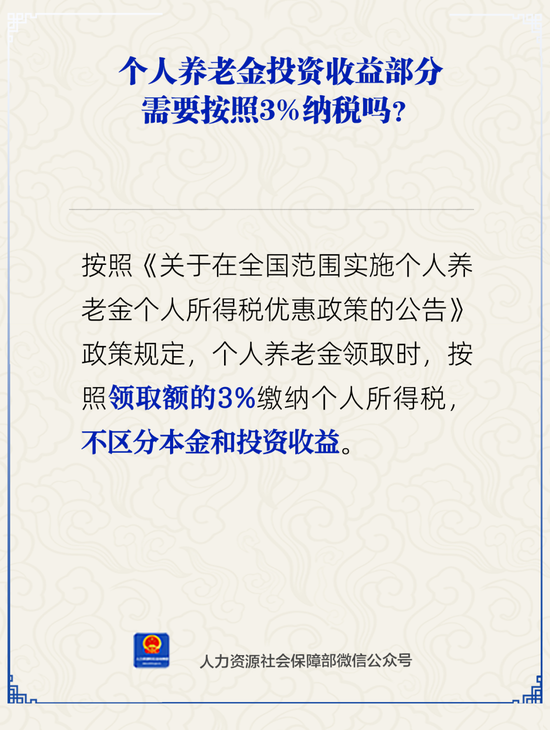
Core Viewpoint - The article clarifies the tax implications of personal pensions in China, emphasizing that while basic pensions are exempt from individual income tax, personal pensions are subject to a 3% tax upon withdrawal, with specific conditions and limits in place to encourage participation in the third pillar of the pension system [1][2][4]. Group 1: Taxation of Pensions - Basic pension benefits are exempt from individual income tax as they are considered a government-provided basic public service aimed at ensuring the basic living standards of retirees [2][4]. - Personal pensions, which are voluntary and market-driven, are subject to a 3% individual income tax upon withdrawal, with a maximum annual contribution limit of 12,000 yuan that can be deducted from taxable income [5][6]. Group 2: Structure of Pension System - China's pension system consists of three pillars: the first pillar is the basic pension insurance, the second pillar includes enterprise and occupational annuities, and the third pillar is represented by personal pensions, which include tax-deferred commercial insurance and other retirement products [3][4]. - The government encourages the development of the third pillar through tax incentives, allowing individuals to defer taxes on contributions and investment gains until withdrawal [5][6]. Group 3: Policy Implications - The tax policy aims to promote participation in personal pension schemes, thereby expanding the supply of retirement products and alleviating pressure on the basic pension system [5][6]. - The 3% tax rate on withdrawals is designed to balance the need for tax revenue with the goal of encouraging savings for retirement, while preventing high-income individuals from disproportionately benefiting from tax incentives [5][6].