失业率

Search documents
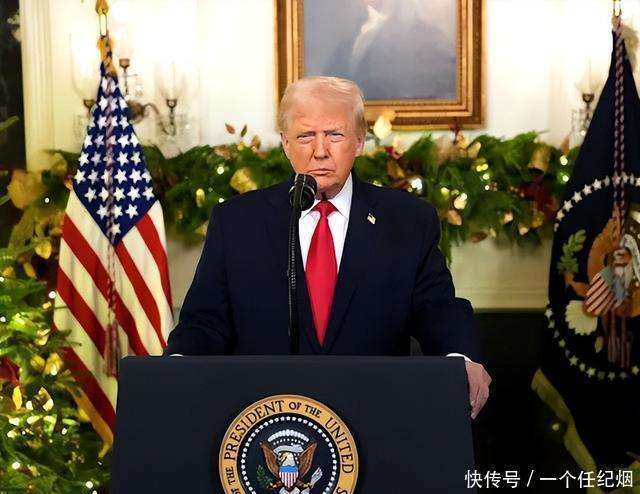
特朗普全国讲话“变脸”!罕见读稿不嬉笑,内容却让核查员崩溃?
Sou Hu Cai Jing· 2025-12-30 07:24
Core Viewpoint - Trump's recent national address marks a significant shift in his speaking style, moving from a spontaneous and passionate approach to a more serious and scripted delivery, reflecting the pressures his administration is currently facing [1][3]. Group 1: Speech Style and Context - On December 17, Trump's 18-minute address was broadcasted live by major TV networks, contrasting sharply with his usual informal style, as he read from a script with a serious demeanor [3]. - The change in style is attributed to the high stakes of the address, typically reserved for major policy announcements or national crises, amid significant governance challenges [4]. Group 2: Economic Challenges - Recent polls indicate that only 33% of American adults support Trump's economic policies, marking the lowest approval rating since his second term began, with a notable 8% drop among his core supporters since April [4]. - The unemployment rate rose to 4.6% in November, the highest since October 2021, with 7.83 million unemployed, highlighting the economic difficulties faced by the administration [4]. Group 3: Speech Content and Controversies - Trump attributed the current economic struggles to the previous Biden administration, claiming he inherited a "mess" and is working to fix it, despite being in office for nearly a year [6]. - He attempted to reassure the public about economic recovery, claiming "inflation has stopped" and promising significant improvements by 2026, although these statements were met with skepticism and fact-checking [8]. - The introduction of the "warrior bonus" plan, which proposes $1,776 payments to 1.45 million military personnel funded by tariffs, has raised concerns about the legality of the tariffs being challenged in court [9]. Group 4: Policy Focus - The speech largely avoided foreign policy issues, focusing instead on domestic economic concerns, including a brief mention of ending eight wars since taking office [11]. - Trump's push for a new Federal Reserve chair to lower interest rates aligns with his desire for a more accommodative monetary policy to stimulate the economy [13]. - The administration's approach to the national debt leans towards increased spending and revenue generation through tariffs, contrasting with traditional views advocating for debt reduction [15].

汇率高频追踪
Zhong Xin Qi Huo· 2025-12-29 07:51
1. Report's Industry Investment Rating - Not provided 2. Core View of the Report - After the release of the 4.6% unemployment rate data in the US, the threshold for the decline of the long - end US Treasury yield increased again, the US Treasury yield curve continued to steepen, and the US dollar continued to weaken. Against the backdrop of a weakening US dollar, the RMB continued to appreciate to around 7. However, the RMB's appreciation speed may slow down in the short term [2] 3. Summary by Related Contents Exchange Rate Operation Core Logic - After the December FOMC meeting and the release of the US November unemployment rate data, market concerns about the non - linear rise of the US unemployment rate in the future resurfaced, shifting the focus from inflation to the labor market [2] - The reasons for the weakening of the US dollar are the possible statistical problems in the household survey part due to the US government shutdown in October affecting the November data and market concerns about a false signal similar to last year's [2] - The RMB has been appreciating, with the offshore RMB exchange rate performing stronger than the onshore one, indicating increased attractiveness of domestic asset returns and continuous inflow of foreign capital. The enhanced willingness to settle foreign exchange and the year - end seasonal peak also support the RMB, but the central bank's guidance on the mid - price and the rising short - end swap points may slow the RMB's appreciation [2] Economic Indexes and Exchange Rates - The difference between the US and European Citi Economic Surprise Indexes has rebounded [7] - The difference between the US and European long - term inflation expectations has increased [9] - The US long - term inflation expectation has declined [11] - The short - term US interest rate expectation has slightly changed [13] - The VIX index has fallen back to a low level [15] - The difference between the US and European short - term interest rate expectations has slightly decreased [16] Other Indicators and Exchange Rates - The euro swap basis shows that the US dollar cross - border liquidity pressure is limited [20] - The CFTC net position shows that the US dollar maintains a net negative position exposure [24] Exchange Rate and Commodity Prices - The copper price has significantly increased [30] - The crude oil price has remained at a low level [32]
周观:如何看待2026年1月的流动性情况?(2025年第50期)
Soochow Securities· 2025-12-28 11:35
1. Report Industry Investment Rating No information provided in the content. 2. Core Views of the Report 2.1 Liquidity in January 2026 - The yield of the active 10 - year Treasury bond rose 0.05bp to 1.8355% from 1.835% last Friday. The yield fluctuated during the week due to various factors such as LPR expectations, government bond issuance concerns, and policy news [1][11]. - Five factors affect the super - reserve ratio. In January 2026, foreign exchange funds are expected to decrease by about 63 billion yuan; the central bank is expected to maintain reasonable and sufficient liquidity through various means and there is a possibility of a reserve requirement ratio cut; fiscal deposits are expected to increase by about 62 billion yuan; M0 is expected to increase by about 78 billion yuan; and required deposit reserves are expected to increase by about 50 billion yuan. The liquidity gap is about 190 billion yuan, which can be adjusted through open - market operations and reserve requirement ratio cuts [15][16][21]. - In the bond market, institutions may pay more attention to institutional behavior. It is expected that the allocation power of banks and insurance will strengthen at the beginning of next year, and interest rates may decline [21]. 2.2 US Economic Data and Fed Policy - Spot gold prices exceeded $4,500 per ounce, and it is expected to continue to play an important role in different asset portfolios. The RMB - US dollar exchange rate once exceeded 7. The long - term RMB value is systematically undervalued, but in the medium - term, the role of macro - policies in the transition from exogenous to endogenous growth needs to be considered [22][23]. - US economic data shows that inflation pressure is easing, economic expansion momentum is weakening, the labor market is stable, and the Fed is in a "data - dependent" mode. It is likely to keep interest rates unchanged in the short term, but if economic data weakens, it may resume gradual interest rate cuts from January to April [23][26]. 3. Summary by Relevant Catalogs 3.1 One - Week Views 3.1.1 Liquidity in January 2026 - **Weekly review**: The yield of the 10 - year Treasury bond fluctuated during the week. The reasons included LPR non - adjustment, concerns about government bond issuance, and policy news [12]. - **Weekly thinking**: Analyze the five factors affecting the super - reserve ratio and predict the liquidity situation in January 2026. The overall liquidity gap is about 190 billion yuan, and the central bank may use various means to maintain liquidity [15][16][21]. 3.1.2 US Economic Data and Fed Policy - **Gold and exchange rate**: Gold prices are expected to continue to rise. The RMB - US dollar exchange rate is affected by fiscal deficit and fiscal monetization [22][23]. - **US economic data**: The December PMI initial values were lower than expected, the November CPI and core CPI were lower than expected, the unemployment rate rose to 4.6%, and the labor participation rate was stable. The Fed's policy is focused on "liquidity guarantee and prudent policy balance" [23][24][26]. 3.2 Domestic and Overseas Data Summaries 3.2.1 Liquidity Tracking - **Open - market operations**: From December 22 - 26, 2025, the central bank's open - market operations had a net investment of 6.52 billion yuan [38]. - **Interest rates**: Various interest rates such as money market rates, bond yields, and futures prices are presented in figures and tables, showing their trends and changes [39][40][42] 3.2.2 Domestic and Overseas Macroeconomic Data Tracking - **Commodity prices**: Steel prices declined, and LME non - ferrous metal futures prices increased. The prices of other commodities such as coal, oil, and vegetables also had corresponding changes [59][61]. - **Financial market data**: Data on various financial market indicators such as stock indices, bond yields, and exchange rates in the US and other countries are presented [71][73][76] 3.3 Local Bond One - Week Review 3.3.1 Primary Market Issuance Overview - This week, 6 local bonds were issued with an amount of 2.037 billion yuan, a repayment of 5.211 billion yuan, and a net financing of - 3.174 billion yuan. The bonds were mainly issued by Shenzhen, Hunan, and Inner Mongolia [85][87]. - No local special refinancing bonds for replacing hidden debts were issued this week. Since January 1, 2025, a total of 2.199521 trillion yuan of such bonds have been issued [90]. 3.3.2 Secondary Market Overview - The local bond stock was 54.6 trillion yuan, the trading volume was 362.073 billion yuan, and the turnover rate was 0.66%. The top three active trading provinces were Guangdong, Xinjiang, and Jiangsu, and the top three active trading terms were 30Y, 10Y, and 15Y [101]. 3.3.3 This Month's Local Bond Issuance Plan The issuance plan of Beijing from December 29, 2025, to January 2, 2026, is presented in a figure [106]. 3.4 Credit Bond Market One - Week Review 3.4.1 Primary Market Issuance Overview - This week, 211 credit bonds were issued with a total issuance of 254.432 billion yuan, a total repayment of 213.649 billion yuan, and a net financing of 40.783 billion yuan, which decreased by 16.672 billion yuan compared with last week [108]. - Specifically, the net financing of urban investment bonds was - 261 million yuan, and that of industrial bonds was 4.1044 billion yuan. By bond type, short - term financing had a net financing of - 4.4152 billion yuan, medium - term notes had 8.0004 billion yuan, enterprise bonds had - 719 million yuan, corporate bonds had 1.5045 billion yuan, and private placement notes had - 292 million yuan [109][112]. 3.4.2 Issuance Interest Rates The actual issuance interest rates and their changes of various bond types such as short - term financing, medium - term notes, and corporate bonds are presented in a table [119]. 3.4.3 Secondary Market Transaction Overview The trading volume data of credit bonds in different ratings and types are presented in a table, with a total trading volume of 626.442 billion yuan [120]. 3.4.4 Yield to Maturity The yield to maturity and its changes of various bonds such as government - backed development bonds, short - term financing, medium - term notes, enterprise bonds, and urban investment bonds are presented in tables [120][121][122] 3.4.5 Credit Spreads The credit spreads of short - term financing, medium - term notes, enterprise bonds, and urban investment bonds showed a differentiated trend, and their changes are presented in tables and figures [124][125][128] 3.4.6 Rating Spreads The rating spreads of short - term financing, medium - term notes, enterprise bonds, and urban investment bonds generally widened, and their changes are presented in tables and figures [135][137][139] 3.4.7 Trading Activity The top five most actively traded bonds of each type are presented in a table, and the industrial sector had the largest weekly trading volume of bonds [143][144] 3.4.8 Issuer Rating Changes The issuer rating or outlook improvement information of two companies, Wenzhou Transportation Development Group Co., Ltd. and Guangxi Energy Group Co., Ltd., is presented in a table [146]
东吴证券晨会纪要2025-12-26-20251226
Soochow Securities· 2025-12-26 02:13
Macro Strategy - The core viewpoint of the report indicates that the Q3 2025 US GDP grew at an annualized rate of +4.3%, significantly exceeding Bloomberg analysts' consensus expectation of +3.3% and the Atlanta Fed's GDPNow estimate of +3.5% [1][7] - The strong consumer spending and reduced inventory drag were the main contributors to this growth, with inventory changes being the largest marginal contributor to the acceleration in GDP growth [1][7] - Despite the strong GDP data, the market's initial reaction suggested overheating, leading to a temporary cooling of interest rate cut expectations, which later reversed as asset prices adjusted [1][8] - Looking ahead, the report anticipates a significant cooling in Q4 2025 GDP growth due to government shutdown impacts, with short-term interest rate cut expectations depending on upcoming employment and inflation data [1][8] Fixed Income - The report notes that during the week of December 15-19, 2025, the yield on the 10-year government bond rose slightly from 1.8425% to 1.835% [2][9] - It emphasizes that the bond market's response to economic data has been muted, reflecting a focus on policy expectations rather than fundamental economic performance [9] - The report suggests that while there is limited immediate need for significant liquidity release through reserve requirement cuts, the possibility of easing policies in early 2026 remains [11] Industry Insights - Jiufeng Energy is focusing on expanding its commercial aerospace special gas market share through the development of its launch site and partnerships with rocket companies [19][20] - The company has completed the first phase of its Hainan commercial aerospace launch site project, with core products undergoing multiple launch validations, indicating a strong operational track record [19][20] - Jiufeng Energy's profit forecasts for 2025-2027 are set at 1.56 billion, 1.80 billion, and 2.13 billion yuan, respectively, with corresponding PE ratios of 18.0, 15.6, and 13.2 [19][20]

美经济韧性强2026风险隐现 圣诞休市沪金承压回调
Jin Tou Wang· 2025-12-25 06:02
Group 1 - The core viewpoint of the news highlights the resilience of the U.S. economy in 2025 despite multiple pressures such as rising tariffs, inflation, fluctuating consumer confidence, slowing job recruitment, and increasing unemployment rates [3] - The GDP growth rate reached a two-year high, and inflation increased less than expected, contrasting with earlier predictions of recession or severe inflation by some economists [3] - Consumer confidence remains low, with 75% of the public rating the economy as C, D, or F, primarily due to high prices in essential goods like food and healthcare [3][4] Group 2 - The gold futures market is currently under pressure, trading around 1006.24 yuan per gram, with a decline of 0.63% [1] - The short-term outlook for gold futures appears bearish, having breached key support levels, although the long-term upward logic remains intact due to expectations of Federal Reserve rate cuts and geopolitical risks [5] - The MACD indicator shows a risk of red bar contraction, indicating potential volatility in gold prices [5]
油价暴跌却没人夸?奥巴马前智囊“心疼”特朗普:这届消费者太难带
Jin Shi Shu Ju· 2025-12-25 03:03
Group 1 - The article discusses the challenges faced by President Trump in addressing American consumers' concerns about affordability, despite low gasoline prices [1][2] - According to AAA, the average price of unleaded gasoline in December reached its lowest level of the year at $2.85 per gallon, which is $0.18 cheaper than last year [1] - Consumer confidence has dropped to its lowest level since April, indicating increasing discontent with Trump's economic management [1] Group 2 - Jason Furman highlights that consumers are primarily focused on rising grocery prices, which have increased nearly 30% over the past five years, complicating the economic outlook [2] - The U.S. economy grew at its strongest pace in two years, with a GDP growth of 4.3%, surpassing analysts' expectations, while the unemployment rate rose to 4.6% in November, up from 4.2% a year ago [2] - Furman expresses uncertainty about the "K-shaped economy," noting that while low prices persist, wage growth remains strong, although the lowest income quartile has seen a decline in wage growth from 7.5% to about 3.5% [2][3] Group 3 - Diane Swonk, chief economist at KPMG, connects economic growth and rising unemployment to the "K-shaped economy," suggesting that companies are achieving growth without hiring, which may be exacerbated by AI replacing jobs [3] - The current productivity gains are largely attributed to companies being hesitant to hire and trying to operate more efficiently [3]
12月25日白银早评:圣诞节贵金属市场休市 银价仍处于70美元上方
Jin Tou Wang· 2025-12-25 02:03
Group 1 - The precious metals market is closed due to Christmas, with a focus on the upcoming speech by the Bank of Japan Governor Ueda [1] - On December 24, the US dollar index fell by 0.04% to 97.926, while spot silver rose by 0.68% to $71.94 per ounce [1] - Spot gold reached a historical high above $4520 before retreating, closing at $4480.09 per ounce, while platinum and palladium also saw declines [1] Group 2 - As of December 24, silver ETF holdings decreased by 56.4 tons to 16,446.97 tons [2] - US officials prefer sanctions over military action regarding Venezuela [2] - The initial jobless claims in the US unexpectedly decreased by 10,000 to 214,000, although the unemployment rate may remain high due to weak employment [3] Group 3 - Japan plans to reduce the issuance of ultra-long-term government bonds to approximately 17 trillion yen for the fiscal year 2026, the lowest level in 17 years [3] - Technical analysis indicates that silver prices are accelerating above 70, with potential adjustments if buying hesitates [3]
隔夜美股 | “圣诞老人行情”如期而至 标普500指数创历史新高
Zhi Tong Cai Jing· 2025-12-24 22:31
Market Performance - The three major U.S. indices closed higher, with the S&P 500 reaching an intraday all-time high of 6937.32 points [1] - The Dow Jones Industrial Average rose by 288.75 points, or 0.60%, closing at 48731.16 points; the Nasdaq increased by 51.46 points, or 0.22%, to 23613.31 points; and the S&P 500 gained 22.26 points, or 0.32%, finishing at 6932.05 points [1] European and Asian Markets - The UK FTSE 100 index fell by 0.19%, while the French CAC40 and Euro Stoxx 50 indices were nearly flat [2] - In Asia, the Nikkei 225 index decreased by 0.14%, the KOSPI index fell by 0.21%, the BSE SENSEX dropped by 0.14%, and the Indonesian Composite index declined by 0.55% [2] Currency Exchange Rates - The U.S. Dollar Index fell slightly, closing at 97.941 [2] - The Euro traded at 1.1775 USD, the British Pound at 1.3496 USD, and the Japanese Yen at 156.02 JPY against the dollar, all showing slight declines from the previous trading day [2] Commodity Prices - Spot gold decreased by 0.1%, settling at 4480.77 USD, with an intraday low of 4448.53 USD [4] - Crude oil prices saw minor declines, with light crude oil futures for February delivery at 58.35 USD per barrel, down 0.05%, and Brent crude oil futures at 62.24 USD per barrel, down 0.22% [4] Economic Indicators - Initial jobless claims unexpectedly fell by 10,000 to 214,000, while the unemployment rate for December is expected to remain high at 4.6% [5] - Barclays raised its forecast for Q4 GDP growth to 2.0%, citing strong consumer spending and demand momentum [6] Mortgage Rates - U.S. mortgage rates for 30-year fixed loans decreased to 6.18%, down from 6.21% the previous week [7] - The number of active homebuyers in the market was reported at approximately 1.43 million, the lowest since April 2020 [7] Federal Reserve Outlook - BlackRock analysts predict limited rate cuts by the Federal Reserve in 2026, with expectations for only two rate cuts [8] Cryptocurrency Regulations - The EU's new digital asset tax transparency regulations will take effect on January 1, 2026, requiring crypto service providers to report user transaction details [9] Company-Specific News - Tesla is under investigation by U.S. regulators regarding emergency door handles on Model 3 vehicles, affecting approximately 179,000 units [10] - Goldman Sachs warned clients about potential data breaches due to a security incident involving an external law firm [11]


Stocks End Mildly Higher as Bullish Sentiment Continues
Yahoo Finance· 2025-12-24 19:23
Market Performance - The S&P 500 Index rose by +0.32%, reaching a new record high, while the Dow Jones Industrials Index increased by +0.60%, and the Nasdaq 100 Index rose by +0.27% on Wednesday [1] - March E-mini S&P futures and March E-mini Nasdaq futures also saw increases of +0.27% and +0.20%, respectively [1] Economic Indicators - The US Q3 real GDP grew by +4.3% (quarter-over-quarter annualized), surpassing market expectations of +3.3% [3] - Initial unemployment claims decreased by -10,000 to 214,000, indicating a stronger labor market than the expected 224,000 [4] - However, continuing claims rose by +38,000 to 1.923 million, which was weaker than the anticipated 1.900 million [4] Consumer Confidence - The Conference Board's December US consumer confidence index fell by -3.8 points to 89.1, below market expectations of 91.0 [3] Monetary Policy - The People's Bank of China (PBOC) emphasized long-term stability and indicated it would avoid sudden interest rate cuts despite challenges in the property market and weak domestic demand [5] Seasonal Trends - Historical data shows that the S&P 500 has risen 75% of the time in the last two weeks of December, with an average increase of 1.3% [6] - The market is currently pricing in a 16% chance of a -25 basis point rate cut at the upcoming FOMC meeting on January 27-28 [6] International Markets - Overseas stock markets had mixed results, with the Euro Stoxx 50 down by -0.05%, while China's Shanghai Composite rose by +0.53% for the sixth consecutive day, and Japan's Nikkei Stock 225 decreased by -0.14% [6]
美国消费者信心连续第五个月下滑 就业看法更趋悲观
Xin Lang Cai Jing· 2025-12-23 20:27
Group 1 - The consumer confidence index in the U.S. has declined for the fifth consecutive month, dropping from 92.9 to 89.1, marking the longest decline since 2008 [2][6] - The current conditions index fell to 116.8, the lowest level since February 2021, while the expectations index for the next six months remained unchanged in December [2][6] - Concerns over inflation, tariffs, and the political situation continue to suppress consumer confidence, with high prices and labor market worries persisting throughout the year [4][8] Group 2 - Economists had initially expected a rebound in consumer confidence following the end of a record government shutdown, but the report indicates ongoing declines [4][8] - Job growth remains weak, the unemployment rate is rising, and inflation is still above the Federal Reserve's target, which may continue to drag down consumer confidence [4][8] - The proportion of consumers who believe "jobs are hard to find" has increased, while those who think "jobs are plentiful" has decreased, narrowing the gap to the lowest level since early 2021 [4][8] Group 3 - Respondents' assessment of their current financial situation has declined, with this indicator falling into negative territory for the first time in nearly four years [4][8] - There has been a decrease in purchasing plans for major appliances, housing, and automobiles, as well as a decline in the proportion of consumers planning to travel [4][8]