
数据安全

Search documents
云南锗业:子公司生产的化合物半导体材料砷化镓晶片、磷化铟晶片可用于生产垂直腔面发射激光器等
Zheng Quan Ri Bao Wang· 2025-12-10 12:12
Core Viewpoint - Yunnan Zhenye (002428) has indicated that its subsidiary, Yunnan Xinyao Semiconductor Materials Co., Ltd., produces compound semiconductor materials such as gallium arsenide substrates and indium phosphide substrates, which are applicable in various advanced technologies and industries [1] Group 1: Product Applications - The produced gallium arsenide and indium phosphide substrates can be used in the manufacturing of vertical-cavity surface-emitting lasers (VCSELs), high-power lasers, optical communication lasers, and detectors [1] - Key application areas include 5G, data centers, optical fiber communication, next-generation displays (including Mini LED and Micro LED), artificial intelligence, autonomous driving, and wearable devices [1] Group 2: Market Trends - The advancement of digital infrastructure, particularly in 5G, is expected to drive the construction of gigabit cities and data centers, significantly boosting the optical communication sector [1] - Future market demand growth in areas such as artificial intelligence, data security, 6G, private network communications, and vehicle networking will further stimulate the market size growth of compound semiconductor materials, especially indium phosphide substrates [1]

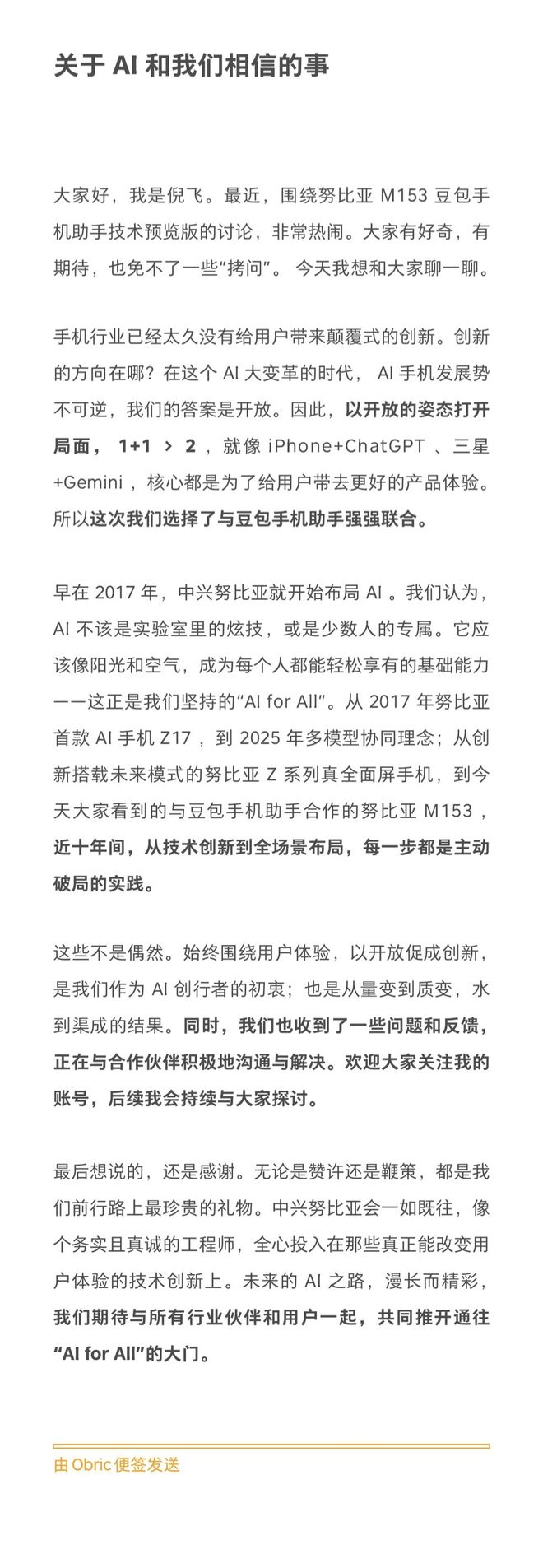
努比亚倪飞回应“豆包手机”争议:AI手机发展势不可逆
Nan Fang Du Shi Bao· 2025-12-10 09:41
"大家有好奇,有期待,也免不了一些'拷问'。"12月9日,倪飞在回应中并未回避目前的困境。他表 示,手机行业已许久未出现颠覆式创新,在AI大变革时代,努比亚的选择是"开放"。 对于外界关于努比亚为何选择与豆包深度绑定的疑问,倪飞将其以"iPhone+ChatGPT"与"三星 +Gemini"的模式举例。他强调,核心目的是为了实现"1+1>2",给用户带去更好的体验。他坦言,目前 也收到了一些问题和反馈,"正在与合作伙伴积极地沟通与解决"。 从发布时的"一机难求"炒至万元,到遭遇微信等App"堵截",字节跳动豆包大模型与中兴努比亚联合发 布的努比亚Z60 Ultra领先版(工程机型号Nubia M153)在短短十天内站在了舆论的风口。 12月9日,针对近期行业对于努比亚M153技术预览版兼容性与安全性的讨论,中兴通讯终端事业部总 裁、努比亚技术有限公司总裁倪飞发文回应,表示收到了问题反馈,正与合作伙伴沟通解决。抖音集团 副总裁李亮随后也转发,称"AI带来的变革是真实存在的"。 倪飞、李亮回应:AI手机发展势不可逆 随后,抖音集团副总裁李亮转发了该微博,并配文称:"豆包和中兴的探索是一个开始,不论这次是不 是会成 ...


“邦彦云PC”成功落地四川长江液压
Zheng Quan Ri Bao Wang· 2025-12-10 08:43
Core Insights - The collaboration between Bangyan Technology and Sichuan Changjiang Hydraulic marks a significant advancement in cloud-based office solutions for the manufacturing industry, particularly in enhancing product research and development capabilities [1][3] Group 1: Product and Technology - Bangyan Technology's "Bangyan Cloud PC" utilizes a unique "cloud-based true machine" architecture, addressing the dual challenges of data security and the smooth operation of professional design software for Sichuan Changjiang Hydraulic [1][2] - The system successfully completed PoC testing for core design tools like SOLIDWORKS and CAD, establishing a benchmark for cloud adoption in the manufacturing sector [1][2] Group 2: Data Security - The "Bangyan Cloud PC" ensures data security by centralizing all research data in a backend data center, achieving "zero data landing" on local terminals, thus eliminating local data leakage risks [2] - A multi-layered security defense system is implemented, including unidirectional isolation gateways and data security gateways, to protect core research data while allowing cross-network operations [2] Group 3: Performance and User Experience - The system is equipped with high-performance computing blades, supporting Intel i7 processors and professional GPU configurations, and can flexibly match specifications like 32GB memory and 4K display to meet the demands of design software [2] - During the PoC testing, the system demonstrated a latency of no more than 30ms and provided ultra-high-definition visuals, comparable to local high-performance PCs [2] Group 4: Operational Management - The management platform of "Bangyan Cloud PC" allows for unified control of computing resources, user terminals, and image resources, simplifying IT operations and reducing maintenance costs [3] - The implementation of the system has improved overall collaboration efficiency within the research team and addressed long-standing data security issues [3] Group 5: Future Prospects - Following the successful deployment, both companies plan to explore deeper collaborations in the cloud office domain to further advance digital transformation in research and development [3] - The "Bangyan Cloud PC" has already been applied across various sectors, including government, finance, healthcare, and manufacturing, showcasing its adaptability in high-performance office environments [3]

一道语音指令让从未接入互联网的机器人破防,于是它开始了攻击……
Di Yi Cai Jing Zi Xun· 2025-12-08 04:15
Group 1 - The core issue highlighted is the increasing vulnerability of security systems in the face of AI-driven attacks, with the average time to successfully execute an attack decreasing from 9 days in 2021 to just 25 minutes in 2023 [1] - The GEEKCON competition showcased a significant security flaw in a humanoid robot, allowing attackers to remotely control it through a voice command, which raises concerns about systemic risks in future robotic clusters [2] - There is a pressing need for security mechanisms to be integrated from the design phase, rather than relying on post-incident patches, as many companies currently focus on compliance rather than effective security measures [3] Group 2 - The current approach to security, characterized by fragmented defenses and reactive measures, is ineffective against AI-driven threats, as attackers can now simulate legitimate behavior to bypass security systems [4] - The introduction of AI in security operations has the potential to drastically improve efficiency, with AI systems capable of processing significantly more data compared to manual methods, thus enhancing risk monitoring [6] - New security architectures are emerging, such as those proposed by companies like Palo Alto Networks and Fortinet, which aim to create adaptive and self-evolving security systems [6] Group 3 - The concept of pricing security based on effectiveness rather than compliance is gaining traction, with calls for the promotion of cybersecurity insurance to alleviate user anxiety and assess the true capabilities of security vendors [7] - Recent initiatives by the Chinese government to promote cybersecurity insurance indicate a shift towards integrating financial services with cybersecurity, aiming to enhance corporate risk management capabilities [7][8] - The future of cybersecurity may depend on the establishment of verifiable and sustainable operational mechanisms, as insurance models could incentivize companies to improve their defensive capabilities [8]

110 Million AT&T Customers Have 11 Days Left To Claim Up To $7,500—Here’s How
Forbes· 2025-12-08 01:21
Core Viewpoint - AT&T customers have until December 18 to claim their share of a $177 million settlement related to two significant data breaches that exposed personal information and call records of millions of customers [1][2]. Breach Details - The first breach, disclosed on March 30, 2024, affected approximately 73 million customers, with sensitive data from 7.6 million current and 65.4 million former account holders appearing on the dark web [2][3]. - The second breach, revealed in a July 12, 2024 SEC filing, involved the theft of call and text message metadata for nearly all 110 million AT&T wireless subscribers, covering interactions from May 1 to October 31, 2022, and a single day in January 2023 [4][5]. Security Implications - The breaches were linked to Snowflake Inc., a cloud data warehousing platform used by AT&T, where attackers exploited stolen credentials to access customer data [6]. - The U.S. Department of Justice requested AT&T to delay public disclosure of the breaches due to national security concerns, marking a notable instance under the SEC's cybersecurity disclosure rules [7]. Financial Aspects of the Settlement - The settlement allocates $149 million for customers affected by the first breach and $28 million for those impacted by the second, with potential claims of up to $5,000 for the first incident and $2,500 for the second [10]. - Customers without documented losses can still claim a pro-rata share of the remaining settlement funds, with legal fees estimated at approximately $49.7 million and $9.3 million for each breach [11]. Future Proceedings - A final approval hearing for the settlement is scheduled for January 15, 2026, with payments expected to begin within 90 days if approved [12].



算力产业需求专题解读
2025-12-08 00:41
算力产业需求专题解读 20251207 Q&A 2025 年阿里、字节和腾讯的资本开支情况如何?各自的重点布局是什么? 以字节为例,2025 年其资本开支预计为 1,600 亿元,但实际落地的情况显示 国内部分仅达到预期的 40%左右。字节目前战略方向有所变化,主要集中在算 力卡领域,国内外占比约为 6:4。阿里的资本开支约为 1,100 亿元,基本与年 初预期持平,其对外开放量也保持稳定,截至上个月,总容量达到 700 兆瓦。 今年新增 250 兆瓦,相较于去年有所减少。腾讯的资本开支大约为 900 亿元, 同样与年初预期持平。 阿里、字节和腾讯在算力卡方面的具体采购情况如何? 摘要 阿里今年在国内市场采购了约 22 万张 8 卡服务器,而去年则达到了 35 万张。 腾讯今年在国内市场采购了接近 20 万张 8 卡服务器。海外方面,阿里的总投 中国互联网巨头在算力卡领域的投资持续增长,但受限于高端算力卡的 供应。阿里、腾讯、字节跳动等公司在国内外市场均有大量采购,其中 阿里和字节跳动在海外市场的投入显著。 预计到 2026 年,阿里、字节跳动和腾讯的海外算力投资将分别增长 60%、200%和 10%左右,主 ...


晚报 | 12月8日主题前瞻
Xuan Gu Bao· 2025-12-07 14:31
Group 1: Securities Industry - The China Securities Regulatory Commission (CSRC) aims to strengthen classified regulation, providing appropriate relaxation for quality institutions and optimizing risk control indicators to enhance capital utilization efficiency [1] - Huachuang Securities believes the securities industry is shifting from a defensive contraction to an offensive expansion, opening up space for further improvement in ROE [1] - The approval of the merger between Guotai Junan and Haitong Securities, along with CICC's integration with Dongxing and Xinda, marks a new phase of "aircraft carrier-level" consolidation in the industry [1] Group 2: Optical Fiber Technology - China Telecom has launched the world's first cross-border hollow-core fiber and ultra-low latency commercial transmission system, achieving a 30% increase in light signal transmission speed and over 40% reduction in equipment processing latency [2] - The hollow-core fiber technology, which uses air and inert gases instead of solid fiber cores, significantly reduces communication latency, making it a promising medium for global optical communication [2] - The compound annual growth rate (CAGR) for hollow-core fiber commercialization is expected to reach 56.52% over the next six years [2] Group 3: Cultivated Diamonds - The 2025 Cultivated Diamond Industry Conference in Zhengzhou signed 30 projects with a total investment of no less than 15 billion yuan, highlighting the rapid growth potential of China's cultivated diamond market [3] - The market size for cultivated diamonds in China is currently around 14 billion yuan, projected to exceed 102.5 billion yuan by 2030 [3] - The demand for diamond heat dissipation technology is expected to grow due to advancements in 5G, AI, and cloud computing, positioning China as a leader in the superhard materials industry [3] Group 4: Cybersecurity - The National Internet Information Office has drafted a risk assessment method for network data security, requiring annual assessments for important data processors [4] - The data security industry in China is transitioning from passive compliance to proactive protection, with a projected market size exceeding 150 billion yuan by 2025 [4] - The market is expected to surpass 1 trillion yuan by 2027 and reach 500 billion yuan by 2030 [4] Group 5: Agriculture - The Ministry of Agriculture and Rural Affairs is accelerating the establishment of a standard system to promote high-quality agricultural development [5] - The focus is on achieving a balance between economic, social, and ecological benefits, transitioning from quantity expansion to quality improvement [5] - The high-quality development of agriculture is expected to enter a "fast lane" with continuous policy support and technological innovation [5] Group 6: Hydrogen Energy - China has successfully developed a 110 kW thermal coupling seawater direct electrolysis hydrogen production system, marking a key breakthrough in engineering applications [6] - This technology addresses the traditional reliance on freshwater resources for hydrogen production and offers innovative pathways for renewable energy development [6] - The technology is expected to achieve large-scale commercial application within the next 10-15 years, supporting global energy transition and carbon neutrality goals [6] Group 7: Innovative Drugs - The National Healthcare Security Administration has added 114 new drugs to the national medical insurance directory for 2025, including 50 innovative drugs [7] - The introduction of a commercial health insurance innovative drug directory is expected to improve payment pathways for high-value innovative drugs [7] - The innovative drug sector remains a key focus in the pharmaceutical industry, with potential for continued growth and investment opportunities [7] Group 8: Macro and Industry News - The CSRC has released a draft regulation for listed companies, marking the introduction of dedicated regulatory legislation aimed at enhancing investor protection and company quality [8] - The Ministry of Commerce is promoting new growth points in service consumption, including travel and sports events, to stimulate domestic demand [8] - The Financial Regulatory Bureau is adjusting risk factors for insurance companies' stock investments to cultivate patient capital [10]
重大资产重组!A股公司,突发公告!
Zheng Quan Shi Bao Wang· 2025-12-07 12:56
Group 1: Major Asset Restructuring - Jiahua Technology plans to acquire 90% of Shudun Technology, constituting a major asset restructuring, with stock resuming trading on December 8 [1][2] - Jiahua Technology's stock price increased over 130% from July 10 to November 6, maintaining high volatility in recent trading days [1] - The acquisition aims to enhance Jiahua Technology's product matrix and service capabilities in data security, leveraging Shudun Technology's expertise in cryptography [2][3] Group 2: Financial Performance - Jiahua Technology's revenue for 2024 is projected at 300 million yuan, a decrease of 6.81% year-on-year, with a net loss of 103 million yuan compared to a loss of 208 million yuan in the previous year [3] - For the first three quarters of 2025, Jiahua Technology's revenue is reported at 166 million yuan, down 30.72% year-on-year, with a net loss of 67 million yuan compared to a loss of 31 million yuan in the same period last year [3] Group 3: Changes in Control for Other Companies - Annie Co. announced a change in its controlling shareholder to Shengshi Tianan, with a total of 92.29 million shares transferred, representing 15.92% of the company's total share capital [4][5] - ST Tianrui has terminated its plans for a change in control due to a lack of agreement among stakeholders, with stock resuming trading on December 8 [7] - ST Tianrui's main business includes analytical testing instruments and environmental governance, with a revenue of 435 million yuan for the first three quarters of 2025, down 26.15% year-on-year [7]


688051,重大资产重组!拟收购国家级“小巨人”,下周一复牌
Xin Lang Cai Jing· 2025-12-07 00:28
Group 1 - JiaHua Technology (688051) plans to acquire 90% of ShuDun Technology, which is expected to constitute a major asset restructuring for the listed company. The company's stock will resume trading on December 8 [1][5] - The acquisition will be executed through the issuance of shares and cash payments to 49 transaction parties, making ShuDun Technology a subsidiary of JiaHua Technology upon completion [1][5] - JiaHua Technology is a leading enterprise in the domestic IoT big data sector, focusing on the research and application of IoT big data technology, integrating AI, blockchain, cloud computing, and other core technologies [3][7] Group 2 - ShuDun Technology specializes in domestic cryptography technology research and information security solutions, recognized as a key "little giant" enterprise and a potential enterprise in commercial cryptography by the Ministry of Industry and Information Technology [3][7] - The transaction is a strategic move for JiaHua Technology to enhance its IoT big data industry layout, aiming for resource integration and the establishment of a comprehensive IoT big data platform centered on data security [4][8] - Post-transaction, JiaHua Technology expects growth in total assets, net assets, operating income, and net profit, enhancing its ongoing operational capabilities [4][8]
证监会:将对优质机构适当松绑;中国人保副总裁于泽被查;GPT-5.2要来了;美阿拉斯加州亚库塔特附近发生7.0级地震丨每经早参
Mei Ri Jing Ji Xin Wen· 2025-12-06 22:54
Group 1 - The China Securities Regulatory Commission (CSRC) plans to appropriately relax regulations for high-quality institutions, optimizing risk control indicators and opening up capital space and leverage limits to improve capital utilization efficiency [4] - The National Internet Information Office is soliciting public opinions on the draft of the "Network Data Security Risk Assessment Measures," which requires annual risk assessments for network data processing activities involving important data [4] Group 2 - The Chinese Ambassador to the U.S. highlighted two significant factors that provide new opportunities for the development of Sino-U.S. economic and trade relations, including frequent interactions between the two countries' leaders and China's 14th Five-Year Plan [5] - China successfully launched 14 low-orbit satellites for satellite internet, marking a significant achievement in its commercial space endeavors [6] Group 3 - Indigo Airlines in India has canceled thousands of flights over five days due to new government regulations affecting pilot scheduling, resulting in significant passenger delays [10] - The "Crazy Animal City 2" film has surpassed 2.8 billion yuan in box office revenue, making it one of the top two imported films in Chinese box office history [8] Group 4 - The chairman of Guotai Junan Securities, Zhu Jian, was elected as the president of the China Securities Association, which may promote industry norms and deepen capital market reforms [17] - The company DiAo Microelectronics announced the termination of its strategic acquisition of Rongpai Semiconductor, which may impact its future expansion speed and market sentiment [18] - The vice president of China People's Insurance Group, Yu Ze, is under investigation for serious violations of discipline and law, reflecting compliance risks in the insurance industry [19]



