
虚拟货币

Search documents
国泰君安国际再跌超5% 较年内高点跌超六成 央行表态坚持禁止虚拟货币
Zhi Tong Cai Jing· 2025-12-09 07:13
Core Viewpoint - Guotai Junan International (01788) has seen a significant decline of over 63% from its year-to-date high of HKD 7.02, currently trading at HKD 2.59, reflecting a drop of 4.78% as of the latest report [1] Group 1: Company Performance - Guotai Junan International's stock price fell to a low of HKD 2.57, with a trading volume of HKD 153 million [1] - The company had previously announced on August 28 that it would launch cryptocurrency trading services for Hong Kong investors, aiming to meet the growing demand in the cryptocurrency market [1] Group 2: Regulatory Environment - On November 28, the People's Bank of China held a meeting emphasizing that virtual currencies do not have the same legal status as fiat currencies and should not circulate in the market [1] - The meeting highlighted that activities related to virtual currencies are considered illegal financial activities, and stablecoins currently do not meet requirements for customer identity verification and anti-money laundering [1] - Concerns were raised regarding the potential use of stablecoins for money laundering, fundraising fraud, and illegal cross-border fund transfers [1]
港股异动 | 国泰君安国际(01788)再跌超5% 较年内高点跌超六成 央行表态坚持禁止虚拟货币
智通财经网· 2025-12-09 07:12
据悉,国泰君安国际8月28日公告,国泰海通集团下属公司国泰君安国际控股有限公司宣布正式为香港 投资者推出加密货币交易服务,旨在满足香港投资者对加密货币市场日益成长的需求。公告称,客户成 功开通加密货币账户后,可立即交易包括比特币、以太币等不同的加密货币。 消息面上,11月28日,中国人民银行召开打击虚拟货币交易炒作工作协调机制会议。会议强调,虚拟货 币不具有与法定货币等同的法律地位,不具有法偿性,不应且不能作为货币在市场上流通使用,虚拟货 币相关业务活动属于非法金融活动;针对稳定币,会议明确指出,目前稳定币无法有效满足客户身份识 别、反洗钱等方面的要求,存在被用于洗钱、集资诈骗、违规跨境转移资金等非法活动的风险。 智通财经APP获悉,国泰君安国际(01788)再跌超5%,低见2.57港元,较年内高点7.02港元已跌超63%。 截至发稿,跌4.78%,报2.59港元,成交额1.53亿港元。 ...
价值超1300万泰达币待认领!警方:六个月无人认领将上缴国库
2 1 Shi Ji Jing Ji Bao Dao· 2025-12-09 05:32
Core Viewpoint - The article discusses the seizure of 1.9 million Tether (USDT) worth over 13 million yuan by the police in Hubei Province, highlighting the legal implications and the nature of virtual currency in criminal cases [1][3]. Group 1: Legal Implications - The police announcement regarding the unclaimed virtual currency is a typical action for handling criminal case assets, aimed at clarifying ownership and ensuring lawful processing of seized items [3]. - The announcement serves a dual purpose: it seeks to identify the rightful owner while also encouraging potential victims to report or provide evidence related to the crimes [4]. - The legal status of virtual currencies in China is that they are recognized as having property value but do not possess legal tender status, meaning losses from illegal trading activities are self-borne and not covered by law [6]. Group 2: Regulatory Environment - The Chinese government maintains a strict stance against illegal financial activities involving virtual currencies, emphasizing a "zero tolerance" policy towards such activities [6]. - The case illustrates the increasing capability of law enforcement to trace virtual currencies, countering the notion that they can be used to evade legal accountability [6]. - The regulatory framework is evolving to balance strict oversight of illegal financial activities with the protection of potential victims' rights in cases involving virtual currencies [6]. Group 3: Practical Guidance for Claimants - To reclaim the seized USDT, claimants must provide three core types of evidence: transaction records of USDT purchases, proof of the source of funds, and documentation showing they were forced to transfer funds due to criminal actions [7]. - Legal provisions exist to ensure that property unrelated to the case is returned promptly, and rightful owners can reclaim their assets after proper evaluation [7]. - The use of stablecoins like USDT in financial crimes complicates judicial investigations, but the current case demonstrates the traceability and accountability of virtual currencies in legal contexts [7].


别轻信“造富神话”!多方警示虚拟货币交易炒作风险
Sou Hu Cai Jing· 2025-12-09 03:43
Core Viewpoint - The rise in virtual currency investment is accompanied by significant risks, prompting regulatory bodies in China to issue warnings against virtual currency trading and speculation [1][4]. Group 1: Regulatory Actions - A joint risk warning was issued by seven associations, including the China Internet Finance Association, stating that virtual currencies cannot be used as currency within China and that no tokenization activities have been approved [1]. - The People's Bank of China and other departments have reiterated that virtual currency-related activities are illegal financial activities, specifically naming stablecoins as a form of virtual currency with inherent risks [4][5]. - Regulatory measures have been in place since 2013, prohibiting financial institutions from engaging in activities related to Bitcoin and other cryptocurrencies, highlighting the need for stricter enforcement against illegal trading [5]. Group 2: Market Dynamics - The virtual currency market has seen a resurgence in speculative activities, with social media platforms being used to attract new users with promises of high returns [2]. - Reports indicate that Bitcoin's price has experienced significant volatility, with a drop below $89,000 and a total liquidation amounting to $1.11 billion affecting nearly 100,000 market participants [2][3]. - The allure of quick profits has led many investors to suffer substantial losses, with some reporting complete account depletion due to market fluctuations [3]. Group 3: Investor Awareness - Investors are advised to avoid speculative trading in virtual currencies and to choose legitimate investment channels to protect their assets [8]. - The public is encouraged to remain vigilant against virtual currency-related activities and to report any suspicious activities to regulatory authorities [8]. - The importance of not falling for the "get rich quick" myth is emphasized, along with the need to safeguard personal information and avoid facilitating illegal transactions [8].

湖北警方公告招领190万USDT 价值1350万元人民币
Xin Lang Cai Jing· 2025-12-08 05:14
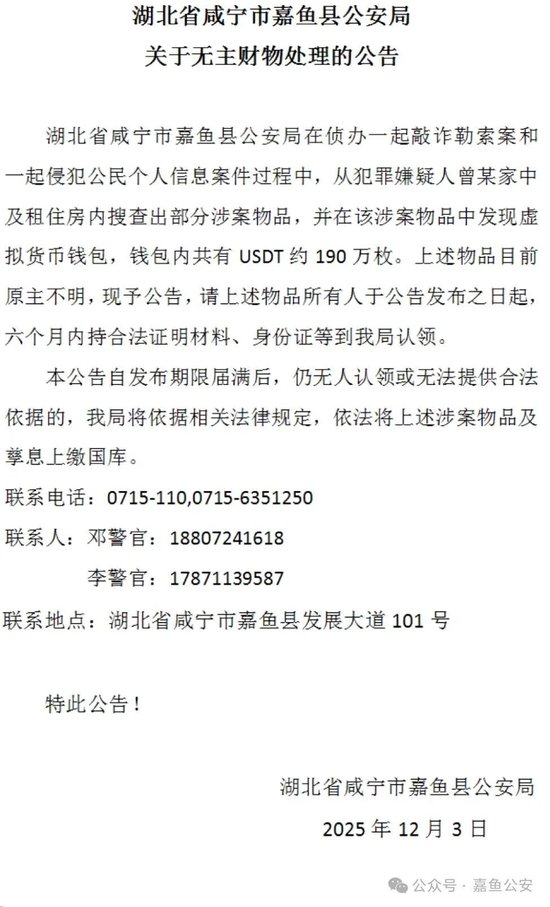
12月8日金融一线消息,日前,湖北省咸宁市嘉鱼县公安局发布公告,寻找一笔涉敲诈勒索案的虚拟货 币原主人,虚拟货币钱包内共有USDT币约190万枚。根据最新的市场汇算数据,大约价值1350万元人 民币。 以下是公告全文: 湖北省咸宁市嘉鱼县公安局在侦办一起敲诈勒索案和起侵犯公民个人信息案件过程中,从犯罪嫌疑人曾 某家中及租住房内搜查出部分涉案物品,并在该涉案物品中发现虚拟货币钱包,钱包内共有 USDT约 190万枚。上述物品目前原主不明,现予公告,请上述物品所有人于公告发布之日起六个月内持合法证 明材料、身份证等到我局认领。 本公告自发布期限届满后,仍无人认领或无法提供合法依据的,我局 将依据相关法律规定,依法将上述涉案物品及孳息上缴国库。 责任编辑:李琳琳 12月8日金融一线消息,日前,湖北省咸宁市嘉鱼县公安局发布公告,寻找一笔涉敲诈勒索案的虚拟货 币原主人,虚拟货币钱包内共有USDT币约190万枚。根据最新的市场汇算数据,大约价值1350万元人 民币。 以下是公告全文: 湖北省咸宁市嘉鱼县公安局在侦办一起敲诈勒索案和起侵犯公民个人信息案件过程中,从犯罪嫌疑人曾 某家中及租住房内搜查出部分涉案物品,并在该涉案 ...
中泰期货晨会纪要-20251208
Zhong Tai Qi Huo· 2025-12-08 02:32
交易咨询资格号: 晨会纪要 2025 年 12 月 8 日 | | [Table_Finance] | | | | | | --- | --- | --- | --- | --- | --- | | 联系人:王竣冬 | 2025/12/8 | | 基于基本面研判 | | | | 期货从业资格:F3024685 | 趋势空头 | 震荡偏空 | 震 荡 | 震荡偏多 | 趋势多头 | | | | 玉米 | 工业硅 | 红枣 | | | 交易咨询从业证书号:Z0013759 | | 碳酸锂 | 沥青 | 上证50股指期货 | | | 研究咨询电话: | | 纸浆 锰硅 | 多晶硅 原油 | 玻璃 沪深300股指期货 | | | 0531-81678626 | | 焦炭 | 液化石油气 | 二债 | | | | | 焦煤 | 燃油 | 五债 | | | 客服电话: | | 甲醇 | 锌 | 三十债 | | | | | 塑料 | 合成橡胶 | 十债 | | | 400-618-6767 | | | 尿素 | | | | | | | 橡胶 | | | | 公司网址: | | | | | | | | | | 铅 | | | ...
8点1氪:苹果资深高管正加速离职;5款百万抗癌药纳入首版商保目录;12306回应高铁盲文无凸起
36氪· 2025-12-07 23:57
美国苹果公司,正在面临"后乔布斯时代"最严峻的人事动荡。 整理 |迟雨 点击上方【36氪随声听】,一键收听大公司热门新闻。听完音频记得添加进入 【我的小程序】 中哟! 接近这个年龄段。古 尔曼也透露,主管苹 果自研芯片的硬件技术高级副总裁约翰尼·斯鲁吉近期告知库克,他正认真考虑在不 久的将来离职。斯鲁吉也已经告诉同事们,如果最终决定离开,他打算跳槽去别的公司。(财联社) 5款百万抗癌针纳入首版商保目录 12月7日,2025创新药高质量发展大会在广州召开,会议将发布2025年《国家基本医疗保险、生育保险和工伤保险药品目录》 和首版《商业健康保险创新药品目录》。据了解,本次目录调整新增114种药品,其中50种为1类创新药,包括替尔泊肽、国产 ADC(抗体偶联药物)芦康沙妥珠单抗等明星药物。商保创新药目录则覆盖了5款国产抗癌药CAR-T(嵌合抗原受体T细胞免疫 疗法)细胞药物、2款进口阿尔茨海默病药物及罕见病药物。据悉,如果自费使用CAR-T疗法,单次治疗费用超过百万元。 (每日经济新闻) 12306回应高铁盲文无凸起:工作人员可向视障人士提供帮助 12月6日,有网友通过社交媒体账号发布视频称,在高铁上,一块向残疾 ...

【早知道】国家金融监督管理总局调整保险公司相关业务风险因子
Zheng Quan Shi Bao Wang· 2025-12-07 23:52
Group 1 - The National Financial Regulatory Administration has adjusted the risk factors related to insurance company operations, allowing for appropriate relaxation for high-quality institutions and moderately increasing capital space and leverage limits [2] - Zhu Jian, Chairman of Guotai Junan, has been elected as the President of the China Securities Association [2] - China is set to introduce its first specialized administrative regulations for the supervision of listed companies [2] Group 2 - Seven associations have jointly issued a risk warning to prevent illegal activities related to virtual currencies [2] - The National Internet Information Office is soliciting opinions on the draft of the "Network Data Security Risk Assessment Measures" [2] - Fujian Province has achieved key technological breakthroughs in the field of deep-sea new energy equipment [2] Group 3 - The 2025 medical insurance drug list has been released, adding 114 new drugs, of which 50 are classified as category 1 innovative drugs [2] - The central bank has increased its gold holdings for the 13th consecutive month [2]
警惕虚拟货币领域无序创新
Sou Hu Cai Jing· 2025-12-07 22:57
Core Viewpoint - The People's Bank of China (PBOC) has reiterated its stance on combating virtual currency trading and speculation, with multiple associations warning about the associated risks, particularly concerning the rise of real-world asset tokens and other related activities [1][3][4]. Group 1: Risks Associated with Virtual Currencies - A joint risk warning was issued by seven associations, including the China Internet Finance Association and the China Banking Association, highlighting the dangers of virtual currencies, stablecoins, and real-world asset tokens [1][3]. - The warning emphasizes that activities related to stablecoins and real-world asset tokens could lead to various risks, including false asset risks, operational failure risks, and speculative trading risks [4][6]. - The rise of concepts like stablecoins and real-world asset tokens has been linked to illegal fundraising and scams, with the PBOC categorizing stablecoins as a form of virtual currency [3][4]. Group 2: Regulatory Measures and Industry Response - Financial institutions are prohibited from engaging in any business related to virtual currencies and must conduct thorough due diligence to identify potential risks [6][7]. - The associations have called for heightened vigilance among the public regarding virtual currency activities, urging individuals to be cautious of high-yield promises and to avoid engaging with suspicious platforms [6][7]. - The joint risk warning aims to enhance compliance and reduce the presence of virtual currencies and related activities in the domestic market, promoting a more coordinated regulatory approach across financial sectors [7][8].

七家协会联合发布虚拟货币风险提示
Qi Huo Ri Bao Wang· 2025-12-07 16:50
Core Viewpoint - The China Internet Finance Association and six other associations issued a risk warning regarding illegal activities related to virtual currencies, emphasizing the illegality of certain financial activities involving virtual currencies and token issuance within the country [1] Summary by Relevant Categories Regulatory Actions - Domestic institutions and individuals engaging in the exchange of legal currency for virtual currencies, issuance of tokens, and financing activities are suspected of illegal financial activities such as illegal token sales, illegal fundraising, unauthorized public securities issuance, and illegal futures operations [1] International Implications - Foreign virtual currency service providers conducting business activities in China, either directly or indirectly, are also considered to be engaging in illegal financial activities [1] Accountability Measures - Domestic staff of foreign virtual currency service providers, as well as domestic institutions and individuals who knowingly provide services related to virtual currencies, will be held legally accountable [1] Public Awareness - The public is urged to enhance their risk awareness and ability to identify potential risks, and to avoid participating in activities related to virtual currencies and token issuance, as well as illegal fundraising and securities issuance disguised as virtual currency mining [1]